
To implement a true perimeter-less zero trust na nuvem multi cloud, you map identities, devices, networks and data across all providers, enforce least privilege via identity-first controls, segment traffic with microperimeters, encrypt and classify data consistently, and continuously verify behavior with unified logging, automation and policy-as-code integrated into CI/CD.
Core Principles for Zero Trust in Multi‑Cloud
- Assume breach across every cloud account, VPC/VNet and region; never rely on a single perimeter.
- Make identity (user, workload, device) the primary control plane across all providers.
- Use small, explicit trust zones with network segmentation and service-to-service policies.
- Apply consistent data protection (classification, encryption, DLP) in every cloud.
- Continuously verify with telemetry, analytics and adaptive policies, not one-time approvals.
- Automate zero trust guardrails in CI/CD, Terraform and configuration baselines.
- Align governance and skills so security and platform teams share one multi-cloud model.
Assessing the Multi‑Cloud Attack Surface and Trust Zones

This phase fits companies already running workloads on at least two cloud providers (for example AWS and Azure) and planning soluções zero trust para segurança em nuvem. It is less suitable if you are still in early experimentation with few resources and no defined landing zones.
| Phase | Checklist item | How to validate |
|---|---|---|
| Preparation | Inventory all cloud accounts/subscriptions and projects | Central list of IDs for AWS, Azure, GCP maintained in a single repo |
| Preparation | Document current network topology and peering | Updated diagrams for VPC/VNet layout and interconnects |
| Action | Identify high-value assets and business-critical data flows | Clear mapping from system to business process and data sensitivity |
| Action | Group resources into candidate trust zones | List of zones (e.g., prod-payments, prod-analytics, shared-services) |
| Validation | Confirm findings with app, network and security owners | Reviewed and approved inventory and zone definitions |
Practical steps to map the attack surface and trust zones across your multi-cloud:
- Build a consolidated cloud inventory
Export accounts and projects from each provider and centralize them.- AWS:
aws organizations list-accounts --query "Accounts[].Id" - Azure:
az account list --query "[].id" - GCP:
gcloud projects list --format="value(PROJECT_ID)"
- AWS:
- Map network boundaries and reachable paths
Collect all VPCs/VNets, subnets, VPNs and private links to understand where packets can travel today.- Export AWS VPCs:
aws ec2 describe-vpcs - Export Azure VNets:
az network vnet list -o table
- Export AWS VPCs:
- Identify internet-exposed and third-party-facing assets
Search for public IPs, load balancers and API gateways.- AWS:
aws ec2 describe-addresses - Use your WAF and DNS logs to find exposed hostnames.
- AWS:
- Define business-aligned trust zones
Group resources by sensitivity, function and blast radius, not by technology only. Each zone should have a clear owner and purpose. - Record current trust assumptions
Document where access is implicitly allowed today (for example, any pod to any database within a VPC) to know what zero trust must tighten.
Designing Identity‑First Access Controls and Authentication Flows
Zero trust in a plataforma zero trust para multi cloud corporativo depends on unified identity. Before you start, align IAM, security and HR so user lifecycle and workload identities can be consistently managed across clouds and SaaS used in Brazil-based operations.
| Phase | Checklist item | How to validate |
|---|---|---|
| Preparation | Choose a central IdP (e.g., Entra ID, Okta) | All corporate users synchronized and authenticated through the IdP |
| Preparation | Catalog human vs. service identities in each cloud | Document listing IAM roles, service accounts, managed identities |
| Action | Enforce MFA and conditional access for admins | All privileged actions require MFA and pass device/compliance checks |
| Action | Implement least-privilege roles and just-in-time elevation | No standing admin accounts; approvals logged and time-bound |
| Validation | Run access reviews per app and cloud environment | Owners attest that granted access matches current duties |
Concrete implementation tasks for identity-first controls that support melhores práticas zero trust cloud para empresas:
- Integrate each cloud with the central IdP using SSO and SCIM provisioning.
- Example (Azure AD to AWS): configure AWS as an enterprise application, then run
aws configure ssoon admin machines.
- Example (Azure AD to AWS): configure AWS as an enterprise application, then run
- Standardize admin access patterns:
- Disable local cloud-user passwords where possible and enforce federated access.
- Use short-lived roles: in AWS, set role session duration to limited values for sensitive roles.
- Separate human and workload identities:
- Use Kubernetes service accounts, AWS IAM roles for service accounts, and Azure managed identities instead of shared keys.
- Implement strong auth flows for remote workforce (common in pt_BR context):
- Use device compliance signals (MDM/EDR) and location-based policies to gate access to critical SaaS and cloud consoles.
Network Segmentation, Microperimeters and Service‑to‑Service Controls
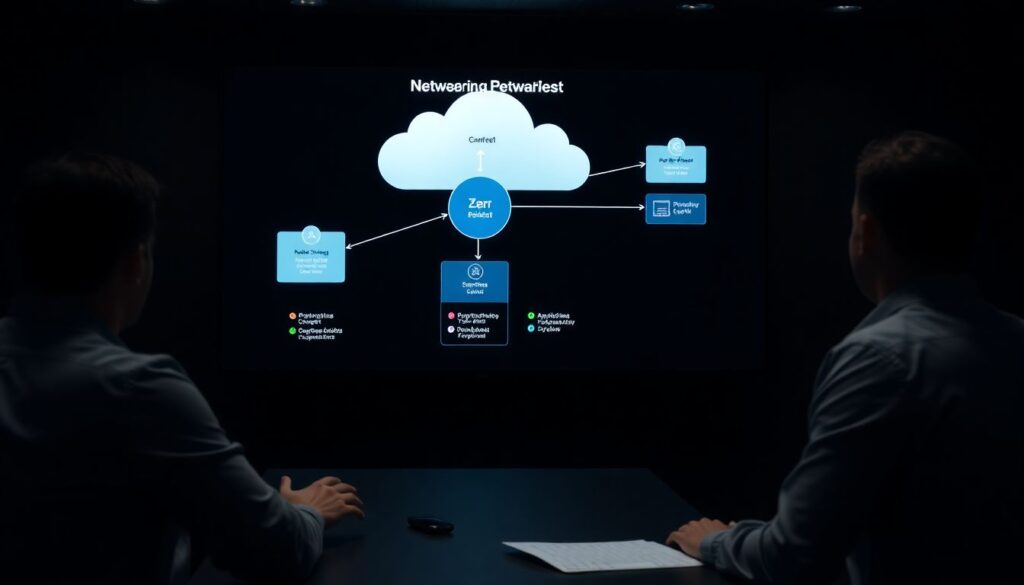
Before changing network paths in a multi-cloud environment, prepare a controlled rollout plan to avoid outages while you implement como implementar arquitetura zero trust em ambiente multi cloud.
- List applications and dependencies that will be affected by new segmentation.
- Ensure you have recent backups and tested rollback for critical workloads.
- Deploy monitoring on latency and error rates per service before changes.
- Schedule changes in low-traffic windows and communicate with stakeholders.
- Test new rules first in staging environments that mirror production.
| Phase | Checklist item | How to validate |
|---|---|---|
| Preparation | Define microperimeters around critical apps | List of apps with clear inbound/outbound flows documented |
| Preparation | Select network enforcement points per cloud | Decision on using NSGs, security groups, service mesh, firewalls |
| Action | Apply least-privilege policies to east-west traffic | Only required ports and protocols open between specific identities |
| Action | Secure service-to-service calls with mTLS | Certificates rotated automatically; plaintext internal HTTP blocked |
| Validation | Run connectivity and failover tests | All expected paths work; unauthorized paths are blocked and logged |
- Choose your segmentation primitives per cloud
Identify all the tools you will use to build microperimeters.- AWS: security groups, NACLs, AWS Network Firewall, AWS PrivateLink.
- Azure: NSGs, Azure Firewall, Private Endpoints.
- GCP: VPC firewall rules, hierarchical policies, Private Service Connect.
- Define microsegments around applications
Group workloads by application or bounded context, not a flat environment like "prod".- Create dedicated subnets for "payments-api", "billing-api", "backoffice" instead of a single shared application subnet.
- Implement deny-by-default network policies
Start with wide logging, then tighten.- Kubernetes: apply a baseline NetworkPolicy that denies all traffic, then allow specific namespaces and labels.
- AWS example: remove
0.0.0.0/0from security group inbound rules and replace with specific CIDR or prefix list.
- Enforce identity-aware service-to-service access
Use mTLS with service identities to authenticate workloads.- Service mesh example (Istio): enable peer authentication
STRICTand define AuthorizationPolicies per service. - Verify with:
curl https://service.namespace.svc.cluster.local -vand confirm TLS handshake succeeds only from allowed workloads.
- Service mesh example (Istio): enable peer authentication
- Protect cross-cloud traffic
For zero trust na nuvem multi cloud, secure the links between providers.- Prefer private interconnects or VPN with strong IPsec instead of public internet where possible.
- Terminate TLS with enterprise certificates and inspect only where compliant with local regulations.
- Continuously test and refine rules
Use automated tests in CI/CD to verify required ports and endpoints remain reachable after each change.- Example: write integration tests that fail the pipeline if a health check endpoint is unreachable from its expected caller network.
Unified Data Protection: Encryption, DLP and Cross‑Cloud Policies

Use this checklist to confirm your data protection layer is consistent across all providers and aligned with soluções zero trust para segurança em nuvem that your company already uses.
| Phase | Checklist item | How to validate |
|---|---|---|
| Preparation | Define data classification levels | Shared taxonomy (e.g., Public, Internal, Confidential) applied company-wide |
| Preparation | Decide on centralized or per-cloud key management | Document where keys are hosted and who owns them |
| Action | Enable encryption at rest and in transit everywhere | No storage or major data flow left unencrypted |
| Action | Configure DLP policies for sensitive data | Alerts and blocks triggered on policy violations |
| Validation | Test access, rotation and recovery of keys | Successful rotation drills and restore tests |
- Each sensitive dataset tagged with a classification label in the cloud metadata.
- All object storage buckets (S3, Blob, GCS) and databases have encryption at rest turned on with customer-managed or provider-managed keys.
- Transport encryption (HTTPS/TLS) enforced on all public and internal endpoints; no plaintext protocol allowed for business traffic.
- Key management policies define owners, rotation frequency and recovery procedures for each KMS or HSM environment.
- DLP rules exist for personal data (PII), payment data and confidential business documents across email, SaaS storage and cloud workloads.
- Cross-border data flows are documented and compliant with Brazilian regulations and customer contractual obligations.
- Backup copies and snapshots follow the same encryption and access policies as primary data.
- Logging is enabled for key usage and data access, and logs are retained long enough for forensic analysis.
Observability, Continuous Verification and Adaptive Response
A zero trust model fails without visibility. This section highlights frequent mistakes when teams try to implement melhores práticas zero trust cloud para empresas but leave observability under-funded or fragmented.
| Phase | Checklist item | How to validate |
|---|---|---|
| Preparation | Agree on common logging schema and retention | Documented fields and retention targets across all platforms |
| Preparation | Choose central SIEM or logging platform | All providers can send logs to the chosen platform |
| Action | Ingest identity, network and application logs | Dashboards show events from every cloud & region |
| Action | Define zero trust-specific detection rules | Alerts for policy violations, anomalous paths, risky devices |
| Validation | Test playbooks and automated responses | Simulated incidents trigger expected containment steps |
- Relying only on provider-native consoles without forwarding logs to a central SIEM, making cross-cloud correlation nearly impossible.
- Not logging denied connections, losing crucial signals about attempted lateral movement and failed policy checks.
- Turning on verbose logging everywhere without a plan, then disabling it later due to cost instead of tuning it properly.
- Creating many alerts but no tested runbooks, so on-call engineers ignore notifications or act inconsistently.
- Forgetting to monitor machine identities and service accounts, focusing only on human users.
- Not integrating detection rules into CI/CD, so new services and APIs are deployed without corresponding visibility and controls.
- Ignoring local peculiarities (for example, Brazil-specific IP ranges or regulatory reporting requirements) when tuning behavioral analytics.
Operationalizing Zero Trust: Automation, CI/CD, Compliance and Roles
Once the foundations are in place, you must decide how strongly to automate and centralize zero trust controls in your multi-cloud pipelines and governance. The options below describe realistic alternatives when implementing zero trust na nuvem multi cloud in enterprises of different sizes.
| Phase | Checklist item | How to validate |
|---|---|---|
| Preparation | Map current CI/CD tools and infrastructure-as-code usage | Inventory of pipelines (GitHub Actions, GitLab, Azure DevOps, etc.) |
| Preparation | Define security guardrails that must be automated | List of mandatory checks (e.g., no public S3, MFA for admins) |
| Action | Embed policy-as-code into pipelines | Builds fail when zero trust policies are violated |
| Action | Clarify roles between platform, security and app teams | RACI agreed and published for all relevant processes |
| Validation | Run periodic audits and game days | Zero trust controls behave as expected during simulations |
- Centralized platform security model
Security and platform engineering own shared modules and enforce controls via reusable Terraform modules, policies and templates.- Good for medium/large enterprises wanting strong consistency.
- Example: use Open Policy Agent or HashiCorp Sentinel to block insecure infrastructure plans before apply.
- Decentralized with strong guardrails
Product teams own most configs, but global policies are enforced.- Good when teams are autonomous but must follow regulatory requirements.
- Example: organization-level policies preventing creation of public buckets or disabling logging.
- Managed security platform solution
Adopt a third-party plataforma zero trust para multi cloud corporativo that integrates IAM, network, data and observability controls.- Useful if internal expertise is limited or you must move quickly.
- Ensure it supports all your providers and aligns with your compliance obligations in pt_BR.
- Hybrid "advisory first" model
Begin with guidance and reporting only (no hard enforcement), then gradually turn recommendations into blocking controls once teams adapt.- Appropriate in organizations with low automation maturity or high legacy footprint.
Common Operational Challenges and Decision Points
How do I phase zero trust rollout without disrupting production?
Start with visibility-only changes: central logging, traffic mirroring, shadow policies. Then secure non-critical paths, followed by admin access and high-value applications. Use canary deployments and blue/green patterns to validate segmentation and policy changes before global rollout.
Can I implement zero trust in one cloud first and extend later?
Yes, but design with multi-cloud in mind from the start. Use provider-agnostic concepts for identity, zones, data classes and policy-as-code. When adding another cloud, map its native controls onto your existing model to avoid reinventing everything.
How do I choose between native controls and third-party zero trust platforms?
Evaluate based on coverage across your clouds, integration with your IdP and SIEM, operational complexity and lock-in risk. For smaller teams, a managed platform may reduce overhead. For mature teams, native controls plus open-source components can offer more flexibility.
What metrics show that zero trust is actually improving security?
Track reduction in standing privileges, number of exposed endpoints, time-to-detect and time-to-contain incidents, and percentage of workloads with enforced mTLS and encryption. Measure how many policy violations are caught in CI/CD instead of in production.
How should I handle legacy systems that cannot support strong authentication?
Place legacy systems behind strong gateways or proxies that enforce modern authentication, network segmentation and monitoring. Treat them as high-risk zones, limit lateral movement, and plan a roadmap to modernize or retire them as early as feasible.
What governance model works best for Brazilian subsidiaries of global companies?
Adopt global zero trust principles and baseline controls, then add Brazil-specific policies for data residency, regulatory reporting and local SaaS usage. Ensure local teams participate in threat modeling and exception handling to address regional realities.
How often should zero trust policies be reviewed and updated?
Review core identity, network and data policies at least quarterly or after significant architecture or regulatory changes. Run targeted reviews after incidents or near misses to adjust detection rules, segmentation and access boundaries based on real-world learnings.