
A cloud incident runbook is a structured, step-by-step guide that tells your team exactly what to do when something breaks or looks malicious in your cloud infrastructure. It defines scope, roles, triggers, actions, tools, SLAs, and verification checks so resposta a incidentes em nuvem serviços gerenciados and in-house teams can act consistently and safely.
Critical Elements of a Cloud Incident Runbook
- Clear scope and incident types tailored to your specific cloud providers and services.
- Up-to-date inventory, tagging strategy and access matrix mapped to incident roles.
- Standardized detection, prioritization and alerting playflows with decision tables.
- Safe containment and recovery steps with explicit rollback checkpoints.
- Post-incident review, metrics and improvement backlog integrated into operations.
- Automation using ferramentas de runbook para incidentes em cloud where it reduces toil without hiding risk.
- Regular testing, drills and validation of every runbook scenario.
Scope and Objectives for Cloud Incident Response
This runbook focuses on incidents that affect workloads in public cloud (AWS, Azure, GCP or similar) in Brazil-based or global environments with an intermediate maturity level.
It is appropriate when you have:
- Production workloads running on at least one major cloud provider.
- Basic monitoring and logging already enabled (e.g., CloudWatch, Azure Monitor, GCP Cloud Logging).
- A small but stable operations/SecOps team, internal or via resposta a incidentes em nuvem serviços gerenciados.
- Documented change management (even if lightweight) and a defined on-call model.
It is not appropriate when:
- You have no monitoring or logging at all; first fix observability before writing detailed playbooks.
- Your team cannot be reached 24/7 and you do not use any managed detection/response provider.
- There is no executive support for incident SLAs, communication, or basic security controls.
Objectives of this runbook:
- Reduce mean time to detect and respond to security and availability incidents in cloud.
- Provide a reusable modelo pronto de runbook de resposta a incidentes para cloud that teams can adapt per account/subscription.
- Minimize business impact with safe, reversible actions and clear decision points.
- Align with melhores práticas de segurança e resposta a incidentes em infraestrutura cloud adopted in pt_BR enterprises.
Environment Inventory, Tagging and Access Matrix

Before defining playflows, prepare your environment data and access structure.
Minimum environment inventory
- List all cloud accounts/subscriptions/projects with business owner and technical owner.
- Map critical workloads (per app/service) to:
- Cloud regions and availability zones.
- Primary data stores (RDS, Cloud SQL, Cosmos DB, S3, Blob, etc.).
- Network entry points (ALB/ELB, Application Gateway, Cloud Load Balancing, API Gateways).
- Identify shared components: CI/CD, IAM, central logging, VPN, Direct Connect/ExpressRoute.
Tagging strategy for incident response
Define and enforce tags/labels that support fast triage and ownership mapping:
Owner: squad or team responsible (e.g.,squad-payments).Environment:prod,stg,dev, etc.Criticality:P0,P1,P2based on business impact.DataClass: categorization of data sensitivity.Runbook: link or ID of the specific incident runbook section.
Ensure your CI/CD pipelines apply and validate these tags on every deployment.
Access matrix aligned to incident roles
Create an access matrix that maps roles to cloud permissions necessary during incidents:
| Role | Typical Responsibilities | Minimum Cloud Permissions | Notes |
|---|---|---|---|
| Incident Commander | Coordination, decision-making, external communication. | Read access to all logs, metrics, and resource states. | Should not need write access to avoid conflicts with technical leads. |
| Cloud Operations Lead | Executes containment and recovery actions. | Change security groups/NSGs, scale instances, restart services, manage snapshots. | Access restricted to production and shared infra accounts. |
| Security Analyst | Threat validation, forensics, eradication guidance. | Read logs, modify IAM roles/policies (with approval), manage KMS keys. | Stronger logging of all privileged actions. |
| Application Owner | Business impact assessment, app-level changes. | Access to app logs, feature flags, and non-destructive config changes. | Writes user-facing communication with Incident Commander. |
Detection, Prioritization and Alerting Playflows
This section gives a practical model for detection and triage. You can also engage consultoria para montar runbook de resposta a incidentes cloud to refine thresholds and integrate with existing SIEM/SOAR.
Priority 1 (P1) security incident playflow

-
Define P1 triggers (5-10 minutes)
Document concrete triggers that automatically classify an incident as P1. Examples:
- Confirmed credential leak affecting production IAM users or service principals.
- Mass deletion or encryption of data in critical storage accounts or databases.
- Public exposure of a storage bucket with sensitive data.
-
Configure alerts in monitoring tools (30-60 minutes per environment)
Use native tools and, where applicable, ferramentas de runbook para incidentes em cloud to connect metrics/logs to alerts:
- AWS: CloudWatch Alarms + CloudTrail + GuardDuty + EventBridge rules.
- Azure: Azure Monitor Alerts + Activity Log + Defender for Cloud.
- GCP: Cloud Monitoring alerts + Cloud Logging + Security Command Center.
-
Route alerts via a central channel (15-30 minutes)
Standardize routing to on-call and incident channels:
- On-call tool: PagerDuty, Opsgenie, VictorOps or similar.
- Collaboration: dedicated Slack/Teams channel per active incident.
- Fallback: SMS/phone escalation if no acknowledgment within SLA.
-
Initial triage and confirmation (15 minutes SLA)
Document a triage script for the first responder:
- Validate alert source and timestamp; check for duplicates.
- Review recent changes in the affected account/region/app (deploys, config changes).
- Decide: false positive, confirmed incident, or needs senior review.
Example safe CLI to list recent events (AWS):
aws cloudtrail lookup-events --lookup-attributes AttributeKey=EventName,AttributeValue=DeleteBucket --max-results 20 -
Assign roles and start incident timeline (10 minutes SLA)
Once confirmed, appoint an Incident Commander, Security Analyst, and Cloud Ops Lead, then open an incident record in your ticketing tool with start time, scope, and hypothesis.
Decision-flow table for P1 security incidents
| Trigger | Immediate Action | Owner | Target SLA |
|---|---|---|---|
| Alert: suspicious IAM activity from foreign region | Confirm via logs; temporarily block affected credentials; enable additional MFA checks. | Security Analyst | Acknowledge within 5 minutes, contain within 30 minutes. |
| Alert: public bucket with sensitive data detected | Set bucket to private; verify access logs; notify Incident Commander for comms. | Cloud Operations Lead | Access blocked within 15 minutes. |
| Alert: mass deletion in production database | Stop automated jobs hitting the DB; capture snapshot; coordinate with app owner. | Cloud Operations Lead | Write operations halted within 10 minutes. |
| Multiple P1 alerts in the same account | Declare major incident; create unified war room; escalate to leadership. | Incident Commander | War room open within 10 minutes. |
P2 performance and availability incident playflow
-
Define P2 triggers (5-10 minutes)
For example: sustained high latency, error rate spikes, resource saturation without immediate data loss.
-
Attach auto-remediation where safe (1-2 hours to configure)
Only automate actions that are idempotent and easy to roll back, like scaling instance counts or restarting stateless workloads.
-
Review after auto-remediation (15-30 minutes)
If the issue persists or repeats within a short period, escalate to P1 or open a problem ticket for deeper analysis.
Decision-flow table for P2 performance incidents
| Trigger | Immediate Action | Owner | Target SLA |
|---|---|---|---|
| HTTP 5xx rate > defined threshold | Check last deployments; roll back via CI/CD if correlated; notify app owner. | Cloud Operations Lead | Acknowledge within 10 minutes, initial mitigation within 30 minutes. |
| CPU utilization > threshold for 15+ minutes | Trigger safe auto-scaling; verify database and external dependencies health. | On-call Engineer | Auto-scale rule execution within 15 minutes. |
| Regional cloud provider degradation | Evaluate failover to secondary region according to DR plan. | Incident Commander + Cloud Operations Lead | Failover decision within 30 minutes. |
Fast-track mode for detection and prioritization
When you need a quick but safe setup, apply this short algorithm:
- Define 3-5 P1 triggers and 3-5 P2 triggers specific to your workloads.
- For each trigger, pick a single owner role and a maximum acknowledgment time.
- Implement alerts in one central tool and route them to on-call with escalation.
- Test by simulating at least one P1 and one P2 scenario per month.
Containment, Eradication and Measured Recovery Steps
Use this checklist to validate that containment and recovery actions in your runbook are safe, controlled, and reversible.
- Containment steps never delete data or permanently change IAM without an explicit rollback section.
- Every containment action specifies:
- Who can execute it (role, not individual).
- Maximum duration for the change (e.g., temporary firewall rule for 2 hours).
- How to verify that the action took effect (metrics, logs, or manual check).
- Eradication tasks (patching, rotating keys, removing malicious artifacts) are separated from containment, so you can stop after containment if risk is reduced but root cause is still unknown.
- Each recovery path has:
- A clear entry point: conditions for starting recovery.
- Rollback checkpoints: state snapshots, database backups, infrastructure-as-code revisions.
- Safe testing steps in non-production before full production rollout, where time permits.
- There is a documented preference for infrastructure-as-code changes over manual clicks for long-term fixes, reducing configuration drift.
- API/CLI examples focus on inspection and non-destructive changes first, for example:
# Example: list security group rules before changes (AWS) aws ec2 describe-security-groups --group-ids <sg-id> - Every destructive action (like revoking access keys) has:
- Business approval requirements.
- Communication template to affected users or customers.
- Monitoring to confirm no unexpected side effects.
- Recovery completion is defined in measurable terms: error rates, performance metrics, and security alerts back within normal baselines.
- Incident is not closed until logging and monitoring are confirmed to be operational and correctly time-synchronized.
Post-Incident Review, Metrics and Continuous Improvement
When you run reviews, avoid these common mistakes in cloud environments:
- Focusing only on technical symptoms instead of mapping the timeline to customer and business impact.
- Ignoring weak signals from logs or anomaly detection because they did not cause visible outages yet.
- Failing to update the runbook after an incident, leaving outdated steps, owners or tool names.
- Not capturing metrics such as time to detect, time to contain, time to recover, and number of handoffs.
- Blaming individuals instead of improving processes, observability, access control, or automation.
- Skipping validation that new controls are effective, for example, by not replaying similar scenarios in staging.
- Leaving cost and resilience trade-offs undocumented when tuning auto-scaling, redundancy or retention policies.
- Not integrating learnings into training, on-call onboarding, and tooling backlog.
- Failing to align with melhores práticas de segurança e resposta a incidentes em infraestrutura cloud recommended by your cloud providers and local regulations.
Automation, Orchestration, Testing and Runbook Validation
Different organizations need different levels of automation in their runbooks; here are practical options.
Option 1: Manual-first with guided scripts
Best when your team is still learning cloud specifics and wants maximum visibility. Use step-by-step instructions, CLI read-only commands, and screenshots. Automation is limited to notifications and simple checks, reducing risk while you mature processes.
Option 2: Semi-automated with SOAR and workflows
Combine runbooks with orchestration tools or SOAR platforms as ferramentas de runbook para incidentes em cloud. Automate repetitive steps such as gathering logs, creating tickets, and populating dashboards, but still require human approval for containment and recovery actions that may impact production.
Option 3: Fully integrated with managed detection and response
If you rely heavily on resposta a incidentes em nuvem serviços gerenciados or an MDR provider, your internal runbook should define handoff points, data sharing requirements, and how provider actions map into your own incident taxonomy, rather than duplicating low-level playbooks.
Testing and validation cadence
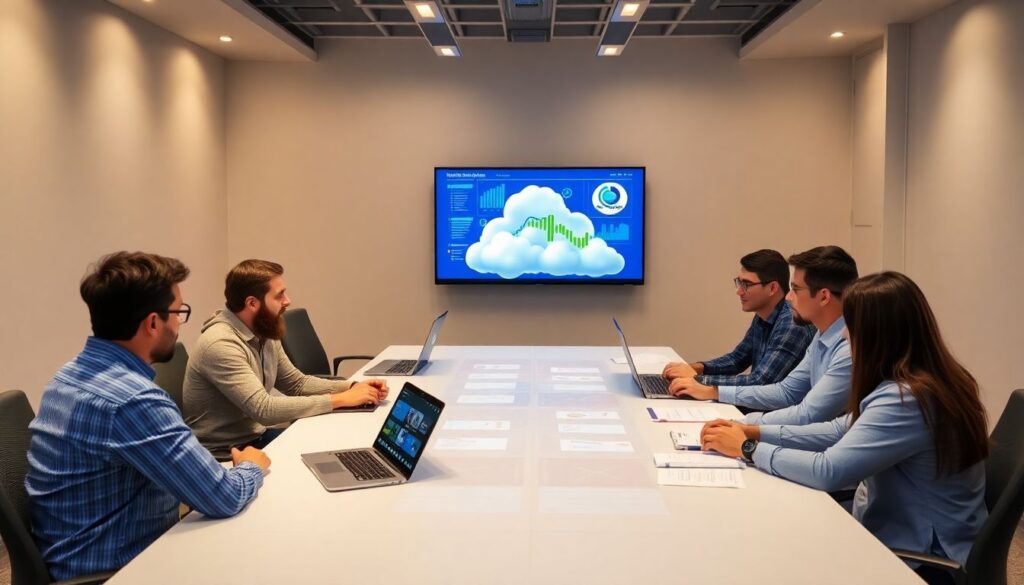
- Run tabletop exercises for at least one P1 and one P2 scenario per quarter.
- Use staging environments to test rollback checkpoints and automated steps safely.
- Periodically request consultoria para montar runbook de resposta a incidentes cloud to review assumptions, SLAs and tooling alignment with your growth and complexity.
- Review each modelo pronto de runbook de resposta a incidentes para cloud annually or after major architecture changes.
Operational Clarifications and Edge Cases
How detailed should each step in the runbook be?
Each step should describe the goal, the exact action, the owner role, and how to verify success. Avoid overly generic guidance like “check logs”; specify which console, which query, and what constitutes a red flag.
What if we operate in multiple cloud providers?
Keep one generic process runbook plus provider-specific annexes. For each playflow, list separate commands, consoles and services for AWS, Azure and GCP, but reuse the same triggers, priorities and roles to avoid confusion.
How do we keep the runbook updated without huge overhead?
Link runbook reviews to existing ceremonies: after major incidents, after major architecture changes, and on a fixed quarterly cadence. Make updates part of your normal change management and assign a clear owner for each section.
Can junior engineers safely follow this runbook?
Yes, if you clearly mark which actions require senior approval and which are safe for anyone on-call. Use explicit warnings and separate read-only diagnostics from potentially disruptive changes.
How do we handle incidents caused by third-party SaaS dependencies?
Include a dedicated section that maps each critical SaaS to its status page, support contacts, and runbook for traffic shifting, feature toggling, or graceful degradation when that provider is down or degraded.
What is the right frequency for testing runbooks?
A practical baseline is to test at least one high-impact security scenario and one availability scenario every quarter. High-risk or frequently used runbooks may require monthly tests or after every major change.
Do we need a separate runbook for compliance-related incidents?
Not always. You can embed compliance steps, such as mandatory notifications or evidence collection, into existing runbooks. Create a separate one only if the legal or regulatory workflow is significantly different.