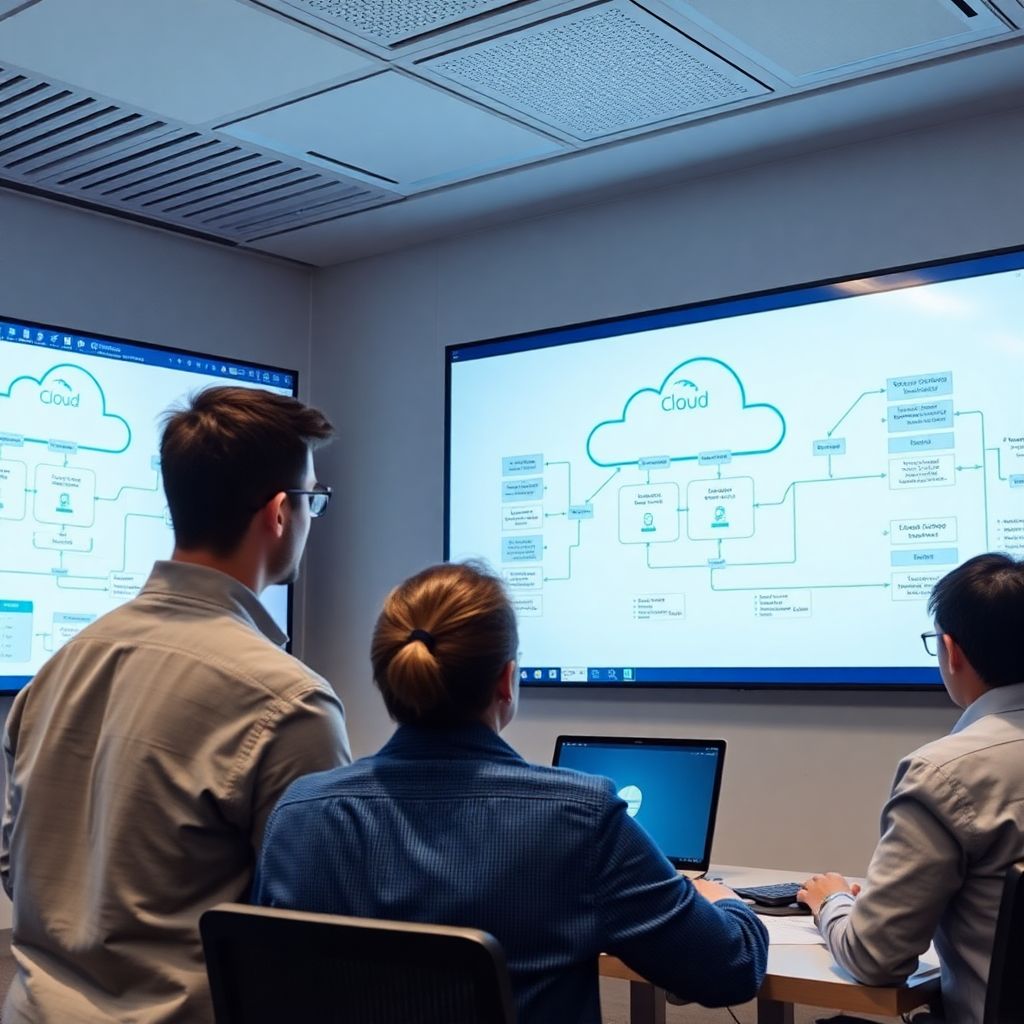
To meet LGPD, GDPR and ISO 27001 requirements in complex cloud environments, start by mapping data flows across all clouds, defining shared responsibilities, and translating legal duties into concrete technical and process controls. Then implement encryption, IAM, logging and monitoring, supported by strong contracts, third‑party risk management and continuous, evidence‑based audits.
Compliance readiness snapshot
- All personal data flows across AWS, Azure, GCP and SaaS are documented, including cross‑border transfers and subprocessors.
- Legal requirements from LGPD, GDPR and ISO 27001 are mapped to specific cloud controls and owners.
- Encryption, IAM, logging and monitoring are consistently configured and tested in every cloud account and region.
- Cloud provider and SaaS contracts define data protection, audit rights, SLAs, incident handling and data residency.
- Evidence (logs, reports, screenshots, tickets) is collected and stored to prove control effectiveness over time.
- Internal skills are complemented when needed by consultoria lgpd gdpr em ambiente cloud or specialized managed services.
Mapping data flows and control scope in multi-cloud
Use this section when your organization runs workloads in multiple clouds or mixes IaaS, PaaS and SaaS. Do not start deep ISO 27001 work before you have at least a draft map of systems, data types and providers; otherwise you will miss critical LGPD and GDPR obligations.
-
Identify systems and providers. List all AWS accounts, Azure subscriptions, GCP projects and key SaaS (CRM, HR, billing, marketing, support).
- Include shadow IT discovered from expense reports, SSO logs or CASB tools.
- Tag which systems process personal data or sensitive data as defined by LGPD and GDPR.
-
Map personal data flows end‑to‑end. For each key process (sales, hiring, support, product usage), map how personal data enters, moves and leaves your environment.
- Document sources (web forms, mobile apps, APIs), processing systems, storage locations and data exports.
- Highlight cross‑border data transfers and between‑cloud synchronizations.
-
Define control boundaries. For each flow, mark what is under your direct control, what is under the cloud provider and what belongs to third‑party processors.
- Use the shared responsibility model diagrams of each cloud provider as a reference.
- Clarify who owns configurations (e.g., S3 bucket policies, Azure Key Vault, GCP IAM).
-
Classify data and criticality. Classify data per LGPD and GDPR (personal, sensitive, anonymized) and by business impact.
- Use labels/tags in cloud resources (e.g., AWS tags, Azure tags, GCP labels) to mark critical workloads.
- Higher‑risk flows will require stronger controls and additional evidence.
-
Prioritize remediation hotspots. From the map, identify flows with high risk and weak controls.
- Examples: unaudited data exports to spreadsheets, direct database access over the public internet, unmanaged SaaS integrations.
- Create a prioritized backlog to address these before audit or regulator interaction.
Translating LGPD and GDPR obligations into cloud controls
To know como adequar lgpd e gdpr em cloud computing, collect your legal and security requirements, the right tools and proper access in each environment. This includes DPO/legal input, cloud security teams, and, when internal capacity is limited, an empresa especializada em segurança da informação e lgpd na nuvem.
Inputs and prerequisites

- Current privacy documentation: RoPA (records of processing activities), privacy notices, data subject rights procedures, data retention rules.
- Information security baseline: existing policies, ISO 27001 scope if any, risk register and incident response playbooks.
- Technical inventories: list of cloud services used (e.g., AWS S3/RDS, Azure SQL Storage, GCP BigQuery, key SaaS tools).
- Administrative access: at least read‑only security/audit roles in AWS, Azure, GCP and core SaaS to review configurations.
- Supporting ferramentas de compliance para lgpd gdpr iso 27001 em cloud (e.g., CSPM, compliance dashboards, DLP, ticketing system).
Requirement → cloud control → evidence mapping
Use a simple matrix to connect legal obligations to specific cloud controls and the evidence you will present to auditors or regulators.
| Legal / standard requirement | Typical cloud control (AWS / Azure / GCP examples) | Evidence to collect |
|---|---|---|
| LGPD & GDPR: lawfulness, purpose limitation, consent management | Centralized API gateway with consent flags; configuration enforcing purpose‑based data use in microservices; restricted marketing data exports. | Architecture diagrams, API schemas, screenshots of consent UIs, tickets showing denied improper data use. |
| LGPD & GDPR: data minimization and storage limitation | Data lifecycle policies on S3 / Azure Blob / GCS; database column reduction; pseudonymization in analytics environments. | Lifecycle configuration exports, DDL scripts, sample anonymized datasets, automated deletion job logs. |
| LGPD & GDPR: data subject rights (access, rectification, deletion, portability) | Standardized APIs or workflows to search, export and delete data across clouds; restricted admin dashboards. | Process description, screenshots of self‑service portals, sample anonymized requests and responses, audit logs of deletion. |
| LGPD & GDPR: security of processing (confidentiality, integrity, availability) | Encryption at rest and in transit, hardened IAM, network segmentation, backups and tested recovery in every cloud region. | Key management configs, IAM policies, VPC/NSG/Firewall rules, backup policies, DR test reports. |
| ISO 27001: risk assessment and treatment | Cloud‑specific risk register, threat modeling for key workloads, security controls aligned with Annex A for each service. | Risk assessment reports, risk treatment plans, mapping of Annex A controls to AWS/Azure/GCP services. |
| ISO 27001: supplier management | Vendor due diligence for cloud providers and SaaS, contractual security clauses, periodic reassessment. | Vendor assessments, signed contracts, security questionnaires, SOC reports tracking. |
Aligning ISO 27001 ISMS with cloud-native architectures

Before adjusting your ISMS to the cloud, prepare with this short checklist so the following steps are safe and practical.
- Confirm top management support for ISO 27001 and cloud security scope.
- Assign an ISMS owner who understands AWS, Azure and GCP basics.
- Ensure read‑only access to cloud audit logs and configuration views.
- Define the list of in‑scope cloud services and critical SaaS tools.
- Align timelines and expectations with any serviços de compliance iso 27001 em nuvem you plan to hire.
-
Define the ISMS scope around cloud workloads. Clearly document which business units, locations, cloud accounts and SaaS providers are covered.
- Include production, staging and critical development environments where real personal data might appear.
- Exclude only what you can justify with low risk and solid segregation.
-
Map assets and owners in each cloud. Build an asset register that includes applications, data stores, networks, identities and keys.
- Use tags/labels to connect cloud resources to ISMS asset IDs and owners.
- Define a single accountable owner for each critical workload or dataset.
-
Adapt Annex A controls to cloud-native services. For each ISO 27001 control, define how it is implemented in AWS, Azure and GCP.
- Example: access control via IAM roles, Azure AD groups, GCP IAM bindings and SSO.
- Document control objectives, configurations and operational procedures.
-
Formalize shared responsibility with providers. Document what is handled by you, what is handled by each provider and how you verify them.
- Base yourself on official shared responsibility models and contracts.
- Define checks: review SOC reports, security whitepapers, configuration baselines.
- Run a cloud-focused risk assessment. Evaluate threats such as misconfiguration, credential theft, insecure APIs and dependency on single regions.
-
Integrate operations: changes, incidents and monitoring. Connect change management, incident response and monitoring into the ISMS.
- Define safe deployment patterns (e.g., infrastructure as code with reviews).
- Ensure incidents in the cloud trigger documented LGPD/GDPR breach triage procedures.
-
Establish continuous improvement loops. Schedule internal audits, management reviews and corrective actions focused on cloud controls.
- Track findings in a central system and assign responsible owners and deadlines.
- Use metrics like mean time to remediate high‑risk misconfigurations.
Technical controls: encryption, IAM, logging and telemetry
Use this checklist to confirm that your technical baseline supports LGPD, GDPR and ISO 27001 expectations in complex cloud environments.
- All storage services with personal data (databases, object storage, disks, backups) are encrypted at rest with managed keys (KMS, Key Vault, Cloud KMS) and strong access controls.
- TLS is enforced everywhere: load balancers, APIs, service‑to‑service calls, database connections and messaging queues.
- Access uses least privilege with role‑based access control, short‑lived credentials and centralized identity (e.g., Azure AD, IAM Identity Center, Google Cloud Identity).
- Privileged actions (role changes, key use, firewall changes) are logged in CloudTrail, Azure Activity Logs, GCP Audit Logs or equivalent and retained per policy.
- Administrative interfaces (management consoles, bastion hosts, jump boxes) are protected by MFA and network restrictions (VPN, private endpoints, conditional access).
- Workloads emit structured application logs and security events to a central SIEM or log analytics solution with alerts for suspicious behavior.
- Backups and disaster recovery plans are tested, with clear RPO/RTO for critical services containing personal data.
- Security scanning (vulnerabilities, container images, IaC templates) runs automatically in CI/CD and production, with a defined triage and fix process.
- Keys, certificates and secrets are stored only in secure vaults, rotated regularly and never hard‑coded in source code or images.
Contractual strategies and third‑party risk for cloud providers
These are the most common mistakes organizations make when dealing with cloud contracts, especially without specialized consultoria lgpd gdpr em ambiente cloud or legal support.
- Assuming standard cloud terms automatically satisfy all LGPD and GDPR requirements, without checking data processing details and locations.
- Not signing or properly reviewing data processing agreements (DPAs), standard contractual clauses or international transfer mechanisms.
- Ignoring sub‑processors used by major cloud and SaaS vendors and not tracking changes to their sub‑processor lists.
- Failing to define breach notification timelines, responsibilities and formats that align with LGPD and GDPR reporting obligations.
- Omitting clear rights to receive security documentation, audit reports or to perform reasonable assessments on providers.
- Not aligning SLAs (availability, incident response) with business criticality and ISO 27001 risk treatment decisions.
- Accepting broad data use clauses that allow providers to reuse customer data for their own purposes beyond what is compatible with LGPD/GDPR.
- Lacking exit and data return/deletion clauses, making it hard to migrate away or prove secure deletion at contract end.
- Managing vendor risk only during onboarding, with no periodic reassessment after major incidents, feature changes or acquisitions.
Auditability: monitoring, evidence collection and continuous assurance
There is no single way to structure assurance for cloud compliance. These options can be combined depending on your size, risk profile and maturity.
-
Internal continuous compliance program. Use internal teams and tools to monitor configurations, collect evidence and perform periodic reviews.
- Suitable for organizations with strong cloud and security teams that want full control over processes and tooling.
-
Co‑managed model with external specialists. Work with an empresa especializada em segurança da informação e lgpd na nuvem to design controls and dashboards, while operating them internally.
- Useful when you need deep expertise to start, but want to keep daily operations in‑house.
-
Outsourced managed compliance services. Engage serviços de compliance iso 27001 em nuvem or privacy‑focused MSSPs to run monitoring, evidence collection and reporting.
- Works best for smaller teams or organizations without enough internal cloud security capacity.
-
Hybrid multi‑tool approach. Combine internal tooling with external ferramentas de compliance para lgpd gdpr iso 27001 em cloud for configuration checks, DLP and ticket management.
- Appropriate when each cloud or line of business has different requirements and existing tools you must integrate.
Typical implementation challenges and practical fixes
How do I start if my cloud environment is already messy?
Begin with a lightweight inventory and data flow mapping of the highest‑risk systems, not with a big policy rewrite. Focus on a few critical workloads, document flows and owners, then iterate. This makes later LGPD, GDPR and ISO 27001 work safer and more focused.
Do I need separate controls for LGPD and GDPR in the cloud?
Usually no. Design a single control set that satisfies the stricter interpretation of both regulations, then document how each control supports specific LGPD and GDPR articles. Differences tend to appear more in documentation and legal bases than in technical controls.
How can I prove to auditors that cloud controls are working?
Collect consistent evidence: configuration exports, screenshots, log extracts, tickets, risk registers and test results. Organize them by control and by requirement (LGPD, GDPR, ISO 27001) and keep a periodic evidence collection schedule so you are not rushing before audits.
What if my SaaS providers do not offer detailed security information?
Ask for their security whitepaper, certifications and audit reports, then assess whether residual risks are acceptable. If transparency remains low, consider compensating controls, contract changes or switching providers, especially for services processing sensitive personal data.
Is infrastructure as code mandatory for compliance in cloud?
It is not mandatory but strongly recommended. IaC makes configurations reviewable, versioned and consistent, which directly supports ISO 27001 and simplifies LGPD/GDPR evidence gathering. If you cannot use IaC everywhere, start with the most critical and exposed workloads.
How do I coordinate legal, security and DevOps teams?
Define a simple RACI for privacy and security decisions, then create short, recurring syncs with clear backlogs. Use shared tools (ticketing, documentation) and assign named owners for each major control area to reduce gaps and duplicated efforts.
When should I bring in external consultoria lgpd gdpr em ambiente cloud?
Bring external specialists when internal teams lack experience with multi‑cloud, when facing regulatory pressure, or when preparing for ISO 27001 certification on aggressive timelines. Choose partners who understand both legal frameworks and real AWS/Azure/GCP operations.