A practical cloud security baseline for AWS, Azure and GCP means one unified set of controls (identity, network, data, logging, operations) with provider-specific mappings. You document minimum requirements once, then implement them consistently using native services, automation and continuous posture monitoring across all tenants, subscriptions, accounts and projects.
Baseline Summary and Scope
- Define a single control set that works for all providers, instead of three separate standards.
- Translate each baseline control to concrete services and configurations in AWS, Azure and GCP.
- Prioritize identity, network segmentation, encryption at rest/in transit and logging as the core.
- Use automation and ferramentas cloud security posture management aws azure gcp to monitor drift.
- Limit scope initially to shared services and most critical workloads, then expand gradually.
- Align baseline with existing norms and melhores práticas cloud security multi cloud already adopted internally.
Defining Unified Security Objectives and Risk Criteria
This type of baseline is ideal when you already run workloads in at least two providers and need consistent segurança em nuvem aws azure gcp for audits, incident response and operations. It fits regulated environments, platform teams and any organization planning strategic multi-cloud adoption.
Do not invest in a full multi-cloud baseline if you are:
- Running only experiments or short-lived PoCs in a second provider.
- Lacking minimal governance (no clear ownership of accounts, subscriptions or projects).
- Without capacity to maintain automation; manual multi-cloud hardening quickly becomes unmanageable.
Define objectives and risk criteria before touching configurations:
- Clarify business drivers – compliance, resilience, vendor-independence, cost, or partner requirements. This drives how strict and detailed the baseline must be.
- Choose reference frameworks – e.g. CIS, NIST, LGPD privacy principles or internal policies. Use them to justify why each control exists.
- Define risk levels – what is unacceptable (e.g. public S3 bucket with personal data), what is tolerated with approval, and what is low-risk.
- Set target state – examples: all identities federated, all storage encrypted with customer-managed keys for critical data, centralized logging for every account.
- Agree on scope per phase – phase 1: shared tools, CI/CD, landing zones; phase 2: business apps; phase 3: legacy migrations.
Only after objectives and risk criteria are accepted by security, platform and application teams you start designing technical mappings and templates.
Mapping Technical Controls to AWS, Azure and GCP Services
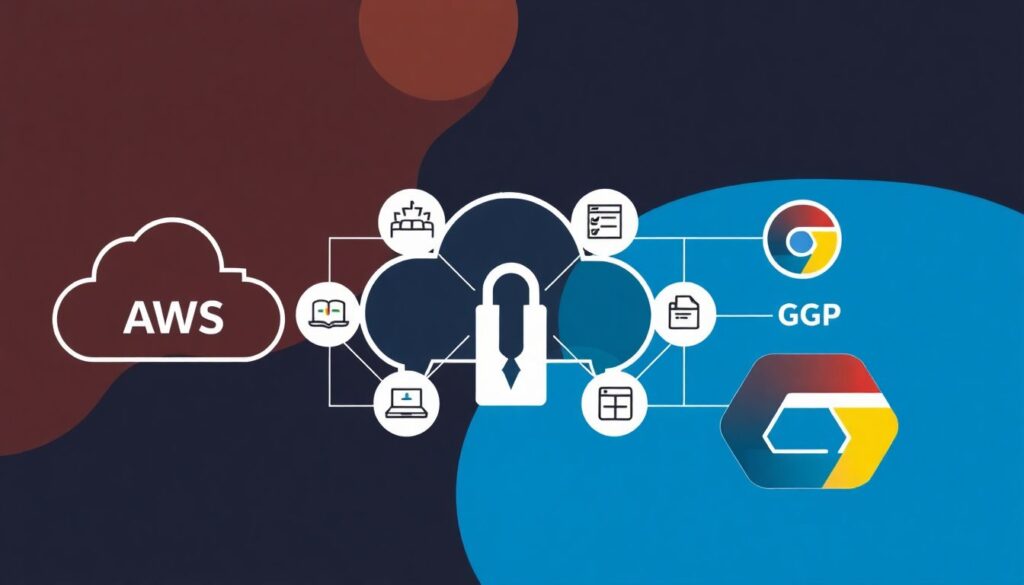
To realmente responder à pergunta como padronizar segurança em nuvem entre provedores aws azure gcp, you must translate each control to technologies and teams. Start from a minimal toolset and access model.
Prerequisites and Access Requirements
- At least one organization-level admin for each provider (AWS Organizations, Azure Tenant Root, GCP Organization) cooperating with security.
- Read access (and later write) to all accounts/subscriptions/projects that will be onboarded to the baseline.
- Central identity provider (IdP) such as Entra ID, Okta, Ping or corporate IdP able to federate to all clouds.
- Version control (Git) and CI/CD to store and apply baseline definitions via Terraform, Bicep, CloudFormation or similar.
- One CSPM or equivalent stack (even if homegrown) to continuously measure adherence to the baseline.
Example Mapping Table for Core Baseline Controls
| Baseline Control | AWS Services / Features | Azure Services / Features | GCP Services / Features |
|---|---|---|---|
| Centralized Identity and SSO | AWS IAM Identity Center, IAM Roles, AWS Organizations | Microsoft Entra ID, Management Groups, PIM | Cloud Identity / Google Workspace, IAM, Folders & Organization |
| Least-Privilege Access Control | IAM policies, Permission Boundaries, SCPs | Role-Based Access Control (RBAC), Custom Roles, Azure Policy | IAM Roles, Custom Roles, Organization Policies |
| Network Segmentation | VPC, Subnets, Security Groups, NACLs | Virtual Network, Subnets, NSGs, UDRs | VPC Networks, Subnets, Firewall Rules |
| Perimeter and WAF | VPC Lattice, AWS WAF, AWS Shield, CloudFront | Azure Firewall, Azure Front Door, Web Application Firewall | Cloud Armor, Cloud Load Balancing, VPC Firewall |
| Encryption at Rest | KMS, default EBS/S3/RDS encryption | Key Vault, Storage Service Encryption, Disk Encryption | Cloud KMS, CMEK for Storage, Disks and Databases |
| Centralized Logging | CloudTrail, CloudWatch Logs, S3 log buckets | Azure Monitor, Activity Log, Log Analytics | Cloud Audit Logs, Cloud Logging, BigQuery sink |
| Posture Management | Security Hub, Config, Inspector | Defender for Cloud, Azure Policy, Secure Score | Security Command Center, Organization Policy, SCC Findings |
If you do not have a single vendor CSPM, you can still approximate ferramentas cloud security posture management aws azure gcp using the native posture tools listed above plus custom dashboards.
Identity and Access Management: Consistent Policies and Patterns
IAM is the safest area to standardize first. Use this step-by-step process to create a portable IAM baseline across AWS, Azure and GCP.
-
Establish organization-level structure and ownership – create or confirm Organization / Tenant / Organization in each cloud and define who owns it.
- AWS: enable AWS Organizations, define management account and security account.
- Azure: configure Management Groups (Root, Platform, Corp, Online) and subscriptions under them.
- GCP: ensure single Organization node, create Folders for environments and business units.
-
Centralize human identity with SSO and federation – avoid local users in each cloud.
- Configure SAML/OIDC trust between IdP and each provider (AWS IAM Identity Center, Entra ID, GCP).
- Map groups from the IdP to roles in each cloud (e.g., “Cloud-Admins”, “App-Owners”).
- Disable or strictly limit long-lived IAM users with access keys.
-
Define role taxonomy with least privilege – create a naming and scoping standard reusable across providers.
- Separate roles for administration, read-only, break-glass and automation.
- Document which tasks each role can perform; keep them similar across clouds.
- Prefer built-in roles as a base, then apply customizations only where needed.
-
Implement environment-based access boundaries – prod and non-prod must be clearly separated.
- AWS: use separate accounts per environment; apply Service Control Policies for production.
- Azure: use different subscriptions and Management Group hierarchy per environment.
- GCP: isolate projects by environment and apply Organization Policies.
-
Standardize machine identities and workload access – treat workloads as first-class identities.
- Use instance/managed identities instead of embedded secrets or long-lived keys.
- Define patterns for CI/CD access to deploy resources in each cloud.
- Rotate any unavoidable keys using managed services (Secrets Manager, Key Vault, Secret Manager).
-
Enforce MFA and conditional access policies – apply them through the IdP as much as possible.
- Require MFA for administrator and privileged roles.
- Use conditional access rules (location, device compliance) for high-risk actions.
- Configure periodic access reviews for sensitive roles.
-
Codify IAM baseline as code and reusable modules – ensure repeatability.
- Implement standard roles, policies and bindings via Terraform/Bicep/CloudFormation.
- Store definitions in Git; changes go through pull requests and approvals.
- Use policy-as-code (e.g., Open Policy Agent, Conftest) to validate changes before deployment.
-
Continuously verify IAM posture with automated checks – do not rely on manual audits.
- Enable least-privilege anomaly detection in native tools where available.
- Configure periodic reports for highly privileged roles, unused roles and risky permissions.
- Use your CSPM or equivalent to monitor IAM misconfigurations across providers.
Fast-track mode for IAM baseline
- Enable SSO with your IdP in all three clouds and stop creating local user accounts.
- Create only three roles per environment per provider at first: Admin, PowerUser, ReadOnly.
- Separate production into distinct accounts/subscriptions/projects with stricter access.
- Onboard all admin roles into a CSPM or native IAM analyzer to flag overly broad permissions.
Network Segmentation, Perimeter and Ingress/Egress Controls
Use this checklist to verify if your network baseline is consistently applied across AWS, Azure and GCP.
- Every workload runs inside a managed VPC/VNet with non-overlapping CIDRs, never directly on the public internet.
- Production, non-production and shared services have isolated networks (separate VPCs/VNets/projects/subscriptions).
- Ingress to applications is only through managed load balancers and WAF; no direct public IPs on databases or internal services.
- Security Groups/NSGs/Firewall rules only allow necessary ports from specific sources, not open to 0.0.0.0/0 unless explicitly justified.
- Outbound traffic (egress) from critical workloads is restricted and logged, using egress firewalls or proxies where available.
- DNS is centralized and controlled; split-horizon or private zones are used for internal services.
- Network flow logs (VPC Flow Logs, NSG Flow Logs, VPC Flow Logs on GCP) are enabled and sent to a central log or SIEM location.
- Remote access for admins uses hardened paths (VPN, bastion, privileged access workstations), not random public SSH/RDP.
- Inter-cloud connectivity (VPN/peering) is documented, encrypted and limited to the necessary subnets and ports.
- Regular network posture reviews are performed, ideally integrated into consultoria segurança em nuvem aws azure gcp engagements or internal assessments.
Data Protection: Classification, Encryption and Key Management
Data protection failures are often subtle. Avoid these common mistakes when defining a unified baseline.
- Treating all data the same and skipping classification, leading to overexposed sensitive data in test and dev environments.
- Relying only on provider-managed keys when regulations or internal policies require customer-managed keys for specific datasets.
- Enabling encryption at rest but leaving keys unmanaged (no rotation policy, no clear ownership, no documented recovery process).
- Mixing keys for multiple systems or tenants in a single key ring or vault without proper separation of duties.
- Storing secrets in code repositories, CI/CD variables without protection, or plain-text configuration files.
- Not enforcing TLS for all external and internal services, resulting in occasional clear-text traffic between microservices.
- Allowing ad-hoc data exports to unmanaged storage (e.g., developer personal buckets) for debugging or analytics.
- Failing to configure backups and snapshots with the same security level as primary data (encryption, access controls, logging).
- Ignoring cross-border data transfer constraints in Brazil and other jurisdictions when placing or replicating data in multi-cloud.
- Not testing key loss and recovery scenarios, which can turn a minor incident into a permanent data loss event.
Operationalization: Automation, Compliance Mapping and Drift Detection
There are several ways to operate your baseline in production. Choose the approach that fits your size, skills and tooling.
-
Native-first with light automation – use each provider's policy and compliance tools plus scripts.
- Good for smaller teams starting with multi-cloud.
- Combine AWS Config + Security Hub, Azure Policy + Defender for Cloud, GCP SCC + Organization Policy.
-
CSPM-centric operating model – a central CSPM layer becomes the primary lens for posture.
- Suitable when you already invested in ferramentas cloud security posture management aws azure gcp.
- Use it to enforce your baseline controls as checks, with tickets and workflows for remediation.
-
Platform engineering with full GitOps – baseline lives as code and is pushed via pipelines.
- Ideal for organizations with mature DevOps and infra-as-code skills.
- Terraform/Bicep modules and policies are the single source of truth; drift is auto-detected and corrected.
-
Hybrid with external advisory – combine internal automation with periodic external reviews.
- Use consultoria segurança em nuvem aws azure gcp to validate your baseline against industry evolution.
- Keep operations internal but benchmark design and metrics periodically.
Troubleshooting and Common Questions
How many controls should a first multi-cloud security baseline include?
Start small and cover identity, network, logging and encryption with a limited set of mandatory controls. You can later expand into more detailed items for container security, serverless and application-level protections as your teams mature.
What if one provider cannot implement a specific control exactly as defined?
Keep the objective constant and adjust the technical implementation. For example, if a feature is missing, combine existing services to achieve a similar effect or document an accepted deviation and compensating controls.
Do I need a CSPM tool to enforce the baseline?
No, but it helps. You can approximate posture management with native tools and custom dashboards, then later add a unified CSPM when scale grows or compliance requirements become stricter.
How often should I review and update the cloud security baseline?
At minimum once per year, and additionally after major provider changes, new regulations or security incidents. Treat the baseline as a living standard, updated through a change management process with clear approvals.
How do I handle legacy workloads that cannot meet all baseline requirements?
Document exceptions with a clear risk description, owner and expiration date. Apply compensating controls like additional monitoring or network isolation while planning a remediation or migration path.
What is the best way to train teams on the new baseline?

Create short, provider-specific playbooks with concrete examples and minimal configs instead of long theory documents. Run hands-on sessions where teams implement baseline modules in non-production environments.
How can I prove to auditors that the baseline is actually enforced?
Maintain evidence from automation logs, CSPM or native reports, and version-controlled baseline definitions. Show mappings from baseline controls to provider configurations and recent posture reports covering all in-scope environments.