Why DevSecOps for cloud workloads looks different in 2026
In 2026, setting up a DevSecOps pipeline for cloud workloads is no longer just “CI/CD plus a few security scans”. Cloud platforms have evolved, attacks have become more automated, and regulations have caught up. At the same time, you have far better tooling and managed services at your disposal. The result: you can build an automated, observable and resilient DevSecOps pipeline that treats security as a built‑in property of the system, not an afterthought. To get there, it helps to think in terms of risk‑driven automation, policy‑as‑code and minimal human bottlenecks, instead of just gluing together scanners around a legacy CI server.
Core principles before you touch any tool
Security as code and as data
Before picking specific tools, define how security rules, exceptions and evidence will be represented as code and as data. This means: security policies live in version control, enforcement is automated through pipelines, and all relevant artifacts (scan reports, SBOMs, attestation metadata, compliance findings) are stored in a queryable way. When you treat security configurations like any other source code, you can review, test and roll them back. That mindset is at the heart of a robust implementação devsecops cloud segurança por padrão, because it turns “security by default” from a slogan into a repeatable engineering practice.
Shifting everywhere, not just “left”
“Shift left” used to mean putting static analysis early in the build. In 2026, the more realistic view is “shift everywhere”: give developers fast feedback at commit time, keep strong gates in CI, enforce runtime policies in Kubernetes and serverless, and continuously validate infrastructure drift. Attackers exploit mistakes at any layer, so your pipeline has to cover supply chain (builds), infrastructure (IaC and cloud configs) and runtime (clusters, functions, APIs). The goal is a coherent set of controls from IDE to production, not a random pile of scanners that nobody understands or tunes.
Designing a modern DevSecOps pipeline for cloud
High‑level architecture for a cloud‑native pipeline
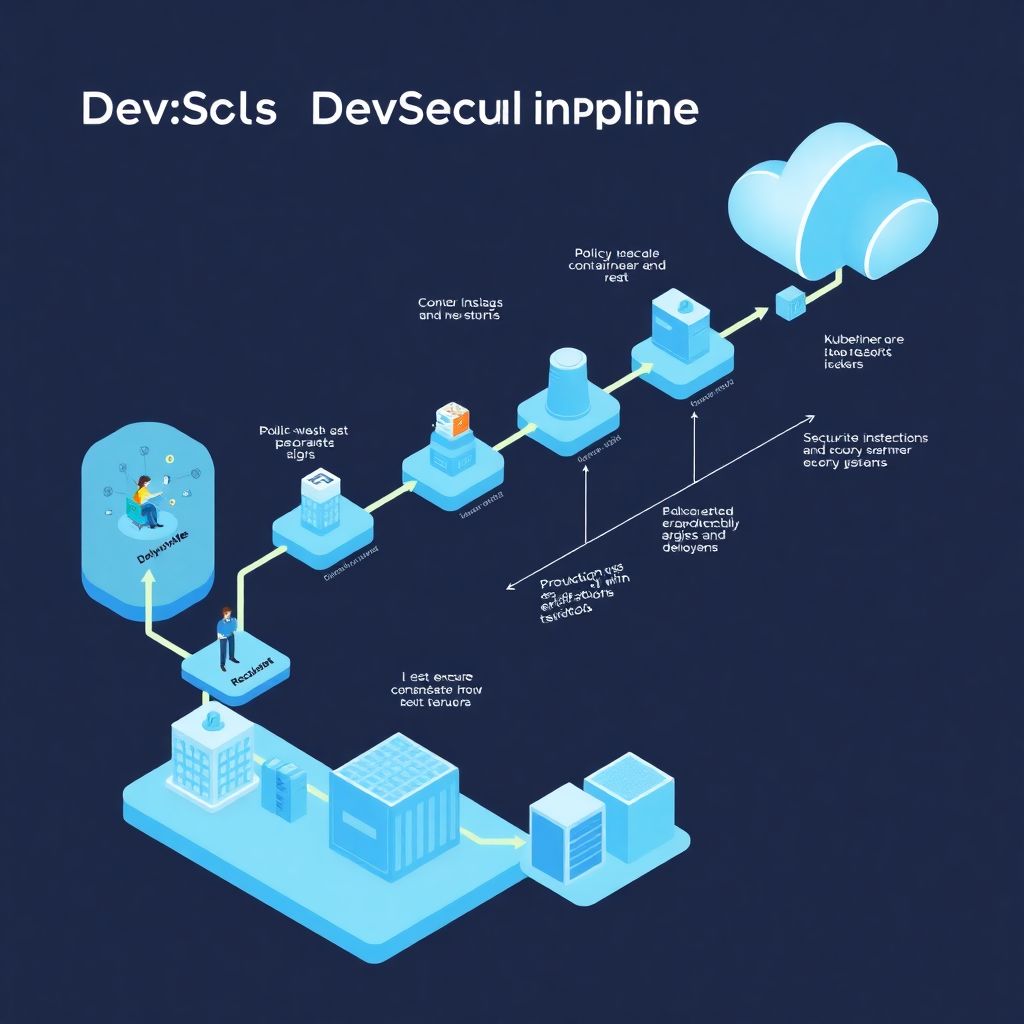
A modern pipeline for cloud workloads typically follows a consistent flow: developers push code and infrastructure definitions; automated checks run on pull requests; builds are created in isolated, ephemeral agents; artifacts are signed and stored; deployments are controlled by policies, not ad‑hoc approvals; runtime telemetry flows back into the development loop. Whether you use Jenkins, GitHub Actions, GitLab CI or a cloud‑native orchestrator, the pattern is similar: separate build, test, security‑assessment and deploy stages, each with clear inputs, outputs and quality gates that developers can see and reason about without needing to be security experts.
Step 1: Map your workloads and shared responsibilities
Before wiring any stages, create a living map of your workloads: microservices, batch jobs, event‑driven functions, data pipelines and the cloud accounts or projects they run in. Then, clarify the shared responsibility model for every part of the stack: what your cloud provider secures, what your team must configure and what cannot be automated yet. This map lets you place the right checks at the right layer—container scanning for microservices, serverless permission analysis for functions, IAM reviews for cross‑account data access—and keeps you from over‑securing low‑risk pieces while ignoring critical ones like public APIs or administrative backends.
Step 2: Choose cloud‑native and managed building blocks
In 2026, fighting your cloud platform usually makes less sense than using the native components it offers. Most teams mix a central CI platform with cloud‑native build services, managed registries and secret managers. For heavy lifting like software composition analysis, container scanning or policy engines, you can decide between self‑hosted open source and fully hosted security SaaS. That is where a well‑designed pipeline devsecops em nuvem serviços gerenciados becomes attractive: offload undifferentiated plumbing to the provider, keep critical policy logic and risk decisions inside your organization, and focus your engineers on wiring these capabilities into a reliable, auditable flow.
Practical stages of a secure‑by‑default DevSecOps pipeline
On every commit: fast checks that developers actually read
At the commit or pull‑request stage, the checks must be fast and highly relevant; otherwise, developers will simply learn to ignore them. Practical examples include lightweight static analysis, IaC linting for Terraform or CloudFormation, dependency checks against known critical CVEs, and basic secrets detection in code and config. The trick is to tune them to minimize false positives: disable irrelevant rules, match them to your coding guidelines and mark certain findings as “informational” rather than blocking. When the feedback is quick and actionable, you transform early security checks into a habit instead of a source of friction.
- Run lightweight SAST, IaC linting and dependency checks on pull requests only for changed components.
- Set time budgets for PR jobs (e.g., under 10 minutes) to keep developers in the feedback loop.
- Autogenerate suggested fixes or code snippets for common misconfigurations, like over‑permissive IAM policies.
Build stage: secure artifacts and supply chain controls
During the build stage, you care about the integrity and provenance of what you produce. This is where supply chain security patterns, now standard by 2026, come into play. Use reproducible builds when feasible, sign container images and packages, generate Software Bills of Materials (SBOMs) and attach attestations describing which checks passed. Store all artifacts in a hardened registry with strict access controls and mandatory image scanning. By enforcing that only signed, vetted artifacts are allowed to progress to later environments, you greatly reduce the chance that compromised build agents or malicious dependencies silently slip into production workloads.
Pre‑deployment: policy‑as‑code instead of manual approvals
Traditional change boards are too slow for continuous delivery. Instead, enforce pre‑deployment gates with policy‑as‑code frameworks integrated directly into the pipeline. These policies can verify that only approved base images are used, that containers run as non‑root, that all external endpoints use TLS with verified certificates, and that sensitive data flows conform to your rules. Security teams express requirements as code, developers see the same policies and test locally, and the CI system becomes an impartial judge. This shift from people‑based approvals to automated checks keeps velocity high while satisfying regulatory and internal control mandates.
- Use policy engines to validate Kubernetes manifests, serverless configs and Terraform plans before apply.
- Block deployments when critical policies fail, but allow risk‑accepted exceptions via documented pull requests.
- Log all policy decisions and attach them as metadata to releases for audits and incident post‑mortems.
Post‑deployment: continuous verification and feedback
Security does not stop when code is deployed. A 2026‑ready pipeline includes continuous verification in staging and production: dynamic application security testing, runtime protection rules in WAFs or service meshes, anomaly detection on API traffic, and posture management for cloud resources. The key is to feed these signals back into development in a structured way: create tickets automatically with context, link alerts to specific commits or pull requests, and integrate findings into sprint planning. Over time, this closes the loop: issues discovered in production lead to tighter policies earlier in the pipeline, steadily reducing the number of security surprises in live systems.
Choosing and integrating DevSecOps tools in 2026
Balancing open source, SaaS, and cloud‑native options
The tooling landscape for DevSecOps in 2026 is mature but crowded. You can assemble an end‑to‑end stack from open source components, rely heavily on commercial SaaS platforms, or combine them with your cloud provider’s native services. When evaluating ferramentas devsecops para integração contínua segura, prioritize how well they integrate with your existing CI/CD, version control, and observability platforms. Look for strong APIs, support for common artifact formats, and the ability to export evidence for audits. Avoid choosing tools solely for individual feature lists; instead, optimize for how they compose into a maintainable, end‑to‑end security workflow.
Practical integration patterns that scale
In practice, integrating security tools at scale means not running every possible check on every pipeline. A common pattern is to differentiate between fast, blocking checks in main pipelines and deeper, scheduled analyses that run nightly or weekly. For instance, run quick dependency checks on every build, but schedule full container image scans and exhaustive SAST for off‑peak hours. Centralize results in a single “security findings” service, mapped to projects and teams, so developers are not chasing alerts across multiple dashboards. This layered approach keeps pipelines responsive while ensuring that important analyses still happen regularly and feed back into your remediation backlog.
- Define which checks are blocking, which are advisory and which are periodic for each repo or service.
- Standardize result formats (e.g., SARIF) so multiple tools can feed a shared findings repository.
- Automate ticket creation with ownership and SLAs based on severity and regulatory impact.
Working with specialists and scaling across teams
When to bring in external DevSecOps expertise
Not every organization has in‑house specialists who have built complex security pipelines for large, multi‑cloud environments. Engaging a focused consultoria devsecops para workloads em cloud can help you avoid common pitfalls: misconfigured policies that block everything, brittle pipelines that are hard to debug, or controls that look good on paper but do not match your threat model. The most effective partnerships are collaborative: the external team helps you design the architecture, codify policies and bootstrap automation, while your internal engineers own the day‑to‑day evolution so knowledge does not leave when the contract ends.
Building internal enablement rather than bottlenecks
Inside your organization, the security team should act more like a platform provider than a gatekeeper. Instead of manually reviewing every change, they offer paved roads: reusable pipeline templates, pre‑approved base images, central policy libraries and well‑documented examples for common architectures (REST APIs, event‑driven systems, data pipelines). Developers choose these paved roads and get strong default protection without having to understand every security nuance. Over time, you measure success not by the number of manual reviews performed, but by how many services adopt the common patterns and how quickly new teams can onboard safely.
When a specialized DevSecOps company makes sense
For organizations with highly regulated environments, complex multi‑tenant platforms or aggressive growth plans, partnering with an empresa especializada em pipeline devsecops na nuvem can accelerate your journey. Such a partner typically brings pre‑built reference architectures, hardened pipeline modules and proven patterns for handling secrets, keys, identity and compliance evidence at scale. The value is not just technical; they can help you translate regulatory frameworks into actionable controls, align with internal audit and give your board a clear picture of risk reduction. The important part is to retain ownership of the strategic vision so that their work strengthens your capabilities instead of creating long‑term dependency.
Modern trends shaping DevSecOps pipelines in 2026
AI‑assisted security and autonomous remediation

By 2026, AI is embedded into many security platforms, not as magic, but as a way to reduce noise and suggest concrete fixes. Models digest volumes of alerts, logs and scan outputs to highlight the handful of issues that truly matter, propose code changes or policy updates, and even trigger safe rollbacks based on learned patterns. The practical impact on your DevSecOps pipeline is that you can afford to collect more data and signals without overwhelming teams, because triage and prioritization become semi‑automated. However, you still need clear human oversight and guardrails to avoid over‑reliance on automated decisions in high‑risk scenarios.
Zero‑trust, identity‑centric pipelines
Another noticeable shift is treating pipelines themselves as high‑value targets. Build agents, runners and orchestration services now follow zero‑trust principles: short‑lived credentials, workload identity instead of long‑lived keys, mutual TLS between components, and strict segmentation. Cloud‑native identity systems allow you to grant minimal permissions to each pipeline job on the fly, reducing blast radius if a runner is compromised. You should periodically review pipeline permissions just like you would review production IAM roles, and ensure secrets never appear in logs or build artifacts. In a world of supply chain attacks, securing the pipeline infrastructure is as crucial as securing the applications it builds.
Compliance as continuous evidence, not annual panic
Regulatory requirements in 2026 increasingly expect continuous proof of control, not just point‑in‑time audits. A mature pipeline automatically collects and tags evidence: which tests ran on which build, what policies were applied, who approved which exceptions, and how vulnerabilities were triaged and fixed. This turns compliance from an annual scramble into a steady background process: when auditors arrive, you generate reports from existing data instead of chasing spreadsheets. Designing your DevSecOps workflows with evidence capture in mind from day one pays off later, especially in industries like finance, healthcare or critical infrastructure.
Putting it all together: a realistic rollout path
Start small, iterate, and measure outcomes
Configuring a cloud‑native DevSecOps pipeline with security by default does not have to be a multi‑year, all‑or‑nothing project. A pragmatic path is to pick one or two critical services, implement a basic CI with fast checks and artifact signing, then add policy‑as‑code gates and runtime telemetry step by step. Measure tangible outcomes such as reduction in critical vulnerabilities reaching staging, time to remediate high‑severity findings, or percentage of services using standard base images. Use these metrics to justify further investment and refine your controls, always keeping an eye on the balance between safety and delivery speed.
Make “secure by default” the easy choice
The most effective DevSecOps pipelines in 2026 share a common characteristic: they make the secure path the path of least resistance. Developers default to templates that already include tests, scanners and policies; creating a new microservice or function automatically wires in logging, tracing and basic access controls; enabling a new region or account comes with baseline guardrails pre‑configured. When security is woven into automation in this way, teams no longer perceive it as a separate phase or external demand. It simply becomes the normal way of building and running cloud workloads—exactly what “integrated continuous delivery with security by default” was supposed to mean all along.