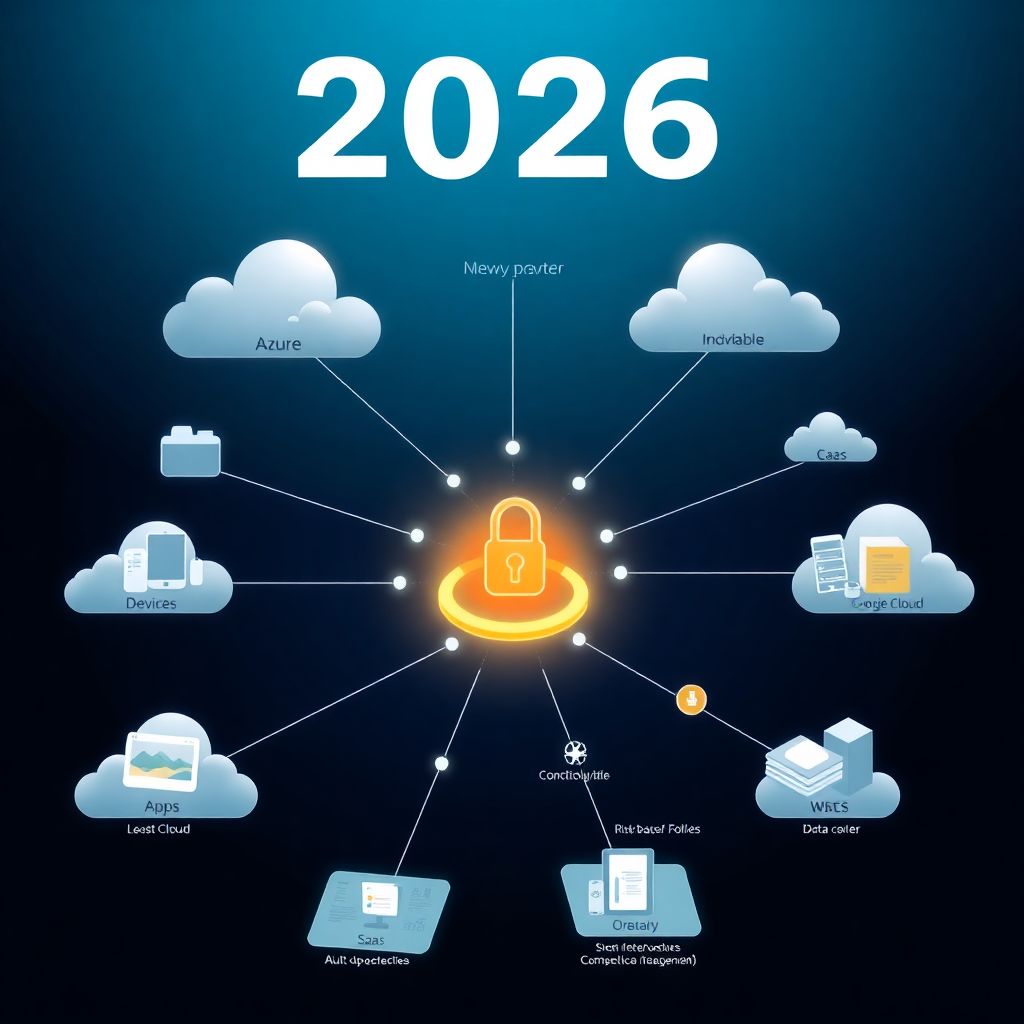
Por que IAM em ambientes híbridos virou assunto de sobrevivência em 2026
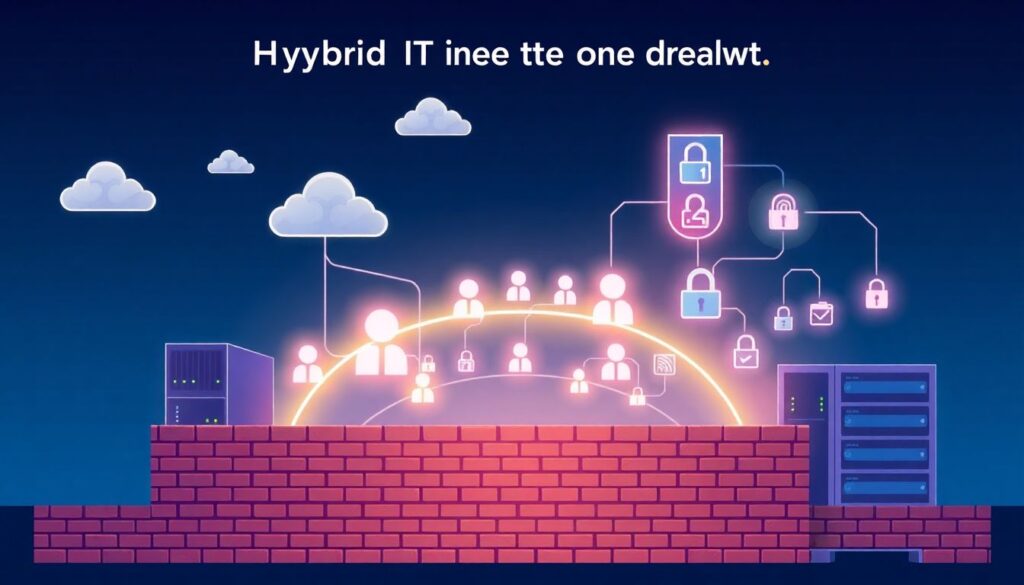
Hybrid is no longer a buzzword, it’s the default. Most organizations now keep a mix of cloud workloads, SaaS apps and stubborn legacy systems running on‑premises. That means identity has quietly become the new network perimeter. Instead of closing “ports on a firewall”, we’re now closing gaps in who can access what, from where, and under which conditions. Recent industry reports estimate that over 80% of breaches still involve stolen or abused credentials, and in hybrid setups misconfigured access between cloud and data center is repeatedly flagged as one of the top three attack paths. When you spread identities, roles and policies across Azure AD, AWS IAM, Google Cloud, VPNs, AD on‑prem and dozens of SaaS tools, the room for error explodes. That’s exactly why a solução IAM para ambientes híbridos deixou de быть “nice to have” и превратилась в ядро архитектуры безопасности.
Как гибридная модель ломает старый подход к управлению доступом
In the classic on‑prem world, identity and access management was relatively contained: a single Active Directory, a few VPN profiles, some group policies and manual reviews once or twice a year. In 2026 this model is not just outdated, it is actively dangerous. We see identities belonging to people, devices, apps, APIs, bots and service accounts, each leaving traces in different directories and identity providers. The same user might exist in three or four systems with different roles and passwords. Attackers take advantage of this fragmentation, hopping from a poorly protected SaaS account to cloud admin roles and eventually into the data center. That’s why companies are turning to ferramentas de gestão de identidade e acesso em nuvem e on-premise that can see the full picture: who has which privileges, where they came from, and whether those privileges still make sense for the job that person or workload is doing today.
Ключевой принцип: минимизация поверхности атаки через идентичность
When we talk about “reducing attack surface” in hybrid environments, we’re essentially talking about cutting unnecessary access paths. Every extra admin role, legacy account or forgotten API token is a small door that might be forced open. A modern plataforma de segurança IAM para reduzir superfície de ataque focuses on enforcing least privilege by default, automating lifecycle management of identities, and tightening conditional access based on risk signals. This means that instead of one universal access granted forever, your policies adapt: high‑risk login, unfamiliar device, privileged action or access to sensitive data triggers step‑up authentication or is blocked altogether. Over time, this risk‑adaptive model significantly reduces both the number of open “doors” and the time window an attacker can exploit misused credentials.
Практические основы: что должно быть в современной IAM‑архитектуре для гибридной среды
There is no single magic product, but there is a fairly clear set of building blocks that most mature organizations converge on. At the center, an identity provider capable of handling cloud and on‑premises identities, with federation to major SaaS platforms. Around it, you add strong authentication, fine‑grained authorization, centralized logging and continuous monitoring. A well‑designed software de controle de acesso híbrido com autenticação multifator becomes the user’s visible entry point, while behind the scenes you orchestrate SSO, just‑in‑time elevation of privileges and session recording for sensitive actions. The key is to avoid running separate IAM stacks for every environment and instead treat identity as a shared service that applications consume, no matter where they run.
• Central identity provider (cloud‑ready, with federation)
• Unified policy engine for authorization across cloud and on‑prem
• Strong MFA and risk‑based conditional access for all critical apps
Статистика и сухие цифры: насколько IAM реально снижает риски
Numbers help cut through the marketing noise. Industry analyses from 2024–2025 showed that organizations with mature IAM programs (including centralized SSO, MFA, and regular access reviews) experienced up to 60–70% fewer credential‑related incidents compared to peers. Time to detect access abuse shrank from weeks to hours when access logs from cloud and on‑premises systems were unified. By 2025, more than 65% of large enterprises reported using at least one cloud identity platform integrated with on‑prem directories; forecasts for 2026–2028 expect this number to exceed 85%. Perhaps more telling, over a third of new cyber‑insurance contracts now explicitly require evidence of enforced MFA and periodic recertification of privileged accounts, particularly in hybrid infrastructures, turning IAM maturity into a measurable financial and compliance factor rather than a purely technical concern.
Экономика IAM: сколько это стоит и как окупается
From a finance angle, IAM has shifted from “extra cost” to a lever for operational efficiency. Yes, the initial investment in licenses, migration and process redesign can look substantial, especially if the organization has a lot of legacy systems. But several cost lines move in your favor once the solution is in place. Automated provisioning and deprovisioning cut the manual workload for IT and HR, while fewer access‑related tickets ease the pressure on helpdesks. Centralized identity and access control reduce the effort required for audits and certifications. When companies adopt serviços gerenciados de IAM para empresas híbridas, they often convert unpredictable integration and maintenance efforts into a predictable subscription cost, while gaining 24/7 monitoring they would struggle to staff internally. Over three to five years the combination of lower incident rates, smaller compliance penalties and less manual labor tends to outweigh the up‑front price of a robust IAM program.
Лучшие практики: как реально уменьшить поверхность атаки в гибридной среде
Translating high‑level principles into daily practice is where many IAM initiatives either succeed or stall. A useful mindset is to start with visibility, then move to control, and only after that to optimization. You cannot protect accounts or permissions you don’t know exist, so the first phase usually involves inventorying all identity sources, admin accounts and trust relationships across cloud and on‑prem. Next, you enforce consistent password and MFA policies, normalize role definitions and remove obviously excessive privileges. Finally, you can adopt more advanced techniques: just‑in‑time access, time‑bound tokens, and adaptive policies that take into account context like device posture or geolocation.
• Consolidate identity stores and reduce shadow directories
• Implement least privilege and remove standing high‑level access
• Schedule recurring access reviews with clear business ownership
Технологические тренды и прогноз до 2030 года
Looking ahead from 2026, three trends stand out that will reshape how we handle IAM in hybrid environments. First, identity threat detection and response (ITDR) is becoming as standard as EDR is on endpoints. IAM platforms ingest behavioral data, detect anomalies in login patterns or privilege escalations and automatically trigger containment actions. Second, machine learning is moving from buzzword to supporting actor, helping suggest role optimizations, spot dormant accounts and predict which permissions are likely to be abused. Third, we see a growing move toward identity‑centric zero trust, where network location becomes almost irrelevant and every request is evaluated in real time based on identity, device, and risk level. Over the next four years, expect regulators to bake more explicit identity‑related requirements into sector‑specific rules, making robust IAM not only a technical best practice, but a baseline legal expectation in finance, healthcare, energy and public services.
Влияние на индустрию: от ИТ‑проекта к стратегической функции
The shift to hybrid IAM is already changing the internal power balance in organizations. Identity is no longer just the responsibility of a small infrastructure team; it sits at the intersection of security, compliance, HR and business operations. Many companies have created dedicated “identity engineering” or “digital identity” teams, reflecting the fact that outages or misconfigurations in IAM can bring the whole business to a halt. For vendors, this evolution fuels consolidation: separate tools for SSO, MFA, privileged access and API keys increasingly merge into unified identity security platforms. On the consulting and services side, demand for experts who can design and operate end‑to‑end IAM in complex hybrid environments keeps climbing. Organizations that manage to turn IAM into a well‑governed, reliable shared service gain a competitive edge: they onboard partners faster, integrate new SaaS solutions safely and adapt to regulatory changes more smoothly than those still patching together ad‑hoc solutions.
Практические шаги на ближайшие 12–18 месяцев

For an organization sitting in 2026 and wondering where to start, it helps to think in terms of stages rather than a big‑bang “IAM transformation”. Begin with a candid assessment: map your identity sources, privileged accounts and critical business applications, and identify where the largest exposure sits today. Use this to prioritize: for many, that means enabling MFA and SSO for key SaaS and admin portals first, then moving to deeper integration with on‑prem systems. As you evaluate a solução IAM para ambientes híbridos, look for platforms that can act as the backbone for both current data center workloads and future cloud migrations, instead of locking you into one direction. Finally, treat processes and culture as seriously as technology: define ownership for roles, approvals and access reviews, train staff on secure usage, and bake IAM checks into project lifecycles. Done this way, identity and access management stops being a bottleneck and becomes the quiet but critical mechanism that keeps your hybrid environment both agile and resilient against modern attacks.