
Cloud-native network segmentation and microsegmentation mean isolating workloads using identity, labels and policies instead of only IP-based firewalls. In Brazilian environments running Kubernetes and managed cloud computing services, good practice is to combine cluster NetworkPolicies, service mesh or host firewalls, plus automation and monitoring, always balancing security depth with team skills and available resources.
Core principles for cloud-native network segmentation
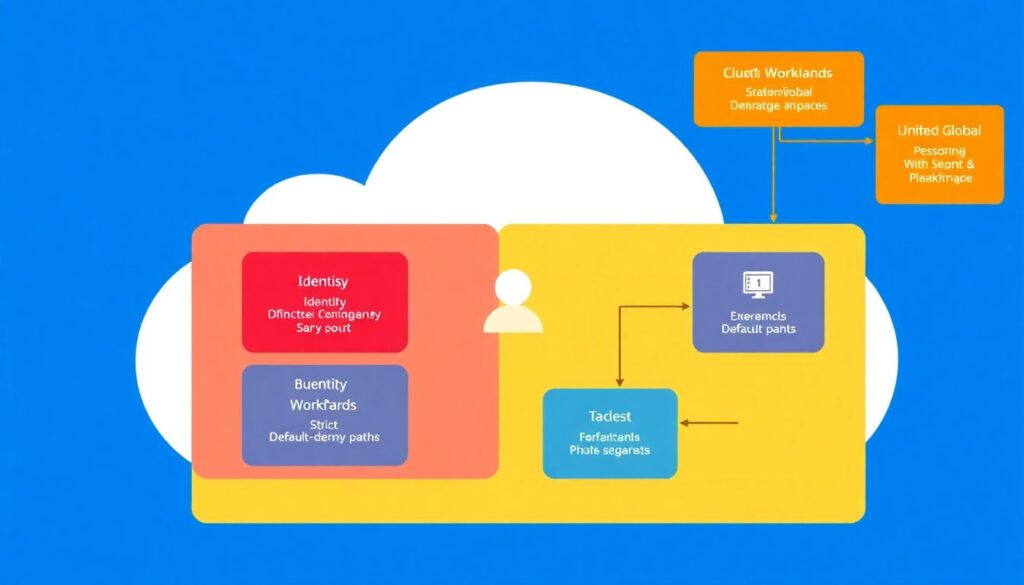
- Design segments around application purpose and data sensitivity, not only IP ranges or VLANs.
- Use workload identity and labels as the primary selectors for policies.
- Apply default-deny for east-west and expose only explicit, audited paths.
- Keep one global intent model, then map it to each cloud and cluster technology.
- Automate policy deployment, testing and rollback as part of CI/CD.
- Continuously verify with telemetry, flow logs and simple attack simulations.
- Prefer simple, low‑cost controls first; add advanced tools only where they pay off.
Segmentation models: zones, tiers and intent-driven policies
In cloud-native architectures, segmentation models define how you logically split applications and data to reduce blast radius. Instead of only carving IP networks, you group workloads into zones and tiers based on business purpose, risks and required trust relationships, then enforce that model consistently across clusters and cloud computing services.
A zone is usually a high-level trust boundary: internet-facing zone, internal business apps, restricted data, admin/management. A tier is an application layer inside a zone: web, API, background workers, databases. Intent-driven policies describe which zones and tiers may talk, in what direction and on which ports, independent of where workloads physically run.
Good practice for segmentação de rede em cloud computing serviços in Brazil is to keep the model small and stable: a dozen zones and tiers are easier to reason about than many ad-hoc security groups. You then map zones to security groups/VPCs/subnets and tiers to Kubernetes namespaces, labels or projects in each cloud provider.
For teams with limited resources, start with three simple zones (public, internal, restricted) and two or three tiers (frontend, backend, data). Implement them with basic cloud security groups and namespace-level policies. As your maturity grows, refine into more granular, intent-driven segments without breaking the original structure.
Workload-centric microsegmentation: identity, labels and zero trust
Workload-centric microsegmentation enforces communication based on what a workload is (identity and labels) instead of where it lives (IP and subnet). This aligns directly with zero trust: every connection is explicitly authorized, authenticated and logged, including east-west traffic inside the cluster.
-
Use labels as the core policy language
Assign consistent labels:app,tier,environment,team,data_sensitivity. Policies then reference labels (e.g. allowtier=frontendto talk totier=api) instead of IPs. This survives scaling, rescheduling and multi‑AZ deployments. -
Bind identity using service accounts and mTLS
Combine Kubernetes ServiceAccounts with mTLS identities from a mesh (Istio, Linkerd) or SPIFFE/SPIRE. The cryptographic identity represents the workload, and authorization policies decide which identities can talk, aligning with plataformas de zero trust e microsegmentação em ambientes cloud. -
Start from default-deny and open only necessary flows
Apply a default-deny stance on namespaces or host firewalls, then add narrowly scoped policies. Document each rule with the business justification so future reviews can safely remove obsolete permissions. -
Integrate with cloud-native firewalls and security groups
Use cloud network controls to isolate big zones and reduce unnecessary exposure to the internet. Inside those zones, use microsegmentation policies for Kubernetes and VMs to further constrain traffic between services. -
Log, tag and review denied connections
Enable flow logs, audit logs and mesh telemetry. Tag blocked flows by zone, tier and app owner so Brazilian teams and any consultoria em segmentação de rede cloud native can quickly see which services are misconfigured or over-permissive. -
Balance cost versus depth of control
Commercial ferramentas de segurança para microsegmentação em nuvem give rich visibility, compliance mapping and centralized policy, but many intermediate teams can begin with built‑in CNIs, iptables and open source meshes. Evaluate soluções de microsegmentação para Kubernetes preço against the cost of incidents and regulatory pressure in your sector.
Implementing policies in Kubernetes: NetworkPolicy, CNI and limitations
In Kubernetes, segmentation is enforced mainly via NetworkPolicy objects interpreted by the cluster CNI plugin. Not all CNIs support the full feature set, and some add proprietary extensions, so you must understand both the policy model and runtime behavior before relying on it for strict isolation.
-
Isolating namespaces with baseline default-deny
Apply a default-deny ingress policy per sensitive namespace, then explicitly allow only necessary ingress from specific labels or namespaces.kubectl apply -n payments -f - <<EOF apiVersion: networking.k8s.io/v1 kind: NetworkPolicy metadata: name: deny-all-ingress spec: podSelector: {} policyTypes: [Ingress] ingress: [] EOF -
Implementing tier-based communication
Use labels such astier=frontend,tier=api,tier=dband write NetworkPolicies allowing only the specific flows defined in your intent model. Keep policy YAML next to application manifests in Git to version changes with code. -
Restricting egress to known services
Use egress rules to limit pods to internal DNS names, service CIDRs or specific external APIs. This reduces data exfiltration risk and helps enforce regulatory boundaries for Brazilian data residency requirements. -
Understanding CNI-specific behaviors
Some CNIs (Calico, Cilium) support advanced L7 policies and global network sets, while others implement only basic L3/L4. Test critical rules in a staging cluster; do not assume uniform behavior when migrating between managed Kubernetes services. -
Combining NetworkPolicy with node-level hardening
For resource-constrained teams, a pragmatic strategy is to rely on simple NetworkPolicies plus strict security groups and host firewall rules. This gives a solid baseline even without advanced commercial platforms. -
Recognizing limitations and when to add a mesh
NetworkPolicy cannot natively enforce mTLS, authenticate services or do per-request authorization. When these needs arise, or when running multi‑cluster, it is time to evaluate a service mesh or specialized microsegmentation products.
Service mesh and sidecar strategies for fine-grained east‑west control
A service mesh adds a data plane of sidecar proxies and a control plane that programs them, providing mTLS, traffic policies and observability for east-west traffic. It extends segmentation by enforcing identity-based rules per call, not just per IP and port.
Sidecars intercept all pod traffic; policies are expressed in mesh CRDs instead of or alongside NetworkPolicies. This allows fine-grained restrictions like HTTP method and path, rate limits and identity-based authorization between services across namespaces and clusters.
Benefits of mesh-based microsegmentation
- Uniform mTLS between services, simplifying compliance in multi-cloud and hybrid environments.
- Per-service identity and authorization policies decoupled from IP addresses.
- Rich telemetry (latency, error rates, call graphs) that helps validate segmentation and spot bypasses.
- Traffic shifting and canary releases to safely roll out stricter policies.
- Cross-cluster and multi-cloud connectivity with consistent security, useful when you mix on-premises and Brazilian public clouds.
Constraints and low-resource alternatives
- Mesh adds operational complexity and resource overhead per pod; not ideal for very small clusters.
- Istio, Linkerd and similar tools require dedicated management; misconfiguration can cause outages.
- For small teams, combine basic mutual TLS (at ingress/egress gateways), NetworkPolicies and strict security groups instead of a full mesh.
- When budgets are tight, prioritize hardening critical payment or personal-data namespaces with a mesh and keep less sensitive workloads on simpler controls.
A minimal Istio policy example limiting calls to a specific identity might look like:
apiVersion: security.istio.io/v1beta1
kind: AuthorizationPolicy
metadata:
  name: allow-frontend-to-api
  namespace: api
spec:
  selector:
    matchLabels:
      app: api
  rules:
  - from:
    - source:
        principals: ["cluster.local/ns/frontend/sa/frontend-sa"]
Ingress, egress and perimeter considerations in multi-cloud environments
Ingress and egress controls define how traffic enters and leaves clusters, while perimeter controls define boundaries between networks and providers. In multi‑cloud, inconsistent policies or over-reliance on a single layer easily create blind spots.
- Myth: the cloud provider perimeter is enough – Security groups and WAFs are essential, but they do not control pod-to-pod or service-to-service communication; you still need in-cluster segmentation.
- Error: flat egress to the internet from all namespaces – Allowing unrestricted outbound from pods simplifies development but enables data exfiltration. Block or proxy egress per namespace, and explicitly allow required domains or IPs.
- Myth: one global ingress is always simpler – A single shared ingress and DNS entry per region can become a noisy, risky chokepoint. Use separate ingress gateways per zone or app group, especially for regulated Brazilian workloads.
- Error: inconsistent policies across clouds – Applying strong NetworkPolicies in one cloud and only basic security groups in another leaves asymmetric risk. Maintain a common intent model and minimum baseline across providers.
- Myth: microsegmentation replaces perimeter firewalls – Microsegmentation complements, not replaces, perimeter controls. Keep DDoS, WAF and rate limiting at the edge while controlling lateral movement inside.
- Error: ignoring DNS and identity at the perimeter – Without strong DNS controls and identity-aware proxies, attackers can pivot via compromised credentials even if network paths look restricted.
Verification and automation: telemetry, testing and policy lifecycle
Verification and automation ensure segmentation and microsegmentation remain correct as services, clusters and clouds evolve. You treat policies like code: test, deploy, monitor and retire them with the same discipline as application changes.
A simple, resource-aware workflow for Brazilian teams might be:
- Describe intended flows (zones, tiers, namespaces) in a small YAML or Markdown file stored with application code.
- Translate intent into Kubernetes NetworkPolicy and, if used, service mesh policies using reusable templates.
- Run basic connectivity tests in CI using tools like
kubectl execwithcurlornetcatto assert that allowed paths work and blocked ones fail. - Deploy policies gradually: first in staging, then to non-critical namespaces, finally to production clusters.
- Continuously collect flow logs and mesh telemetry, and review them weekly or monthly to remove obsolete rules.
Example of a very small test script you can adapt in CI pipelines:
# Allowed: frontend -> api
kubectl exec deploy/frontend -n frontend -- curl -sSf http://api.api.svc.cluster.local/health

# Blocked: frontend -> db
kubectl exec deploy/frontend -n frontend -- nc -zv db.db.svc.cluster.local 5432 &>/dev/null &&
  echo "Unexpected: frontend can reach db" || echo "OK: frontend blocked from db"
When you outgrow this lightweight approach, consider engaging consultoria em segmentação de rede cloud native to help design a scalable model and assess whether advanced plataformas de zero trust e microsegmentação em ambientes cloud or commercial ferramentas de segurança para microsegmentação em nuvem are justified for your specific risks and compliance requirements.
Practical clarifications and common implementation pitfalls
How is cloud-native microsegmentation different from traditional VLAN-based segmentation?
Cloud-native microsegmentation controls communication at workload and identity level instead of only at subnet or VLAN boundaries. In Kubernetes and modern clouds, IPs are highly dynamic, so policies based on labels, namespaces and identities are more stable and better aligned with zero-trust principles.
Can I rely only on Kubernetes NetworkPolicy for strong isolation?
NetworkPolicy is a key building block, but its effectiveness depends on the CNI and cluster configuration. You still need cloud security groups, proper ingress and egress controls and, for sensitive workloads, mTLS or a mesh to authenticate and encrypt service-to-service traffic.
What should small teams do if they cannot operate a full service mesh?
Use a simple mix of NetworkPolicies, cloud security groups, host firewalls and TLS termination at ingress gateways. Focus mesh-like controls (mTLS, fine-grained auth) only on the most critical namespaces or services, and keep tooling minimal to match your operational capacity.
Do I need commercial microsegmentation tools for Kubernetes?
Not necessarily. Many intermediate teams in Brazil can start with open source CNIs, open source meshes and built-in logging. Commercial platforms become attractive when you need centralized policy across many clusters and clouds, strong compliance mapping and rich visualization of flows.
How do I avoid breaking production when enabling default-deny policies?
First deploy policies in staging that mirror production traffic. Then apply default-deny only to a single, low-risk namespace, monitor logs and gradually expand coverage. Keep rollback manifests ready and use canary-style rollouts for policies just like you do for application changes.
What is the role of identity providers and SSO in network segmentation?
Identity providers and SSO handle human and sometimes service identities, which feed into authorization decisions at proxies, API gateways and meshes. While they do not replace network policies, they complement them by ensuring only authenticated, authorized principals can use allowed network paths.
How does multi-cloud affect my segmentation strategy?
Multi-cloud adds complexity because each provider exposes different primitives. Maintain one abstract intent model (zones, tiers, flows) and map it to each cloud’s tools. Regularly review for gaps where one cloud’s weaker controls might undermine your overall security posture.