To map security risks in a migração de workloads para nuvem segurança scenario, start by classifying workloads, modeling threats on each migration path, and validating network, identity, data and operations controls. Use a structured checklist, evidences and simple tools so intermediate teams in Brazil can execute a safe, auditable migration.
Primary security domains to map before migration
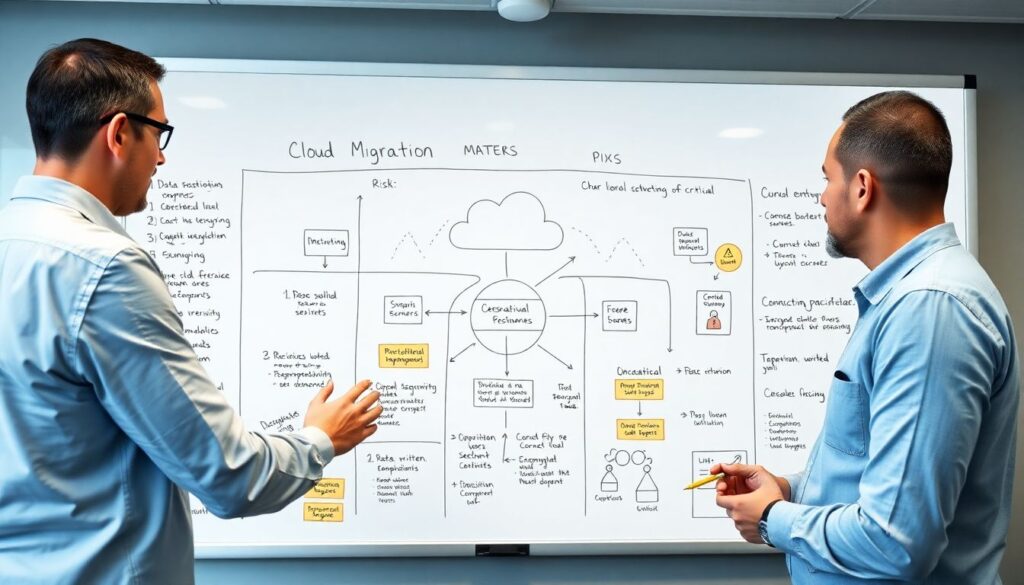
- Workload inventory, business criticality and data sensitivity classification.
- Threat modeling of migration paths, tools and integration points.
- Network and connectivity design, including hybrid and VPN links.
- Identity, access management and privilege escalation scenarios.
- Data protection, encryption and regulatory compliance alignment.
- Operational resilience: backup, monitoring, logging and recovery SLAs.
Inventory and workload classification checklist
This checklist suits teams planning checklist segurança migração on-premise para cloud in small to medium environments or segmented phases of a large program. It is not ideal when the environment is completely unknown, undocumented, or in severe technical debt; in that case, run a separate discovery and stabilization project first.
| Item | Risk severity | Evidence to collect | Mitigation action |
|---|---|---|---|
| List all workloads and business owners | High | CMDB export, spreadsheets, architecture diagrams | Consolidate inventory; assign accountable owner for each workload before migration. |
| Classify data sensitivity per workload | High | Data flow diagrams, sample records, legal input | Tag workloads as public, internal, confidential, highly confidential; define required controls per class. |
| Identify business criticality and RTO/RPO | High | Interviews with business, service catalogs | Prioritize high criticality workloads; align cloud SLAs and backup strategy with RTO/RPO. |
| Map technical dependencies | Medium | Application maps, DNS records, firewall rules | Group tightly coupled systems into migration waves; avoid breaking hidden dependencies. |
| Identify compliance-bound workloads | High | List of regulatory requirements (LGPD, PCI, etc.) | Flag workloads under regulation; pre-select compliant cloud regions and services. |
| Detect legacy or unsupported components | Medium | OS inventory, middleware versions, vendor support status | Plan remediation, replatforming or isolation patterns before cloud migration. |
| Choose migration pattern per workload | Medium | Architecture review, performance baselines | Decide rehost, replatform, refactor; document security impact of each choice. |
Threat modeling for migration paths and attack surfaces
For melhores práticas segurança migração para nuvem, prepare a basic threat modeling toolkit and access to documentation and stakeholders before you start.
| Item | Risk severity | Evidence to collect | Mitigation action |
|---|---|---|---|
| Define migration paths per workload | High | Project plan, runbooks, tool list (VPN, Direct Connect, migration tools) | Document all hops, temporary components and data flows; avoid ad-hoc paths. |
| Identify new attack surfaces | High | Diagrams of public endpoints, APIs, management planes | Minimize public exposure; require WAF and authentication for new internet-facing points. |
| Analyze data-in-transit exposure | High | Protocol list, port mappings, TLS configurations | Enforce end-to-end encryption; disable insecure protocols during migration windows. |
| Consider temporary storage and staging areas | Medium | Migration tool configs, temp bucket or file share listings | Encrypt staging storage; restrict access; delete or anonymize data after migration. |
| Evaluate third-party tools and scripts | Medium | Vendor security docs, code repositories, SBOMs | Whitelist tools; restrict privileges; scan scripts and containers for vulnerabilities. |
| Model insider and admin abuse risks | High | Admin access list, change management logs | Use approvals, just-in-time access and detailed logging for migration activities. |
| Assess roll-back and failure scenarios | Medium | Rollback plans, DR procedures, test reports | Ensure safe rollback steps; avoid data divergence or insecure temporary states. |
Network topology, connectivity and perimeter risks
Before running the steps below, use this quick preparation checklist so that ferramentas para avaliação de riscos na migração para nuvem can be applied safely:
- Collect current on-premise network diagrams and VLAN lists.
- Export existing firewall and router rules for critical segments.
- Decide which cloud connectivity model will be used (VPN, private link, direct connection).
- List all internet-facing services and their DNS names.
- Confirm who can approve network changes and maintenance windows.
- Map current and target network segmentation. Draw how workloads are segmented today and how they should be segmented in cloud (VPCs, subnets, security groups). Focus on isolating environments (prod, non-prod) and sensitive workloads from general traffic.
- Plan secure hybrid connectivity. Choose and document VPN, ExpressRoute, Direct Connect or equivalent. Define which subnets are reachable, required bandwidth and redundancy. Ensure routes do not accidentally expose internal networks to the internet.
- Harden perimeter and ingress paths. Identify all paths from the internet to workloads. Decide which will remain public, which will move behind VPN or Zero Trust access. Plan WAF, DDoS protection and rate-limiting for exposed endpoints.
-
Review firewall, NSG and security group rules. Start from least-privilege. Remove broad rules like any-any; restrict by CIDR, ports and protocols. Align cloud security groups with existing segmentation, not with temporary shortcuts.
- Normalize naming conventions for rules and tags.
- Plan rule clean-up after decommissioning on-prem segments.
- Secure management access. Define how admins access servers, databases and network devices in cloud. Prefer bastion hosts, VPN or privileged access workstations instead of direct RDP/SSH from the internet.
- Validate DNS, certificates and TLS. Map all DNS zones and records affected by the migration. Plan certificate issuance or renewal and enforce modern TLS configurations on new cloud endpoints.
- Test connectivity and logging before cutover. Execute non-production tests to validate routes, latency and logging of denied and allowed connections. Adjust rules and routes before moving critical traffic.
| Item | Risk severity | Evidence to collect | Mitigation action |
|---|---|---|---|
| Undefined network segmentation in cloud | High | VPC/VNet design docs, subnet plans | Design and approve segmentation before deploying workloads; enforce isolation for sensitive tiers. |
| Overly permissive hybrid connectivity | High | VPN configs, route tables, peering settings | Limit reachable CIDRs; implement route filters and NACLs; monitor for unexpected flows. |
| Publicly exposed admin ports | High | Cloud security group and firewall exports | Block RDP/SSH from internet; use bastion, VPN or Just-in-Time access solutions. |
| Unprotected internet-facing applications | High | List of public IPs, DNS names, WAF configs | Place apps behind WAF and reverse proxies; enforce TLS and authentication. |
| Lack of network-level logging | Medium | Firewall logging settings, flow logs status | Enable VPC/VNet flow logs; centralize logs in SIEM; define retention and access. |
| Misconfigured DNS or certificates | Medium | DNS zone exports, certificate inventories | Review all DNS changes; automate certificate issuance and renewal; test failover. |
Identity, access management and privilege escalation risks
Use this checklist to validate IAM hardening before and during consultoria migração on-premise para nuvem segura engagements.
| Item | Risk severity | Evidence to collect | Mitigation action |
|---|---|---|---|
| Single sign-on and identity source alignment | High | IdP configs, federation settings, user stores | Standardize on a central IdP; configure federation with cloud IAM; retire local admin accounts where possible. |
| Multi-factor authentication coverage | High | MFA policies, coverage reports, admin account list | Enforce MFA for admins and sensitive workloads; apply conditional access for risky locations and devices. |
| Privilege escalation paths | High | Role hierarchy diagrams, group memberships | Review role chains; remove indirect paths to global admin; apply least privilege roles. |
| Service accounts and secrets | High | Account list, key vault inventories, code repos | Migrate secrets to managed vaults; rotate credentials; use managed identities where available. |
| Temporary migration accounts | Medium | Change tickets, list of special migration users | Time-bound migration roles; disable or delete accounts at the end of each wave. |
| Audit logging and access reviews | Medium | IAM audit logs, review schedules, past reports | Enable directory and cloud IAM logs; schedule periodic access reviews; remediate anomalies quickly. |
| Integration with on-premise directories | Medium | Sync tool configs, OU scoping, sync logs | Scope synchronized objects; secure sync servers; monitor for replication errors and drift. |
- All privileged accounts are known, documented and have MFA enforced.
- No standing global admin access for contractors or temporary staff.
- Serviced workloads use managed identities or centrally stored secrets.
- Access to cloud management consoles is logged and reviewed.
- Legacy on-premise admin paths are closed when workloads move to cloud.
- Segregation of duties exists between migration engineers and approvers.
Data protection, encryption and regulatory compliance checks
Data protection errors are among the most expensive in any migração de workloads para nuvem segurança project. Watch these common pitfalls closely.
| Item | Risk severity | Evidence to collect | Mitigation action |
|---|---|---|---|
| Unencrypted storage or databases | High | Storage configs, DB parameter sets, KMS usage | Enable encryption at rest; standardize key management; document key rotation policies. |
| Weak data classification and tagging | High | Tagging policies, resource inventories | Apply consistent tags for sensitivity and owner; enforce policies via automation. |
| Non-compliant data residency | High | Cloud region list, dataset locations, legal guidance | Restrict sensitive data to approved regions; use geo-fencing and policies. |
| Inadequate backups and retention for legal holds | Medium | Backup configs, retention policies, legal requirements | Align backup and archive retention with regulatory needs; test restore of sampled datasets. |
| Exposure in logs, metrics and diagnostics | Medium | Sample logs, observability configs | Mask or tokenize sensitive fields; restrict log access; apply shorter retention where possible. |
| Unclear controller/processor roles with cloud provider | Medium | Contracts, DPAs, shared responsibility docs | Clarify roles under LGPD and similar; ensure contracts include security and incident clauses. |
| Manual key and certificate handling | Medium | Key inventories, certificate spreadsheets | Move to centralized KMS and certificate management; automate issuance and rotation. |
- Copying production data to test environments without masking or anonymization.
- Leaving temporary migration storage unencrypted or publicly accessible.
- Using personal cloud accounts to move datasets for convenience.
- Ignoring data residency limitations when selecting regions or services.
- Storing encryption keys in code, scripts or configuration files.
- Not involving legal and compliance early when changing processing locations.
Operational resilience: backups, monitoring and recovery SLAs
Several alternatives exist to implement resilient operations during a segurança-focused migration. Choose options that realistically match your team skills and budget.
| Item | Risk severity | Evidence to collect | Mitigation action |
|---|---|---|---|
| Documented RTO/RPO per workload | High | SLAs, business impact analyses | Validate that backup, replication and DR designs meet or exceed agreed RTO/RPO. |
| Consistent backup strategy during migration | High | Backup job lists, success reports across on-prem and cloud | Ensure no gaps arise when workloads move; overlap backups until cutover is stable. |
| Monitoring and alerting coverage | Medium | Tool dashboards, alert catalogs, runbooks | Integrate cloud monitoring with existing tools; define thresholds and on-call responsibilities. |
| Disaster recovery tests and game days | Medium | Test reports, drill logs, findings | Run realistic DR tests for critical workloads; fix gaps found before decommissioning on-prem DR. |
| Vendor and provider SLAs | Medium | Cloud service SLAs, third-party contracts | Compare provider SLAs to business needs; add redundancy or multi-region where needed. |
| Incident response readiness | High | IR playbooks, contact lists, tooling access | Adapt IR procedures to cloud; ensure logs, snapshots and evidence can be quickly collected. |
- Lift-and-shift with cloud-native managed backups: simple to operate, good when you can standardize on one provider.
- Hybrid backup platforms covering on-prem and multi-cloud: useful for complex estates needing central control.
- Active-active or pilot-light DR in cloud: appropriate for high criticality systems with strict downtime limits.
- Managed operations and SRE from a partner: viable when internal teams lack 24×7 capacity but must meet strict SLAs.
Quick answers to recurring migration security concerns
How early should security join a cloud migration project?
Security should be involved from the initial planning, before any architecture decisions. That is when threat modeling, workload classification and the first version of your checklist segurança migração on-premise para cloud bring the most value and lowest rework.
Do I need a separate environment for testing migration steps?

Yes. Use non-production environments to validate connectivity, IAM and automation. Never use real sensitive data in tests unless it is masked or anonymized according to your data protection policy.
Which tools help assess risks without overcomplicating the project?

Start with your cloud provider security center, configuration analyzers, basic vulnerability scanners and log analytics. Combine them with simple planilhas and diagrams to keep risk discussions understandable for all stakeholders.
How can small teams handle identity and access security correctly?
Standardize on a single IdP, enforce MFA, and rely on built-in cloud IAM roles instead of custom ones where possible. Automate user provisioning and deprovisioning to reduce manual mistakes.
Is it necessary to hire consultoria migração on-premise para nuvem segura?
It is not mandatory, but experienced consultants can accelerate design reviews, threat modeling and controls selection, especially for regulated workloads or first-time cloud adopters in Brazil.
What if legacy systems cannot support modern encryption?
Isolate these systems in tightly controlled network segments, use encrypted gateways or proxies in front of them, and plan a modernization roadmap. Document residual risks and obtain business acceptance.
How often should I review security after the migration completes?
Plan at least annual reviews for architecture and controls, with more frequent checks for critical workloads. Major environment changes or new services should always trigger a focused risk review.