
Serverless API security in pt_BR environments depends on strong identity, least privilege, and tight observability around every function and endpoint. Focus on robust authentication and authorization, encrypted tokens with rotation, proteção contra ameaças comuns em apis rest serverless via WAF and rate‑limits, secure CI/CD, and ferramentas para segurança e monitoramento de apis serverless fully integrated.
Security snapshot: immediate risks and priorities for serverless APIs
- Map all public and internal endpoints; remove anonymous access where not strictly needed.
- Standardize autenticação e autorização em arquiteturas serverless with a single identity provider and consistent policies.
- Enforce token validation, rotation, and revocation; never store secrets in code or images.
- Place APIs behind a WAF, enable DDoS protection, throttling, and schema or payload validation.
- Treat infrastructure-as-code as critical asset: code review, scanning, and change approvals.
- Implement centralized logging, tracing, and alerts tuned for segurança de apis serverless behavior.
- Drill incident runbooks for compromise of keys, tokens, or functions.
Threat landscape: common attack vectors targeting serverless APIs
This guidance targets intermediate engineers and architects running APIs in Brazilian cloud regions (pt_BR), especially where teams are consolidating on serverless. It is less suitable if you operate only on-prem monoliths or if you lack basic logging and monitoring; fix those foundations first.
Common threats to segurança de apis serverless include:
- Broken or missing authentication – public endpoints without auth, weak tokens, or relying only on API keys.
- Excessive permissions – functions granted wide cloud roles, enabling lateral movement after a single compromise.
- Injection and deserialization bugs – unvalidated JSON, SQL/NoSQL injection, template and command injection.
- Insecure direct object references – IDs in URLs without authorization checks, leaking cross-tenant data.
- Event data abuse – poisoned messages, oversized payloads, or malformed events causing logic bypass or DoS.
- Weak configuration of gateways – missing rate limits, CORS misconfigurations, and open test routes.
- Supply-chain and CI/CD compromise – malicious IaC, dependencies, or pipelines shipping backdoors into functions.
Mitigation for these threats centers on melhores práticas de segurança para apis em nuvem: treat every endpoint as internet-facing, enforce strong authentication and authorization, validate all inputs, and keep strict control over what each function can access.
Authentication and authorization patterns tailored for serverless
Before you standardize autenticação e autorização em arquiteturas serverless, prepare the following elements:
- A cloud-native API gateway (e.g., AWS API Gateway, Azure API Management, GCP API Gateway) with WAF support.
- An identity provider (IdP) capable of OAuth2/OIDC (e.g., cloud-native IAM, commercial IdP, or open-source IdP).
- Defined user and service identities: humans, backend services, CI/CD, and third parties.
- Organization-wide passwordless or MFA policies for sensitive operations.
- Key management via KMS/HSM for signing keys, TLS certificates, and token encryption keys.
- Central policy definitions for roles and permissions (RBAC/ABAC) mapped to cloud-native IAM.
The table below compares common auth approaches you will combine in a real-world segurança de apis serverless deployment.
| Pattern | Main use | Strengths | Risks / caveats |
|---|---|---|---|
| JWT (signed tokens) | Stateless auth between client, gateway, functions | Fast, no DB lookup; widely supported; works well with serverless APIs | Harder revocation; must validate signature, audience, expiry, and scopes correctly |
| OAuth2 / OIDC | User login and delegated access for web/mobile clients | Mature ecosystem; integrates with IdPs; supports scopes and consent | Flows can be misconfigured; must protect redirect URIs and client secrets |
| mTLS | Service-to-service and B2B API trust | Strong mutual identity; good for internal or high-value APIs | Certificate lifecycle complexity; may require private PKI and careful automation |
| Cloud-native IAM | Authorizing functions and services to cloud resources | Fine-grained permissions; integrated logging; low ops overhead | Easy to over‑grant; policies can become hard to audit if not managed as code |
As a baseline:
- Use OAuth2/OIDC plus JWTs for user-facing APIs.
- Use mTLS and JWT or signed requests for internal service calls.
- Use cloud-native IAM for function-to-cloud-resource authorization, following least privilege.
Token security: issuance, storage, rotation and revocation
Token handling is a critical part of proteção contra ameaças comuns em apis rest serverless. The following safe procedure assumes an IdP, a gateway, and serverless functions behind it.
-
Design token model and lifetimes
Define which tokens exist (access, refresh, id), their audiences, and lifetimes. Keep access tokens short-lived, and use refresh tokens only where necessary.
- Separate machine-to-machine and user tokens; apply stricter scopes to machines.
- Document which services can issue and consume each token type.
-
Issue tokens securely via the IdP
Use standard OAuth2/OIDC flows. For SPA and mobile, use Authorization Code with PKCE; for backends, use client credentials.
// Example: minimal OAuth2 client-credentials request
POST /oauth2/token
grant_type=client_credentials
client_id={id}
client_secret={secret}
scope=api.read api.write
Enforce TLS everywhere and never expose client secrets in front-end code.
-
Validate tokens at the edge (gateway)
Configure your API gateway to validate JWT signatures, issuer, audience, expiry, and required claims before requests reach functions.
# Pseudo-config: JWT validation on gateway
jwt_validation:
  issuer: https://idp.example.com/
  audience: my-api
  required_scopes: [ "api.read" ]
This offloads heavy crypto from functions and standardizes checks.
-
Store tokens and secrets safely
On the client, rely on secure storage appropriate to the platform; in backends and serverless functions, never hard-code secrets or long-lived tokens.
- Use cloud secret managers for client secrets, signing keys, and API keys.
- Inject secrets via environment variables or parameters, not source code.
-
Implement key and token rotation
Regularly rotate signing keys using KMS and advertise them through JWKS endpoints. Configure consumers to trust key sets, not individual keys.
- Use key IDs (kid) in JWT headers so gateways can choose the right key.
- Overlap old and new keys for a safe grace period.
-
Enable revocation and session management
Although JWTs are stateless, you still need mechanisms to revoke access promptly when accounts or clients are compromised.
- Use short-lived access tokens plus revocable refresh tokens.
- Maintain a revocation list or session store for high-risk use cases.
-
Log and monitor token-related activity
Log token issuance, failures, and anomalous validation errors as security events and aggregate them with ferramentas para segurança e monitoramento de apis serverless.
- Alert on unusual token grant spikes or repeated failed validations.
- Correlate with IPs, devices, and geographies for fraud signals.
Fast-track mode: minimal safe token setup
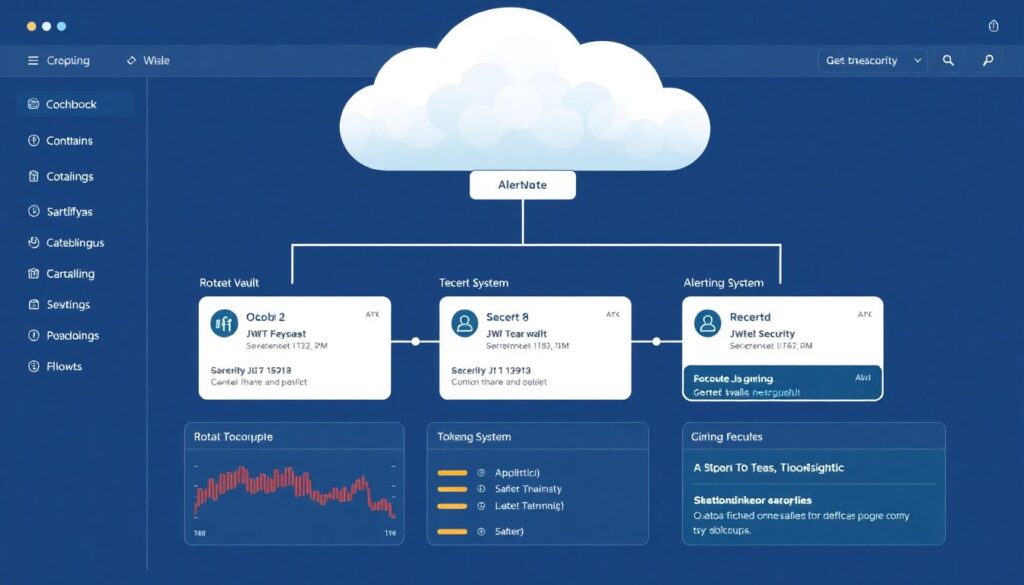
- Adopt OAuth2/OIDC with short-lived JWT access tokens validated at the API gateway.
- Store all secrets and signing keys in a cloud secret manager backed by KMS.
- Rotate signing keys on a regular schedule and support JWKS key rollover.
- Enable logging and alerts for failed logins, token errors, and unusual token issuance.
- Use least-privilege scopes and separate human and machine identities.
Network and runtime protections: WAFs, VPCs, and function hardening
The checklist below helps confirm your network and runtime protections are correctly applied to segurança de apis serverless deployments.
- All public APIs fronted by a managed gateway with integrated WAF and DDoS controls.
- Rate limits, throttling, and burst limits configured per route and per API key or identity.
- Only required endpoints are publicly exposed; admin and debug routes are private or disabled.
- Functions accessing sensitive data run in isolated subnets or VPCs with restricted egress.
- Outbound network access from functions limited to approved domains or services.
- Runtime environments kept minimal: no unused runtimes, dependencies, or system tools.
- Input validation applied at the gateway (schemas) and in functions (type and length checks).
- Centralized logging of gateway traffic, WAF events, and function logs with retention policies.
- All TLS endpoints use current protocols and ciphers; certificates managed and rotated centrally.
- Security scans regularly run against public endpoints to validate WAF and gateway rules.
Secure CI/CD and infrastructure-as-code practices for serverless deployments
Even with strong runtime controls, weak CI/CD and IaC can undermine melhores práticas de segurança для apis em nuvem. Common mistakes to avoid:
- Committing secrets, tokens, or keys into Git repositories or CI/CD configuration files.
- Allowing CI/CD runners broad admin roles in cloud IAM instead of scoped deployment roles.
- Skipping peer review for IaC changes that open new API routes or alter security groups.
- Not scanning IaC templates for dangerous defaults (public endpoints, open security groups, wildcard IAM).
- Lack of dependency scanning for function code, letting vulnerable libraries reach production.
- Bypassing security checks with manual hotfixes deployed outside of pipelines.
- Missing environment separation: reusing the same accounts or projects for dev, test, and prod.
- No automated tests for authorization paths, leading to regressions when roles or scopes change.
- Untracked manual changes in cloud consoles, drifting away from declared IaC state.
- Not tagging or documenting APIs and functions, making it hard to know what is exposed.
Post-incident activities: detection, containment and forensic readiness
When incidents occur, you have several patterns for detection, containment, and investigation that suit different team sizes and maturity levels.
-
Centralized logging plus managed SIEM
Stream gateway logs, function logs, and IAM events to a central log store integrated with a managed SIEM. This suits teams that prefer cloud-native tooling and minimal ops.
-
Dedicated security monitoring stack
Use open-source or commercial tools for deeper analytics and correlation across multiple clouds and on-prem. This is useful if you have a security team comfortable operating custom tooling.
-
Incident playbooks integrated with CI/CD
Automate containment actions, such as revoking keys, blocking IPs, or disabling routes, via pipeline jobs triggered from alerts. This pattern fits organizations with mature DevSecOps practices.
-
Forensic-ready architecture
Design APIs and serverless functions to preserve evidence: immutable logs, trace IDs, and versioned deployments. This is essential where regulatory or contractual obligations require detailed post-incident reports.
Practical answers to implementation hurdles and edge cases
How do I secure a public serverless REST API consumed by mobile and web apps?
Use OAuth2/OIDC with short-lived JWT access tokens, validate them at the API gateway, and enforce scopes per route. Add WAF rules, rate limits, and strict CORS. For extra protection, enable device binding or attestation where supported by the platform.
What is the safest way to handle machine-to-machine calls between serverless functions?
Prefer mTLS between internal services combined with JWT or signed requests carrying minimal scopes. Use cloud-native IAM roles to authorize access to cloud resources. Avoid hard-coded shared secrets; store credentials and keys in a secret manager.
How can I gradually improve segurança de apis serverless without a big redesign?
Start by centralizing authentication at the gateway and enforcing token validation. Then add rate limits, WAF rules, and logs for all endpoints. Next, clean up IAM permissions and introduce IaC scanning in CI/CD. Iterate in small, reversible steps.
Which ferramentas para segurança и monitoramento de apis serverless should I prioritize first?
Begin with your cloud provider's native logging, metrics, and WAF, then integrate with a SIEM or monitoring platform you already use. Only after gaining visibility should you add more specialized API security products.
How do I protect against data leakage across tenants in multi-tenant serverless APIs?

Enforce tenant isolation in every access check, using tenant IDs from validated tokens. Never rely on client-supplied tenant identifiers alone. Add automated tests that try to cross-access between tenants and monitor for unusual response patterns.
What should I log for effective incident response in serverless architectures?
Log request metadata, authentication results, authorization decisions, and key business actions with correlation IDs. Include function version, identity, and resource identifiers. Ensure logs are immutable, centrally stored, and retained according to your regulatory needs.
How do I handle legacy clients that cannot support modern OAuth2 flows?
Place a translation layer at the gateway that converts legacy API keys or basic auth into short-lived internal tokens. Apply strict rate limits, IP allowlists, and monitoring for these clients, and plan a migration timeline to modern flows.