
Por que falar de monitoramento e observabilidade de segurança em cloud em 2026
If you work in security today and your stack touches the cloud (which is almost everyone), you’ve probably noticed a shift: it’s no longer enough to “collect logs and send to a SIEM”. The game has moved to monitoramento e observabilidade de segurança em cloud, where the blue team has to reason about behavior, context and relationships between events across dozens of managed services. In 2026, environments are a mix of Kubernetes, serverless, managed databases, managed identity, and tons of SaaS integrations. The attack surface is highly dynamic, and attackers are abusing identities, control planes and supply‑chain weaknesses far more than raw infrastructure exploits. In this scenario, observability concepts borrowed from reliability engineering — logs, metrics and traces — have become essential weapons for defenders, not just for SREs trying to keep uptime high.
From syslog to observability: a quick historical detour
Back in the 2000s, security monitoring was basically: ship syslog, firewall logs and maybe IDS alerts into a central server, run some regexes, then hope to catch something. Early SIEMs stitched this together with correlation rules and dashboards, but the model was still batch‑oriented and on‑prem. When public cloud started to go mainstream around 2010–2015, vendors copied the same mindset: lift‑and‑shift of logging into the cloud, without truly embracing cloud‑native patterns. Around 2017–2020, the observability movement came from the reliability / DevOps world, with distributed tracing, high‑cardinality metrics and event‑driven pipelines. Security teams watched from the sidelines at first, then slowly realized those same signals (especially tracing and high‑granularity metrics) gave them a new way to detect lateral movement, abuse of APIs and stealthy exfiltration across microservices.
Clear definitions: monitoring vs observability for security teams
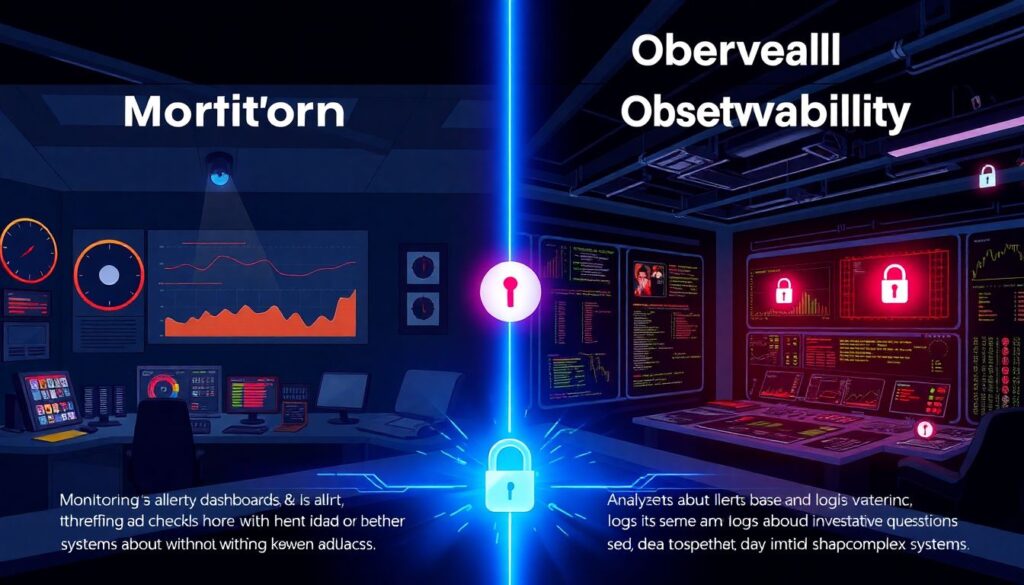
In a security context, “monitoring” and “observability” are close, but not the same. Monitoring is about predefined checks: you decide ahead of time what “normal” looks like and configure alerts when metrics or logs deviate. Observability, on the other hand, is your ability to ask new forensic questions about the system without having predicted them in advance. For blue teams in cloud, that means having rich, correlated data — logs from all layers, metrics with sufficient labels and high resolution, and traces that connect user identities, services and data flows — so that when something odd shows up, you can drill down interactively and reconstruct the attacker’s path, even for scenarios you never wrote a rule for.
Logs, metrics and traces: what they really mean in practice
We hear these terms constantly, but it’s worth grounding them in security‑specific definitions. Logs are discrete records of events: a login attempt, a role assumed, a function invocation, a firewall decision, a file read. Metrics are numeric time series that evolve over time, such as number of failed logins per minute, size of outbound traffic per VPC, or count of 5xx responses for a given API method. Traces are end‑to‑end transaction records that follow a request (or workflow) as it hops across services, each hop annotated with metadata like user, tenant, IP, roles and resource identifiers. For defenders, logs support precision and detail, metrics give you early anomaly detection at scale, and traces reveal flow and relationships that would otherwise be hidden.
Text‑based diagrams: how these signals fit together
To visualize how these signals interact for cloud security, imagine a layered diagram drawn with ASCII where each tier passes context downward. At the top, you have “User / Attacker” sending requests; below that, “Edge & Identity” handling authentication and authorization; then “Application / Microservices” where business logic and data access live; then “Infrastructure & Cloud Control Plane” that enforces networking, storage and IAM changes. Now picture three vertical lanes cutting across all these layers: one lane labeled “Logs”, one “Metrics” and one “Traces”. Each component emits all three types of data into its lane, and at the bottom, those three lanes converge into a “Security Data Platform” rectangle, where correlation, analytics and response automation happen.
In a slightly different mental diagram, think of concentric circles. The inner circle is “Traces”, capturing detailed end‑to‑end paths for a smaller fraction of requests. The middle circle is “Logs”, covering a broad variety of events with medium volume and detail. The outer circle is “Metrics”, which are lightweight aggregates continuously capturing health and activity. A potential attack starts as a faint disturbance in the outer metrics ring (e.g., spike of errors), then is narrowed down using specific log lines, and finally reconstructed end‑to‑end via traces that show exactly which identity touched which data under which role from which origin.
Why blue teams care: from detection to response
For blue teams, the main benefit of bringing observability into security is speed and clarity. Traditional SIEM‑only workflows often lead to slow triage: an alert fires weeks after a pattern is defined, analysts pivot across multiple tools, then struggle to build a coherent incident narrative. In contrast, when a team has embraced ferramentas de observabilidade em nuvem that feed both reliability and security use cases, they can detect subtle anomalies in near real time, immediately slice and dice the data by tenant, region or service, and pivot between metrics dashboards, log search and trace views without context switching. This does not eliminate the need for rules or threat intel, but it transforms investigations from “log archaeology” into “guided exploration”.
Comparing with classic SIEM‑centric architectures
It’s worth comparing this to the older SIEM‑centric architectures to highlight the differences. Classic SIEMs mostly ingest logs and structured events, normalize them, and enforce a fixed schema (often discarding high‑cardinality fields to keep storage manageable). Query languages are powerful but sometimes clunky, and correlation is rule‑driven. By contrast, modern soluções de logs e métricas для segurança em cloud treat logs, metrics and traces as first‑class citizens with flexible schemas and rich labels. Instead of forcing all events into a narrow data model, they preserve details like trace IDs, unique user IDs, workflow names and cloud resource identifiers, which are critical in complex attacks involving multiple services and identities.
Cloud‑native signals: what the big providers actually give you
In practice, each cloud provider exposes its own flavor of these signals. There are control‑plane logs for API calls that change infrastructure and permissions, data‑plane logs for actual resource usage, network flow logs, and application logs from containers or functions. On top of that, managed services like databases, message queues and secret managers emit their own detailed telemetry. Observability‑oriented teams standardize ingestion of all these sources into pipelines that tag events with environment, account, region, application and security context. Good platforms de segurança para blue team em cloud also enrich raw signals with identity information (who is this principal?), asset inventory (what is this resource?) and known threat indicators, so your queries can phrase questions in human terms instead of low‑level IDs.
From metrics to detection: practical scenarios
Let’s ground this with concrete scenarios. Imagine a multi‑tenant SaaS running on Kubernetes and serverless functions. Metrics can show you a spike in HTTP 401 and 403 codes for a specific tenant combined with a rise in CPU for the authentication microservice. On their own, these metrics only suggest stress. But correlated with logs that detail failed MFA challenges, weird device fingerprints and unexpected geolocations, suddenly it looks like a password spraying or MFA fatigue attempt. Traces then confirm whether any of those attempts succeeded and what resources were subsequently accessed, allowing the blue team to quantify blast radius and trigger targeted containment.
How traces become a superpower for incident response
Distributed tracing arrived to debug microservices latency, but for defenders it turns into a kind of “CCTV for your APIs”. Each trace records spans: individual steps in a workflow, such as “ValidateToken”, “LoadUserProfile”, “QueryOrders”, “WriteToBucket”. If you propagate security‑relevant metadata (user ID, roles, device type, risk score) through trace contexts, you can later search for all traces where a low‑reputation IP obtained elevated privileges or touched sensitive tables. During an incident, instead of reading thousands of logs, analysts can pull up a small set of traces that show the entire malicious session or automated attack run, then quickly identify lateral movement, privilege escalation and data exfil paths.
Text diagram: traces across services
Picture a horizontal timeline diagram, with vertical columns representing microservices: “API Gateway”, “Auth Service”, “Orders Service”, “Billing Service”, “Storage Service”. For a normal user action, a horizontal arrow labeled “Trace 1234” enters API Gateway, then jumps across columns, spawning small boxes labeled “Span: VerifyJWT”, “Span: GetCustomer”, “Span: ChargeCard”, “Span: SaveInvoice”. For an attacker, you might see “Trace 9876” hitting unusual combinations like “Span: ExportAllRecords” and “Span: ReadBackupBucket”. Lining up multiple traces one above another like a subway map makes patterns pop: a particular script might always skip billing but hit exports and backups at insane rates, screaming automated data theft.
Architectural patterns for security observability in cloud
When organizations design serviços de monitoramento e análise de logs em nuvem in 2026, the most successful ones converge on a few architectural patterns. First, they implement centralized, multi‑account log collection with strict guardrails, ensuring that no development team can accidentally disable critical audit streams. Second, they consolidate metrics for both reliability and security, so spikes in latency or error rates are naturally seen as potential security signals too. Third, they integrate tracing deeply with identity and authorization workflows, so that session and role context is visible at every hop. Finally, they connect all three — logs, metrics and traces — into a single query plane or federated search, often powered by scalable columnar storage and streaming analytics.
Comparing platform choices and trade‑offs
Compared with purely open‑source DIY stacks, managed observability platforms reduce operational overhead but may constrain data retention, schema flexibility or cross‑cloud visibility. Fully self‑hosted approaches give more control and sometimes cost transparency, but require in‑house expertise to tune indexing, storage tiers and sampling strategies. In the middle, hybrid models let teams keep sensitive security logs in their own accounts while leveraging vendor tools for visualization and alerts. The right mix depends on data sensitivity, regulatory needs, and the skill set of the blue team. What matters more than any single tool is that the design treats security as a first‑class consumer of observability data rather than an afterthought.
Practical steps: how to use logs, metrics and traces in favor of the blue team
To make this less abstract, here is a short, opinionated roadmap that many teams have followed successfully. Each step builds on the previous one, gradually evolving from simple log aggregation to full‑fledged observability‑driven defense. The idea is to avoid the trap of buying a flashy platform without having the basics — consistent schemas, identity context, clear ownership — in place. As you go through the steps, keep asking: “If an attacker abused this component, do we have the data to notice, understand and respond quickly?”
1. Normalize and centralize critical logs
2. Turn metrics into security signals
3. Propagate security context in traces
4. Build cross‑signal investigations
5. Automate responses based on observability
1. Normalize and centralize critical logs
The first priority is still logs. Start by cataloging which audit and access logs are truly critical: cloud control plane events, IAM and SSO logs, network flows, data access from managed storage, plus app auth and authorization logs. Ensure all these are enabled in every account and environment, shipped to a central, immutable store, and tagged with consistent metadata like environment, tenant, region and data sensitivity. This might sound basic, but gaps here are what let many 2020s breaches slip by unnoticed. Then, implement parsing and normalization so that fields like “user”, “role”, “source IP”, “action” and “resource” are queryable in a uniform way across multiple providers.
2. Turn metrics into security signals
Once your logs are flowing reliably, start treating metrics as early warning for attacks, not just performance. Export counters and gauges for failed logins, password resets, role changes, API error codes, throttling events and anomalous traffic patterns. Define baseline behavior per tenant or region and configure alerts when deviations hit both volume and variety thresholds. For example, a moderate spike in 401s plus a change in user‑agent distribution may signal a credential stuffing campaign. The advantage is scale: metrics can be retained at high resolution for long periods, giving the blue team a fast way to answer “Has this pattern been happening intermittently for weeks?” before diving into log detail.
3. Propagate security context in traces
The next move is to design your tracing strategy with security in mind. Whenever a request is authenticated, inject key attributes into the trace context: user or service principal ID, roles, tenant, device posture or risk score. As the request flows through downstream services, each span inherits that context, so at query time you can filter traces where “role=SupportEngineer” accessed “resource_type=CustomerSecrets” from “geo=unexpected_country”. This requires collaboration with developers and SREs, but the payoff is huge: instead of cross‑joining multiple log sources, a single trace view tells you who did what, where and under which permissions, across dozens of microservices.
4. Build cross‑signal investigations
With all three types of data integrated, change how you investigate. Start from the most aggregated signal that fired (maybe a metric alert) to identify time windows, tenants or services of interest. Jump into logs to confirm specific suspicious events (unusual auth flows, role escalations, failed access to restricted resources). Then pivot to traces for the entities or sessions you flagged, reconstructing the complete timeline of hostile actions. Over time, codify these workflows into playbooks, with saved queries that move analysts step by step from metrics to logs to traces. This not only speeds up response but also makes training new team members much easier, because the process becomes repeatable instead of artisanal.
5. Automate responses based on observability
Once your blue team trusts the observability data, start automating at least the low‑risk responses. For example, if traces show a service token suddenly calling admin APIs it never touched before, automatically reduce its permissions or quarantine the workload. If metrics indicate a password spraying attack across many tenants, dynamically step up MFA requirements or throttle login attempts from certain IP ranges. The key is to use confidence scores that combine multiple signals — for instance, abnormal metric plus log evidence of malicious patterns plus trace continuity — to avoid overreacting to noise. Over time, this kind of automation turns observability from a passive mirror into an active shield.
Comparing observability‑driven and traditional blue team workflows
When you compare day‑to‑day life in a traditional SOC with one that embraces observability, the contrast is stark. In the old model, analysts live in ticket queues and alert feeds, rarely see the full application context, and often fight the same “false positive” battles repeatedly. In an observability‑driven model, they have direct visibility into how the system behaves under real traffic, can run ad‑hoc experiments (“Show me all traces last hour where this role touched that table”), and partner closely with engineering. This does not magically fix staffing shortages or the skills gap, but it does make each analyst much more effective. Over time, the SOC evolves from purely reactive log triage to a hybrid of threat hunting, chaos‑style security experiments and continuous control validation.
The road ahead: where security observability is going after 2026
Looking beyond 2026, the direction of travel is clear. As more workloads become event‑driven and as AI‑augmented coding and operations introduce new attack surfaces, the importance of rich, correlated telemetry will only increase. We can expect monitoramento de segurança em cloud to be tightly coupled with application development workflows, where new microservices ship with tracing, logging and security metrics baked in from the first lines of code. Likewise, ferramentas de observabilidade em nuvem will likely offer built‑in “security lenses” that automatically highlight suspicious flows, sensitive data paths and privilege escalations in trace visualizations, closing the gap between SRE dashboards and SOC consoles.
Closing thoughts: making observability a native skill for blue teams

In the end, adopting observability for security is less about buying another shiny dashboard and more about changing how blue teams think. The best platforms de segurança para blue team em cloud are those that let defenders speak the same language as developers and SREs, using common traces, logs and metrics instead of isolated security‑only tools. By carefully designing soluções de logs e métricas para segurança em cloud, standardizing schemas, enriching events with identity and asset context, and embedding these capabilities into incident response playbooks, organizations can finally align cloud‑native architectures with cloud‑native defense. The teams that make this transition now will be far better prepared for the next decade of increasingly complex, distributed and automated attacks.