
To choose the best Cloud Workload Protection Platform (CWPP) for VMs, containers and serverless, first classify your workloads and clouds, then decide between cloud‑native, agent‑based, Kubernetes‑centric, open‑source, or MSSP‑managed options. Balance coverage, integration effort, performance impact, and team maturity, then run a short proof‑of‑concept in each major environment.
Snapshot of CWPP protection priorities
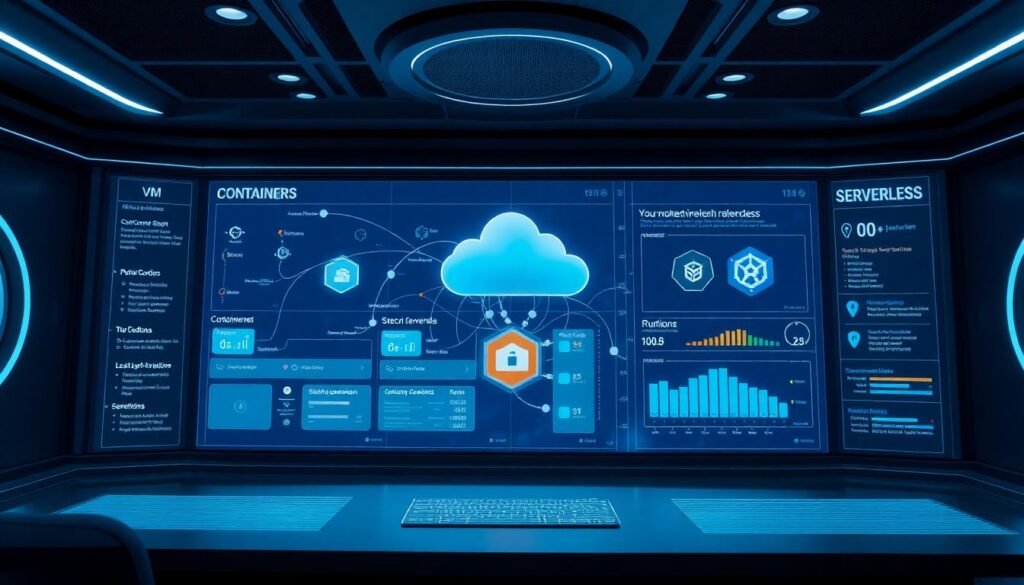
- Map all workloads: legacy VMs, containers, Kubernetes clusters, and serverless functions per cloud account and region.
- Prioritise runtime protection and least‑privilege controls over purely static vulnerability scanning.
- Prefer ferramentas cloud workload protection CWPP para VM containers serverless that integrate with your current SIEM and ticketing tools.
- For Brazilian teams, validate suporte, documentação e UI in pt_BR before standardising.
- Use a structured comparativo de ferramentas cloud workload protection para empresas before signing multi‑year contracts.
- Test performance overhead on real production‑like workloads, especially high‑throughput services.
- Plan runbooks and ownership for alerts before enabling blocking or auto‑remediation in production.
How CWPP addresses threats across VMs, containers and serverless
Cloud Workload Protection Platforms unify visibility and security controls across heterogeneous compute types. When comparing melhores soluções CWPP para proteção de workloads em nuvem, focus on coverage breadth and operational fit rather than just feature lists.
- Asset and workload discovery: Ability to automatically discover VMs, containers, Kubernetes pods/nodes, and serverless functions across AWS, Azure and GCP accounts.
- Vulnerability management: Image and package scanning for containers, host OS scanning for VMs, and library scanning for serverless runtimes, integrated with CI/CD where possible.
- Runtime threat detection: Behavioral monitoring, anomaly detection, and exploit prevention for workloads, including syscall or eBPF‑based sensors for containers and lightweight hooks for serverless.
- Least‑privilege enforcement: Support for hardening OS, container, and function permissions, including integration with cloud IAM policies for software de proteção de workloads em nuvem CWPP para AWS Azure GCP.
- Configuration and posture control: Policy checks for Kubernetes clusters, container registries, and serverless configurations, complementing but not replacing CSPM tools.
- Container and Kubernetes depth: For plataformas de segurança CWPP para containers Kubernetes e serverless, validate cluster‑level controls (admission controllers, network policies) and per‑namespace governance.
- Serverless‑aware protections: Support for function‑specific attack patterns (event injection, over‑privileged roles, data exfiltration via environment variables and layers).
- Integration and automation: Webhooks, APIs, and native connectors to SIEM, SOAR, ITSM, and messaging platforms used by your SOC or SRE teams.
- Governance, reporting, and compliance: Multi‑tenant views, custom reports per squad or business unit, and evidence exports for audits without heavy manual work.
Evaluation criteria and weighted scoring for intermediate teams
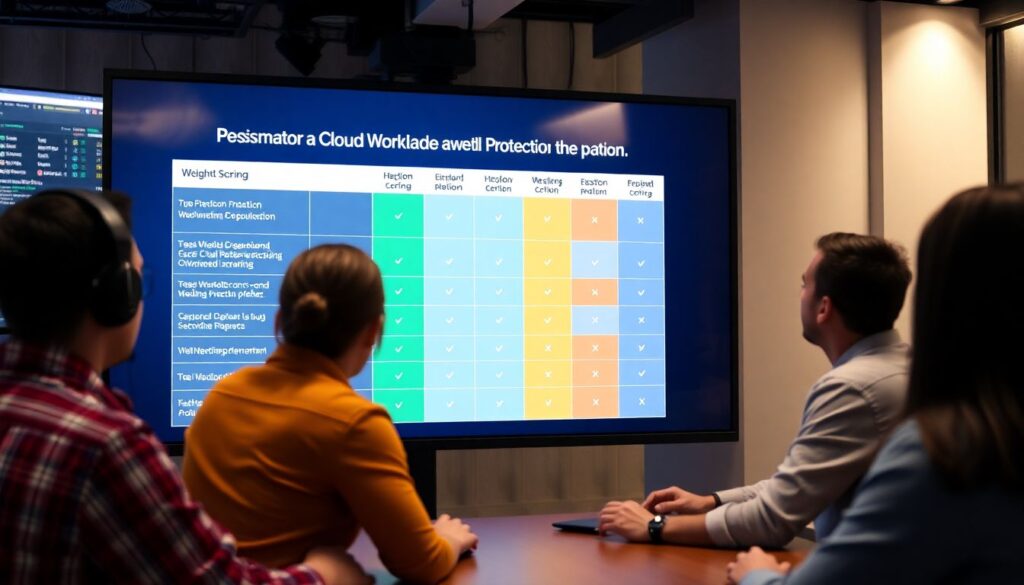
For intermediate teams, a weighted scoring model helps compare CWPP options objectively. Below, five archetypal approaches to CWPP are compared. You can adapt the criteria weights to your risk appetite, cloud mix, and internal skills.
| Option | Best suited for | Pros | Cons | When to choose |
|---|---|---|---|---|
| Cloud-native CWPP from AWS/Azure/GCP | Teams mostly on one hyperscaler with limited security engineering capacity. | Tight integration with cloud services and IAM; simplified billing and setup; good baseline coverage for VMs, containers, and some serverless. | Multi‑cloud visibility is fragmented; advanced runtime controls can be limited; features evolve differently per provider. | Choose when 80%+ of workloads are in a single cloud and you want fast time‑to‑value with lower operational overhead. |
| Container/Kubernetes-centric CWPP platform | Organisations heavily invested in Kubernetes and containers, including multi‑cluster and service mesh setups. | Deep cluster context; strong image scanning and admission control; rich policies for namespaces, pods, and registries. | VM and legacy workload coverage may be basic; requires Kubernetes fluency; may introduce cluster performance overhead if mis‑tuned. | Choose when most critical apps run in Kubernetes and you can supplement VMs with lighter controls or existing tools. |
| Agent-based multi-cloud CWPP suite | Enterprises with mixed VMs, containers on VMs, and multiple clouds or on‑prem data centres. | Uniform policies across environments; mature threat detection; granular process‑level visibility for incident response. | Requires agent deployment and lifecycle management; potential performance impact; licensing can be complex for bursty workloads. | Choose when you need a single pane for diverse workloads and have automation (Ansible, Terraform, pipelines) to manage agents. |
| Open-source CWPP toolchain | Security‑savvy teams comfortable assembling and maintaining multiple tools. | High flexibility; no or lower licensing cost; can customise detection logic and dashboards to your environment. | Integration overhead; no single vendor support; gaps likely for niche features like serverless‑specific detection. | Choose when budget is tight, engineering capacity is strong, and you accept higher build‑and‑operate responsibility. |
| MSSP-managed CWPP service | Teams with limited 24×7 monitoring and incident response capacity. | Outsourced monitoring and triage; predictable coverage; access to specialised threat expertise and runbooks. | Less direct control; potential latency in decisions; tuning changes may require change‑requests to the provider. | Choose when internal security staffing is constrained and you need continuous operations quickly across all workloads. |
Operational tips per option:
- Cloud-native CWPP from AWS/Azure/GCP: Standardise tagging and account structure first, so built‑in policies can segment workloads by environment and business unit.
- Container/Kubernetes-centric CWPP platform: Start with audit‑only policies in admission controllers, then gradually enforce after validating impact in staging.
- Agent-based multi-cloud CWPP suite: Automate agent deployment via golden images and configuration management to avoid drift and blind spots.
- Open-source CWPP toolchain: Define a supported stack (e.g., scanner + runtime sensor + SIEM dashboards) and treat it as an internal product with versioning.
- MSSP-managed CWPP service: Co‑create playbooks and escalation matrices early so alerts are routed correctly to internal owners.
Comparison matrix: vendors, features, and licensing trade-offs
Instead of focusing on vendor names, classify tools by scenario patterns to guide your selection. The matrix below can be used as a mental model when evaluating real vendors and contratos de ferramentas cloud workload protection CWPP para VM containers serverless.
- If your workloads are 70%+ Kubernetes and containers, prioritise a container/Kubernetes‑centric CWPP platform. Accept that you may need a lighter, possibly cloud‑native control just for remaining legacy VMs.
- If you are strongly multi-cloud (AWS, Azure, GCP) and hybrid, lean towards an agent‑based multi‑cloud CWPP suite or MSSP‑managed service that spans all environments with consistent policies.
- If you are early‑stage or cost‑sensitive, adopt cloud‑native CWPP in your main provider and selectively complement with open‑source components. Re‑evaluate as the environment and risk profile grow.
- If you lack 24×7 security monitoring, combine a tool from the above categories with an MSSP‑managed CWPP service rather than trying to build a full in‑house SOC from day one.
- If compliance reporting is a key driver, pick platforms with strong reporting and evidence export. Run sample compliance audits using trial data to validate before committing.
- If performance is business‑critical (low latency trading, APIs, or gaming), benchmark agents and runtime sensors under load. Downgrade or replace tools that add measurable latency in representative tests.
- If dev teams own most of the platform, favour CWPPs with developer‑friendly APIs, CLI tools, and CI/CD integration, so security becomes part of the pipeline instead of a separate silo.
Deployment patterns, integration effort and runbook implications
Use this detect → assess → deploy → operate checklist to evaluate plataformas de segurança CWPP para containers Kubernetes e serverless and more traditional options in a consistent way.
- Detect: map workloads and data flows
Inventory all VMs, clusters, namespaces, and serverless functions; identify business‑critical systems and data residency constraints per region and per cloud. - Assess: score against your threat model
For each CWPP option, rate coverage of your top risks (exposed services, lateral movement, data theft, misconfigurations) rather than generic feature counts. - Deploy: design a staged rollout
Start with non‑production accounts, deploy sensors/agents as code, and validate observability, logging, and alert quality before enabling protection in production. - Integrate: wire into existing platforms
Connect the CWPP to your SIEM, SOAR, ticketing, chat, and identity solutions, ensuring alerts contain enough context for on‑call teams to act quickly. - Operate: define runbooks and SLAs
Create simple workflows for triage, containment, and remediation, including change procedures for blocking rules or agent rollbacks if issues appear. - Improve: feedback into pipelines
Translate recurring incidents into new CI/CD checks, hardened base images, or infrastructure‑as‑code guardrails to reduce noise at runtime. - Review: revisit fit every 6-12 months
As your mix of workloads and clouds changes, reassess whether your current CWPP category still matches your needs and market offerings.
Performance, scalability and resource overhead in mixed environments

Performance and scalability can vary substantially between CWPP approaches. When running a comparativo de ferramentas cloud workload protection para empresas, highlight these frequent mistakes and explicitly test for them.
- Skipping realistic load tests and relying on vendor demos, which usually do not reflect your traffic patterns or peak loads.
- Deploying full agents with all features enabled to every workload instead of using tiered profiles for critical, standard, and batch systems.
- Ignoring the impact on auto‑scaling groups and Kubernetes autoscalers, where heavy agents or sidecars can skew resource metrics.
- Underestimating data volume and storage costs for logs, traces, and security telemetry sent from CWPP sensors to your SIEM.
- Assuming serverless protections are “free” in terms of overhead, without checking for cold‑start penalties or increased execution time.
- Not tuning detection rules, causing high CPU usage from inspection engines that parse unnecessary traffic or events.
- Running CWPP management components on under‑sized control planes, leading to lag in policy updates and delayed incident visibility.
- Overlooking cross‑region and cross‑account scaling, where centralised CWPP collectors or proxies become bottlenecks.
- Failing to plan for blue/green or canary rollouts of agent updates, increasing the risk of widespread outages if a bad version is deployed.
- Neglecting to measure user‑perceived latency for APIs and web apps after enabling deep inspection or TLS interception features.
Policy automation, telemetry pipelines and incident response flow
- If you are mostly single‑cloud with standard web workloads, lean on cloud‑native CWPP plus focused container/Kubernetes coverage as you modernise.
- If you are multi‑cloud, hybrid, and have strong internal engineering, choose an agent‑based multi‑cloud CWPP suite to unify policies.
- If your team is small or lacks 24×7 coverage, prefer an MSSP‑managed CWPP service, ideally built on tools you can later take in‑house.
- If budget is constrained but skills are strong, build an open‑source CWPP toolchain and selectively add commercial pieces for the hardest gaps.
- If Kubernetes and serverless are your strategic platforms, prioritise plataformas de segurança CWPP para containers Kubernetes e serverless with strong CI/CD integration and admission controls.
The best CWPP choice is contextual: cloud‑native platforms are usually best for small, single‑cloud estates; Kubernetes‑centric tools or agent‑based suites fit complex, multi‑modal environments; open‑source stacks favour cost‑aware but skilled teams; MSSP‑managed CWPP is optimal when operational capacity and 24×7 coverage are your bottlenecks.
Common deployment dilemmas and quick resolutions
Which CWPP approach fits a small Brazilian company mainly on AWS?
Start with AWS native CWPP capabilities for basic VM, container, and serverless protection, then add a lightweight container‑focused tool if Kubernetes usage grows. This minimises complexity and cost while keeping operations manageable for a small team.
How should I secure mixed VMs, containers, and serverless across AWS, Azure, and GCP?
Adopt an agent‑based multi‑cloud CWPP or MSSP‑managed service as the central layer, complemented by provider‑native controls for each cloud. This keeps policies consistent while still leveraging unique cloud‑specific integrations.
Do I need a separate CWPP for Kubernetes if my vendor already protects VMs?
Not always, but you need deep Kubernetes context: cluster, namespace, pod, and admission‑control visibility. If your VM‑centric CWPP does not offer this depth, add a Kubernetes‑centric platform or switch to a unified solution that covers both.
How can I limit performance impact from CWPP agents on critical services?
Define performance‑sensitive tiers, disable non‑essential features for those workloads, and benchmark each agent version before broad rollout. Use canary deployments and monitor latency and error rates closely during the first days.
What is the best way to integrate CWPP alerts into my existing SOC tools?
Use native connectors or APIs to send alerts to your SIEM and SOAR, adding normalisation and enrichment rules there. Ensure each alert type maps to a clear playbook, owner, and priority to avoid alert fatigue.
How do I evaluate open-source CWPP options realistically?
Prototype an end‑to‑end toolchain covering scanning, runtime detection, and dashboards in a test account. Estimate the engineering hours needed to maintain and extend it compared to a commercial or MSSP‑managed solution.
When should I involve an MSSP in my CWPP strategy?
Involve an MSSP when you cannot staff 24×7 monitoring, lack incident‑response expertise, or must meet regulatory SLAs quickly. Keep governance and architecture in‑house while outsourcing detection and initial triage.