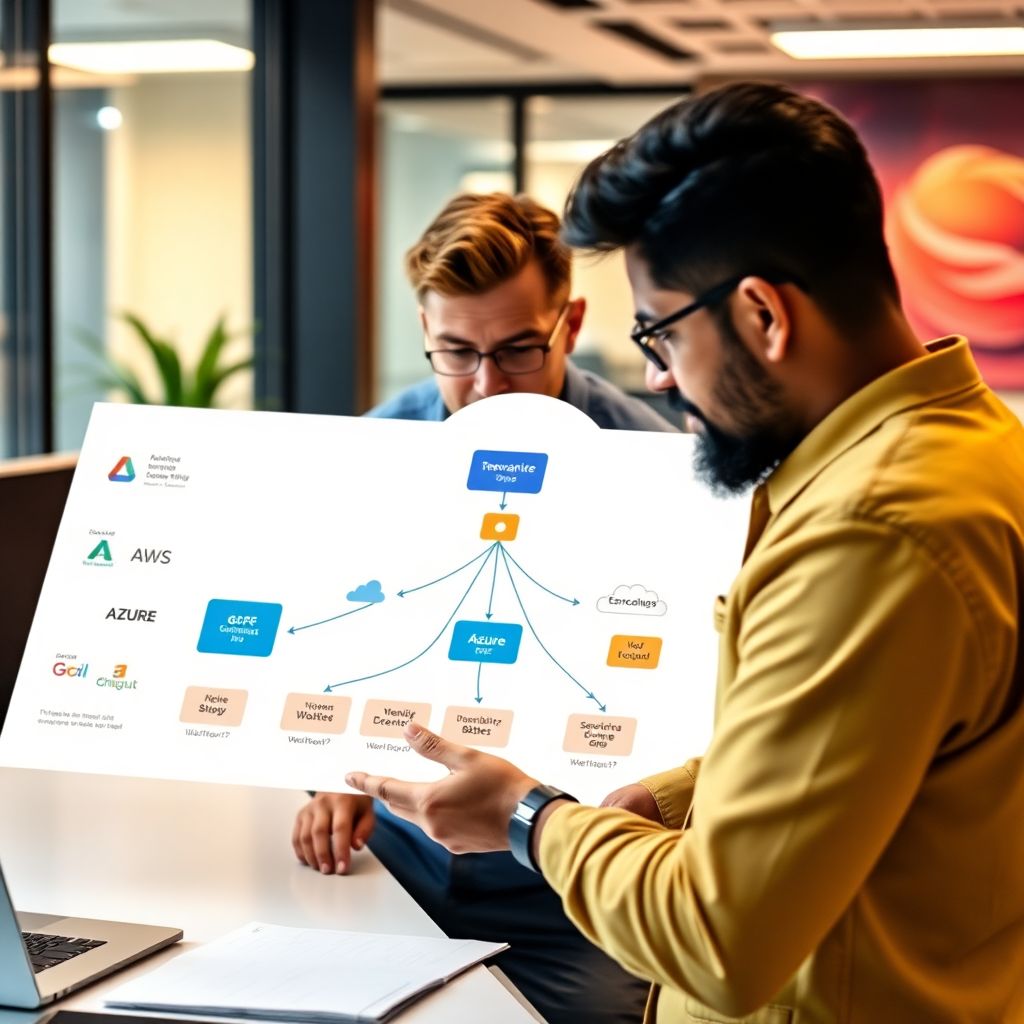
Cloud network segmentation and microsegmentation split your workloads into smaller, controlled zones, limiting lateral movement and simplifying compliance for Brazilian companies. This guide explains practical models, safe steps, and real-world AWS, Azure, and GCP examples so you can design, implement, and operate segmentation that balances security, performance, and operational complexity in production environments.
Primary Principles of Cloud Segmentation
- Start with clear business domains and data sensitivity levels before drawing technical boundaries.
- Prefer simple, coarse network segmentation for most workloads; reserve microsegmentation for high-value or regulated assets.
- Use identities, tags, and attributes (not only IPs) to define access policies wherever the cloud provider supports them.
- Automate policy creation and drift detection using infrastructure as code and CI/CD pipelines.
- Continuously validate segmentation with traffic logs, flow records, and attack-path simulations.
- Design for incident response: segmentation should help contain breaches without making investigations harder.
Comparing Network Segmentation and Microsegmentation in Cloud Environments
For most segmentação de rede em cloud para empresas, start with classic network segmentation: VPCs/VNETs, subnets, and security groups/NSGs. This approach is easier to maintain and already covers many LGPD and internal policy requirements.
Microsegmentation adds per-workload or per-process controls. It is ideal for:
- High-value data stores (PII, financial records, health data).
- Shared Kubernetes clusters or multi-tenant platforms.
- Legacy apps that cannot be easily rewritten but must be tightly constrained.
It may not be worth doing deep microsegmentation when:
- Your team lacks mature observability and automation; manual rule management will quickly become fragile.
- Applications change frequently, but deployments are not yet automated (Terraform, Ansible, GitHub Actions, GitLab CI, Azure DevOps, etc.).
- Latency budgets are tight and every extra hop (proxies, service mesh sidecars, host agents) could break SLAs.
microsegmentação em nuvem soluções de segurança bring strong containment, but they are expensive in terms of design time and operational care. Often, a staged approach works best: start with robust VPC/zonal isolation, then add microsegmentation in narrow, well-understood areas.
Architectural Models: VPC/Zonal, Service-Centric, and Sidecar-Based Topologies
Before implementing any of the melhores práticas de arquitetura de segmentação de rede cloud, validate that you have the required tools, permissions, and visibility.
Required capabilities and components
- Account and networking access
- AWS: ability to create/modify VPCs, subnets, route tables, security groups, and AWS Network Firewall or NACLs.
- Azure: permissions for VNets, subnets, NSGs, Azure Firewall, and route tables.
- GCP: roles to manage VPC networks, subnetworks, firewall rules, and Cloud Armor where relevant.
- Workload platforms
- Kubernetes clusters (EKS, AKS, GKE, or on-prem) with support for NetworkPolicies and, optionally, a service mesh like Istio or Linkerd.
- VM environments where you can install host-based agents or configure OS firewalls (iptables, nftables, Windows Defender Firewall).
- Identity and policy engines
- Cloud IAM (AWS IAM, Azure AD, GCP IAM) with tagging/labels to support attribute-based policies.
- Optionally, a central policy controller (OPA/Gatekeeper, custom controllers, or commercial tools).
- Observability and logs
- VPC flow logs / NSG flow logs / GCP VPC Flow Logs enabled in all critical networks.
- Centralized logging (CloudWatch Logs, Azure Monitor/Log Analytics, GCP Cloud Logging, or SIEM).
- Change management and automation
- Infrastructure as code for networks (Terraform, Pulumi, AWS CDK, Bicep, etc.).
- CI/CD pipelines for deploying segmentation changes with approval steps and rollbacks.
Comparative view of segmentation models
| Model | Typical Implementation | Main Benefits | Main Risks / Limitations | Best Fit Scenarios |
|---|---|---|---|---|
| VPC/Zonal Segmentation | Separate VPCs/VNETs per environment or domain; limited peering; shared services in hub VPC. | Simple mental model; strong blast-radius reduction; clear compliance boundaries. | Too coarse for multi-tenant clusters; can explode peering complexity; harder fine-grained rules. | Small-medium environments; first phase of segmentação de rede em cloud para empresas. |
| Service-Centric Segmentation | Security groups/NSGs and Kubernetes NetworkPolicies per app/service. | Aligns with microservices; maps well to CI/CD; good balance of control and complexity. | Requires accurate service inventory; risk of rule sprawl and hidden dependencies. | Modern microservices; regulated workloads needing clear data flows. |
| Sidecar-Based / Service Mesh | Istio/Linkerd/Envoy sidecars enforcing L4/L7 policies and mTLS between services. | Strong Zero Trust; rich telemetry; app-aware policies (paths, HTTP methods). | Higher latency and resource usage; complex debugging; steep learning curve. | Large Kubernetes platforms; multi-tenant SaaS; fine-grained internal APIs. |
| Host-Based Microsegmentation | Agents or OS firewalls on each VM/container host with central policy orchestration. | Works across mixed clouds and on‑prem; independent of underlay network. | Agent management overhead; risk of outages if policies are mispushed. | Hybrid data centers; legacy VMs; ferramentas de microsegmentação em cloud para datacenter. |
Policy Design Patterns: Zero Trust, Identity-Aware, and Attribute-Based Controls

Before the step-by-step, keep in mind several key risks and constraints when designing segmentation policies:
- Overly strict rules can cause outages and false positives during peak business hours.
- Relying only on IPs makes policies fragile when autoscaling, load balancers, or Kubernetes are involved.
- Distributed enforcement (mesh, agents) may introduce latency and CPU overhead that affects SLAs.
- Incomplete logging or retention can make incident response and LGPD investigations difficult.
- Map business domains and data sensitivity
Start from your business architecture, not from subnets. Identify domains such as billing, customer identity, analytics, and shared platform services, and classify data (public, internal, sensitive, restricted) in each.- Use these domains as the first-level segmentation boundary (VPCs, VNets, or projects).
- Align with your LGPD and internal risk categories.
- Define trust levels and directional flows
For each domain, document which other domains it legitimately talks to and in which direction. Keep this as a simple matrix that security, networking, and developers understand.- Example: "Web Frontend" can call "API", which can call "Database"; no direct Web → Database access.
- Explicitly mark disallowed flows; treat them as "deny by default" zones.
- Choose Zero Trust and identity primitives
Decide how you will express identity (workload, user, device) and enforce Zero Trust.- On VMs: instance roles (AWS IAM roles, GCP service accounts, managed identities in Azure).
- On Kubernetes: service accounts, namespaces, labels, and optionally SPIFFE IDs via a mesh.
- For users: SSO via Azure AD/Entra ID or other IdPs for management-plane access.
- Design attribute-based policies using tags and labels
Translate your domains and trust levels into tags (AWS), labels (GCP), or resource tags (Azure) for workloads and networks.- Define a minimum tag set:
env,domain,data_sensitivity,owner. - Configure policies that reference these attributes instead of IP addresses wherever possible.
- Define a minimum tag set:
- Implement coarse network boundaries first
Create separate networks per environment (prod, staging, dev) and per major domain.- AWS: VPC per environment, subnets per domain, security groups per service tier.
- Azure: spoke VNets per domain, peered to a shared hub with Azure Firewall.
- GCP: one or more VPCs per environment, with firewall rules scoped via target tags or service accounts.
- Add service-centric and microsegmentation controls
Once coarse boundaries are stable, incrementally add finer-grained policies for sensitive services.- Kubernetes: use NetworkPolicies to limit traffic by namespace, label, and port.
- Service mesh: define policies allowing specific HTTP paths or methods only.
- Host-based agents: restrict east-west traffic between VMs to approved ports and tags.
- Implement safe rollout and validation mechanisms
Deploy policies in "observe" or "log-only" mode where supported, then tighten.- Compare flow logs before and after a change to detect unexpected drops.
- Use canary deployments for new policies in a single zone, node pool, or app instance.
- Prepare and test rollback plans in CI/CD.
- Continuously refine based on incidents and audits
Feed lessons from penetration tests, red-team exercises, and real incidents back into the segmentation design.- Adjust trust boundaries when new services are added or merged.
- Update attribute schemes when teams or ownership structures change.
Implementation Techniques: Security Groups, Service Mesh, and Host-Based Agents
Use this checklist to verify that your implementation behaves as designed and remains supportable over time.
- Each environment (prod, staging, dev) has distinct VPC/VNet/VPC‑equivalent networks with no accidental peering.
- Security groups/NSGs are named and tagged by domain and service (not by IPs or ticket numbers).
- All internet-facing services are isolated in dedicated subnets, with only required inbound ports open.
- Internal services deny traffic by default and explicitly allow only documented upstream callers.
- Kubernetes clusters have NetworkPolicies applied to all namespaces that host sensitive or multi-tenant workloads.
- Service mesh or host-based agents are deployed first in non-production, with clear SLOs for latency and resource overhead.
- Flow logs show that blocked traffic matches expected "disallowed" paths, with no significant volume of unexpected denies.
- Segmentation configurations (Terraform, Helm, mesh policy YAML) are stored in version control and pass automated validation tests.
- Runbooks exist for temporarily relaxing segmentation in emergencies, with explicit approval steps and logging.
- Monitoring dashboards correlate segmentation policy changes with error-rate, latency, and CPU/memory metrics.
Minimal configuration snippets
AWS security group allowing only app → DB within same VPC
# Terraform-style example
resource "aws_security_group" "db" {
  name   = "sg-db-prod"
  vpc_id = aws_vpc.prod.id

  ingress {
    description      = "App to DB"
    from_port        = 5432
    to_port          = 5432
    protocol         = "tcp"
    security_groups  = [aws_security_group.app.id]
  }

  egress {
    from_port   = 0
    to_port     = 0
    protocol    = "-1"
    cidr_blocks = ["0.0.0.0/0"]
  }
}
Kubernetes NetworkPolicy restricting namespace
apiVersion: networking.k8s.io/v1
kind: NetworkPolicy
metadata:
  name: db-allow-from-app
  namespace: prod
spec:
  podSelector:
    matchLabels:
      role: db
  ingress:
  - from:
    - namespaceSelector:
        matchLabels:
          name: prod
      podSelector:
        matchLabels:
          role: app
    ports:
    - protocol: TCP
      port: 5432
Istio AuthorizationPolicy for HTTP microservice
apiVersion: security.istio.io/v1beta1
kind: AuthorizationPolicy
metadata:
  name: orders-allow-checkout
  namespace: prod
spec:
  selector:
    matchLabels:
      app: orders
  rules:
  - from:
    - source:
        principals: ["cluster.local/ns/prod/sa/frontend"]
    to:
    - operation:
        paths: ["/checkout"]
        methods: ["POST"]
Deployment Case Studies: Public Cloud, Hybrid Cloud, and Multi‑Tenant SaaS Examples
This section highlights common mistakes and lessons learned for typical deployment patterns, including when to consider serviços gerenciados de segmentação de rede e microsegmentação rather than building everything in-house.
- Public cloud, single provider (AWS example) – Mistake: using one "shared" VPC for all environments and teams, making it impossible to reason about blast radius or to apply consistent policies.
- Public cloud, Azure with VNets – Mistake: relying only on NSGs attached to NICs and skipping subnet-level controls, which leads to inconsistent rules and surprises during audits.
- GCP with multiple projects – Mistake: creating many ad-hoc VPC peering links instead of a hub‑and‑spoke model, making routing and firewall rule evaluation very hard to debug.
- Hybrid cloud with on‑prem data center – Mistake: extending flat on‑prem VLANs directly into cloud networks via VPN without rethinking segmentation or Zero Trust principles.
- Multi-tenant SaaS on Kubernetes – Mistake: isolating tenants only via logical IDs in the application layer, while sharing namespaces, node pools, and network policies.
- Using host-based microsegmentation agents – Mistake: rolling out aggressive policies across all VMs at once, causing outages when unknown dependencies are blocked.
- Adopting service mesh for microsegmentation – Mistake: turning on mTLS and restrictive authorization policies without first ensuring that certificates, time sync, and retries are correctly configured.
- Outsourcing to managed security services – Mistake: delegating control to a provider but not granting them enough context about application flows, causing conservative (overly permissive) rules.
Short real-world style examples
Public AWS workload: A Brazilian fintech separates "core banking", "customer portal", and "analytics" into different VPCs, with only specific VPC peering routes allowed. Inside "core banking", Kubernetes NetworkPolicies and a mesh enforce strict microsegmentation around payment and ledger services.
Hybrid cloud: A retailer connects on‑prem ERP to Azure via ExpressRoute. They keep on‑prem VLANs flat but introduce strong segmentation in Azure VNets and NSGs, then gradually refactor on‑prem to mirror cloud trust zones, reducing lateral movement risk.
Multi-tenant SaaS: A SaaS provider on GKE assigns each tenant to a dedicated namespace with NetworkPolicies, and relies on a service mesh to enforce tenant-aware policies using custom JWT claims, achieving defense in depth beyond simple app-level checks.
Operational Tradeoffs: Monitoring, Automation, Performance and Incident Response
There are several alternative strategies you might choose depending on team maturity, risk tolerance, and budgets, especially when selecting microsegmentação em nuvem soluções de segurança.
- Simplified, network-only segmentation
Use only VPC/VNet boundaries and coarse firewall rules. This is suitable for smaller teams or less critical workloads where the overhead of microsegmentation is not justified. You trade some containment capability for much lower complexity and operational cost. - Managed segmentation and security services
Rely on cloud-native or third-party serviços gerenciados de segmentação de rede e microsegmentação that provide policy engines, visibility, and guided onboarding. This fits organizations that prefer to invest OPEX instead of building deep internal expertise, while still demanding strong controls and compliance reporting. - Identity-first, application-layer controls
Focus on strong authN/authZ (OAuth2/OIDC, mTLS, API gateways) and treat network segmentation as a secondary, coarse guardrail. This is appropriate for highly dynamic microservices platforms where IP-based controls are fragile, provided your observability and security engineering teams are mature. - Gradual, risk-based microsegmentation rollout
Instead of aiming for full coverage, prioritize high-risk domains (payments, identity, admin consoles) and expand only after stabilizing metrics and runbooks. This reduces the risk of outages and performance regressions while still delivering quick security wins.
Practical Problems and Concise Remedies for Segmentation Projects
How do I start segmentation in a legacy, flat cloud network without breaking everything?

Begin by separating environments (prod vs non-prod) into distinct VPCs or VNets and introducing read-only flow logging. Use logs to identify critical dependencies, then apply deny-by-default rules only around a small, well-understood domain first.
What if my developers complain about latency and debugging complexity with service mesh?
Limit service mesh adoption to services that truly need L7 policies or mTLS. Provide clear observability tools (distributed tracing, mesh dashboards) and SLOs, and keep a documented procedure for temporarily bypassing the mesh during incidents.
How can I avoid rule sprawl when using security groups or NSGs?
Standardize naming and tagging conventions, and manage security groups/NSGs through Terraform or equivalent tooling. Periodically run reports to detect unused rules and consolidate patterns into reusable modules.
What is the safest way to test microsegmentation policies in production?

Use log-only or permissive modes when available, or mirror rules in a staging environment with realistic traffic first. Then roll out changes gradually using canary deployments and monitor error rates and flow logs closely.
How do I handle third-party vendor access within a segmented environment?
Create dedicated, tightly scoped network segments and identities for vendors, with explicit time-bound access. Avoid giving them broad access to core VPCs/VNets; instead, proxy their access through bastion hosts, VPNs, or zero-trust access tools with full auditing.
What metrics show whether my segmentation is effective?
Track blocked lateral-movement attempts, number of reachable high-value assets from a compromised node, mean time to detect/contain incidents, and configuration drift rate. Combine these with performance metrics to ensure segmentation does not degrade user experience.
When should I consider commercial ferramentas de microsegmentação em cloud para datacenter?
Consider them when you have a large hybrid estate, limited internal expertise, or strict regulatory requirements that demand deep visibility and centralized control. They help standardize policy across on‑prem and multiple clouds but require careful vendor evaluation and integration planning.