
To protect cloud-exposed APIs, combine a WAF, an API gateway, strong authentication and authorization, and rate limiting. Start by mapping threats, then place controls in front of your APIs, validate configs in a staging environment, monitor aggressively, and iterate. Prioritize simple, low-friction protections before deploying complex rules to production.
At-a-glance: core protections for cloud-exposed APIs
- Terminate all traffic through an API gateway and apply proteção de apis na nuvem waf at the edge before requests reach services.
- Use strong, centralized authentication for all APIs, including machine-to-machine, with autenticação forte para apis rest na nuvem.
- Apply rate limiting para segurança de apis em produção based on client identity, HTTP method, and endpoint sensitivity.
- Continuously monitor logs and metrics; alert on anomalies such as spikes, errors, or unexpected geographies.
- Harden default configurations; disable unauthenticated debug endpoints and avoid exposing internal admin APIs to the internet.
- Test all changes in a staging environment and have a documented rollback plan for misbehaving WAF or gateway rules.
| Control type | Main role | Typical strengths | Typical weaknesses | Common failure modes |
|---|---|---|---|---|
| WAF | Filter malicious HTTP traffic before it hits the API | Blocks generic attacks (SQLi, XSS, bots), virtual patching, protocol enforcement | Limited understanding of business logic, may cause false positives if rules are strict | Over-blocking legitimate clients; or being bypassed when new endpoints are published without WAF onboarding |
| API gateway | api gateway gerenciamento de apis em nuvem, routing and policy enforcement | Central routing, per-API policies, auth integration, quotas, versioning | Misconfiguration can expose internal services; adds complexity and latency | Open paths without auth, inconsistent policies between routes, broken dependencies during migrations |
| Auth & tokens | Identify and authorize users and clients | Fine-grained access control, revocation, auditability | Token leakage and long-lived tokens increase impact; incorrect scopes grant excessive access | Accepting unsigned or weakly-signed JWTs, skipping checks on some endpoints, key rotation issues |
| Rate limiting & quotas | Control request volume to prevent abuse and overload | Mitigates brute force, credential stuffing, and resource exhaustion | Difficult to size correctly; may block legitimate traffic during spikes | Overly strict limits causing outages; or limits disabled on sensitive endpoints |
Threat landscape for cloud APIs: common attack vectors and expected impact

This approach fits organizations in Brazil and elsewhere that expose APIs over the internet via Kubernetes, serverless, or managed services, and need practical baselines rather than heavy frameworks. It is especially relevant when integrating multiple SaaS products or mobile apps with public APIs.
You should not rely only on these patterns if your APIs handle highly regulated data with strict local requirements, or if you lack operational capacity to monitor and adjust controls. In such cases, complement them with specialized consulting and platform assessments.
Common threats for cloud-exposed APIs include:
- Injection attacks (SQL, NoSQL, OS command) exploiting insufficient input validation.
- Broken authentication and session handling, especially when token validation is inconsistent across services.
- Broken object level authorization (IDOR) and excessive data exposure.
- Automated abuse and scraping using stolen tokens or anonymous requests.
- Denial-of-service via high request rates or expensive query patterns.
- Misconfigurations in cloud load balancers and gateways that bypass layers like WAF or logging.
Expected impacts range from data exfiltration and account takeover to service unavailability and unforeseen cloud cost spikes. For Brazilian organizations, additional risks include violation of LGPD due to exposed personal data and potential contractual breaches with local partners.
Designing the perimeter: where to place WAFs and how to craft rules
Before designing the perimeter, ensure you have:
- Inventory of all public API endpoints, including URLs, methods, and owning teams.
- Access to the cloud console (AWS, Azure, GCP or local providers) and to the existing WAF or load balancer configuration.
- Documentation for your waf para apis http na nuvem preços and capacity limits, to estimate cost impact of new rules.
- API gateway documentation covering routing, custom domains, TLS termination, and authentication integration.
- A non-production environment (staging) mirroring production routing, to test WAF and gateway changes safely.
Baseline perimeter design recommendations:
- Place WAF in front of the main entry point. Attach the WAF to the public load balancer or API gateway edge so that all HTTP/S traffic to your APIs passes through it.
- Use managed rule sets first. Enable vendor-managed OWASP-style rule sets to cover generic attacks. Start in “log only” mode, then gradually switch to blocking based on observed false positives.
- Add API-specific custom rules. For sensitive endpoints (authentication, payments, PII), constrain allowed methods, paths, header sizes, and typical payload patterns.
- Segment by application. Group APIs into WAF policies per business application or risk level, so teams can adjust rules independently without affecting unrelated services.
- Define a rollback mechanism. For each major WAF change, prepare a documented rollback (previous policy version, disable specific rule group) and ensure on-call staff know the procedure.
Residual risks include logical abuse that bypasses generic WAF rules, and new endpoints accidentally configured without WAF protection. Reduce these risks by integrating WAF onboarding into your API publishing process and regularly scanning DNS and ingress configurations.
Coordinating API gateways and WAFs: division of responsibilities
Before the step-by-step, understand key risks and limitations of this layered design:
- If routing is changed at the API gateway without updating the WAF, some endpoints might be reachable without proteção de apis na nuvem waf.
- Overlapping features (auth, rate limits) between WAF and gateway can create confusion and inconsistent enforcement.
- Complex rules increase the chance of outages; always prefer simpler, well-tested policies over tightly coupled logic.
- Central gateways can become a single point of failure; design for high availability and tested fallback paths.
-
Define clear responsibility boundaries
Document which concerns belong to the WAF and which to the API gateway. As a practical rule, keep protocol-level and generic security in the WAF, and business-aware policies in the gateway.
- WAF: block obvious attacks, enforce HTTP protocol correctness, basic geolocation and IP reputation filtering.
- Gateway: routing, versioning, authentication, authorization, and rate limiting per API or per consumer.
-
Standardize ingress patterns
Ensure that all public API domains resolve to a small number of entry points (edge gateways or load balancers) that are consistently protected by the WAF.
- Avoid side channels such as direct IP access or unmanaged load balancers pointing to the same backends.
- In Kubernetes, use a single ingress controller type for internet-facing APIs, integrated with the WAF.
-
Centralize authentication and token validation at the gateway
For autenticação forte para apis rest na nuvem, integrate the API gateway with your IdP (e.g., OAuth2/OpenID Connect server) and enforce token validation there.
- Reject requests with missing, expired, or malformed tokens before they reach services.
- Propagate only validated identity attributes (subject, scopes, roles) to downstream APIs.
-
Implement rate limiting in the gateway, not the WAF
Concentrate rate limiting para segurança de apis em produção in the gateway, where you can use API keys, client IDs, and tokens as identifiers.
- Apply stricter limits on anonymous flows and expensive operations (search, reports, exports).
- Align per-consumer quotas with contractual SLAs and expected traffic for Brazilian and global customers.
-
Configure logging and correlation IDs
Enable detailed access logs on both WAF and gateway, including a shared correlation ID header.
- Generate the ID at the edge and pass it through; use it when investigating incidents.
- Forward logs to a central SIEM or logging stack with retention aligned to your compliance needs.
-
Test failure scenarios and plan rollback
For each change in gateway routing or WAF rules, test in staging and perform a controlled rollout.
- Use canary deployments or percentage rollouts when available in your cloud platform.
- Document rollback steps, such as reverting gateway configs, disabling new WAF rule groups, or restoring previous API versions.
Strong authentication and authorization: mTLS, OAuth2 flows and JWT best practices
- All external APIs require authentication; there are no anonymous-by-default endpoints except explicitly documented public ones.
- OAuth2/OIDC flows are chosen per client type (authorization code with PKCE for mobile/web, client credentials for server-to-server).
- JWT access tokens are signed with strong algorithms (e.g., RS256 or ES256) and keys are rotated on a defined schedule.
- APIs validate token signature, expiration, issuer, audience, and required scopes on every request, not only at login.
- mTLS is enabled for highly sensitive machine-to-machine APIs or internal calls that traverse untrusted networks.
- Permissions are based on least privilege; scopes and roles do not grant broader access than necessary.
- There is a central configuration for trusted IdPs; APIs do not accept tokens from ad-hoc or test identity providers.
- Refresh token usage is controlled, with short-lived access tokens and server-side revocation support when possible.
- Credential material (client secrets, private keys, certificates) is stored only in secure vaults, not in source code or shared documents.
- Access decisions and key authorization failures are logged with relevant identifiers but without leaking sensitive data.
Traffic governance: rate limiting, throttling policies and quota design
- Using only IP-based limits, ignoring authenticated user or client identity, which makes blocking noisy NATed networks more likely.
- Setting global low limits that work in testing but cause outages under real-world traffic spikes or marketing campaigns.
- Not distinguishing between read and write operations, applying the same limit to harmless GETs and expensive POSTs.
- Applying strict limits to callback or webhook endpoints, causing failures in integrations with payment gateways and partners.
- Disabling rate limiting for “internal” APIs that later become exposed via new products or misconfigurations.
- Failing to communicate quotas and HTTP 429 behavior to consumers, leading to unnecessary retries and higher load.
- Not monitoring near-quota usage, so the first sign of trouble is a production incident rather than an early alert.
- Implementing rate limiting in application code only, without using the API gateway capabilities optimized for this function.
- Ignoring region-specific traffic patterns (e.g., Brazilian business hours, local events) when designing and tuning policies.
- Lack of a documented emergency procedure to temporarily relax limits during critical incidents while maintaining minimum protections.
Detection and response: monitoring, alerting and post-incident hardening
Several implementation styles can be effective, depending on your maturity and platform choices:
- Cloud-native security stack: Use your cloud provider’s WAF, API gateway, monitoring, and logging tools. This minimizes integration work and is usually sufficient for many organizations starting with cloud APIs.
- Dedicated API security platform: Adopt a specialized solution that combines discovery, anomaly detection, and policy enforcement. This is suitable when you operate many APIs across multiple clouds and need advanced visibility.
- Hybrid observability-first approach: Keep basic controls in managed services, but focus on exporting detailed logs and metrics to a strong SIEM and observability platform, where you build custom detection rules.
- Managed security services provider: For teams without 24×7 capacity, outsource monitoring and first-line response to an MSSP familiar with your cloud stack and local (pt_BR) regulatory context.
In all cases, after incidents you should review WAF rules, gateway policies, and authentication settings, add new detections that would have caught the attack earlier, and rehearse the incident response process with realistic API abuse scenarios.
Operational questions and concise, risk-focused answers
Where should I start if I have no protections in front of my cloud APIs?
First, route all public APIs through an API gateway and enable basic HTTPS with correct certificates. Then activate a managed WAF in detection mode, integrate centralized authentication, and only after that start tightening rate limits and adding custom rules.
How do I balance WAF strictness with availability for production traffic?
Deploy new or stricter rules in log-only mode, analyze false positives, and whitelist legitimate patterns. Use staged rollouts, and keep a documented rollback step so on-call engineers can quickly revert a problematic rule set during incidents.
Is mTLS necessary for all APIs or only some?
mTLS is most valuable for high-risk machine-to-machine integrations, especially across network boundaries or with partners. For public mobile and browser clients, combine TLS with OAuth2 and robust token validation instead of trying to manage client certificates at scale.
How do rate limiting and quotas affect user experience?
Well-tuned limits protect stability without being noticeable to normal users. Problems arise when limits are too strict or undocumented. Monitor real traffic, adjust thresholds gradually, and communicate expected behavior (including 429 responses) to API consumers.
Can I rely only on the API gateway for security and skip the WAF?
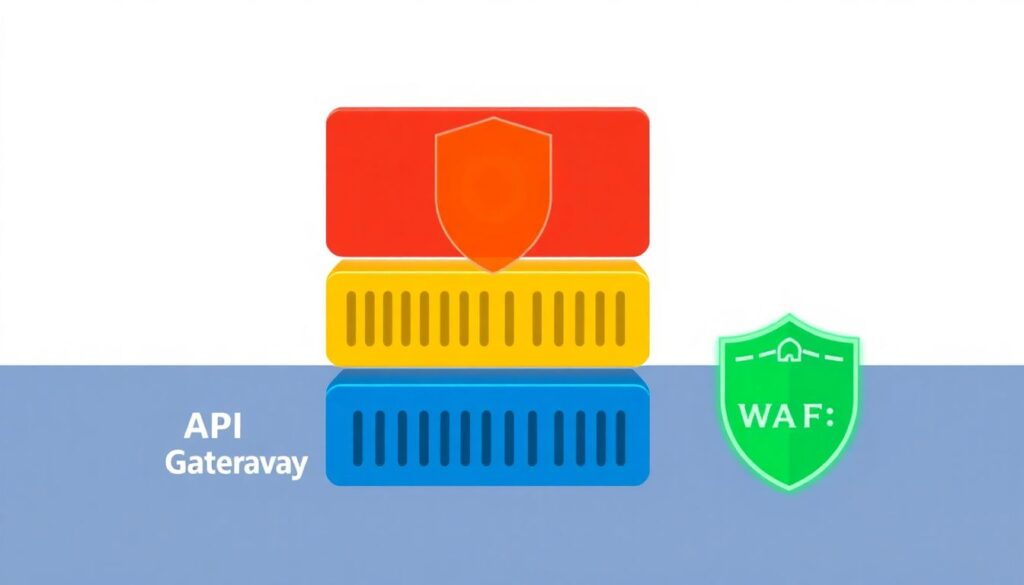
An API gateway provides many controls, but a WAF adds an extra layer focused on generic web attacks and protocol anomalies. For internet-exposed APIs, using both in a complementary way is safer than relying on just one component.
How should I factor cost, like waf para apis http na nuvem preços, into my design?

Estimate typical and peak traffic, then compare managed WAF and gateway pricing tiers. Start with the smallest configuration that fully covers your entry points, monitor usage, and adjust. Avoid over-optimizing costs by removing critical protections or central visibility.
What is the best way to test new security policies before production?
Maintain a staging environment mirroring production domains and routing. Replay recorded production traffic or synthetic tests through new WAF and gateway policies, analyze logs, and only promote changes once you are confident that legitimate use cases are not blocked.