
Serverless security in AWS and other clouds hinges on three pillars: strict identity and permission models, hardened runtimes, and high‑quality logs and traces. Focus first on attack paths with the biggest impact: over‑privileged roles, exposed event sources, insecure dependencies, and missing monitoring. Then iterate permissions, isolation, and observability together.
Security briefing: primary risks and controls for serverless
- Over‑privileged IAM roles for functions are the fastest path to account compromise; enforce least privilege and permission boundaries from day one.
- Publicly reachable triggers (API Gateway, S3, queues) can become initial access points; apply authentication, throttling, and schema validation.
- Insecure supply chain (libraries, layers, containers) often leads to remote code execution; pin versions, scan artifacts, and restrict outbound calls.
- Weak observability hides attacks in ephemeral invocations; design structured logs and traces before going live, choosing suitable ferramentas de monitoramento e logs para serverless.
- Data exposure through misconfigured environment variables and parameters is common; encrypt secrets and keep them outside code and configs.
- Missing incident response playbooks for serverless slows containment; predefine isolation, rollback, and evidence collection procedures.
Threat landscape unique to serverless functions

Serverless is attractive when you want managed scalability, pay‑per‑use, and fast delivery without managing servers. For teams in Brazil using segurança em serverless na aws, it is especially useful for APIs, backends for mobile, data processing, and event‑driven integrations across services.
However, serverless changes where and how attacks happen:
- Expanded event surface: Triggers like S3 events, queues, IoT, and schedulers increase the number of possible entry points.
- Ephemeral execution: Functions start and stop quickly, so traditional host‑based monitoring and forensics rarely apply.
- Hidden shared infrastructure: You rely on the cloud provider runtime isolation; misconfigurations or multi‑tenant issues can have broad impact.
- Complex identity graph: Every function, queue, and API uses roles and policies, which often become overly permissive.
- Third‑party and supply chain: Layers, libraries, and SaaS integrations can introduce malicious or vulnerable code paths.
It is usually not a good fit when you need low‑level OS control, specialized hardware, long‑running stateful workloads, or when regulatory rules demand full control over the runtime and network stack.
Identity, authentication and ephemeral credentials
Before implementing melhores práticas de segurança para arquiteturas serverless, ensure you have the right foundations for identity and authentication.
- Cloud IAM access: Ability to create and edit IAM roles, policies, permission boundaries, and identity providers.
- Central identity provider: Use SSO/IdP (e.g., corporate IdP) for human access and OIDC or JWT‑based identities for services calling your serverless APIs.
- Secrets management: A managed secrets store (e.g., Secrets Manager or Parameter Store) with encryption and rotation enabled.
- Key management: Customer managed keys for data at rest, environment variables, and sensitive logs.
- Monitoring stack: Chosen ferramentas de monitoramento e logs para serverless that can ingest function logs, traces, metrics, and security findings.
- Network controls: VPCs, subnets, and security groups where needed, especially when functions access databases or internal services.
- Service catalog: An inventory of all functions, APIs, queues, topics, and data stores that serverless workloads touch.
For authentication to APIs fronted by serverless, prefer managed identity solutions (e.g., JWT authorizers, Cognito, or corporate IdP integration) rather than custom token logic in functions.
Permission models: designing least-privilege policies
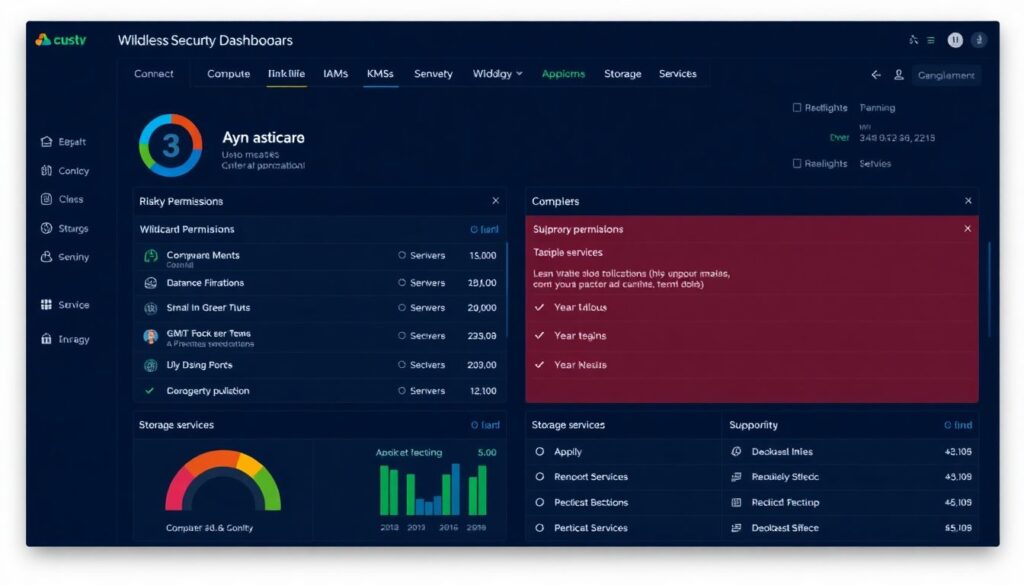
Before the step‑by‑step design of implementação de modelos de permissão em aplicações serverless, be explicit about key risks and limitations.
- Granting wildcard actions on core services (compute, IAM, KMS, storage) often leads to full account takeover if a function is compromised.
- Overly granular manual policies can become unmaintainable, causing teams to fall back to insecure wildcards later.
- Excessive reliance on per‑function configuration can fragment governance; you need some shared guardrails like permission boundaries.
- Cross‑account and third‑party access must be justified and tightly scoped to avoid hidden lateral movement paths.
Comparing common permission models for serverless
| Permission model | Typical use case | Security benefits | Main trade‑offs |
|---|---|---|---|
| Per function IAM role | Critical functions with distinct data access needs | Fine‑grained least privilege, clear blast radius per function | More roles and policies to manage, requires automation and templates |
| Shared role per service or micro‑domain | Multiple functions working on same dataset or bounded context | Simpler management, consistent access model inside one service | Broader blast radius if one function is compromised |
| Role plus permission boundary | Large teams, delegated administration, multi‑account setups | Prevents roles from exceeding defined maximum permissions | More complex to design and debug, requires clear standards |
| IAM plus API Gateway or service RBAC | Public or partner APIs with external callers | Separates caller permissions from backend execution role | Two layers of policy to maintain and test |
Stepwise design of least‑privilege policies

-
Inventory functions, triggers, and target resources
List every function, its triggers (API, S3, queue, schedule), and all resources it reads or writes. Group functions by bounded context, like billing or analytics, to decide where a shared role is acceptable.
- Document data classifications for each resource (public, internal, confidential).
- Note which actions are read‑only versus write or admin.
-
Choose execution role boundaries per context
Decide whether each function gets its own role or shares a role with siblings in the same domain. For high‑risk contexts (payments, identity, secrets), use strictly per‑function roles with clear naming and tags.
- Define a permission boundary policy that forbids dangerous wildcards on core services.
- Attach this boundary to every function execution role.
-
Author minimal allow policies from required actions
For each role, derive the minimal set of
ActionandResourcepairs from the inventory. Start with read‑only, then add writes and admin operations only when justified.- Use resource‑level permissions where supported, avoiding
*for resources. - Add explicit denies for especially sensitive data paths if needed.
- Use resource‑level permissions where supported, avoiding
-
Harden with conditions and environment constraints
Use IAM condition keys to restrict when and how permissions apply. Constrain roles to specific VPCs, subnets, tags, or source accounts to reduce abuse if credentials leak.
- Require encryption in transit and at rest via condition keys.
- Limit use of roles to your organization or specific OIDC providers.
-
Continuously test, log, and refine permissions
Turn on access logs and analyze denied events to refine policies instead of preemptively broadening access. Use automated checks in CI to block policies that violate baseline rules.
- Alert on creation or modification of execution roles with wildcards.
- Review permissions regularly as part of change management.
When internal expertise is limited, engaging consultoria em segurança para aplicações serverless can help validate your permission model and automation design before large‑scale rollout.
Runtime isolation, supply chain and third-party risks
Use this checklist to verify that your serverless runtime and supply chain controls match your risk tolerance.
- Confirm that each function uses the minimal runtime and memory size required, reducing attack surface and cost of exploitation.
- Ensure all dependencies and layers are pinned to specific versions and scanned for vulnerabilities before deployment.
- Avoid bundling unused libraries or tools; strip development utilities and shells from artifacts.
- Restrict outbound network access to only required domains or VPC endpoints, especially for functions processing sensitive data.
- Review third‑party integrations for data handling, encryption, and retention practices compatible with your compliance obligations.
- Separate functions handling untrusted input from those with privileged access, using different roles and, where possible, different network segments.
- Enable runtime monitoring for anomalous behavior such as unexpected outbound connections, timeouts, or spikes in concurrency.
- Document trusted sources for code and artifacts, and block direct deployments from unmanaged developer laptops.
- Regularly test rollbacks for functions and layers to recover quickly from a compromised artifact or misconfiguration.
Observability: structured logs, traces and alerting
Common mistakes in observability for serverless lead directly to blind spots during attacks and outages.
- Logging only errors and ignoring context fields like request IDs, tenant IDs, and principal information, making correlation nearly impossible.
- Embedding secrets, tokens, or personal data in logs, which increases the blast radius of any logging compromise.
- Relying on default log formats instead of enforcing structured, JSON‑style logs with consistent fields across functions.
- Not enabling distributed tracing across API Gateway, functions, and downstream services, leaving gaps in performance and security analysis.
- Sending logs to multiple tools without a clear source of truth, which complicates investigations and dashboards.
- Skipping alert tuning, resulting in noisy, ignored alerts rather than high‑signal notifications tied to real attack patterns.
- Ignoring cold start and concurrency metrics that may reveal denial‑of‑wallet attacks or abusive clients.
- Failing to test log and trace pipelines during game days, so critical fields are found missing only during real incidents.
- Not defining clear retention policies for logs and traces, either losing evidence too early or retaining sensitive data longer than needed.
Incident response and forensics for ephemeral executions
Incident response for serverless must adapt to short‑lived executions and heavy reliance on cloud‑native services. There are several patterns you can choose from depending on your constraints and maturity.
-
Cloud‑native containment and rollback
Use infrastructure as code and deployment pipelines to quickly roll back to a known good version and disable compromised triggers. This is suitable when you have strong automation and versioning in place.
-
Isolation via account or project boundaries
Place high‑risk workloads in separate accounts or projects so you can quarantine an entire environment if needed. This approach fits regulated or high‑sensitivity systems where blast radius must be strictly controlled.
-
Centralized log and evidence collection
Aggregate all function logs, traces, and configuration histories into a dedicated, write‑once store for forensic analysis. This is useful when legal or compliance teams require detailed reconstruction of events.
-
Hybrid model with traditional services
For parts of the system needing deep host forensics or specialized agents, combine serverless with container or VM‑based components. This makes sense when observability and incident handling tooling is strongly oriented toward traditional workloads.
Practical operational questions on securing serverless
How strict should IAM roles be for a new serverless project?
Start with tightly scoped, per‑function roles for any function touching sensitive data or admin actions, and use permission boundaries to prevent wildcards. For low‑risk utility functions, a shared role per bounded context can be acceptable if regularly reviewed.
What logs are essential to keep for serverless incident investigations?
At minimum, keep invocation logs with structured context, API Gateway or equivalent access logs, and changes to IAM roles and function configurations. Ensure they are centralized, immutable, and retained long enough to investigate slow‑moving attacks.
When is VPC integration necessary for serverless functions?
Use VPC integration when functions access internal databases, private services, or must comply with network segmentation rules. Avoid VPCs for simple public APIs that only call managed services, as unnecessary VPC use can add complexity and latency.
How do I safely test new permission policies without breaking production?
Use staging environments mirroring production and run integration tests that simulate real workloads. In production, monitor access denied events after tightening permissions and be ready to roll back quickly via automated deployments.
Do I need a separate monitoring tool just for serverless?
Not necessarily, but your monitoring platform must support short‑lived executions, high‑cardinality metrics, and trace correlation. If your current tools cannot handle this, consider specialized observability solutions or managed add‑ons focused on serverless workloads.
How often should I review serverless permissions and triggers?
Combine continuous checks in CI and policy scanners with periodic human reviews. A quarterly review for critical environments, plus reviews tied to major feature changes, is a practical starting rhythm.
When does external consulting make sense for serverless security?
Consider consultoria em segurança para aplicações serverless when building your first mission‑critical workloads, facing strict audits, or after a security incident. Independent experts can validate your architecture, permissions, and observability strategy more quickly than ad hoc internal efforts.