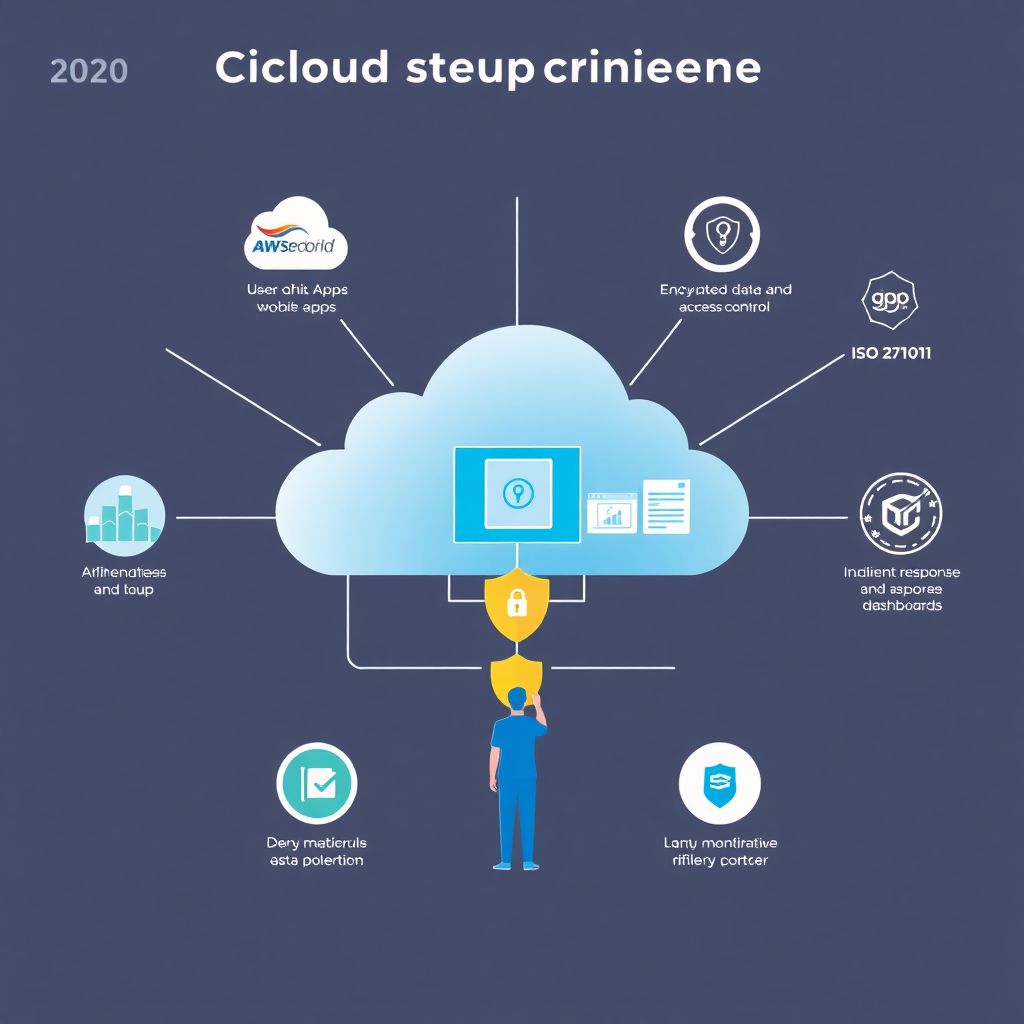
Cloud compliance stopped being a “nice to have” a while ago. In 2026, if you run workloads in AWS, Azure, GCP or any other cloud and process personal data, you’re automatically playing in the LGPD, GDPR and ISO 27001 arena—whether you like it or not. The interesting part is that the real challenge is no longer *technical security* alone; it’s how to align security, privacy and regulatory requirements in a way that still allows your business to move fast.
—
Clear definitions: putting everyone on the same page
Let’s start by nailing the basics, because half of the confusion in “compliance em cloud LGPD GDPR ISO 27001” discussions comes from fuzzy terminology.
A cloud provider (AWS, Azure, GCP, etc.) offers infrastructure, platform or software as a service. You, as the customer, are still responsible for how you configure, use and secure those services. This is the famous *shared responsibility model*: the provider secures the cloud; you secure what you put in the cloud.
LGPD (Lei Geral de Proteção de Dados) is Brazil’s data protection law, while GDPR is the European equivalent. Both define personal data, sensitive data, legal bases for processing, rights of data subjects, duties for controllers and processors, incident notification and heavy penalties.
ISO 27001 is an international standard for Information Security Management Systems (ISMS). Instead of telling you “encrypt this database in exactly this way,” it tells you to establish a risk-based management system, define policies, assign responsibilities, and choose appropriate security controls (documented in Annex A and supported by ISO 27002).
Short version: LGPD and GDPR tell you *what* must be protected and *why* (rights, principles, legal bases). ISO 27001 tells you *how* to manage security in a structured, auditable way. Cloud is just the environment where all of this plays out.
—
Regulation vs. reality: what LGPD and GDPR really want from your cloud
Although LGPD and GDPR have different origins and nuances, they converge on a few central expectations that directly impact cloud architectures:
Longer explanation here is useful. Both laws require you to process only the minimum amount of personal data necessary (data minimization), keep it accurate, store it no longer than needed (storage limitation), and protect it with appropriate technical and organizational measures (security principle). They also demand transparency about what you do with the data, and the ability to honor rights like access, correction, deletion, and portability. In cloud terms, this translates into: understanding exactly which services hold personal data, how long, where (region / country), and with which security controls and logs.
From a practical angle, “como adequar cloud computing à LGPD e GDPR” typically breaks down into five recurring questions:
1) Where is the data physically and logically located?
2) Who can access it, from where and under which conditions?
3) How is it encrypted at rest and in transit?
4) How do you detect, investigate and report a breach?
5) How do you prove all of the above to auditors, regulators and clients?
—
ISO 27001 as the backbone of cloud governance
ISO 27001 adds structure to what might otherwise be a collection of ad‑hoc security measures. Instead of just “turning on some encryption in the console,” you design an ISMS that defines scope (e.g., all production workloads in AWS and Azure), risk assessment methodology, treatment plans, policies, roles (CISO, DPO, system owners), and continuous improvement cycles.
A key point: many “soluções de segurança em nuvem certificadas ISO 27001” are marketed as if the certificate magically made you compliant. In reality, ISO 27001 certification of a provider or tool is useful, but it only covers the provider’s declared scope. You still need your own ISMS that explicitly includes cloud services, third parties, data flows and privacy requirements from LGPD and GDPR.
Short but important nuance: ISO 27001 is about *management* of security risk; it’s not a “cloud config checklist.” When aligned with privacy laws, it becomes a governance layer that makes your cloud controls consistent over time instead of one‑off hero efforts.
—
Text-based diagrams: how a compliant cloud architecture actually looks
Let’s visualize a typical architecture that tries to align security, privacy and regulations in the cloud. Imagine this first diagram in text form:
[Diagram 1 – High-level data flow]
User (data subject) → Web/App Frontend → API Gateway → Microservices → Databases / Data Lake
↓ ↓
IAM / SSO Logging & SIEM
↓ ↓
DPO / Privacy Audit & GRC
In a compliant setup:
– The Frontend enforces consent management and displays privacy notices.
– The API Gateway tags traffic by purpose and legal basis, forwarding those tags downstream.
– Microservices enforce purpose limitation: each service processes only the data necessary for its function.
– Databases are encrypted, with separated schemas or even separate instances for different purposes and data categories.
– Logging & SIEM centralize security events and access logs with strict retention and pseudonymization.
– The DPO/GRC tools rely on those tags and logs to demonstrate compliance and manage data subject requests.
Now a second, more focused “diagram” for access control in cloud:
[Diagram 2 – Identity and access in shared responsibility]
HR System → IAM / IdP (SSO, MFA) → Cloud Roles / Policies → Services (VMs, DBs, Buckets)
↓
Just-in-time access
↓
Session recording / logs
This shows how identities are anchored in a corporate directory, federated into cloud IAM. Privileged access is granted just in time via temporary roles, often with approvals and session monitoring. This architecture is what auditors expect when they look for strong access control under ISO 27001 and LGPD/GDPR security requirements.
—
Step-by-step: aligning cloud security with LGPD, GDPR and ISO 27001
To move from theory to practice, you can structure your cloud compliance journey into a simple but rigorous sequence:
1. Map data and responsibilities
Identify which workloads in each cloud handle personal data or sensitive personal data. Label them with owner, purpose, legal basis, and regions. Map which party is “controller” and which is “processor” under LGPD/GDPR, and how that lines up with the cloud provider’s data processing agreement.
2. Define scope and risk (ISO 27001 style)
Establish the ISMS scope including all relevant cloud accounts, subscriptions and SaaS dependencies. Run a formal risk assessment focused on confidentiality, integrity, availability and privacy risks, not only infrastructure threats.
3. Choose and implement controls
Based on the risk assessment, configure encryption, IAM, network segmentation, monitoring, backup, DLP, and key management. Align these choices with Annex A controls from ISO 27001 and verify they support LGPD/GDPR principles like minimization and accountability.
4. Integrate privacy by design into DevOps
Embed privacy impact checks into CI/CD pipelines: data classification tags, retention policies, and approval gates for new data uses. Make sure that any new microservice touching personal data triggers a DPIA (Data Protection Impact Assessment) when required.
5. Establish evidence and reporting
Configure logs, dashboards and periodic reports that directly answer auditors’ favorite questions: who accessed what, when, from where, with which justification, and according to which policy. This is where many “serviços de consultoria compliance em nuvem LGPD” focus, because the lack of structured evidence is a classic failing during assessments.
6. Drill incident response and DSRs
Test breach scenarios in the cloud: compromised keys, misconfigured bucket, leaked backups. Validate timelines for detection, containment and regulatory notification. Also test data subject requests (DSRs): access, deletion, portability—end‑to‑end, across all involved services.
7. Continuously improve
Treat every incident, near‑miss or audit finding as input to refine both your cloud setup and your ISMS, keeping the alignment with LGPD, GDPR and business objectives.
—
Cloud vs. on‑prem: what really changes for compliance
At first glance, it’s tempting to say that cloud compliance is harder because of multi‑tenancy, shared responsibility and the dizzying number of services. But the comparison with on‑premise environments is more nuanced.
On‑prem, you control the physical environment, but you also carry the full burden of redundancy, physical security, hardware lifecycle, and timely patching. In cloud, some of those responsibilities shift to the provider, who often does them better and can offer built‑in compliance artifacts: data residency controls, specialized encryption options, audit logs, and certifications that support your own ISO 27001, LGPD and GDPR narratives.
The catch is that poor configuration in cloud is *amplified* by the ease of deployment. One misconfigured storage bucket can expose millions of records globally in minutes. So while cloud gives you more powerful native tools to support privacy and security, it also raises the stakes for configuration management, guardrails and governance.
—
Examples from the field: what compliant and non-compliant look like
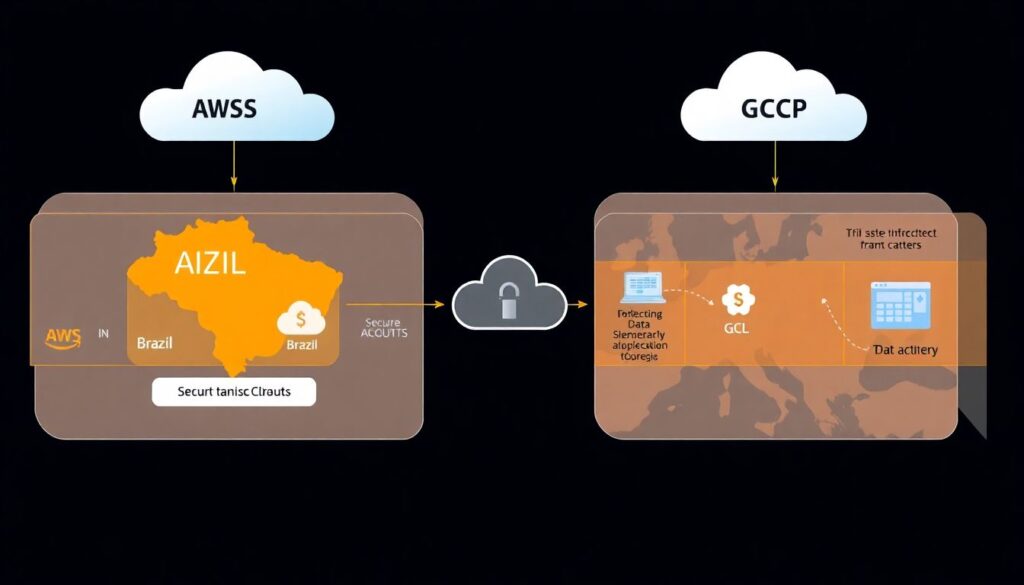
Consider a fintech operating in Brazil and Europe that processes banking transactions in AWS and analytics in GCP. A reasonably mature, compliant setup might look like this: each environment is in its own account/project, data is tokenized before leaving the transaction core, encryption keys are managed by a dedicated KMS team, PII fields in logs are masked, and data lakes in analytics have clear retention and access segregation by purpose. The ISMS scope covers both clouds, and the DPO has dashboards for incident metrics and DSR handling times.
By contrast, a non‑compliant but superficially “secure” example: everything is behind a VPN and security groups, but PII is duplicated into dozens of S3 buckets and BigQuery datasets, backups never expire, and there’s no clear map of where personal data lives. Access is granted by manual ticket and never revoked. If a data subject requests deletion, the company cannot realistically erase or de‑identify all copies. From an LGPD/GDPR standpoint, this is a serious accountability and minimization failure, even if there has never been an external breach.
Short takeaway: compliance is not only about “no breaches” but about demonstrable control over data lifecycle, especially in distributed cloud architectures.
—
When and why to bring in specialized cloud compliance partners
In 2026, more organizations are leaning on an empresa especializada em conformidade cloud LGPD GDPR for acceleration, not just for audits. These partners combine legal, security and cloud architecture skills, which is rare to build in‑house at scale and speed.
They typically help in three ways: first, by translating abstract legal obligations into concrete cloud controls and patterns; second, by designing landing zones and guardrails that bake compliance into new projects; and third, by preparing documentation and evidence for certifications, customer due diligence and regulatory inquiries.
The market for “serviços de consultoria compliance em nuvem LGPD” has matured: serious players now use Infrastructure as Code, policy‑as‑code, automated evidence collection, and pre‑built blueprints for sectors like finance, health and retail. The result is less manual work and fewer one‑off exceptions, which regulators increasingly interpret as a sign of good governance.
—
Forecast: where cloud compliance is heading after 2026
Looking ahead from 2026, a few clear trends are shaping compliance em cloud for LGPD, GDPR and ISO 27001:
First, policy-as-code becomes standard. Instead of PDFs no one reads, organizations encode privacy and security requirements into guardrails: for example, “no public buckets containing PII,” “no databases with PII in non‑approved regions,” or “no resource without a data retention tag.” Whenever engineers try to deploy something that breaks these rules, CI/CD pipelines or cloud policy engines block it automatically.
Second, cross‑regulation convergence will intensify. Besides LGPD and GDPR, frameworks like NIS2, DORA (for financial services) and sector‑specific health or financial rules are pushing for stronger operational resilience and incident reporting. ISO 27001 remains a central reference, but we’re seeing more integrated management systems that combine information security, privacy (ISO 27701), and business continuity (ISO 22301) into one program tightly coupled with cloud architectures.
Third, data localization and sovereignty controls are becoming more granular. Cloud providers are rolling out finer‑grained regional controls, sovereign clouds and “customer controlled key” models, making it easier to argue compliance with cross‑border data transfer rules. However, this also increases architectural complexity: multi‑region, multi‑cloud setups must handle data residency, resilience and latency trade‑offs at once.
Fourth, AI governance on cloud will be a frontline topic. Training and serving models that use personal data trigger new DPIA requirements, more stringent transparency expectations, and sometimes new legal bases for processing. Expect cloud‑native tooling for model lineage, dataset tracking and automated PII checks in training sets to become a core part of compliance strategies.
Finally, evidence automation will separate mature organizations from the rest. Manual screenshots and spreadsheets won’t scale. Systems that continuously collect and normalize logs, configurations, risk registers, DPIAs and access records into auditor‑friendly views will become baseline—not a luxury. Vendors are already building “compliance as code” platforms that connect directly to your cloud accounts and GRC tools.
—
Closing thoughts: making compliance an enabler, not a brake
Aligning security, privacy and regulatory requirements in cloud environments is absolutely possible without slowing innovation, but it requires thinking in systems, not in isolated controls. Treat LGPD and GDPR as the why, ISO 27001 as the how, and cloud architectures as the where. Combine them with automation, policy‑as‑code and a living ISMS, and cloud stops being a compliance headache and becomes a strong argument in your favor with customers, partners and regulators.
In other words, the companies that thrive after 2026 will be those that treat “compliance em cloud LGPD GDPR ISO 27001” not as a checkbox exercise, but as an ongoing design constraint—baked into architectures, processes and culture from day one.