Why protecting data at rest and in transit in the cloud really matters

When you move workloads to the cloud, you’re effectively putting your information on someone else’s computers and wires, o que torna a segurança de dados na nuvem criptografia em repouso e em trânsito uma prioridade prática, não теórica. Attackers rarely “hack the math” behind modern crypto; they go after misconfigured storage buckets, weak keys, outdated TLS versions and sloppy key management. That means the way you implement encryption in real workloads is far more important than choosing the “coolest” algorithm. If you treat encryption as a box‑ticking exercise, you usually end up with a system that looks secure on slides but leaks data through logs, backups, snapshots and debug endpoints that nobody remembered to lock down properly.
Necessary tools and building blocks
Core algorithms and libraries you actually use
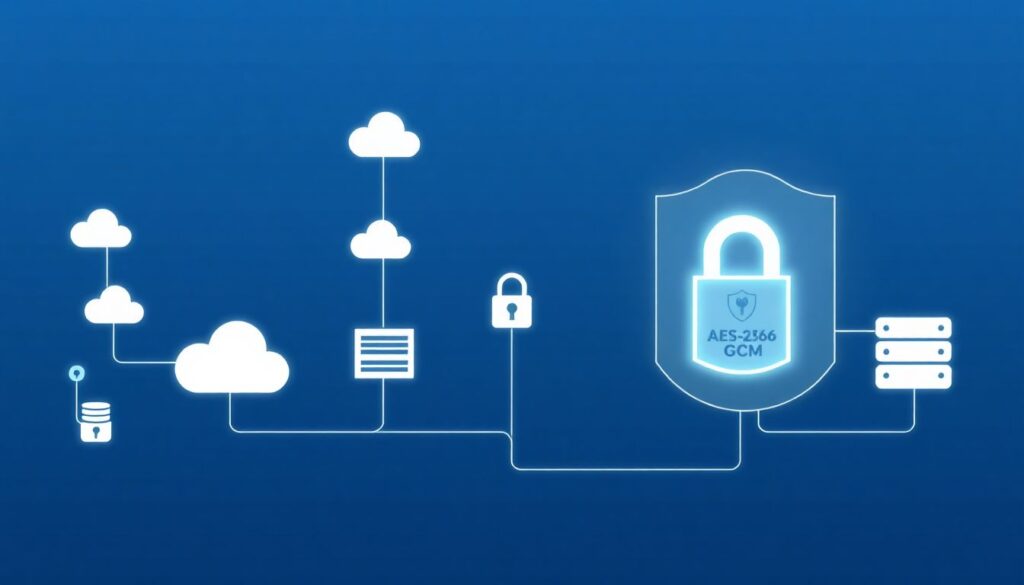
In practice you don’t need a zoo of algorithms; you need a small, boring set that is easy to automate and audit. For bulk encryption of files, databases and backups in the cloud, AES‑256 in GCM mode is the de facto standard, mainly because every cloud provider, HSM and modern CPU supports it efficiently. For keys in transit and key exchanges, you’ll typically rely on either elliptic curves like X25519 and P‑256 or RSA‑2048/3072 where legacy support is required. Instead of coding from scratch, you lean on proven libraries such as OpenSSL, BoringSSL, libsodium or the crypto SDKs that your cloud vendor ships, because subtle bugs in home‑grown code are the fastest way to turn “encrypted” into “recoverable by anyone”.
HSM, KMS and cloud‑native key management
If you want strong protection for encryption keys without turning your team into full‑time custodians of hardware, you usually combine a managed Key Management Service with serviços de HSM na nuvem para proteção de dados sensíveis. The KMS API gives you convenient operations such as “encrypt this blob with key X” or “generate a data key and wrap it”, while the underlying Hardware Security Module enforces that master keys never leave certified hardware. Practically, you use customer‑managed keys for anything regulated or business‑critical, automate rotation and access policies via infrastructure as code, and keep a tight mapping between applications and the keys they’re allowed to touch, reducing blast radius when something goes wrong.
TLS stack, certificates and client support
For data in motion, your backbone is TLS 1.2+ with modern cipher suites, and you normally aim for TLS 1.3 by default wherever clients allow. On the server side you need either a managed certificate solution from your cloud provider or an ACME‑based flow such as Let’s Encrypt, wired into your ingress, load balancers or API gateways. On the client side you rely on HTTP stacks that actually validate certificates, hostname and revocation where possible, avoiding “skip verification” flags that are popular in quick prototypes and then mysteriously remain in production. The implementação de TLS e criptografia end-to-end em aplicações cloud becomes much easier when you standardize on a small set of libraries and build simple wrappers so developers don’t have to think about the details every time.
Step‑by‑step: securing data at rest in the cloud
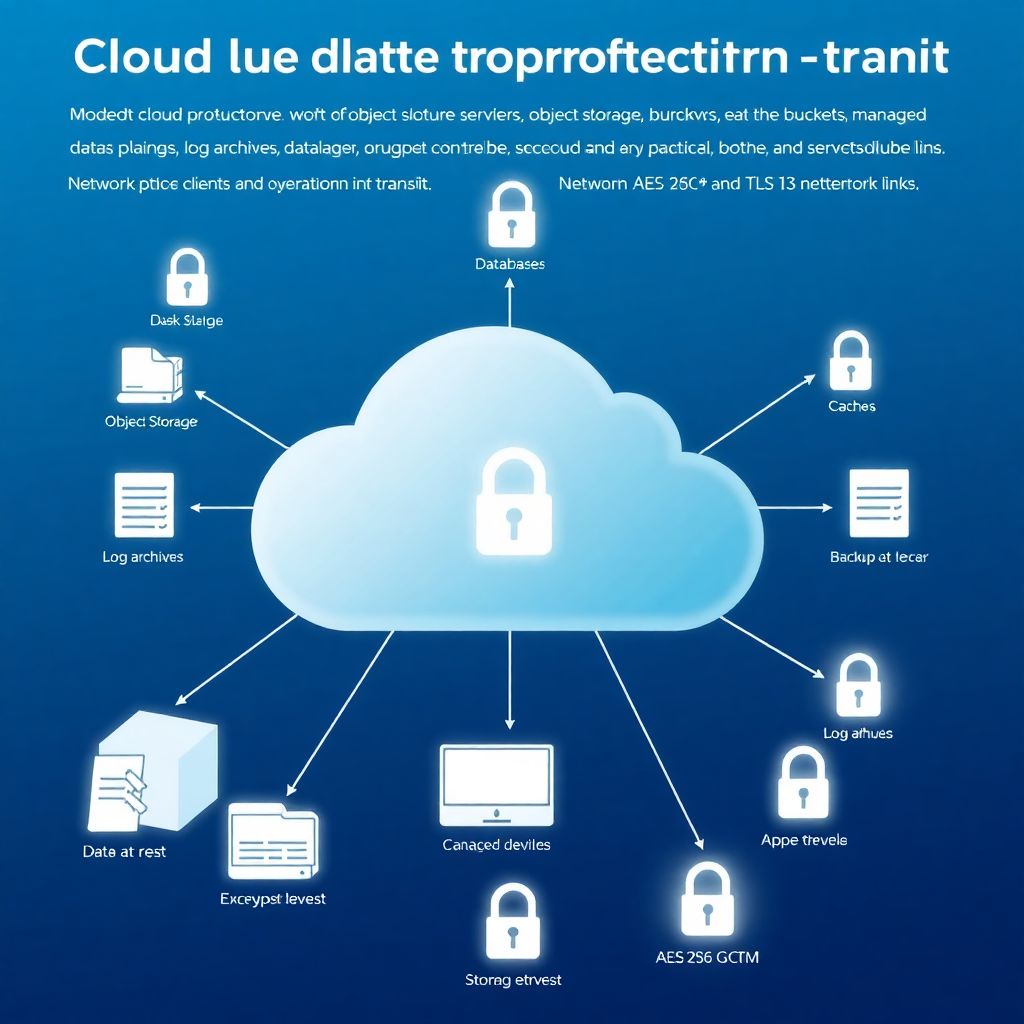
The first move is to inventory where your data really lives: object storage, block volumes, managed databases, caches, log archives and backups. Each of these must be mapped to soluções de criptografia para dados em repouso em provedores de nuvem that you can manage consistently. Start by enabling provider‑native encryption for every storage service, but do it with customer‑managed keys in your KMS, not provider‑managed defaults, so you control rotation, revocation and audit trails. Next, classify which datasets require an extra layer of application‑level encryption, for example personally identifiable information, card data or trade secrets, and design schemas where only specific columns are encrypted, keeping the minimum metadata in plaintext to preserve query performance.
Once the storage layer is covered, move to keys and automation. For each application, create a dedicated key hierarchy: a root key in HSM/KMS, data‑encryption keys for specific tables or buckets, and short‑lived local keys derived at runtime. Your app never stores raw master keys on disk; instead it asks KMS to generate or unwrap data keys, uses them in memory and discards them as soon as practical. Use infrastructure‑as‑code to describe keys, aliases and IAM policies, so any drift or manual changes are visible in version control. For backups, snapshots and exported data sets, enforce that creation pipelines always call the same encryption routines; unencrypted copies tend to appear in edge cases like ad‑hoc exports or emergency incident responses.
Step‑by‑step: securing data in transit and end‑to‑end
For traffic entering your cloud, terminate TLS at a controlled point such as a load balancer or API gateway, using automated certificate management. Force HTTPS everywhere, redirect plain HTTP, and disable weak protocols and ciphers, especially SSLv3, TLS 1.0 and outdated suites like RC4 or 3DES. Internal traffic deserves similar discipline: between microservices, between app and database, and across VPC peering or VPNs, configure TLS with mutual authentication where possible, so a compromised instance cannot impersonate other services easily. Many managed services support “require TLS” flags; turning these on and testing thoroughly is a quick win that closes a lot of accidental plaintext channels.
End‑to‑end encryption comes in when you don’t fully trust intermediaries such as SaaS providers or even some internal platforms. In a messaging or file‑sharing app, for example, keys are generated and managed on the client side, and servers only see ciphertext. The tricky part in implementação de TLS e criptografia end-to-end em aplicações cloud is usually key distribution and recovery: users forget passwords, devices are lost, and you still need a way to handle lawful requests or corporate retention rules. In practice, you often mix end‑to‑end for the most sensitive payloads with server‑side encryption for metadata, and implement transparent re‑encryption flows when rotating keys or changing device sets, always testing mobile and web clients together to avoid version‑mismatch failures.
Necessary tools in practice
On a day‑to‑day basis, the “toolbox” is less about individual binaries and more about integrated workflows. You’ll typically depend on your cloud provider’s CLI and SDKs to orchestrate key creation, policy updates and encryption settings, embedding them into CI/CD pipelines rather than running ad‑hoc commands from laptops. For developers, lightweight client libraries that hide low‑level crypto details are crucial; they expose simple operations like “encrypt field X in this record” or “open a secure channel to service Y” and enforce defaults that align with melhores práticas de proteção de dados na nuvem com HSM e TLS. Security teams then review these shared components instead of auditing bespoke cryptographic logic in dozens of microservices.
Monitoring and observability tools are equally important. You need logs from KMS and HSM services, certificate lifecycle events, TLS handshake metrics and storage‑level encryption status, all funneled into your logging and SIEM stack. Dashboards that show which buckets, volumes or databases are still using provider‑managed keys, or which endpoints haven’t been upgraded to TLS 1.2+, allow you to prioritize work based on real risk rather than assumptions. Finally, for regulated environments, you might add dedicated utilities to verify HSM compliance levels, generate attestation reports and prove that key material is handled according to applicable standards, giving auditors concrete evidence instead of hand‑wavy architecture diagrams.
Troubleshooting and common pitfalls
When things break around encryption, they usually fail in ways that confuse both developers and users. A misconfigured cipher suite can suddenly block older clients; enforcing TLS 1.2+ might cut off legacy scanners or embedded devices; rotating a KMS key without planning can make historical backups unreadable. To debug, start by isolating where the failure occurs: handshake, certificate validation, permission to use a key, or decryption of stored data. Increase logging levels temporarily, capture TLS handshakes with tools like OpenSSL s_client or browser dev tools, and cross‑check whether the keys referenced in error messages still exist, are enabled and have correct policies. Often the fix is as simple as re‑aligning IAM roles or reissuing certificates with proper Subject Alternative Names.
At rest, common problems include applications suddenly being unable to read old data after a migration, or performance drops when encryption is moved from infrastructure to application level. For data‑access issues, verify which key IDs are embedded in stored objects and whether those keys have been rotated, disabled or scheduled for destruction. Having a runbook that documents key hierarchies and rotation schedules pays off here. For performance, profile whether encryption is happening multiple times along the path or on very small chunks instead of streaming; adjusting buffer sizes or offloading encryption to instances with hardware acceleration can make a big difference. When troubleshooting, resist the temptation to “temporarily” disable encryption or weaken TLS; instead, fix the root cause and document the lessons so your next rollout is calmer.
Bringing it all together in real projects
Protecting cloud data in practice is about aligning architecture, automation and day‑to‑day habits. You use HSM‑backed KMS keys to secure the crown jewels, provider‑native encryption to cover the bulk of storage, and consistent TLS everywhere to keep bytes safe on the wire. On top of that, targeted end‑to‑end schemes protect the most sensitive use cases where you don’t want intermediaries to see plaintext at all. Over time, you treat encryption settings as code, test them in staging the same way you test business logic, and wire them into your observability stack so regressions are spotted early. When segurança de dados na nuvem criptografia em repouso e em trânsito becomes a normal part of how you build and ship, rather than a last‑minute compliance fix, you end up with systems that are not only harder to breach, but also easier to reason about and maintain.