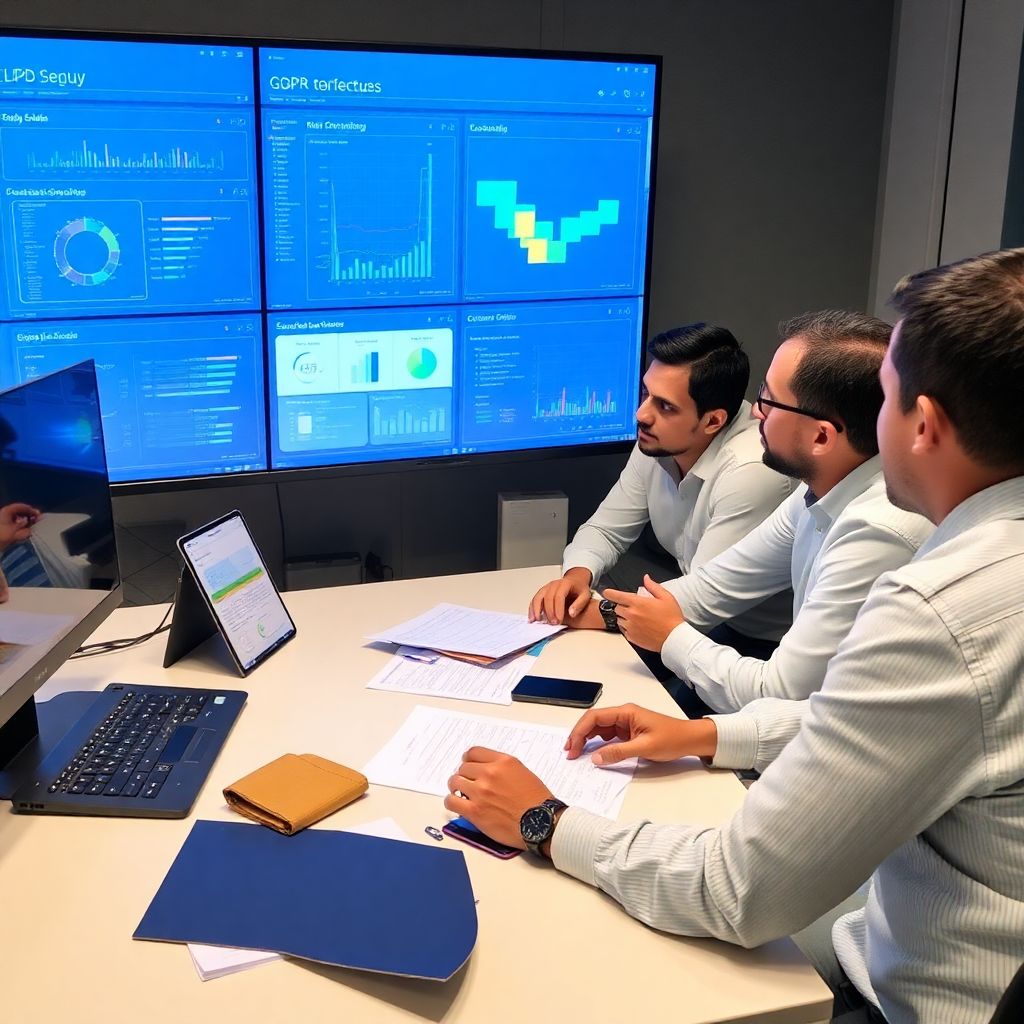
A cloud governance and compliance program for LGPD, GDPR and ISO 27001 defines clear ownership, risk-based controls and continuous monitoring for your cloud workloads. Start by scoping regulations, mapping data flows and defining policies, then implement technical safeguards, vendor controls and recurring audits aligned with your Brazilian context and your providers.
Governance and Compliance Quick-Checklist
- Define scope: which business units, cloud accounts, regions and data types are in scope for LGPD, GDPR and ISO 27001.
- Appoint roles: DPO, information security leader, system owners and data stewards with written responsibilities.
- Map data flows: document where personal data is stored, processed and transferred across cloud services.
- Standardize policies: approve cloud security, privacy, incident response and vendor management policies.
- Implement core controls: IAM, encryption, logging, backup, change management and vulnerability management.
- Embed vendors: align contracts, DPAs and SLAs with regulatory and ISO 27001 requirements.
- Measure and improve: establish KPIs, run periodic audits and track corrective actions to closure.
Assessing Regulatory Scope: LGPD, GDPR and ISO 27001
Use this section to decide if a full cloud governance program is needed now, and where to focus first.
- Confirm whether you process personal data of individuals in Brazil (LGPD) and in the EU/EEA (GDPR), even if your company is based elsewhere.
- Identify whether you have contractual obligations that require implementação ISO 27001 em ambiente de nuvem or similar security certifications.
- List all public, private and hybrid cloud environments used (IaaS, PaaS, SaaS) and match them to business processes that handle personal data.
- Classify workloads: critical (customer data, payments), important (HR, finance) and supporting (logs, analytics) to define governance depth per group.
- Decide on the minimal viable scope for phase 1: for example, only production workloads with customer data in Brazil and the EU.
- If you have very small, low-risk, internal-only cloud use, consider lightweight policies instead of a full ISO 27001-style program.
- When internal expertise is limited, compare internal capability versus hiring consultoria lgpd gdpr iso 27001 nuvem to accelerate design and implementation.
| Area | LGPD | GDPR | ISO 27001 | Typical Cloud Control Example |
|---|---|---|---|---|
| Legal basis & purpose | Legal bases and purpose limitation | Legal bases and purpose limitation | Information security objectives and policies | Data processing register with purposes and legal bases mapped per cloud workload |
| Data subject rights | Access, correction, deletion, portability | Access, rectification, erasure, portability | Requirements for handling information requests | Standard operating procedure for rights requests integrating cloud applications and support tools |
| Security of processing | Technical and administrative safeguards | Integrity, confidentiality and resilience | Annex A controls (e.g., access control, cryptography) | Hardened IAM, encryption at rest/in transit and centralized logging in all cloud accounts |
| Vendors & processors | Controller-operator contracts | Controller-processor contracts and DPAs | Supplier relationship controls | Standard DPA clauses and security schedules in all cloud provider contracts and major SaaS agreements |
| Incident management | Breach communication duties | Breach notification timelines and content | Information security incident management | Runbooks for cloud incidents with notification criteria and regulator timelines documented |
Example artifact: Regulatory Scope and Control Mapping Worksheet (LGPD/GDPR/ISO 27001).
Cloud Risk Inventory and Data Flow Mapping
Prepare these inputs before defining detailed policies and controls for your cloud program.
- Compile an inventory of all cloud services in use (including shadow IT) with owners, data types and regions.
- Identify which services process personal data, sensitive personal data or only operational/technical data.
- Create data flow diagrams for top 5-10 critical processes, showing sources, processing, storage and outbound transfers.
- Record cross-border data transfers (for example, Brazil to EU or US) and the legal transfer mechanisms applied.
- Document shared responsibility models for each major cloud provider so you know which controls are your duty.
- Ensure security and privacy teams have read-only access to cloud consoles, logging tools and ticketing systems.
- Select and configure ferramentas de compliance em nuvem lgpd gdpr (for example, CSPM or data discovery tools) to support continuous inventory and risk visibility.
- Align the inventory structure with whatever empresa de adequação lgpd gdpr para cloud or internal audit team you work with, so evidence expectations are clear.
Example artifact: Cloud Asset and Data Flow Register (spreadsheet with owners, regions, data categories and risk rating).
Policy Framework: Roles, Responsibilities and Controls

Use this mini preparation checklist before you start writing or updating policies for governance and compliance em nuvem.
- Confirm executive sponsor and steering committee for cloud governance decisions.
- Agree on a single policy template format and approval workflow.
- Align terminology (e.g., what counts as personal data, system of record, production).
- Decide which policies apply company-wide and which are cloud-specific standards or procedures.
- Collect existing policies to avoid duplication and conflicting requirements.
-
Define governance structure and key roles.
Document who owns decisions, risk acceptance and exception approvals for cloud.- Assign a DPO (or LGPD/GDPR lead), CISO/security lead, cloud platform owner and system owners.
- Describe responsibilities in a RACI matrix covering privacy, security and vendor management.
-
Create or update the cloud security and privacy policy.
Establish high-level rules applicable to all cloud workloads and projects.- Include principles for data minimization, encryption, logging, backup and access control.
- Reference LGPD, GDPR and ISO 27001 requirements without copying law text.
-
Define control standards for identity, access and privileged accounts.
Turn policy principles into concrete, testable rules.- Require SSO and MFA for all admin access and for users of critical cloud applications.
- Set maximum privilege durations, approval rules and periodic access reviews.
-
Set data classification and handling rules for cloud data.
Align with LGPD/GDPR personal and sensitive data concepts.- Define at least public, internal, confidential and restricted levels.
- Link each level to allowed cloud storage locations, encryption, and sharing restrictions.
-
Establish incident response and breach notification procedures.
Ensure cloud-specific scenarios are covered.- Describe detection sources (SIEM, CSPM, provider alerts) and triage steps.
- Include LGPD and GDPR breach notification criteria, internal timelines and approval chain.
-
Define vendor management and cloud onboarding requirements.
Set a standard path for new cloud services.- Require DPIA/PIA or risk assessment for services that handle personal data.
- Mandate security and privacy review before signing contracts or enabling integrations.
-
Approve, communicate and train.
Make policies visible and understood, not just documents in a shared drive.- Get formal approval from leadership and register version and date.
- Run short training sessions for engineering, DevOps, legal and business teams that use cloud.
Example artifact: Cloud Governance Policy Pack (policy, standard and RACI matrix).
Technical Safeguards: Encryption, IAM and Continuous Monitoring
Use this checklist to verify that core technical controls are implemented and auditable in your cloud environments.
- Ensure encryption in transit is enforced (e.g., HTTPS/TLS) for all external and internal cloud-facing endpoints.
- Confirm encryption at rest for databases, object storage and backups that contain personal or sensitive data.
- Centralize IAM with SSO, enforce MFA and disable direct long-term root keys in cloud provider accounts.
- Implement least-privilege roles for applications and services, avoiding wildcards in permissions.
- Enable detailed logging for access, configuration changes and security events; store logs in a tamper-resistant location.
- Integrate logs into a SIEM or monitoring platform with alert rules for suspicious activities.
- Deploy vulnerability management and baseline configuration checks aligned with ISO 27001 Annex controls.
- Use cloud-native or third-party CSPM as part of your serviços de governança e compliance em nuvem to detect misconfigurations.
- Test recovery regularly: verify that backups can be restored and that RTO/RPO targets are achievable.
- Review and document exceptions where controls cannot be fully applied, with approved risk owners and deadlines.
Example artifact: Cloud Security Technical Controls Checklist (per environment/account).
Operationalizing Compliance: Contracts, Vendor Management and SLAs
Be aware of these frequent mistakes when operationalizing LGPD/GDPR and ISO 27001 compliance with cloud vendors.
- Relying only on big-brand reputation and certifications without reviewing specific data protection terms and technical controls.
- Failing to classify vendors correctly as processors or controllers, leading to incorrect LGPD/GDPR clauses.
- Leaving data processing agreements (DPAs) or LGPD addenda unsigned or inconsistent across similar cloud services.
- Negotiating SLAs focused only on uptime, ignoring incident response times, log retention and cooperation in investigations.
- Not verifying where data is actually stored and processed, especially for backup, analytics and AI services.
- Accepting vague audit rights that do not provide realistic access to evidence or third-party reports.
- Skipping formal onboarding and exit plans for major SaaS platforms, which complicates data return or deletion.
- Ignoring alignment between your ISO 27001 controls and the provider's controls, assuming "ISO certified" fully covers your responsibilities.
- Failing to monitor ongoing vendor posture (new sub-processors, architecture changes, incidents) after contract signature.
- Not leveraging specialized consultoria lgpd gdpr iso 27001 nuvem or internal legal support when evaluating complex, high-risk cloud contracts.
Example artifact: Cloud Vendor Risk and DPA Checklist (per provider/SaaS).
Audit, Metrics and Continuous Improvement Plan

Consider these implementation options and choose the mix that best fits your size, maturity and risk profile.
- Internal audit-driven model: Use internal audit to run periodic reviews against LGPD/GDPR and ISO 27001 controls in cloud environments, ideal for medium to large organizations with established governance.
- Certification-oriented model: Prioritize implementação ISO 27001 em ambiente de nuvem as the backbone, using its Annex A and audit cycles to structure cloud compliance and vendor assessments.
- Managed compliance services: Engage serviços de governança e compliance em nuvem via an external empresa de adequação lgpd gdpr para cloud when internal bandwidth or expertise is limited.
- Hybrid coaching model: Combine internal ownership with periodic guidance from consultoria lgpd gdpr iso 27001 nuvem to design the framework, select ferramentas de compliance em nuvem lgpd gdpr and train teams.
Example artifact: Cloud Compliance Audit and KPI Plan (schedule, scope, metrics and owners).
Practical Answers to Common Implementation Challenges
How narrow can I set the initial scope for my cloud governance and compliance program?
Start with production systems handling customer or employee personal data in your main regions (for example, Brazil and EU). Document why other environments are out of scope and plan a roadmap to include them later as capacity grows.
Do I need both LGPD and GDPR controls if I only have a few EU users?
If you target or monitor EU residents, you should implement GDPR-aligned controls, even for a small user base. In practice, design one unified privacy and security baseline that satisfies the stricter overlapping requirements of LGPD and GDPR.
How do I align ISO 27001 with fast-changing cloud environments and DevOps?
Embed ISO 27001 controls into CI/CD pipelines, infrastructure-as-code and standard templates instead of manual checklists. Focus audits on whether these automated controls are consistently applied and monitored, not on one-time configuration snapshots.
What if my cloud providers do not offer all the controls I want?
Document the gaps, implement compensating controls (for example, additional encryption, network controls or logging) and get risk acceptance from the appropriate owner. If key risks remain unacceptable, look for alternative providers or architectures.
How often should I review cloud policies and vendor contracts?
Review high-impact policies and key vendor contracts at least annually or when there are major changes in law, architecture or business model. Track reviews and outcomes in a simple register so you can demonstrate governance to auditors and regulators.
How can a small team maintain continuous monitoring without overloading people?
Prioritize automations: use cloud-native alerts, CSPM and basic SIEM rules with clear, simple runbooks. Start with a small set of critical alerts, measure false positives and iteratively tune before expanding coverage.
When is it worth bringing in external cloud compliance specialists?
External specialists add strong value when designing the initial framework, running your first DPIAs and preparing for ISO 27001 certification or external audits. They can also validate your architecture and tooling choices before large migrations.