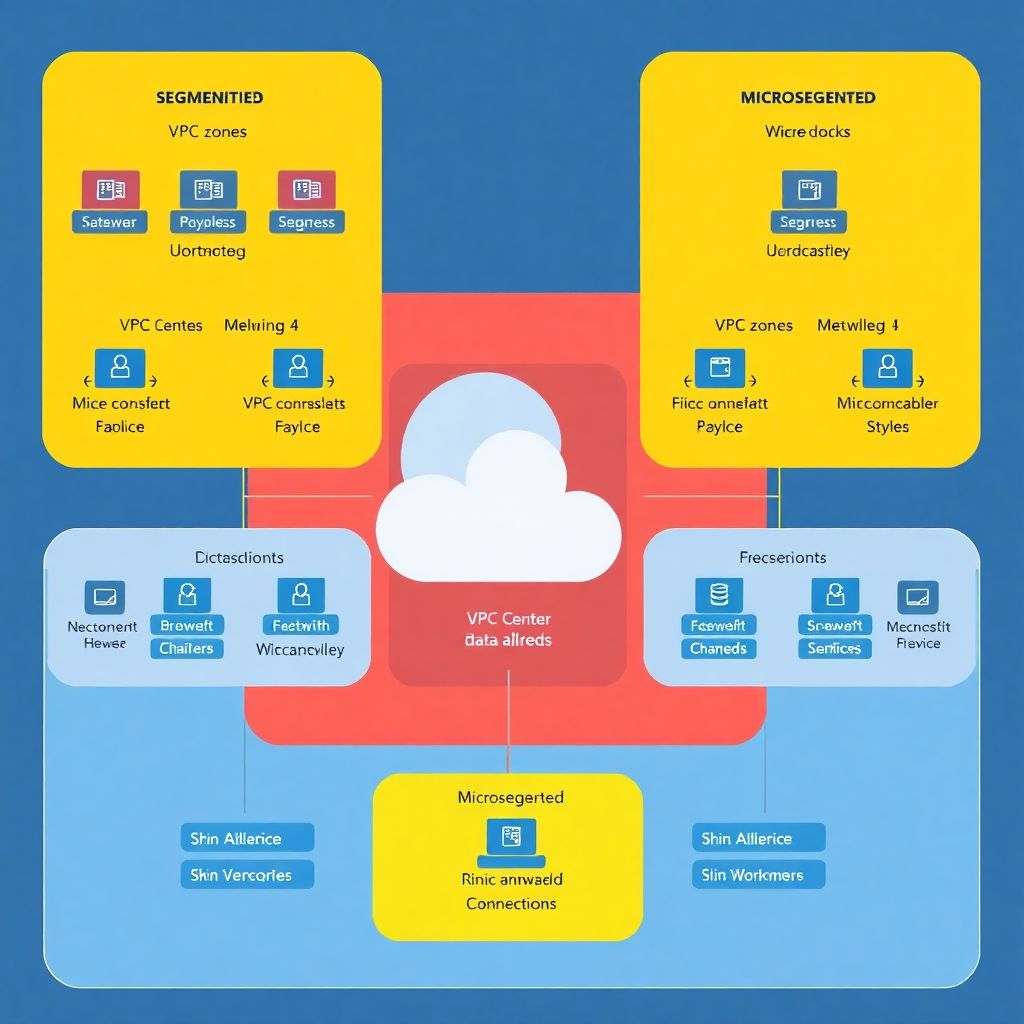
Secure network segmentation and microsegmentation in cloud means grouping workloads by risk, identity and function, then enforcing least-privilege traffic rules at VPC/VNet and workload level. You define environment and application zones, label assets consistently, apply deny-by-default policies, and continuously validate flows with logging, tests and simple rollback options.
Essential design checkpoints for network and microsegmentation
- Clarify zero-trust goals: what business systems must be isolated, monitored and auditable.
- Map current flows before blocking anything, especially between internet, VPN, partners and production workloads.
- Start with coarse segmentação de rede em cloud computing (environments, tiers) before microsegmenting workloads.
- Use labels/tags as the primary source of truth for dynamic grouping and policy targeting.
- Prefer allow-lists with deny-by-default, rolled out in monitor-only mode first.
- Plan incident-safe rollbacks so a bad policy change does not break critical applications.
- Integrate logs and alerts into existing SIEM/monitoring to catch policy regressions quickly.
Foundations: zero-trust objectives and segmentation requirements
For Brazilian organizations adopting cloud, microsegmentação de segurança na nuvem is most effective when guided by clear zero-trust objectives, not by ad‑hoc firewall rules. Define what you are protecting, from whom, and which flows are strictly necessary for those services to operate.
This approach fits when you:
- Run workloads in public cloud (AWS, Azure, GCP, Kubernetes) with mixed sensitivity levels.
- Need compliance with regimes such as LGPD, PCI DSS, or internal security baselines.
- Have at least basic infrastructure-as-code or tagging hygiene in your accounts/subscriptions.
- Need safer soluções de microsegmentação для empresas that scale across multiple regions and teams.
It is usually not the right time to aggressively microsegment when:
- Your asset inventory is outdated and you do not know which services talk to which.
- You lack observability (no flow logs, no central logging) to safely test policies.
- You are in the middle of a large migration and constantly changing IP ranges and VPC/VNet layouts.
- You cannot yet enforce basic melhores práticas de design seguro em redes cloud such as separate prod/non‑prod accounts.
Cloud network topologies and where to place segmentation controls
Before deciding como implementar segmentação de rede em ambiente cloud, confirm which layers you will control: cloud-native network boundaries, security groups / NSGs, Kubernetes network policies, and, optionally, host or agent-based microsegmentation.
| Preparation item | Why it is needed | Owner | Minimum permissions |
|---|---|---|---|
| Cloud account / subscription access | Inspect VPC/VNet, subnets, security groups, route tables and gateways. | Cloud admin / DevOps | Read-only on networking resources, change on non-production. |
| Tagging/labeling standard | Group workloads by environment, app, team and sensitivity for microsegmentation. | Security + Platform team | Ability to read and update tags/labels on compute and services. |
| Flow and access logs | Observe real traffic to design safe allow-lists and detect breaks. | Security / Observability | Enable VPC flow logs, NSG flow logs, Kubernetes audit/network logs. |
| Change management path | Approve, deploy and, if necessary, roll back segmentation policies. | Security change board | Rights to edit security groups, NSGs, network policies in non‑prod and prod. |
| Testing environment | Validate blocking rules without impacting critical production systems. | Platform / Dev | Full change access in at least one staging or sandbox environment. |
Place segmentation controls at several layers:
- Perimeter / entry: Cloud firewalls, load balancers and WAFs separating internet/VPN from VPC/VNet.
- Environment boundaries: Separate VPCs/VNets/accounts for prod, staging and dev, peered only when needed.
- Tier boundaries: Subnets and security groups/NSGs for web, app, and data tiers, with restricted east‑west flows.
- Microsegmentation layer: Security groups, Kubernetes network policies or host agents restricting workload-to-workload access.
Microsegmentation building blocks: identity, labels, and enforcement
Use this mini preparation checklist before changing any runtime policies:
- Export current security group/NSG and firewall rules for the target environment.
- Enable or verify VPC/NSG flow logs are writing to a central log account.
- Confirm backup or snapshot procedures for critical workloads.
- Define and document required flows for at least one application you will microsegment first.
- Agree on labels/tags that will drive policy, such as
env,app,roleandsensitivity.
-
Establish a consistent identity and labeling model
Microsegmentation depends on stable identities; in cloud this usually means tags/labels, security principals and sometimes IP ranges. Design a minimal but expressive schema and apply it to existing resources.
- Cloud tags:
env=prod|stg|dev,app=billing|checkout,role=web|api|db,owner=team‑name,sensitivity=restricted|internal. - Kubernetes labels:
app,tier,team,compliance,zone. - Identity: IAM roles, managed identities or service accounts mapped to application roles.
- Cloud tags:
-
Map flows and define segmentation zones
Create logical zones based on environment, business function and data sensitivity. Use current logs and developer input to document which zones need to talk to each other.
- Zones by environment: prod-front, prod-app, prod-db, stg-front, etc.
- Zones by function: customer-facing, back-office, shared services (identity, logging).
- Data sensitivity: separate workloads handling financial or personal data from general workloads.
-
Define least-privilege policies in monitor mode
For each zone pair, specify required protocols, ports and directions. Implement as allow-list rules but initially in a non‑blocking or log‑only mode where available.
- Inbound internet to web: HTTP/HTTPS via load balancer or API gateway only.
- Web tier to app tier: specific TCP ports, no direct access to databases.
- App tier to database: database port only, from tagged application instances.
-
Implement enforcement using cloud-native controls
Translate policies into security groups, NSGs, Kubernetes network policies or host agents. Apply to groups based on labels, not individual IPs, so the design follows workloads automatically.
- Security groups/NSGs referencing tags or application security groups where supported.
- Kubernetes network policies selecting pods by
appandtierlabels. - Optional commercial soluções de microsegmentação para empresas for mixed environments or legacy OS.
-
Roll out gradually with validation and rollback
Start with one non‑critical application or environment, then expand. For each rollout, document a back‑out plan and success criteria.
- Enable new deny rules on staging first; run application smoke tests.
- Monitor logs for blocked but necessary flows and adjust policies.
- Promote to production during low-traffic windows, with on‑call teams aware of the change.
Translating intent into policy: rule design, scoping and inheritance
Use this checklist to confirm your policy structure matches business intent and is safe to maintain over time.
- Business intent is captured explicitly (e.g., “customers access billing via HTTPS only”) and traceable to specific rules.
- Global/base rules are minimal and apply only to shared services (DNS, NTP, logging), not to every workload.
- Environment-specific policies (prod vs dev) are separated, preferably by different accounts/subscriptions or policy scopes.
- Application-specific rules override only what is necessary and are clearly documented next to the application code or IaC.
- Policies reference labels/tags whenever the platform supports it, avoiding hard-coded IPs and ports where possible.
- Deny-by-default posture is enforced at least at subnet/security group level, with explicit allows for each dependency.
- Ingress and egress rules are symmetrical and audited, especially for outbound internet access from workloads.
- Change history is tracked (Git, change tickets) so you can answer who changed which policy and why.
- Automated tests (smoke tests, connectivity checks) run after each policy change in CI/CD pipelines.
- Shadow or unused rules are periodically reviewed and removed to keep policy sets understandable.
Step-by-step implementations: AWS, Azure and Kubernetes examples
The examples below show safe starting points; each includes a decision hint and a one-line snippet you can expand in infrastructure-as-code.
AWS security groups for three-tier web app
When to use: Standard web/app/db stack in a single VPC, using security groups and ALBs, with clear tags for environment and role.
- Define three security groups:
sg-web,sg-app,sg-db. - Allow internet to
sg-webonly via load balancer; no direct SSH from the internet. - Allow
sg-webto reachsg-appon application ports; block all else. - Allow
sg-appto reachsg-dbonly on the database port; deny other sources.
One-line example (AWS CLI allow web->app):
aws ec2 authorize-security-group-ingress --group-id sg_app --protocol tcp --port 443 --source-group sg_web
Troubleshooting tips:
- If traffic fails, verify instance is associated with the correct security group and subnet ACLs are not blocking.
- Check VPC flow logs for
REJECTentries between web and app subnets. - Confirm the load balancer health checks use allowed ports and security groups.
Validation checklist:
- Application accessible over HTTPS through the load balancer from test clients.
- No direct SSH/RDP access from the internet to app or db instances.
- Database port not reachable from web tier or the internet according to port scans.
Azure NSG microsegmentation for hub-spoke VNets
When to use: You have a hub VNet with shared services and multiple spokes (prod, dev) peered to it.
- Create NSGs per subnet:
nsg-prod-web,nsg-prod-app,nsg-prod-db, etc. - Restrict spoke-to-spoke traffic; allow only required ports from prod-web to prod-app, and prod-app to prod-db.
- In hub, allow only specific inbound from on-prem VPN and management subnets.
One-line example (Azure CLI restrict app->db):
az network nsg rule create --nsg-name nsg-prod-db --name AllowAppToDb --priority 100 --direction Inbound --access Allow --protocol Tcp --source-address-prefixes ProdAppSubnet --source-port-ranges "*" --destination-port-ranges 5432
Troubleshooting tips:
- Check effective security rules at the NIC level in the Azure portal to see merged policies.
- Ensure VNet peering does not have Allow forwarded traffic or Use remote gateway misconfigured.
- Verify no overly permissive
AllowAnyAnyrules placed with higher priority.
Validation checklist:
- Prod database reachable only from prod app subnet on the correct port.
- Dev spokes cannot initiate connections into prod spokes.
- Management and monitoring tools can still reach required resources.
Kubernetes network policies for namespace isolation
When to use: You run multi-tenant or multi-team clusters and want pod-level microsegmentation between namespaces and apps.
- Enable network policy support in your CNI (e.g., Calico, Cilium, Azure CNI with policies).
- Start with a default-deny ingress policy per namespace, then selectively allow required flows.
- Group pods by labels like
app,tierandteamfor flexible targeting.
One-line example (kubectl apply default-deny):
kubectl apply -n prod -f default-deny-all.yaml
Troubleshooting tips:
- If pods lose connectivity, check for missing DNS or metrics service policies.
- Use
kubectl describe networkpolicyand CNI logs to understand which rules matched. - Test connectivity with temporary debug pods in each namespace.
Validation checklist:
- Pods cannot reach other namespaces except where explicitly allowed.
- Ingress traffic arrives only through intended Ingress controllers or gateways.
- Cluster DNS and monitoring remain fully functional after policies are applied.
Verification and observability: testing, alerts and post-deploy playbooks
Several approaches can complement or temporarily replace fine-grained microsegmentation depending on your maturity and tooling.
- Coarse-grained segmentation with strong monitoring: Focus on environment and subnet isolation, combine with detailed flow logs and anomaly detection when deep application knowledge is missing.
- Service mesh with policy features: Use mTLS and service-level authorization (e.g., mesh authorization policies) when you already run a mesh and want identity-driven control within clusters.
- Host-based firewalls and EDR policies: For legacy or on-prem workloads, apply OS firewalls (iptables, Windows Firewall) and EDR network controls as an intermediate solution.
- Commercial microsegmentation platforms: When you have heterogeneous environments and need unified visibility and policy across multiple clouds, consider mature platforms that integrate with your CMDB and SIEM.
Regardless of the option, keep observability in place: flow logs, centralized logging, alert rules for denied traffic spikes, and simple post-deploy playbooks describing what to check and how to roll back if needed.
Practical answers to recurring implementation hurdles
How do I start segmentation without breaking production?
Begin in a non-production environment and enable logs everywhere. Reproduce representative workloads, then apply deny-by-default rules in monitor or log-only mode. Promote only after you have tests and a rollback plan.
Should I segment by IP ranges or by tags and labels?
Prefer tags and labels because they follow workloads when IPs or subnets change. Use IP-based rules only where the platform lacks identity-aware controls or for temporary exceptions.
How does microsegmentation interact with zero-trust networking?

Microsegmentation is one of the enforcement mechanisms of zero-trust, limiting lateral movement. Identities and strong authentication decide who is allowed; segmentation rules constrain where those identities can communicate.
Can I rely only on Kubernetes network policies for cloud security?
No. Network policies protect pod-to-pod traffic but do not replace VPC/VNet boundaries, account separation, or cloud firewalls. Use them in combination, especially for east-west traffic inside clusters.
What is the minimum I should do if I lack time and tools?
Separate prod and non-prod into different accounts or subscriptions, restrict inbound internet access to a few entry points, and enforce least-privilege security groups or NSGs for your most critical applications first.
How often should I review segmentation policies?
Review at least when major application changes occur and during scheduled security reviews. Automate checks to detect unused or overly permissive rules and remove them regularly.
When is a commercial microsegmentation solution justified?

It becomes attractive when you have many hybrid environments, limited internal expertise, and a need for unified visibility and policy management across multiple clouds and data centers.