
To standardize security across multi-cloud and hybrid environments, define one reference security baseline, express it as code, then enforce it through centralized identity, network, data protection and monitoring controls across all providers. Use vendor-neutral tools where possible, and adapt only the minimal provider-specific exceptions needed for Brazilian and global regulatory requirements.
Essential controls for harmonized multi-cloud security
- Define a single, provider-agnostic security baseline aligned with your risk appetite and compliance obligations in Brazil.
- Centralize identity, authentication and authorization for all clouds and data centers.
- Standardize network segmentation patterns and secure connectivity between environments.
- Apply consistent data classification, encryption and key management in every provider.
- Automate provisioning with IaC and policy-as-code, not manual changes.
- Consolidate monitoring, logging and detection across clouds and on-premises workloads.
- Continuously review vendor-specific risks and adjust cross-cloud controls over time.
Unified governance and policy frameworks across providers
Unified governance is essential when you run workloads in more than one hyperscaler or a mix of public cloud and on-premises. It is the foundation of segurança em ambientes multi cloud e híbridos because it ensures that the same rules apply regardless of where a workload runs.
It typically makes sense when:
- You already use at least two providers or a hybrid environment (for example, AWS + Azure + on-premises in Brazil).
- You must meet consistent compliance requirements (LGPD, sector regulators, internal audit) across all locations.
- Your security team needs a single view of policies and exceptions, instead of different spreadsheets per provider.
- You want to evaluate and compare soluções de segurança для multi cloud e nuvem híbrida without rewriting policies each time.
It is usually not the first priority when:
- You are still in early experimentation with a second cloud and have only a few non-critical workloads there.
- Your team has very low cloud maturity and is still learning basic concepts in a single provider.
- You lack any inventory or CMDB; in that case, focus first on visibility (assets, identities, data flows).
For a practical unified framework:
- Choose a primary reference: either a provider baseline (for example, Azure policies) or a neutral baseline (for example, CIS, NIST, internal control catalog).
- Map each requirement to concrete controls in each provider (IAM, security groups, policies, logs, encryption options).
- Decide how you will manage exceptions: central approval flow, time-bound exceptions, documented risk acceptance.
- Implement governance processes: change management for baseline updates, periodic reviews, and simple dashboards for gestão de controles de segurança entre provedores de nuvem.
Identity, authentication and least-privilege enforcement
Identity is usually the safest starting point for standardizing controls in multi-cloud and hybrid environments. To implement consistent identity, authentication and least-privilege you will need:
- Central identity provider (IdP)
- Enterprise IdP or directory (for example, AD/Entra ID, Okta, Ping) as the single source of truth for human identities.
- Federation or SSO integrations with each cloud provider console and major SaaS platforms.
- Role and group model
- Role definitions independent of any single provider (for example, “Cloud Network Admin BR”, “DevOps Prod”, “Data Steward LGPD”).
- Mapping of these roles to provider-specific permissions (IAM roles, custom policies, role assignments).
- Strong authentication requirements
- Multi-factor authentication required for all privileged access, including emergency and break-glass accounts.
- Conditional access policies for remote access from Brazil and from abroad, with risk-based restrictions.
- Mechanisms for least privilege
- Just-enough permissions: avoid wide admin roles (“Owner”, “Administrator”) as defaults; use granular, task-based roles.
- Just-in-time elevation: time-bound privileged access approvals instead of permanent admin assignments.
- Clear separation between production and non-production roles, reflected consistently in all providers.
- Non-human identities
- Standardized approach for service principals, workload identities and secrets for applications and CI/CD tools.
- Central secret management or at least documented mapping between vaults in different clouds.
- Access review and logging
- Central process for periodic access reviews covering all clouds and on-premises directory groups.
- Consolidation of login and authorization logs into your SIEM for detection of abuse and misconfiguration.
Once these elements are in place, you can apply the same access patterns and reviews to any new provider or region with minimal changes, reinforcing melhores práticas de segurança em ambientes híbridos e multi cloud.
Network segmentation and secure connectivity patterns
Risk considerations before designing cross-cloud networking
- Overly flat networks across clouds can allow lateral movement from a compromised workload in one provider into critical systems in another.
- Complex meshes of VPNs and peering links are hard to monitor and can hide insecure shortcuts created under time pressure.
- Routing mistakes might send Brazilian customer data through unintended regions or unencrypted paths.
- Inconsistent firewall policies between providers lead to gaps attackers can exploit.
- Network-based controls alone are not sufficient; always combine them with identity, encryption and robust logging.
The steps below describe a safe and practical way to standardize segmentation and connectivity across providers and on-premises.
-
Define a provider-neutral segmentation model
Create a simple, reusable segmentation pattern that does not depend on any single cloud vendor naming or technology.
- Start from business domains and data sensitivity, not from IP ranges.
- Define a small number of segments: for example, “public edge”, “app”, “data”, “management”, “shared services”.
- Describe which segments may talk to each other and under what conditions (ports, protocols, encryption).
-
Map segments to each provider and on-premises
Translate the neutral model into concrete constructs in each environment to keep gestão de controles de segurança entre provedores de nuvem aligned.
- For each provider, choose which networks (VPCs/VNets), subnets and security groups correspond to each segment.
- For on-premises, align VLANs, VRFs or security zones with the same segmentation names.
- Keep a single reference document or diagram that shows the mapping for all locations.
-
Standardize connectivity patterns between environments
Adopt a small set of approved patterns for connecting clouds and data centers safely.
- Prefer private, encrypted connectivity (dedicated links or VPNs) for production workloads and sensitive data.
- Use hub-and-spoke or transit-style architectures instead of fully meshed point-to-point links.
- Ensure traffic inspection points (firewalls, IDS/IPS) are clearly defined and monitored.
-
Harden and align security controls on each path
Make sure that every allowed path has equivalent security controls, regardless of which provider it traverses.
- Apply consistent firewall rules: same source/destination groups, ports and justification in each provider.
- Enable encryption in transit by default, with modern protocols, between all segments and across all links.
- Limit direct internet exposure; place public endpoints only in designated edge segments.
-
Centralize visibility and configuration tracking
Monitor networks and changes centrally to detect drift and unsafe shortcuts early.
- Export flow logs and firewall logs from all providers into a central analytics or SIEM platform.
- Track network configuration as code (for example, via Terraform) for clouds and, where possible, for on-premises devices.
- Schedule regular reviews of connectivity diagrams to ensure they match real configurations.
-
Test and validate cross-cloud segmentation regularly
Do not assume the design is secure; verify it through controlled testing and reviews.
- Perform connectivity tests and path tracing between key segments across providers.
- Use automated checks to detect open ports or unexpected paths to the internet.
- Include cross-cloud scenarios in penetration testing and incident response simulations.
Data classification, encryption and consistent key management
Use this checklist to confirm your data protection model is coherent across multi-cloud and hybrid environments and supports segurança em ambientes multi cloud e híbridos aligned with LGPD and internal rules.
- Data classification scheme is documented, simple, and applied consistently in all providers (for example, public, internal, confidential, restricted).
- Each classification level has clear, written requirements for storage, transmission, access and retention.
- All storage services in every cloud (databases, object storage, disks, backups) have encryption at rest enabled by default.
- You have a documented position on which keys are provider-managed and which must be customer-managed (CMEK/HSM).
- Key management processes (creation, rotation, retirement, access control) are clearly defined and apply equally to all KMS or HSM instances.
- Access to key management systems is limited to a small, audited group, with strong authentication and separation of duties.
- Encryption in transit is enforced for all external and internal connections carrying personal or sensitive data.
- Data residency and cross-border transfer restrictions are mapped to specific controls in each cloud region and in your on-premises data centers.
- Backups and disaster recovery copies follow the same classification and encryption rules as primary data stores.
- Data discovery and catalog tools, including ferramentas para padronizar políticas de segurança multi cloud, are configured to scan all relevant accounts, subscriptions and regions.
Automation: IaC, policy-as-code and cross-cloud CI/CD controls
Automation is essential to maintain consistent controls, but it introduces its own risks. Below are frequent mistakes to avoid when implementing IaC and policy-as-code for soluções de segurança para multi cloud e nuvem híbrida.
- Using different IaC tools and templates in each provider with no common baseline, making reuse and review difficult.
- Keeping security configurations outside of IaC (manual firewall rules, console-created IAM roles, ad hoc changes in portals).
- Allowing developers or teams to bypass code review and approval flows for infrastructure changes in production.
- Storing secrets, keys or passwords directly in IaC files or CI/CD pipeline definitions instead of secure vaults.
- Not separating environments (dev, test, prod) properly in code, leading to accidental promotion of insecure settings into production.
- Encoding provider-specific assumptions (for example, region names, instance types, identity models) directly into shared modules without abstraction.
- Failing to implement automated policy checks (policy-as-code) before deployments, relying only on manual approvals.
- Ignoring roll-back and drift detection; infrastructure created via portal or CLI slowly diverges from code, and no one notices.
- Giving CI/CD pipelines overly broad permissions in all clouds, instead of narrowly scoped, environment-specific identities.
- Not logging pipeline activities and approvals centrally, which weakens forensic capabilities during investigations.
Monitoring, detection and auditability for hybrid environments
Monitoring strategies will depend on your size, tools and skills. Below are alternative models and when each fits best, especially for organizations modernizing segurança em ambientes multi cloud e híbridos in Brazil.
- Central SIEM with cloud-native integrations
Suitable when you want one main platform for detection and compliance reporting. Ingest logs from all providers and on-premises, normalize fields and build provider-agnostic correlation rules. Requires investment in tuning and storage, but simplifies audits and investigations.
- Cloud-native security services with light centralization
Works well when you already use managed detection services in each cloud. Use each provider's native security center and threat detection, then export only high-value alerts and summaries to a central view. Reduces complexity but may fragment visibility.
- Managed detection and response (MDR) across clouds
Useful if your team lacks capacity to operate 24×7 detection. An MDR provider can collect logs from all environments and operate tooling on your behalf, while you keep responsibility for approvals and remediation in each cloud.
- Hybrid approach with domain-specific tools
Appropriate when you already have specialized tools (for example, for endpoints, identity, or databases). Keep those tools, but define a minimal central layer for incident management, ticketing and compliance dashboards, ensuring melhores práticas de segurança em ambientes híbridos e multi cloud are visible at management level.
Operational questions on implementing cross-cloud controls
How do I start standardizing security if I already use multiple clouds chaotically?
Begin by inventorying accounts, subscriptions and critical workloads, then define a simple, provider-neutral baseline covering identity, network, data protection and logging. Apply it incrementally, starting with new projects and the highest-risk existing environments, and use IaC to reduce manual work.
Should I centralize everything in one security tool or keep each provider's native tools?

Most organizations benefit from a mixed approach: use cloud-native tools for deep provider integration, and a central SIEM or monitoring platform for correlation and reporting. Focus on having one authoritative incident workflow rather than one single technical tool.
How can I manage different compliance requirements across regions, including Brazil?
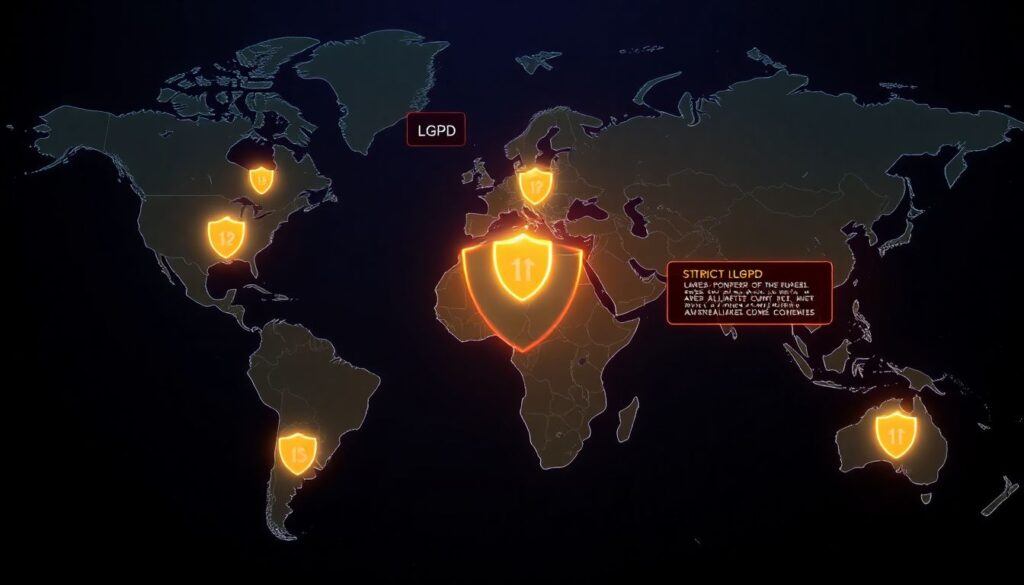
Create a global baseline and then define regional overlays for stricter requirements such as LGPD. Implement overlays as code (for example, policy sets or extra modules) so they are automatically enforced in specific regions or accounts.
What if my network team is not ready for complex multi-cloud architectures?
Keep the design as simple as possible: a limited number of segments, hub-and-spoke patterns and clear ownership per environment. Use managed connectivity services from providers when appropriate and invest early in training and documentation.
How often should I review cross-cloud security policies and exceptions?
Plan at least a periodic review cycle covering policies, exceptions and access rights. Also trigger ad hoc reviews after major incidents, architecture changes or regulatory updates. Automate as many checks as possible to detect drift between reviews.
What is the safest way to give developers flexibility without losing control?
Provide secure-by-default templates, guardrails and self-service platforms with built-in policies. Developers can choose configurations within approved ranges, while security keeps central visibility, alerting and override capabilities for high-risk changes.
How do I choose tools that support future providers or technologies?
Prefer tools and standards that are vendor-neutral, offer open APIs and support multiple clouds explicitly. Evaluate how easily they can onboard new providers and how they represent policies without locking you into proprietary models.