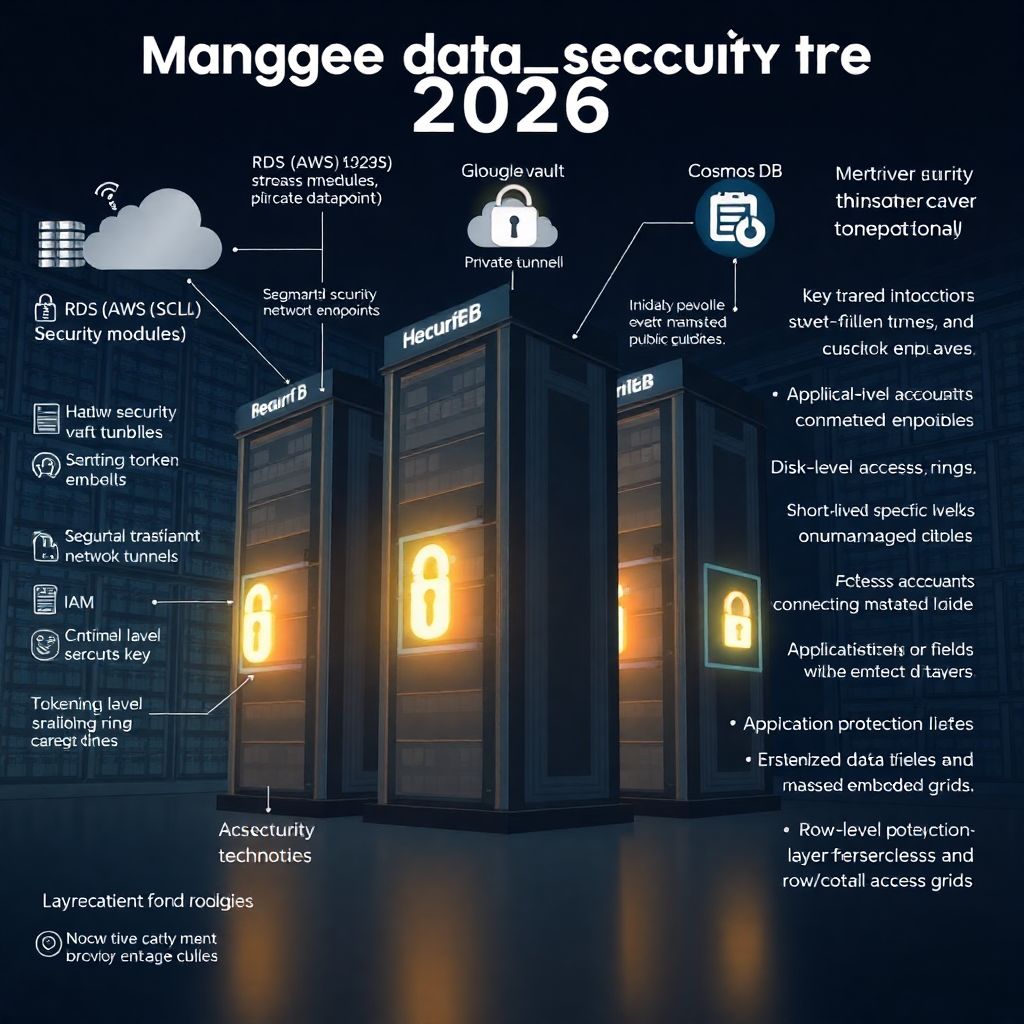
Why managed databases changed the security game
If you work with data long enough, you see the pendulum swing. In the 2000s everyone ran their own SQL servers; security meant firewalls, some backups and a lot of wishful thinking. When AWS RDS arrived, then Cloud SQL and later Cosmos DB, teams rushed to “outsource hassle” without fully understanding the new shared‑responsibility model. By 2026, a series of leaks and LGPD fines forced a reset: cloud vendors provide strong primitives, but they don’t magically give segurança dados sensíveis rds or instant compliance. The real shift is cultural: security has become a product requirement, not an afterthought, and managed databases are now evaluated as much by their protection features as by performance or price.
Core building blocks: encryption, isolation and identity
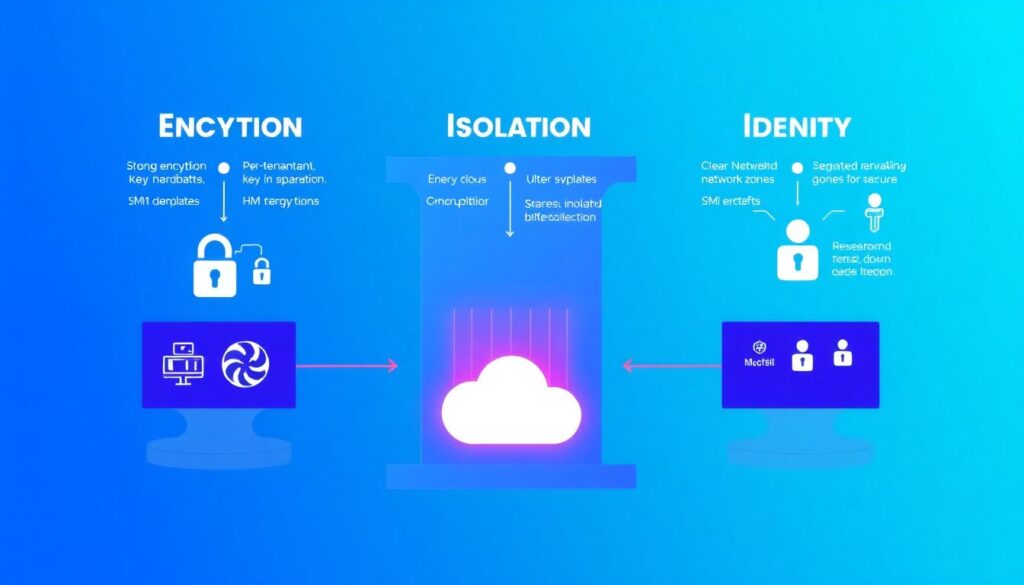
Under the hood, all major providers converge on three pillars: encryption, isolation and identity. Criptografia dados sensíveis banco de dados em nuvem is table stakes now, but details matter: customer‑managed keys, rotation, HSM integration, and per‑tenant keys for multi‑tenant apps. Network isolation evolved from basic VPC peering to private service connect and just‑in‑time access. Identity jumped from static passwords to IAM roles, short‑lived tokens and workload identity for containers and serverless. The trick is to use the strongest options your platform offers by default, then tighten them: no public endpoints, no shared DB users, and no long‑lived credentials baked into code or CI pipelines.
Comparing RDS, Cloud SQL and Cosmos DB approaches
Although they look similar on slides, each service pushes you toward slightly different security patterns. AWS RDS shines when you want fine‑grained network controls and tight IAM integration with the rest of AWS, making segurança dados sensíveis rds easier if your stack is already “all‑in” on AWS. Proteção dados confidenciais cloud sql leans on Google’s strength in default encryption, IAM semantics and strong audit logging, especially attractive for data teams deep into BigQuery. Cosmos DB, as a multi‑model, globally distributed service, focuses on secure data replication, per‑region controls and granular keys, which shapes the melhores práticas segurança cosmos db around partitioning, key scoping and well‑planned access paths for microservices operating at planetary scale.
Pros and cons of the main protection technologies
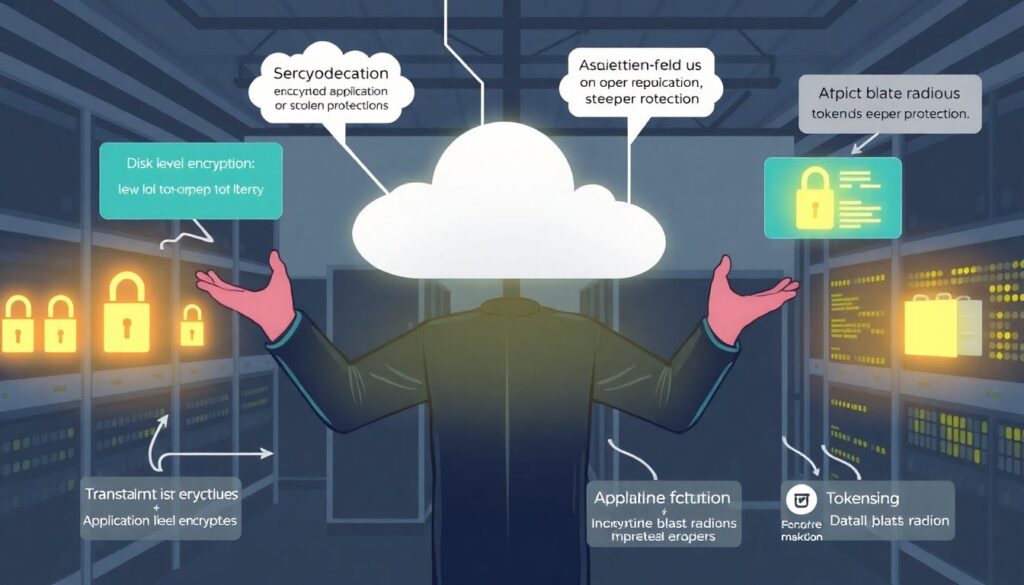
Most teams juggle several tools: transparent disk encryption, application‑level encryption, tokenization and masking. Disk‑level encryption is almost free operationally, but it doesn’t protect against a compromised application or stolen credentials. App‑level encryption gives strong blast‑radius reduction but adds key‑management complexity and hurts query flexibility. Row‑level or column‑level security policies are powerful for multi‑tenant products, though they can complicate query tuning. Tokenization reduces risk for particular fields (cards, documents) but requires careful detokenization flows. The real downside rarely discussed is cognitive overload: too many overlapping controls without a clear threat model often lead to misconfigurations, which attackers exploit more often than cryptographic flaws.
How to choose: practical recommendations for 2026

By 2026, the main question is not “which cloud is safer?” but “which stack lets my team operate safely, consistently and audibly?”. Start from your regulatory envelope: conformidade lgpd bancos de dados gerenciados means you must map data categories, define legal bases, and prove safeguards, not just tick “encrypted at rest”. Then evaluate how naturally each platform supports your identity strategy (SSO, workload identity), your network model (zero trust, private connectivity) and your observability. Favor managed features over custom code whenever possible: native KMS, built‑in audit logs, manager‑driven backups and automatic minor upgrades do more for real‑world risk reduction than bespoke, fragile security frameworks.
Step‑by‑step playbook: from basics to advanced controls
A simple way to structure your rollout is to climb a security maturity ladder instead of trying everything at once:
1. Lock down network paths: private endpoints only, explicit ingress, no public DB exposure.
2. Eliminate static credentials: use IAM auth, short‑lived tokens, secret managers.
3. Harden data tier: enable strongest encryption options, enforce TLS, restrict admin roles.
4. Segment access: per‑service accounts, least privilege, row/column security where needed.
5. Add observability: query‑level logs, anomaly alerts, regular access reviews and drills.
Treat this as an iterative loop: after each incident simulation, refine roles, keys and alerts.
Current and emerging trends in managed DB security
Several trends are reshaping daily practice. First, policy‑as‑code for data access is becoming mainstream: security and platform teams encode who can see which fields in versioned configs, enforced by gateways or data proxies. Second, confidential computing is moving from niche to practical, letting you process sensitive fields inside hardware‑isolated enclaves, especially for analytics workloads that previously required full de‑identification. Third, AI‑assisted configuration analysis now spots misconfigured RDS, Cloud SQL and Cosmos DB instances before attackers do. Finally, there’s a growing push to align developer experience with strong defaults: secure blueprints, golden images and reference architectures that make “the easiest way” also the safest one.