
Zero Trust na nuvem means verifying every identity, device and workload continuously, segmenting access and encrypting data by default. To implement safely, start with cloud inventories and risks, design a reference architecture, harden identity and network controls, protect data with managed keys, then automate monitoring and policy validation.
Implementation snapshot: core Zero Trust steps
- Map cloud accounts, critical workloads and existing controls before any blocking policy change.
- Define a simple Zero Trust reference architecture aligned to your main cloud providers.
- Strengthen identity: MFA, conditional access, least-privilege roles and just-in-time elevation.
- Apply network segmentation and service-to-service policies, blocking direct internet exposure.
- Classify data, enforce encryption in transit and at rest, and centralize key management.
- Implement continuous telemetry, automated policy checks and periodic access review cycles.
Assessing cloud posture, inventories and risk prioritization
Prep checklist for this stage
- Confirm which cloud providers and regions your workloads use today.
- List business-critical applications and data stores that must not be interrupted.
- Ensure read-only access to cloud APIs for discovery and assessment tools.
- Align with leadership on risk appetite and acceptable temporary exceptions.
- Decide whether you will use internal staff or consultoria zero trust na nuvem para negócios.
| Verification item | Expected artifact |
|---|---|
| Cloud account and subscription inventory | Updated list of tenants, accounts, projects and subscriptions |
| Critical workload register | Spreadsheet or CMDB entries with criticality tags and owners |
| Baseline posture snapshot | Export from CSPM or cloud security assessment report |
| Risk ranking | Prioritized list of gaps mapped to workloads and data |
This phase fits organizations starting or restructuring implementação zero trust cloud para empresas, ideally before heavy investment in new workloads. It is not recommended to start a deep assessment during a major cloud migration go-live or when you lack at least minimal inventory and ownership information, because you will misprioritize and create noise.
Collect safe inventories with read-only access
- Use native tools like AWS Config, Azure Resource Graph or gcloud asset inventory only in read-only mode.
- Export lists of VMs, managed services, serverless functions, databases and storage buckets.
- Tag each asset with environment, owner and data sensitivity where possible.
Map identities, permissions and external exposure

- List human identities (employees, partners) and non-human identities (service principals, roles, service accounts).
- Identify admin-granted roles, long-lived keys and accounts without MFA.
- Discover public endpoints, open security groups and exposed management interfaces.
Prioritize Zero Trust adoption domains
- Rank risks by impact: data leakage, account takeover, lateral movement, supply-chain compromise.
- Group findings into workstreams: identity, network, data, device and workload.
- Select a small number of critical applications for early Zero Trust pilot.
Architecting Zero Trust for cloud workloads and service boundaries
Prep checklist for Zero Trust architecture design
- Have a clear list of target cloud platforms and SaaS to include in scope.
- Confirm which identity provider will be the primary source of truth.
- Document existing network patterns: VPNs, peering, private links, on-premises connectivity.
- Identify regulatory and internal policy constraints that impact design choices.
- Evaluate zero trust na nuvem soluções already in use or procured.
| Verification item | Expected artifact |
|---|---|
| Target-state architecture diagram | Diagram showing identity, network, data and monitoring flows |
| Control mapping | Matrix linking Zero Trust principles to specific cloud capabilities |
| Service boundary definitions | Document describing trust boundaries and allowed dependencies |
| Roadmap and phases | Timeline that sequences pilots, expansions and hardening |
Select cloud-native and third-party building blocks
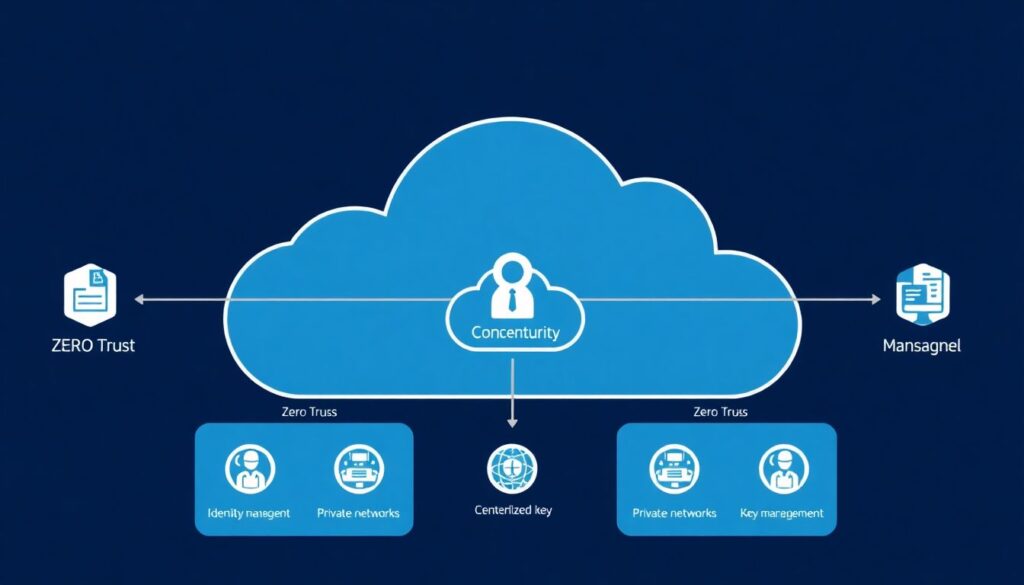
- Decide between cloud-native capabilities and ferramentas zero trust cloud security enterprise for each domain.
- For identity, plan around your IdP and cloud IAM; for network, leverage private endpoints, firewalls and service meshes.
- For data, standardize on one or two key management services per provider.
Define clear service and trust boundaries
- Segment workloads by business domain, sensitivity and environment (prod, staging, dev).
- For each segment, document allowed inbound and outbound communications and dependency chains.
- Mark boundaries that must enforce strong authentication, inspection or data-loss protection.
Plan for pricing and capacity
- When evaluating a plataforma zero trust security na nuvem preço, include data transfer, logging and licensing costs.
- Estimate log volume and storage needs for Zero Trust analytics and forensics.
- Validate that network and policy engines can scale with traffic peaks without degrading latency.
Identity, authentication and least-privilege access controls
Prep checklist for identity hardening
- Centralize workforce identities in a single IdP where possible.
- Ensure administrative break-glass accounts are documented and secured.
- Enable audit logs for sign-in, token issuance and privilege elevation events.
- Agree on naming standards for roles, groups and service accounts.
- Back up current IAM policies before modifying them.
| Verification item | Expected artifact |
|---|---|
| MFA and conditional access baseline | Policy set covering admins and high-risk scenarios |
| Role and group design | Catalog of reusable roles aligned to job functions |
| Service identity inventory | List of apps and workloads with non-human identities mapped |
| Access review process | Documented procedure and schedule for periodic reviews |
-
Enforce strong authentication and conditional access
Enable MFA for all administrative roles and remote access, then expand to all users. Add conditional access rules based on risk, device compliance and location, blocking legacy authentication.
- Example (Azure AD PowerShell, read-only policy listing):
Get-AzureADMSConditionalAccessPolicy - Validate there are no accounts exempt from MFA without documented justification.
- Example (Azure AD PowerShell, read-only policy listing):
-
Design least-privilege roles and groups
Create roles that map to real job functions instead of generic admin rights. Use groups to assign permissions to applications and cloud resources, avoiding direct user-to-resource bindings.
- In AWS, prefer custom IAM policies attached to roles, not users.
- In GCP, use predefined roles as starting points, then restrict where needed.
-
Separate human and workload identities
Ensure each application component and automation pipeline uses a dedicated non-human identity. Block the use of personal accounts inside CI/CD, scripts and service integrations.
- Rotate any long-lived secrets or keys discovered during assessment.
- Prefer managed identities or workload identity federation instead of static keys.
-
Implement just-in-time and approval-based elevation
Replace permanent admin roles with just-in-time elevation that requires justification and, when feasible, approval. Limit elevation duration and automatically log all privileged actions.
- Use cloud-native solutions such as Azure PIM or equivalent third-party tools.
- Require separate accounts for admin activities where supported.
-
Tighten access paths to sensitive cloud resources
Restrict console and API access to production resources through managed devices, secure networks or virtual desktops. Combine identity, device compliance and network conditions.
- Block direct access from unmanaged devices to admin portals.
- Use browser isolation or jump hosts for high-risk operations if needed.
-
Establish continuous access reviews and recertifications
Introduce periodic reviews for privileged roles, sensitive applications and external users. Automate reminders and revocations where possible.
- Export current assignments regularly and compare against HR and contractor records.
- Involve business owners for application-level access decisions.
Network segmentation, service-to-service policies and secure egress
Prep checklist for network and traffic controls
- Have updated network diagrams for VPCs, VNets, peering and on-premises links.
- Identify business-critical third-party APIs and SaaS dependencies.
- Confirm logging is enabled for firewalls, load balancers and gateways.
- Define which workloads must never be exposed directly to the public internet.
- Align with networking teams on change windows and rollback plans.
| Verification item | Expected artifact |
|---|---|
| Microsegmentation model | List of segments with allowed flows explicitly documented |
| Service-to-service policies | Firewall, security group or service mesh policies as code |
| Secure egress strategy | Design showing egress gateways and inspected outbound flows |
| Network telemetry | Centralized logging from key network enforcement points |
Checklist to validate Zero Trust network results
- All administrative interfaces are reachable only from controlled networks or via strong identity-aware proxies.
- Security groups and firewall rules are based on least privilege, using allow-by-exception instead of wide-ranging any-any rules.
- Service-to-service communication is restricted to documented dependencies; unused open ports have been removed or blocked.
- Outbound access to the internet flows through secure egress points with logging and, when required, TLS inspection.
- Public exposure of workloads is limited to well-defined front-door services such as application gateways or WAFs.
- Network policies are defined as code (for example, Terraform or cloud-native firewall policies) and version controlled.
- Test cases exist that simulate blocked and allowed traffic patterns for each critical application.
- Network logs feed into your central detection and response platform with relevant retention and alerts.
Data security: classification, encryption and key lifecycle
Prep checklist for data-centric controls
- List main data stores: databases, object storage, file shares, caches and SaaS repositories.
- Agree on a simple data classification scheme that business users can understand.
- Verify which services already support encryption at rest and in transit.
- Identify existing key management services and ownership.
- Set retention expectations for backups and archives.
| Verification item | Expected artifact |
|---|---|
| Data classification register | Inventory tagging data stores by sensitivity and owner |
| Encryption baseline | List of services with enforced encryption at rest and TLS configurations |
| Key management plan | Document covering key generation, rotation and revocation |
| Backup and recovery runbooks | Tested procedures and RPO or RTO targets per critical service |
Frequent mistakes to avoid in Zero Trust data protection
- Relying on implicit encryption defaults without confirming key ownership, rotation policies and algorithm strength.
- Mixing test and production data in the same storage account or bucket, especially with different sensitivity levels.
- Allowing broad administrative access to data stores without separating platform admins from data stewards.
- Neglecting encryption for internal service-to-service traffic, assuming the cloud network is inherently trusted.
- Keeping long-lived access keys embedded in application code or configuration files instead of using managed identities.
- Failing to classify and protect data replicas, analytics exports and debug dumps that contain sensitive information.
- Not testing restore and key recovery procedures, discovering issues only during real incidents.
- Granting SaaS integrations wide read and write permissions to data instead of narrowly scoped, application-specific access.
- Ignoring data residency and cross-border transfer implications when selecting zero trust na nuvem soluções for storage and analytics.
Operationalization: telemetry, automation and continuous validation
Prep checklist for ongoing operations
- Ensure centralized log collection is in place for identity, network, workload and data layers.
- Define clear ownership for incident response and change management related to Zero Trust policies.
- Document existing automation tools, CI/CD pipelines and infrastructure-as-code repositories.
- Agree on measurable objectives such as reduction of standing privileges or exposed endpoints.
- Plan training for operations teams that will maintain the new controls.
| Verification item | Expected artifact |
|---|---|
| Monitoring and alerting design | Playbooks and dashboards covering Zero Trust controls |
| Automation coverage | List of policies enforced through code or pipelines |
| Continuous validation process | Schedule of tests, simulations and periodic assessments |
| Operating model | RACI and workflows for sustaining Zero Trust in production |
Alternative operating approaches and when to use them
-
Cloud-native first with selective add-ons
Use each provider native tools for logging, access control and policy enforcement, adding targeted third-party analytics. This suits organizations primarily on one or two hyperscalers and limited multi-cloud complexity.
-
Centralized enterprise Zero Trust platform
Adopt ferramentas zero trust cloud security enterprise that unify identity-aware access, policy and telemetry across clouds. This is effective for large enterprises with strong multi-cloud and hybrid footprints that need consistent governance.
-
Managed service with specialized consultancy
Combine internal ownership with external consultoria zero trust na nuvem para negócios and managed detection or response. This works well when you lack internal expertise or need to accelerate delivery without compromising safety.
-
Pilot-led gradual rollout
Run small pilots for one business unit or application, then expand based on proven patterns and tooling. This is ideal when budget or organizational readiness does not support a big-bang rollout of implementação zero trust cloud para empresas.
Operational clarifications and common implementation doubts
How do I choose between native controls and a third-party Zero Trust platform?
Start by mapping your current and future cloud footprint. If you are mostly in a single cloud, native controls plus focused add-ons is often simpler. For complex multi-cloud or strict compliance, consider a plataforma zero trust security na nuvem preço that still integrates well with native features.
Can I implement Zero Trust na nuvem without impacting developer productivity?
Yes, if you involve developers early and automate access paths. Provide self-service, audited role requests, standard service identities in CI/CD and clear network patterns. Avoid manual approvals for routine actions while keeping high-risk operations under stronger controls.
What is a safe starting scope for Zero Trust in an enterprise cloud environment?
Pick one or two critical applications that represent common patterns in your environment. Focus on identity hardening, restricted network flows and data encryption for these, then generalize patterns. Avoid starting with edge cases or highly fragile legacy systems.
How often should I review Zero Trust policies and access rights?
Run access reviews for privileged roles and sensitive applications at least several times per year, and after major organizational changes. Review technical policies whenever new services are introduced, significant architectures change or incidents reveal gaps.
Do I need a separate project for Zero Trust or can it be part of existing cloud programs?
You can integrate Zero Trust into ongoing cloud and security programs as long as ownership and objectives are explicit. Many organizations embed it into modernization, identity or network initiatives, using shared roadmaps and common success metrics.
How do I ensure my Zero Trust design remains effective as new services are added?
Treat Zero Trust as an architectural guardrail, not a one-time project. Require new services to go through design reviews that check identity, network and data controls, and validate them with automated tests and policy-as-code whenever possible.
Is Zero Trust applicable to SaaS applications used by the business?
Yes. Integrate SaaS with your identity provider, enforce strong authentication, restrict access by device or network when needed and monitor activity logs. Extend your data classification and data protection guidelines to cover exports and integrations from SaaS platforms.