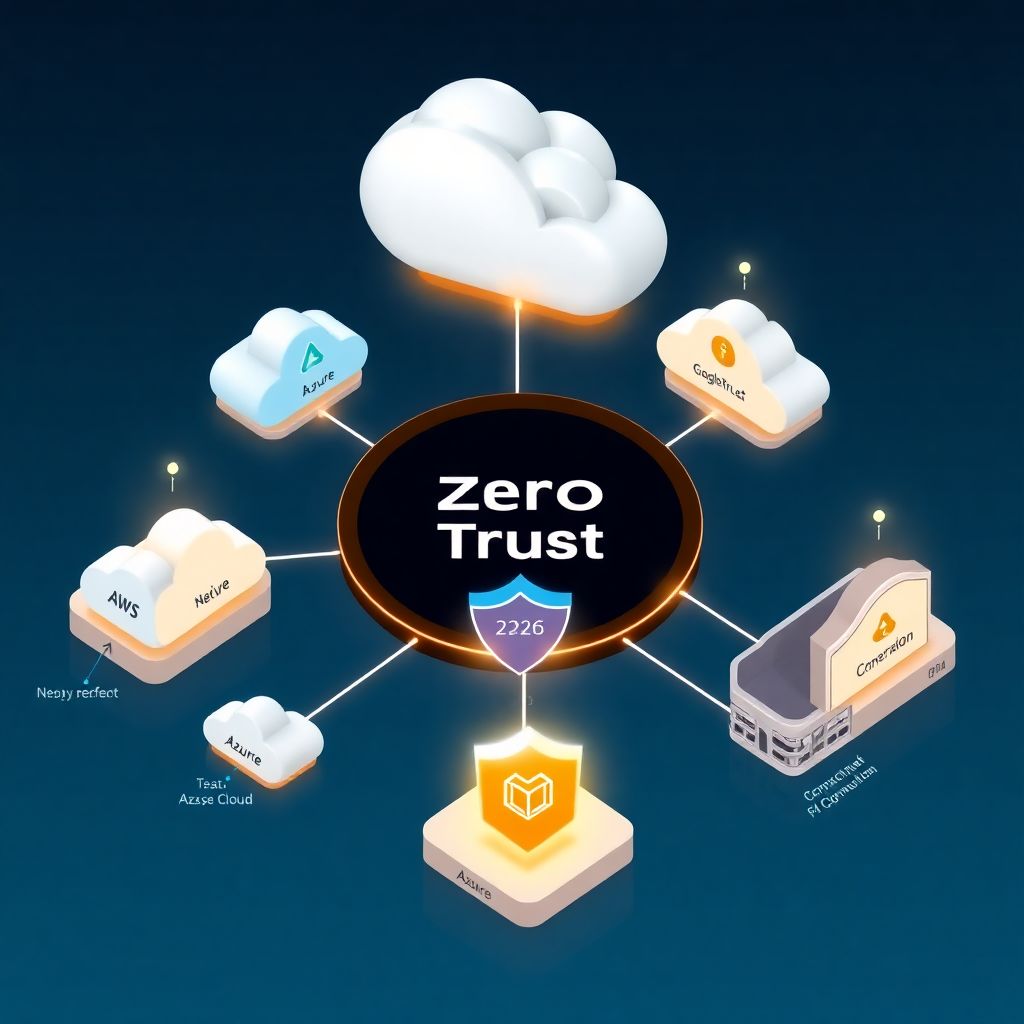
Why Zero Trust in multicloud stopped being optional in 2026
In 2026, “trust but verify” is basically dead. With SaaS sprawl, AI-powered attacks, and employees hopping between devices, you can’t rely on a single perimeter any more. When a company roda em AWS, Azure, Google Cloud e ainda tem um datacenter próprio, the attack surface explodes. Zero Trust comes in as a practical way to say: “I don’t trust a request só porque veio da minha rede, do meu IP interno ou de um usuário logado”. Every access is checked, scored and limitado ao mínimo necessário. In a multicloud corporate world, that’s not theory; it’s the only way to manter controle sem travar o negócio.
Core principles of Zero Trust (in plain language)
Never trust, always verify (even inside your own network)
A classic mistake is achar que “rede interna” é segura por definição. In a modern multicloud, you have containers, serverless, SaaS, VPN, remote workers and partners connected at the same time. Zero Trust flips the logic: every request, from any device or workload, precisa provar quem é e o que pode fazer. That means continuous authentication, context checks (location, device health, behavior) and dynamic policies. When this is well implemented, a compromised account or machine vira um incêndio controlado, not a company-wide disaster.
Least privilege as a daily habit, not a one-off project

Least privilege is often sold as a concept, but in practice it’s messy: devs pedem exceções, projects go live in a rush, and suddenly half the company has admin rights. In a solid Zero Trust setup, access é definido por função, contexto e tempo. You give just enough permission, only while needed, and remove it automatically. This gets way easier in 2026 with policy-as-code: instead of manually clicking in consoles, you version policies like you version code, integrate them into CI/CD and review them in pull requests.
Assume breach and design to contain it
“Assume breach” sounds pessimistic, but it’s realistic. Phishing is increasingly automated by AI, and credential theft is cheap. If you assume someone will eventually entrar, your architecture changes: you segment everything, log everything, and design detection and response as core features, not extras. In multicloud, that means aligning security controls across providers so a lateral movement attempt in AWS looks tão visível quanto um movimento suspeito no Azure, and you can correlate events in minutes, not days.
Mapping your multicloud reality before touching technology
Take inventory of identities, data and workloads
Before thinking about ferramentas, you need a mapa honesto do seu ambiente. In 2026, most companies underestimate three things: how many SaaS apps they really use, how many “shadow” accounts exist in each cloud, and where sensitive data actually lives. A practical Zero Trust start is to build three lists: human identities (employees, partners, bots using API keys), workloads (VMs, containers, functions, SaaS backends) and critical data assets (databases, buckets, document stores). The goal isn’t perfection, it’s visibility enough to know where Zero Trust controls will make real difference first.
- Map the top 20 critical applications and who uses them
- Identify all identity providers (AD, Entra ID, Okta, IAMs de clouds)
- Locate sensitive datasets (PII, financial, IP, health, source code)
- List external connections: partners, APIs, third-party integrations
Classify risk by business impact, not by “cool tech”
Zero Trust in multicloud dies rápido when it vira um exercício de ferramentas “porque são modernas”. In 2026, the smart move is to rank where a breach hurts business the most: revenue-critical systems, compliance-heavy data, or crown-jewel IP. After that, you align Zero Trust controls primeiro nesses pontos. Sometimes, protecting one legacy billing database is more strategic than securing ten trendy microservices. Tie every control to um risco de negócio claro; this makes it much easier to get budget and keep leadership engaged during the whole journey.
Foundations to implement Zero Trust in corporate cloud
Unify identity across clouds and SaaS
If identity is the new perimeter, an identity mess is the new Swiss cheese firewall. Multiple directories, orphan accounts and manual provisioning open huge gaps. A core step in como implementar zero trust em nuvem corporativa is consolidating identities around a primary IdP and using federation for clouds and SaaS. That means SSO where possible, strong MFA as default, and conditional access policies using signals like device compliance and location. The fewer places you manage passwords and roles manually, the smaller your attack surface and your operational headache.
Modern MFA and phishing-resistant authentication
MFA is no longer “nice to have”; it’s base hygiene. But by 2026, attackers know how to bypass weak MFA via push fatigue and token stealing. Aim for phishing-resistant methods: FIDO2 keys, passkeys, or platform authenticators tied to secure hardware. For admin and privileged roles, treat physical security keys as mandatory. For the rest, combine device signals (managed device? OS updated?) with behavioral analytics. It’s not about annoying users; it’s about making it economically painful for attackers to persist in your environment.
Single policy brain for many clouds
In multicloud, cada provider tem sua própria linguagem de políticas, sua consola, seu jeito de logar eventos. If you try to write and maintain everything by hand, you drown. The trend in 2026 is to use a central policy engine (OPA, Cedar, or vendor platforms) to define authorization rules once and apply them across APIs, microservices and even some cloud-native controls via integration. That doesn’t eliminate cloud-specific tuning, but gives you a “single brain” to reason about who can do what, where and under which conditions.
Microsegmentation that actually works in multicloud
From flat networks to application-centric segmentation
Traditional segmentation was about VLANs and firewalls between networks. In a multicloud corporativo, workloads move, scale and die in minutes; IP-based rules explode in complexity. Modern segmentation focuses on applications and identities instead of IP ranges. You describe “Service A can call Service B on this path under policy X”, and enforce it via service mesh, identity-aware proxies or cloud-native tools. This lets you isolate apps even when they share the same cluster or subnet, making lateral movement mucho harder without breaking deployments every week.
Service identity and mTLS by default
Service-to-service traffic é um dos pontos mais esquecidos. Attackers love this, because once they gain a foothold, they ride internal APIs like a free bus. Microsegmentation in 2026 almost sempre inclui identity for workloads (SPIFFE/SPIRE, cloud-native identities) and mutual TLS between services. So a database only accepts connections from a small set of authenticated workloads, not from “anything that reaches port 5432”. This dramatically shrinks the blast radius of a compromised pod, VM or serverless function and aligns with the whole “assume breach” mindset.
Securing data and access across multiple clouds
Consistent data policies, one classification scheme
If each cloud uses a different way to tag and classify data, your Zero Trust rules turn into spaghetti. Define a simple, shared classification scheme (for example: Public, Internal, Confidential, Restricted) and replicate it across buckets, databases, file shares and SaaS. Then, build policies on top of that: which roles can touch “Restricted”? From what locations? With what device posture? When you later adopt DLP or CASB-like tools, this consistency makes enforcement e reporting muito mais simples e confiáveis.
Just-in-time and just-enough access to data
Long-lived, broad access to data is a liability. Use just-in-time permissions so analysts, admins or developers request temporary access to sensitive datasets, with approvals, logging and automatic revocation. Combine that with column/row-level security where supported, so people see only o recorte do dado que precisam. In multicloud this typically means leveraging native features (IAM conditions, Lakehouse access controls, row filters) instead of building homemade workarounds that no one maintains after six months.
Observability and continuous verification
Centralized logging and identity-centric monitoring
Zero Trust sem visibilidade é só um slogan. Each cloud has excellent logs, but they’re fragmented. In 2026, a must-have is routing identity, network and application logs into a central analytics layer (SIEM/SOAR or data lake) with enrichment: who is this user, what device, what risk score, which policies applied. Instead of staring at raw events, you’re looking at stories: “admin account from unmanaged laptop trying to access finance DB at 2am from unusual country”. This correlation is what turns data into real detection capability.
Behavior analytics and policy tuning
Static rules quickly get either noisy or blind. Behavioral analytics (UEBA) helps you understand what “normal” looks like per user, role and workload, and flag weird deviations. The key is to use it not só para alertar, but also para ajustar suas políticas Zero Trust. If you see that certain legitimate flows are constantly blocked, maybe your segmentations are too tight. If a privileged user rarely uses half of their granted permissions, you can shrink their scope safely. Zero Trust in 2026 is iterative, guided by data, not set-and-forget.
Choosing and integrating Zero Trust solutions
What to look for in platforms and tools
With vendors rebranding everything as Zero Trust, you need practical criteria. A good plataforma de segurança zero trust para empresas should integrate with your main IdP, support multicloud connectors, expose APIs for automation, and provide clear policy authoring with versioning. It should also support modern standards (OIDC, SAML, SCIM, FIDO2) and have strong reporting capabilities that your compliance and risk teams can actually understand. Beware of tools that create yet another silo instead of plugging into what you already have.
Avoiding tool sprawl with an architecture-first approach
The biggest anti-pattern is buying five “Zero Trust products” and then trying to make them fit. Start with an architecture diagram: identity flow, device trust, network edges, application access, data locations. Mark where controls should live and which existing tools can be extended. Only then identify real gaps. Often, soluções zero trust para ambientes multicloud come as modular platforms, where you can adopt identity-based access first, then expand to microsegmentation or ZTNA. This staged approach ncourages learning and reduces expensive rework.
Step-by-step: implementing Zero Trust in multicloud environments
Phase 1 – Quick wins that reduce real risk
The first 90 days should focus on controls that drastically lower your breach probability without paralyzing operations. Typical moves: enforce MFA for all remote and privileged access, migrate high-risk apps behind an identity-aware access proxy (ZTNA), centralize log ingestion from all clouds, and clean up obvious toxic combinations of privileges. Also, remove stale accounts e rotacione chaves de acesso antigas. This phase gives you measurable risk reduction while you prepare the heavier lifting around segmentation and data controls.
Phase 2 – Identity, segmentation and policy-as-code
Next, unify identity as much as possible: federate clouds and core SaaS apps to your main IdP, implement role-based access, and introduce just-in-time elevation for admins. In parallel, start microsegmenting a few critical applications to gain experience before rolling out widely. Introduce policy-as-code for at least one layer (for example, service authorization in microservices) and integrate its evaluation into CI/CD. This is where segurança zero trust multicloud corporativo begins to feel real: acessos são mais claros, revisões mais rápidas, e incidentes mais fáceis de conter.
Phase 3 – Advanced controls and continuous improvement
Once the basics are stable, you can add more advanced capabilities: device posture checks in access decisions, broader adoption of mTLS between services, data loss prevention tuned by your unified classification, and automated response playbooks for common attacks. Evaluate whether you need specialized tools or partners for regulated areas (finance, health, government). Use periodic red teaming and purple teaming to test the effectiveness of your Zero Trust controls and feed adjustments back into policies and architecture.
Dealing with people, culture and governance
Make Zero Trust a productivity enabler, not a blocker
Users resist anything that slows them down. The trick is to design Zero Trust so that the secure path é o caminho mais fácil. SSO instead of dozens of passwords, self-service access requests with clear SLAs, and transparent just-in-time access instead of begging for permanent admin. When employees perceive that security actually reduces friction—fewer VPN problems, simpler logins—they naturally collaborate more. Communicate changes in terms of “this is how we keep your work and our customers safe” rather than buzzwords.
Governance, metrics and executive sponsorship
Zero Trust is not a one-year project, it’s a new operating model. You need clear governance: who owns identity, who approves policies, how changes are tested and rolled out. Define metrics from the start: time to provision access, number of over-privileged accounts, mean time to detect/respond, percentage of apps behind ZTNA, coverage of microsegmentation. Present these regularly to leadership in business language: reduced likelihood of data breach, faster audits, more resilient operations. This ongoing alignment keeps investment and priority alive.
When to bring in external expertise
Where partners add real value
Multicloud Zero Trust mixes architecture, identity, networking, DevSecOps and compliance. Few internal teams have deep experience in all of these at once. That’s where a good consultoria implementação zero trust em multicloud can accelerate your journey: helping design a realistic roadmap, avoid dead-end architectures, choose tools that truly integrate with your stack, and train your team to operate the new model. The goal is not to outsource thinking, but to buy time and avoid repeating mistakes that others already paid for.
Keeping ownership while using vendors and MSPs
Even if you envolve vendors, keep ownership of the principles and high-level architecture. Document your Zero Trust reference model, your policy standards and your risk priorities. Demand that partners work within that framework instead of imposing their favourite pattern. Make sure your team learns enough to maintain and evolve the environment after projects end. The healthiest setup in 2026 is where external experts are accelerators, while strategy, policies and critical decision-making stay firmly inside the company.
Final thoughts: Zero Trust as a living system
By 2026, Zero Trust in multicloud isn’t about chasing a buzzword; it’s about admitting that complexity won and adapting your defenses accordingly. Cloud providers will keep launching new services, attackers will keep abusing AI, and your business will keep demanding more connectivity. A static, perimeter-centric model can’t keep up. Treat Zero Trust as a living system: observe, adjust, test, iterate. Start small but intentional, focus on high-impact areas, and keep everything tied to real business risk. Over time, “never trust, always verify” stops being a slogan and becomes simplesmente the way your company operates every day.