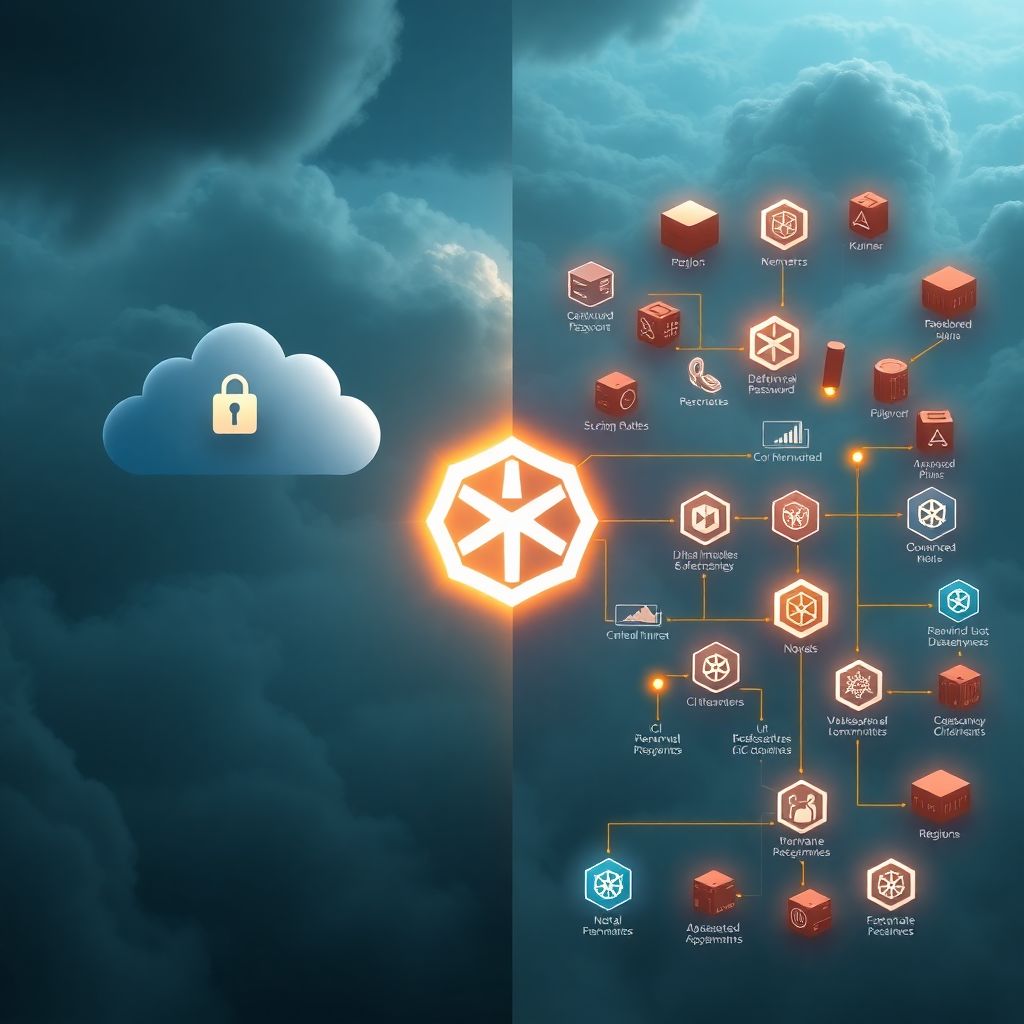
The evolution of cloud infrastructure attacks: from curiosity to industrialized crime
From “someone left an S3 bucket open” to full-blown kill chains
When cloud started going mainstream, most incidents were almost boring:
misconfigured storage buckets, leaked keys on GitHub, default passwords on management consoles. Attacks were opportunistic and noisy.
Fast‑forward a decade and we’re looking at:
– Organized groups specializing in cloud-native intrusion
– Ransomware gangs abusing cloud backup and DR pipelines
– Supply-chain attacks targeting CI/CD and IaC
– “Living off the cloud” instead of “living off the land”
The same creativity that helped us build cloud‑native apps is now being used to break them.
Why cloud changed the game for both attackers and defenders
Cloud turned infrastructure into API calls and configuration files. That was great for agility but also gave attackers:
– A unified control plane to pivot across regions and services
– Global reach without touching on‑prem networks
– Standardized IAM and logging models they can learn once and reuse everywhere
Defenders, on the other hand, suddenly had to master:
– Three or more major providers
– Dozens of managed services
– A jungle of “best practices” that often conflict
That’s where structured segurança em nuvem para empresas stopped being a “security project” and became an ongoing engineering discipline.
—
Key principles of modern cloud attack campaigns
TTPs in cloud: what’s actually happening in real breaches
Most real cloud incidents follow a surprisingly similar skeleton, regardless of which logo you see in the console. At a high level:
1. Initial access
– Stolen credentials (phishing, infostealers, password reuse)
– Access keys exposed in repos, CI logs, artifacts
– Compromised admin workstation with saved cloud sessions
– Exploited exposed management endpoints (Kubernetes API, Jenkins, GitLab, etc.)
2. Privilege escalation & discovery
– Abusing overly permissive IAM roles (the classic `*:*`)
– Enumerating services, regions, and identity relationships
– Reading secrets from parameter stores and vaults
– Attaching more powerful roles to compromised identities
3. Lateral movement in a cloud world
– Pivoting through CI/CD runners and deployment pipelines
– Using internal APIs and service meshes
– Hopping between accounts via cross‑account roles
– Leveraging managed services as “stepping stones”
4. Actions on objectives
– Data exfiltration from databases and object storage
– Cryptomining on under‑monitored clusters
– Tampering with backups or snapshots
– Implanting persistence in IaC, AMIs, images and base containers
What attackers love about cloud specifically
Unlike traditional environments, attackers get some nice “perks”:
– Highly predictable defaults: Many orgs use out‑of‑the‑box policies and templates.
– Self‑service infrastructure: One compromised DevOps engineer often equals “cloud domain admin.”
– Over‑trust in the provider: Teams assume serviços de proteção de infraestrutura cloud magically cover misconfigurations. They don’t.
—
Real‑world style scenarios (based on actual patterns)
Case 1: “Tiny IAM mistake, massive blast radius”
A mid‑sized SaaS company had a “diagnostics” role used by a support team. It was meant to be read‑only. In reality:
– The role had read access to every account’s logs and configs.
– It also allowed attaching additional policies to itself (classic misconfig).
Attack path:
1. Attacker stole a support engineer’s credentials via a phishing kit plugged into a fake SSO page.
2. They logged into the cloud console, assumed the diagnostics role, and enumerated accounts.
3. They quietly attached an admin policy to the same role (no one was watching IAM change events).
4. They created new long‑lived keys, deployed a miner fleet to spare compute capacity in dev and test, and started slowly exfiltrating customer data from backups.
What worked for the attacker:
– Predictable role names and patterns: “diagnostics,” “support‑read.”
– No guardrails to prevent privilege escalation by policy attachment.
– Weak monitoramento e resposta a incidentes em ambiente cloud: no one correlated odd IAM changes with unusual compute usage.
What would have changed the game:
– A very simple policy: “roles used by humans cannot grant themselves additional privileges, ever.”
– Mandatory just‑in‑time elevation for support roles.
– A basic set of ferramentas de detecção de ameaças em cloud tuned to:
– Detect policy attachment to critical roles
– Alert on new access keys for those roles
– Flag sudden resource creation in unusual regions or accounts
—
Case 2: CI/CD as the real perimeter
Another common pattern: the infrastructure isn’t hacked; the pipeline is.
A company had a polished IaC setup, strict network policies, and tight secrets management in production. But:
– Self‑hosted CI runners in a cloud VPC had broad IAM permissions.
– Build logs sometimes printed temporary credentials and tokens.
– Branch protection rules were weak for “internal” repos.
Typical attack chain:
1. Attacker gained access to a developer’s Git account via token reuse from a different breached service.
2. They pushed a subtle change to a pipeline template used across multiple projects (one shared YAML).
3. The modified step exfiltrated CI runner environment variables and IAM credentials to a remote server.
4. With those credentials, the attacker started manipulating cloud resources, including image registries, base AMIs and Helm charts.
You can harden environments all you want, but if your pipeline can:
– Assume production roles
– Modify infrastructure
– Push images to registries
…then your CI environment is effectively your cloud perimeter.
—
Non‑obvious patterns and future trends
Trend 1: “Living off the cloud” instead of malware
Modern attackers increasingly:
– Avoid custom malware
– Use your own cloud tooling as their toolbox
– Blend into legitimate workloads and traffic
Examples:
– Using built‑in serverless functions to scan internal networks
– Triggering managed data transfer jobs to exfiltrate data “legitimately”
– Leveraging provider CLIs and SDKs from compromised containers so everything looks like normal automation
This shifts the focus: serviços de proteção de infraestrutura cloud that only look for malware signatures or “weird binaries” will miss a lot. Detection has to understand *intent* and *context*, not just artifacts.
Trend 2: Abuse of automation and remediation tools
Auto‑remediation is fashionable: “a Lambda that fixes security group misconfigs” or “a bot that reverts dangerous IAM changes.” Great idea… in theory.
Attackers know this and may:
– Trick auto‑remediation to “fix” something by granting themselves access
– Race conditions: change resource state between check and fix
– Use remediation tools’ identities (which often have high privilege) as a stepping stone
A non‑standard but powerful control:
Treat every automatic remediation tool as a production app with its own threat model, code review, and test suite. Don’t let “security bots” bypass your normal SDLC just because they sound defensive.
Trend 3: Soft perimeters around third parties and consultants
You might invest heavily in consultoria de segurança em cloud computing, but then:
– Grant external consultants wide access to multiple accounts “temporarily”
– Forget to revoke roles and API keys afterward
– Allow third‑party support tools to sit permanently connected with powerful tokens
Attackers love this. It’s simpler to compromise a small vendor with weaker defenses than a large, mature enterprise.
—
Core defensive principles (beyond the obvious checklists)
Principle 1: Treat cloud identities as your new “hosts”
In classic on‑prem thinking, servers were the core assets. In cloud:
– IAM roles, service accounts, and workload identities *are* the real perimeter.
– Every permission grant is a new “open port,” conceptually.
Unconventional but pragmatic approach:
– Build an “identity inventory” dashboard that’s as visible as your VM/cluster inventory.
– For every identity, track:
– Who can assume it
– What it can do
– What data domains it touches (prod/dev, PII/non‑PII, etc.)
Then do identity threat modeling the same way we used to threat‑model network segments.
Principle 2: Make your logs actually usable, not just “enabled”
Many companies proudly “turn on all logging” but then:
– Never route logs to a place analysts can query comfortably
– Forget to correlate cloud logs with corporate identity, VPN, and endpoint data
– Keep raw logs for 7 days but incidents span months
Non‑standard recommendation:
– Log less but smarter. Focus on:
– IAM changes (who changed what, from where)
– New keys / tokens / cross‑account role assumptions
– Resource creation/deletion in unusual places
– Add opinionated, high‑value detections rather than generic “everything.”
– Empower your SOC with a very small set of curated cloud playbooks instead of a huge rule zoo.
—
Practical defense moves and surprising wins
Quick wins that don’t need a giant project
You can reduce risk significantly with a few targeted moves:
– Force all human access through SSO with MFA, kill legacy users with local passwords.
– Ban long‑lived access keys for humans; use just‑in‑time federation.
– For machine identities, tie each key or role to exactly one workload and one purpose.
– Enforce “no wildcard admins” (no `*:*`) via policy lints in CI before deploy.
A small, well‑aimed set of guardrails often beats huge, poorly enforced frameworks.
Creative monitoring ideas for cloud environments
Traditional SIEM rules often fail in cloud. Instead, think in terms of simple narratives:
– “No one should create or modify IAM outside working hours, except a tiny break‑glass group.”
– “If a role that usually touches dev suddenly accesses prod data, shout loudly.”
– “If backups are deleted or snapshots are shared cross‑account, treat it like a bank alarm.”
You don’t need fancy AI to start; you need clarity on what “normal” looks like for a handful of critical behaviors and a minimal but sharp set of ferramentas de detecção de ameaças em cloud that can express those patterns.
Example lightweight playbook list for a small team:
– Investigate any new cross‑account role trust relationship.
– Review and confirm any change to DNS or API gateways in production.
– Page someone when an automated remediation tool changes IAM or network policies.
—
Common misconceptions that quietly create breaches
Misconception 1: “The provider is responsible for security”
The shared responsibility model is well‑documented, but in practice people still assume:
– “If it’s managed, it’s secured.”
– “If we turned on default security options, we’re covered.”
Reality:
– Providers secure the *infrastructure* of the cloud.
– You secure your *use* of that infrastructure: identities, config, data, and code.
Security in cloud is an engineering function, not a vendor checkbox.
Misconception 2: “Zero trust = we’re safe”
Many teams adopt zero trust networking but:
– Forget that once inside, identities still have huge powers.
– Assume that because every call is authenticated, it must be okay.
But attackers with valid credentials and tokens love zero trust. It often means:
– Rich logging (good for forensics)
– But also standardized trust decisions they can abuse everywhere
You still need robust least privilege, anomaly detection on identity behavior, and hard limits on what automation can touch.
Misconception 3: “We bought X, so we’re covered”
Whether it’s serviços de proteção de infraestrutura cloud or a next‑gen Cloud‑Native Security Platform, tools are not the strategy.
Common failure modes:
– Tools deployed only in production, leaving dev/test wide open.
– Alerts tuned down because “too noisy,” effectively blinding the team.
– No one owning the platform: infra thinks it’s a security tool, security thinks it’s an infra tool.
If a tool doesn’t come with:
– Clear ownership
– A few specific detection goals
– Agreed response actions
…it will quietly turn into an expensive logging sink.
—
Non‑standard defensive strategies that actually help
1. Red‑teaming your own cloud IaC and pipelines regularly
Instead of waiting for a pentest once a year, run internal “misconfig games”:
– A small blue team sets up a realistically misconfigured sandbox cloud environment.
– Dev and security engineers are invited to “break in” using only:
– Public documentation
– Cloud consoles and CLIs
– The same permissions a normal developer would have
You’ll uncover:
– Surprising privilege chains in IAM
– Overpowered pipeline roles
– Hidden trust relationships with third parties
It also trains people to *think like an attacker* in a very relevant context.
2. Make “security refactors” a first‑class engineering task
Teams refactor code, but rarely refactor IAM, network layouts, or data flows.
Introduce explicit “security refactors” into your roadmap:
– Split a giant admin role into smaller, purpose‑built roles
– Remove direct human access to production databases; go through tooling
– Migrate secrets from env vars to a managed secrets store with strict access boundaries
Treat these like technical debt pay‑down, not “side projects.”
3. Use “tripwire” resources on purpose
Create a few decoy or high‑signal resources:
– A fake “backup” bucket with strong detection on any access
– A deliberately over‑entitled role that no one should ever assume in normal operations
– Honey‑tokens in your own private repos to detect credential scraping
As soon as these are touched, you know you’re not just dealing with random noise.
—
How defense teams can turn lessons into durable practice
Make cloud security everyone’s job, but someone’s actual responsibility
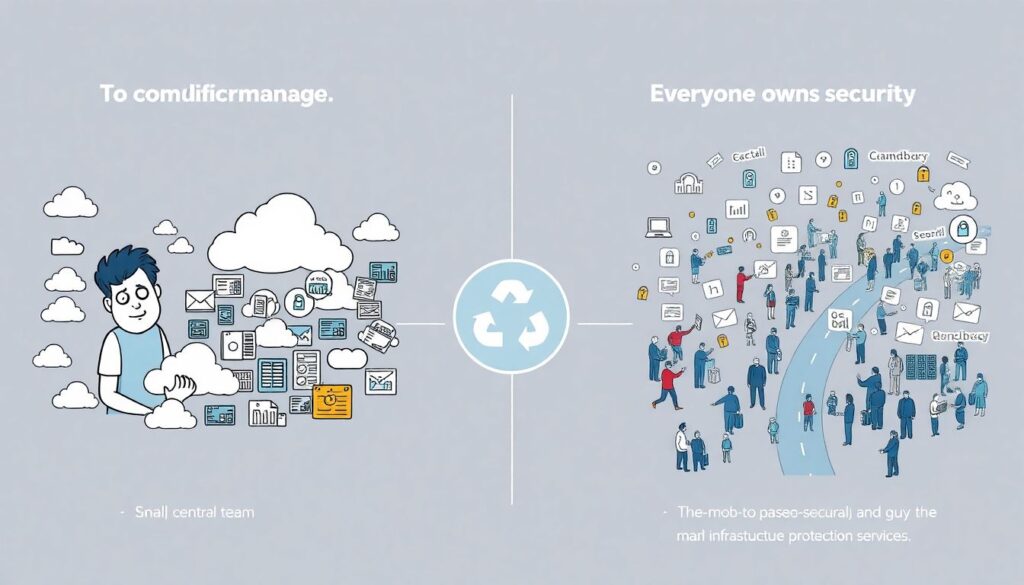
Cloud environments evolve too fast for a central team to micromanage everything. But the opposite extreme (“everyone owns security”) often means no one really does.
Pragmatic structure:
– A small central team sets standards, builds paved roads, and runs the main serviços de proteção de infraestrutura cloud and monitoring stack.
– Product and platform teams own security *within* those paved roads (IaC, permissions, basic controls).
– Regular reviews ensure drift doesn’t accumulate.
Keep learning loops short and honest
Every incident or near‑miss should result in:
– One or two concrete control improvements (a new detection, a tightened role, an updated playbook)
– Clear documentation of what went wrong, without blame
– A short debrief with the teams that were impacted
This is where collaboration with good consultoria de segurança em cloud computing can help, not by dropping 80‑page PDFs, but by co‑designing controls and teaching your team to run and evolve them.
—
Closing thoughts: cloud as a living system, not a static asset
Cloud infrastructure isn’t a data center you “harden once.” It’s a living, programmable system that attackers study almost as carefully as you do.
Teams that succeed at defense in this world:
– Think in identities, data paths, and automation, not just servers and firewalls
– Build lightweight, understandable controls instead of giant frameworks no one reads
– Use targeted, contextual ferramentas de detecção de ameaças em cloud tied to real attacker TTPs
– Treat monitoramento e resposta a incidentes em ambiente cloud as a continuous practice, not a reactive emergency service
If you design your cloud like an attacker would want to *fail* in it—limited blast radius, noisy high‑value actions, and carefully constrained automation—you’ll force even sophisticated adversaries to work much harder for every step they take.