Ransomware in cloud infrastructure relies on misconfigurations, weak identities, exposed services and unprotected data paths. To handle ransomware em cloud como prevenir, combine least‑privilege IAM, network segmentation, hardened backups, immutable storage and a rehearsed incident response runbook. This guide focuses on practical steps, tools and commands usable in typical pt_BR cloud environments.
Executive summary: ransomware threats to cloud infrastructure
- Most cloud ransomware campaigns abuse stolen credentials, overly permissive IAM roles and exposed management endpoints, not hypervisor exploits.
- Shared-responsibility gaps create blind spots; you must configure segurança em infraestrutura cloud contra ransomware beyond provider defaults.
- Segmentation, conditional access and strong MFA greatly constrain lateral movement and blast radius.
- Immutable, off‑region backups and encryption keys isolated from production are critical for data survival.
- Clear, tested melhores práticas de resposta a incidentes ransomware em cloud reduce downtime and data loss.
- Automated backups plus regular restore drills using ferramentas de backup e recuperação de dados na nuvem contra ransomware prevent surprises during real incidents.
- Serviços de proteção ransomware para nuvem (CSPM, CWPP, backup services) are effective only when tuned to your workload patterns.
Common ransomware attack vectors targeting cloud platforms
This section is for operators, DevOps and security engineers running workloads on AWS, Azure, GCP or local providers in Brazil. It is not suitable as the only control in highly regulated environments; there you must also follow sectoral standards and your auditor’s requirements.
Pre-checklist: understanding your exposure surface
- List all public endpoints: VPNs, bastion hosts, APIs, SSH/RDP, databases.
- Identify accounts with administrative roles and where they authenticate from.
- Review existing backups: what is covered, retention, and where they are stored.
- Check which teams can create or modify IAM policies in production.
- Verify central logging coverage for cloud control plane and workload logs.
- Confirm who has authority to trigger incident response and declare an emergency.
Common ransomware delivery and execution paths in cloud:
- Compromised user credentials via phishing of corporate accounts reused for cloud consoles or federated SSO.
- Weak or absent MFA on privileged cloud accounts, allowing simple credential stuffing or brute force.
- Exposed management ports (SSH, RDP) on VMs with weak passwords or unpatched services.
- Insecure CI/CD pipelines where stolen tokens can push malicious artifacts or modify IaC templates.
- Over-permissive storage access such as public buckets or wide write permissions on object stores.
- Compromised third‑party tooling (backup agents, monitoring, RMM tools) used as a distribution channel.
Example detection query (Azure, sign-ins without MFA):
SigninLogs | where ResultType == 0 and ConditionalAccessStatus != "mfaRequired"
Cloud architecture weaknesses that increase ransomware exposure
To address segurança em infraestrutura cloud contra ransomware effectively, you need visibility and the ability to change key controls. Before hardening, ensure you have at least read access to production accounts and admin access to a controlled test environment.
Pre-checklist: prerequisites and tooling
- Access to cloud provider IAM, network and logging consoles (AWS/Azure/GCP).
- CLI tools installed and configured (for example,
aws,az,gcloud). - Centralized logging platform (CloudWatch, Cloud Logging, Sentinel, Elastic, etc.).
- Defined tagging strategy to distinguish production, staging and dev resources.
- Documented network diagrams or IaC definitions for VPC/VNet layouts.
- Contacts for app owners to validate potential impact of stricter controls.
Key architectural weaknesses exploited by ransomware operators:
- Flat networks: single VPC/VNet/subnet where all workloads can talk to each other with minimal restrictions.
- Shared credentials: same local admin password on multiple VMs, shared keys for storage or databases.
- Monolithic IAM roles: roles with broad permissions across accounts and services, often attached to many workloads.
- Single-region dependencies: backups, keys and monitoring all colocated with production workloads.
- Centralized jump hosts without hardening: bastions that, once compromised, allow access across environments.
- Insufficient logging: disabled or low‑retention audit logs, preventing early detection and forensic analysis.
Example: listing overly permissive IAM policies in AWS (wildcards):
aws iam list-policies --scope Local --query "Policies[?contains(PolicyName, 'Admin') == `true`]"
Practical preventive controls: identity, access and network segmentation
This section describes concrete ransomware em cloud como prevenir controls that are safe to apply when tested in a non‑production environment first and rolled out with change management.
Pre-checklist: before changing IAM and networks
- Have a staging account or subscription mirroring production patterns.
- Confirm rollback plans for IAM and security group changes.
- Notify affected teams about upcoming MFA and segmentation enforcement.
- Back up current IAM policies and security group rules as code or JSON.
- Ensure emergency access procedure for cloud admins is documented.
-
Enforce strong authentication and MFA for all privileged users
Enable MFA on all accounts with console access and on federated identities with elevation rights. Use conditional access policies to require MFA from untrusted networks or devices.
- Disable legacy authentication protocols and app passwords.
- Use hardware tokens or app-based MFA, not SMS, for admins where possible.
Example (Azure AD, PowerShell):
New-AzureADMSConditionalAccessPolicy -DisplayName "Require MFA for admins" ... -
Apply least privilege to IAM roles and service accounts
Refactor broad admin roles into task‑focused roles granting only necessary actions on specific resources. Eliminate wildcard
*permissions whenever feasible.- Separate read‑only, operator and administrator roles.
- Use permission boundaries and SCPs (AWS) to cap privilege escalation.
Example (AWS, attach least‑privilege policy):
aws iam attach-user-policy --user-name devops --policy-arn arn:aws:iam::123456789012:policy/ProdReadOnly -
Segment networks to contain lateral movement
Split workloads into isolated subnets or VNets by environment and sensitivity. Restrict east‑west traffic using security groups, NSGs or firewall rules so ransomware cannot spread freely.
- Block direct RDP/SSH from the internet; use VPN or privileged access workstations.
- Allow only required ports between app tiers (web, app, DB).
Example (Azure CLI, restrict RDP to VPN subnet):
az network nsg rule create --name Allow-RDP-VPN --nsg-name prod-nsg --priority 200 --source-address-prefixes 10.10.0.0/24 --destination-port-ranges 3389 --access Allow --protocol Tcp -
Harden management access and jump hosts
Centralize administrative access through hardened bastions or privileged access workstations, monitored and restricted by just‑in‑time access controls.
- Disable direct internet exposure for administrative protocols.
- Record administrative sessions where legally allowed in pt_BR context.
Example (AWS SSM Session Manager, no SSH keys):
aws ssm start-session --target <instance-id> -
Deploy endpoint protection on cloud VMs and containers
Use CWPP/EDR agents on compute workloads with policies tuned to detect ransomware behavior such as mass encryption or suspicious process trees.
- Integrate agent alerts with SOC or on‑call notification channels.
- Block known ransomware extensions and patterns where supported.
Example (Linux, basic hardening step):
sudo apt-get update && sudo apt-get upgrade -y -
Enable and retain detailed audit logs
Turn on management-plane and data-plane logging for all accounts and regions, and centralize to a separate log account or workspace.
- Set retention aligned with legal and investigative needs.
- Restrict write/delete access to logs.
Example (GCP, enable Data Access logs for storage):
gcloud logging buckets update _Default --dataset=<dataset-id>
Control effectiveness vs implementation effort
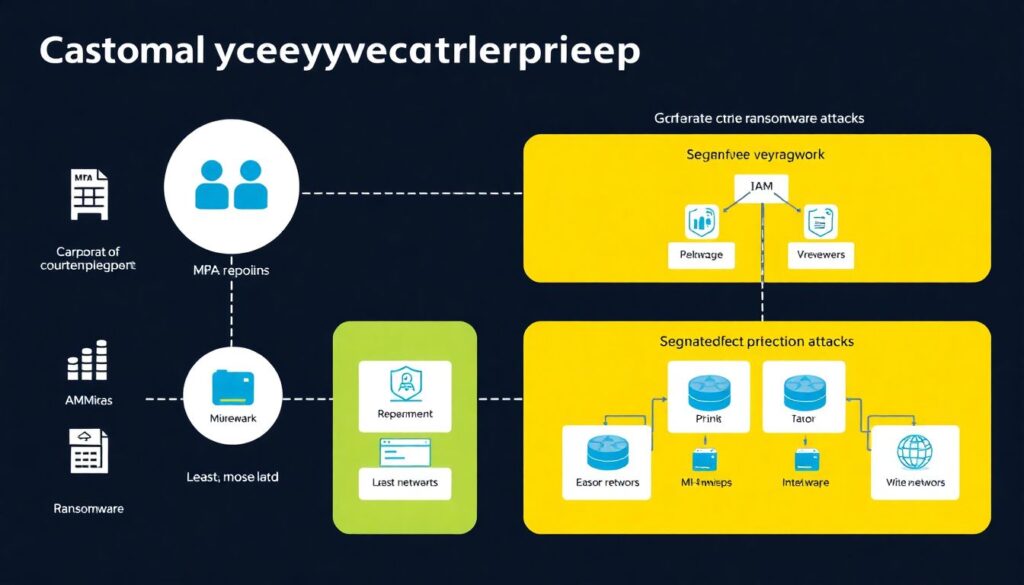
| Control | Implementation effort | Expected ransomware risk reduction | Notes |
|---|---|---|---|
| MFA for privileged users | Low | High | Strongly recommended as an immediate action. |
| Least-privilege IAM refactor | Medium to High | High | Requires good inventory of roles and workloads. |
| Network segmentation | Medium | High | Critical to limit propagation between workloads. |
| Endpoint protection (EDR/CWPP) | Medium | Medium to High | Depends on tuning and response processes. |
| Centralized logging with retention | Low to Medium | Medium | Essential for detection, investigation and compliance. |
| Immutable storage for backups | Medium | High | Prevents backup encryption or deletion by attackers. |
Data resilience: backup strategies, immutability and encryption best practices
Serviços de proteção ransomware para nuvem and robust backup designs ensure you can recover without paying ransom, even in severe incidents.
Pre-checklist: preparing your backup and encryption strategy
- Inventory business‑critical data sets and their RPO/RTO requirements.
- Identify current backup tools, schedules and storage locations.
- Verify who can modify or delete backups and encryption keys.
- Confirm existence of an off‑region or off‑account backup copy.
- Ensure you can perform test restores without impacting production.
- Document which regulations apply to encryption and data residency in Brazil.
Use the following checklist to validate data resilience against ransomware:
- All critical workloads have automated, scheduled backups to a separate account, subscription or project.
- Object storage backups use immutability features (for example, S3 Object Lock, Azure Immutable Blob, GCS Bucket Lock) where supported.
- Backup repositories are logically separated from production credentials and roles.
- Backups are encrypted at rest with keys stored in managed KMS or HSM services.
- Access to encryption keys follows least‑privilege and is monitored with audit logs.
- At least one recent full restore test is executed and documented per critical system.
- Database backups allow point‑in‑time recovery and cover transaction logs where applicable.
- Snapshots of VMs or disks are replicated cross‑region to protect against regional failures.
- Backup management consoles are protected by MFA and, where possible, private connectivity.
- Runbooks exist for restoring entire environments, not only single instances.
Example (AWS CLI, enable S3 Object Lock on new bucket): aws s3api create-bucket --bucket br-prod-backups --object-lock-enabled-for-bucket
When choosing ferramentas de backup e recuperação de dados na nuvem contra ransomware, prefer solutions that support immutable storage, cross‑account backups and API‑level access control to minimize blast radius.
Incident response playbook: containment, eradication and evidence preservation
Clear melhores práticas de resposta a incidentes ransomware em cloud are essential to avoid data loss and maintain legal defensibility in pt_BR environments.
Pre-checklist: readiness for cloud incident response
- Defined on‑call roster and escalation path, including legal and communications.
- Documented authority to isolate workloads, revoke credentials and suspend accounts.
- Access to forensic snapshots, logs and monitoring dashboards.
- Runbooks for containment actions per cloud provider.
- Relationship with cloud provider support for critical incidents.
Avoid these frequent errors during ransomware response:
- Shutting down or deleting compromised VMs before acquiring forensic snapshots and disk images.
- Changing IAM roles or network settings without documenting exact original configurations.
- Using compromised admin accounts to perform remediation, allowing attacker to monitor actions.
- Failing to revoke tokens, API keys and federated sessions associated with suspected accounts.
- Not isolating affected subnets or VNets, which lets ransomware continue spreading.
- Deleting suspicious files or logs, unintentionally destroying evidence required for investigation.
- Communicating sensitive details over unsecured channels or personal accounts.
- Ignoring legal, regulatory and contractual notification requirements, particularly involving Brazilian customers.
- Bringing restored systems online before verifying they are clean and patched.
- Skipping a formal post‑incident review and not updating controls and training.
Example containment action (AWS CLI, detach internet gateway): aws ec2 detach-internet-gateway --internet-gateway-id igw-123456 --vpc-id vpc-123456
Recovery and post-incident hardening: restore workflows and verification
After containment and eradication, structured recovery and hardening reduce the risk of repeat incidents while restoring business operations safely.
Pre-checklist: before starting recovery
- Scope of infection agreed between incident response, IT and business owners.
- Clean golden images available for OS and application layers.
- Verified backups identified, including restore points before encryption.
- Plan for staged restoration, prioritizing critical services.
- Capacity checks to avoid performance issues during mass restoration.
Consider the following alternative recovery approaches and when they are appropriate:
-
Rebuild from golden images plus data restore
Preferred when infrastructure as code exists and configuration drift is low. You recreate infrastructure using templates, then restore data from validated backups.
- Use when you have strong IaC (Terraform, ARM/Bicep, CloudFormation) and tested backup workflows.
- Avoid when critical customizations exist only on running systems.
-
Point-in-time restore of databases and storage
Suitable when application code is intact but data is partially encrypted or corrupted.
- Use when you can tolerate some data loss within RPO targets.
- Avoid when compromise predates the suspected encryption time.
-
Parallel clean environment build
Create a new account, subscription or project, harden it, and migrate only verified clean data.
- Use when the original environment is deeply compromised or poorly segmented.
- Requires more time but improves long‑term security posture.
-
Selective in-place restoration
Restore only affected components on existing infrastructure while leaving unaffected services running.
- Use when infection is clearly contained and logging confirms scope.
- Riskier if your visibility is limited or logging was incomplete.
Example (Azure CLI, restore VM from snapshot): az snapshot create --name clean-snap --resource-group rg-prod --source <disk-id>
After recovery, perform targeted hardening: rotate credentials and keys, tighten IAM and network rules, enable missing logging and deploy or improve serviços de proteção ransomware para nuvem such as CSPM or backup platforms.
Practical operator questions and succinct guidance
How do I start improving ransomware protection in a small cloud environment?
Begin with low‑effort, high‑impact steps: enable MFA on all privileged accounts, lock down exposed SSH/RDP, and configure at least daily backups for critical workloads. Then gradually introduce least‑privilege IAM and better network segmentation.
What is the safest way to test my backups without risking production?
Restore backups into an isolated test account, subscription or project with no connectivity to production. Use masked or subset data if necessary, validate application behavior and document restore steps and timings.
When should I involve my cloud provider’s support during a ransomware incident?
Engage provider support as soon as you confirm encryption is in progress or you suspect large‑scale credential compromise. They can help with account‑level controls, forensic data and, in some cases, temporary relief on usage or throttling limits.
Can I rely only on cloud-native tools to handle ransomware risks?
Cloud-native tools are often sufficient for many intermediate environments if properly configured and monitored. Larger or regulated organizations should complement them with third‑party EDR, SIEM and backup solutions that provide additional control, reporting and independence.
How often should I run incident response simulations for cloud ransomware?

Run at least one focused tabletop exercise per year and a technical drill whenever you significantly change your architecture or tooling. Include participants from operations, security, legal and business lines relevant to Brazilian customers and regulations.
Is paying the ransom ever recommended from a technical standpoint?
From a technical and risk perspective, paying ransom is discouraged: decryption is not guaranteed, attackers may return, and legal issues may arise. Robust backups and tested recovery plans are a safer and more sustainable strategy.
What metrics show that my ransomware defenses are improving?
Track MFA coverage, percentage of least‑privilege roles, number of exposed management endpoints, backup success and restore success rates, and mean time to detect and contain suspicious activity. Improving trends across these metrics indicate stronger defenses.