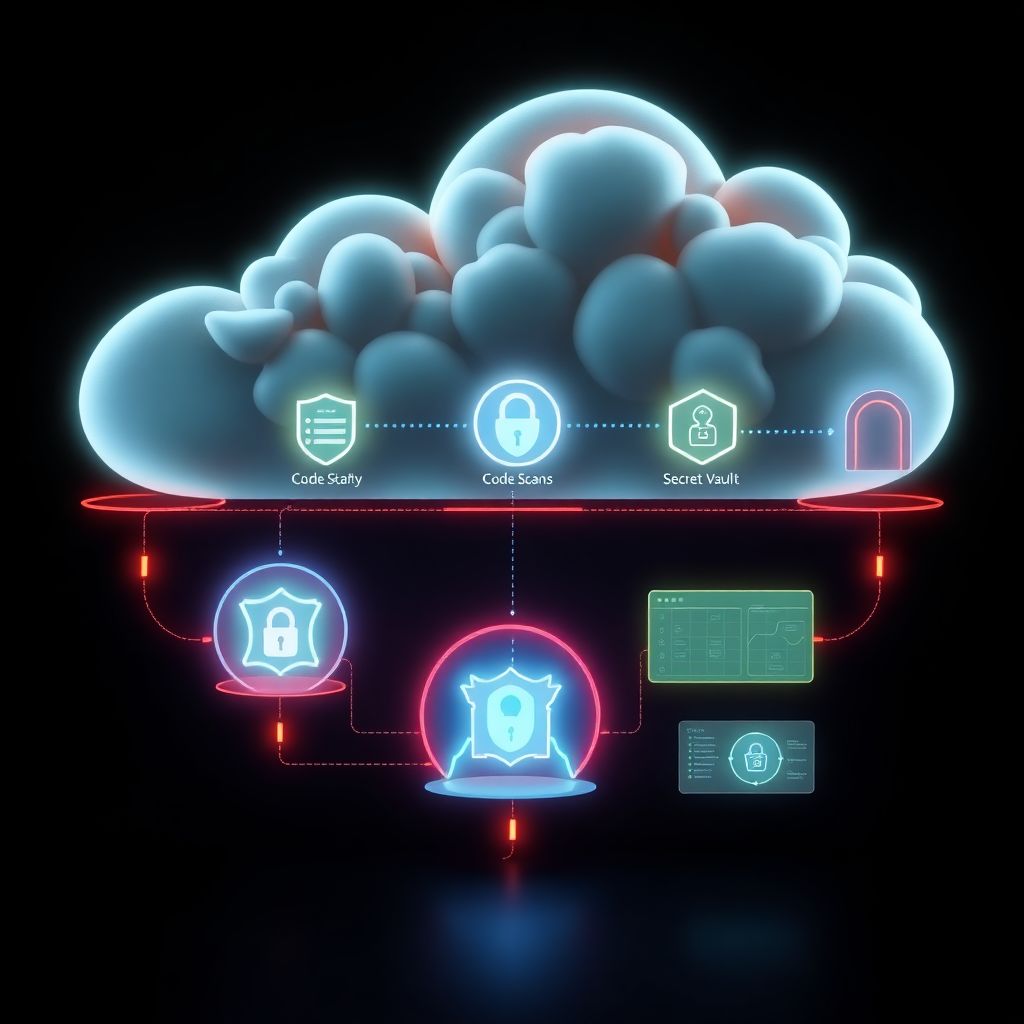
Implement DevSecOps in a cloud CI/CD pipeline by embedding security gates into each stage: design secure architecture, add shift-left code and dependency checks, scan Infrastructure as Code, manage secrets with least privilege, enforce runtime monitoring, and codify compliance. Use small, reversible changes and safe, auditable commands for every step.
Core security goals to embed in a DevSecOps CI/CD pipeline
- Make every merge request pass automated security checks with clear pass/fail criteria.
- Ensure only scanned and signed artifacts reach production environments in the cloud.
- Keep all secrets out of code and logs, rotated and centrally managed.
- Continuously scan cloud infrastructure and Kubernetes manifests before and after deployment.
- Monitor runtime events with actionable alerts and tested incident playbooks.
- Encode policies and compliance requirements as code, versioned alongside applications.
- Use incremental rollout patterns to safely introduce new security controls.
Secure CI/CD architecture patterns for cloud-native projects
This section focuses on architecture patterns that help a Brazilian team building projetos em nuvem implementação devsecops em pipelines ci cd without disrupting delivery speed.
| Checklist item | Recommended tools / services | CI/CD stage | Safe verification command / action |
|---|---|---|---|
| Separate build, test and deploy runners with least privilege | GitHub Actions self-hosted, GitLab Runners, Bitbucket Runners | Pipeline bootstrap | gitlab-runner verify or gh run list --limit 5 to confirm runner scopes |
| Use dedicated CI/CD service accounts in the cloud | AWS IAM Roles, GCP Service Accounts, Azure Managed Identities | Before first deploy | aws sts get-caller-identity, gcloud auth list or az account show to check identities |
| Isolate artifact registry from source control | Amazon ECR, GCP Artifact Registry, Azure Container Registry, Harbor | Build and package | docker pull <image:tag> --quiet to confirm registry access with CI identity |
| Enforce signed images and provenance | Sigstore Cosign, AWS Signer, Google Cloud Binary Authorization | Post-build, pre-deploy | cosign verify <image-ref> to confirm signature before promotion |
| Use environment-specific deployment pipelines | GitHub Environments, GitLab Environments, Argo CD apps, Spinnaker | Deploy (dev/stage/prod) | kubectl get deploy -n <env-namespace> to check isolated workloads |
| Add manual approval for high-risk promotions | GitHub environment protection rules, GitLab manual jobs | Stage → prod promotion | Review pipeline history in UI; ensure latest prod job is manually approved |
| Centralize logs and audit trails for pipelines | CloudWatch Logs, GCP Logging, Azure Monitor, ELK/Opensearch | All stages | Run a test pipeline and confirm new log entries in centralized logging console |
| Review architecture with empresa de segurança em devops e devsecops when needed | Local devsecops serviços de consultoria | Initial setup and periodic review | Document current data flows and get written recommendations before changes |
Shift-left controls: SAST, dependency scanning and build-time checks
Shift-left controls reduce risk early. This section lists practical checks and ferramentas devsecops para projetos em nuvem that fit intermediate teams.
| Checklist item | Recommended tools / services | CI/CD stage | Safe verification command / action |
|---|---|---|---|
| Run SAST on every merge request | Semgrep, SonarQube, GitLab SAST, CodeQL | Pre-merge / pull request | semgrep --config auto --dry-run locally to ensure rules load cleanly |
| Scan open-source dependencies | OWASP Dependency-Check, Snyk, Dependabot, Trivy | Build | trivy fs --security-checks vuln --exit-code 0 . to see baseline findings |
| Enforce minimal quality gates | SonarQube, Code Climate, GitHub Checks | Build / test | Check last pipeline summary for explicit SAST/quality status before merge |
| Block secrets committed to git | Gitleaks, TruffleHog, GitHub secret scanning | Pre-commit / pre-merge | gitleaks detect --no-git -v in local repo to validate rules |
| Add container image scanning in CI | Trivy, Grype, Clair | Post-build | trivy image --exit-code 0 <image:tag> to list vulnerabilities safely |
| Fail builds on high-severity vulnerabilities only | Trivy severity filters, Snyk policy | Build | trivy image --severity HIGH,CRITICAL <image:tag> and verify exit code conditions |
| Maintain baseline allowlist with code owners | CODEOWNERS, .snyk policy files, Semgrep ignore rules | Policy review | List and review current policy/ignore files in the repo for outdated entries |
| Engage devsecops serviços de consultoria to tune rules | Specialized providers in pt_BR market | After initial rollout | Schedule rule review sessions and track false positive rate over a few sprints |
Infrastructure as Code scanning and environment hardening practices
Before applying new security checks to IaC, prepare your team and environments with a short readiness checklist.
- Identify all Terraform, CloudFormation, ARM/Bicep and Kubernetes manifests used for cloud deployments.
- Ensure test cloud accounts/projects exist for non-production validation.
- Grant read-only access to security tooling for your CI runners.
- Back up current CI/CD configuration and environment state descriptions.
- Define a simple rollback plan for misconfigured policies (e.g., revert last commit, disable new job temporarily).
| Checklist item | Recommended tools / services | CI/CD stage | Safe verification command / action |
|---|---|---|---|
| Scan Terraform and Kubernetes manifests for misconfigurations | Checkov, Terrascan, Kubeval, kube-score | Pre-merge / build | checkov -d . --soft-fail to see findings without breaking the pipeline |
| Validate cloud templates before apply | terraform validate, cfn-lint, az bicep build | Build | terraform validate or cfn-lint template.yaml to catch syntax issues |
| Implement policy-as-code for cloud accounts | Open Policy Agent (OPA), Conftest, HashiCorp Sentinel | Pre-deploy | conftest test . to confirm policies run as expected |
| Check Kubernetes cluster security baselines | kube-bench, kubectl rules, CIS benchmark tools | Post-deploy | kube-bench --check <short-check-id> in a non-production cluster |
| Harden container runtime configurations | Dockle, Trivy config, CIS Docker benchmark tools | Build and deploy | dockle <image:tag> to inspect Dockerfile best practices |
| Restrict network paths between CI and cloud | Security Groups, firewall rules, VPC peering | Pipeline bootstrap | List security rules with aws ec2 describe-security-groups or equivalent CLI read-only commands |
| Document approved IaC modules for reuse | Internal Terraform registry, Git submodules | Design | Review registry/module list in source control and tag as "approved" |
-
Centralize Infrastructure as Code repositories
Consolidate Terraform, CloudFormation, Bicep and Kubernetes YAML into dedicated repos or clear directories. This simplifies enabling scanners and policy-as-code in one place per service or platform layer. -
Add IaC scanning jobs to CI in advisory mode
Start with non-blocking jobs so developers can see findings without failed pipelines.- Add a job that runs
checkov -d . --soft-failorterrascan scan -non every push. - Publish reports as CI artifacts for later review.
- Add a job that runs
-
Introduce minimal blocking policies for critical issues
After developers are comfortable, mark only the highest-risk policies as blocking.- Configure IaC tools to fail on public S3 buckets, open security groups, or unauthenticated services.
- Keep everything else as warnings to avoid noisy failures.
-
Integrate policy-as-code into Terraform and Kubernetes workflows
Use OPA/Conftest or Sentinel where supported.- Create policy files in a dedicated
policy/folder. - Add CI steps that run
conftest teston manifests and Terraform plans.
- Create policy files in a dedicated
-
Validate changes in isolated cloud environments
Apply new checks in sandbox accounts or projects before production.- Use separate AWS accounts, GCP projects or Azure subscriptions for testing policies.
- Confirm no required deployments are blocked unexpectedly.
-
Automate environment hardening checks
Run cluster and host baselines regularly in CI or scheduled jobs.- Schedule
kube-benchagainst non-production clusters. - Export reports and compare against previous runs to track drift.
- Schedule
-
Review and tune IaC rules with operations and security
Involve ops and any empresa de segurança em devops e devsecops partner to adjust rules.- Maintain a rule change log with who requested adjustments and why.
- Regularly prune obsolete exceptions to keep policies effective.
Secrets lifecycle, credential rotation and least-privilege pipelines
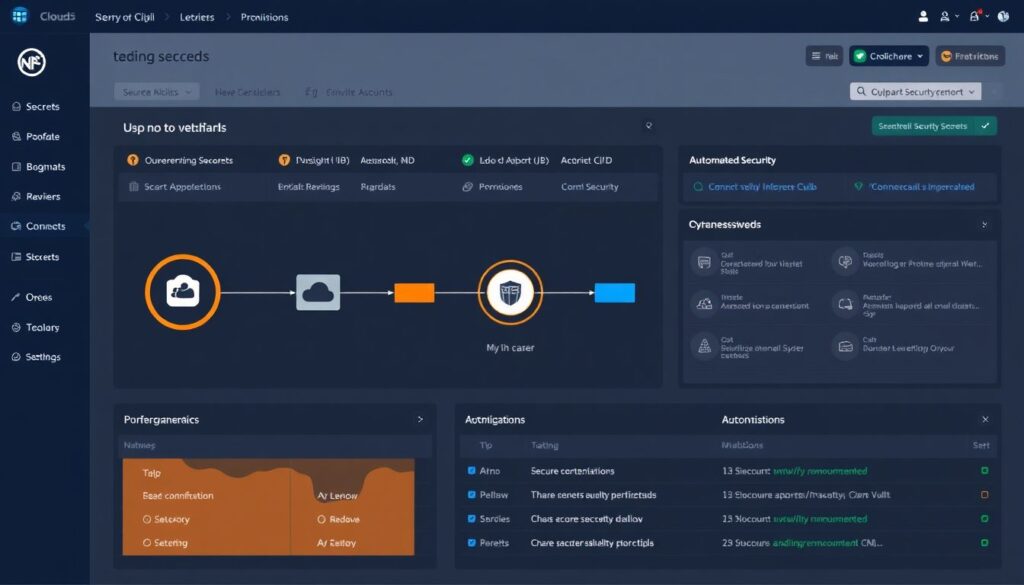
The following checklist helps validate that secrets and privileges in your pipeline are properly controlled when adopting soluções de segurança para ci cd em nuvem.
| Checklist item | Recommended tools / services | CI/CD stage | Safe verification command / action |
|---|---|---|---|
| Store all secrets in a central vault, not in CI variables | HashiCorp Vault, AWS Secrets Manager, GCP Secret Manager, Azure Key Vault | Pipeline bootstrap | Use CLI (e.g., vault list secret/) to confirm secrets are stored centrally |
| Use short-lived tokens and dynamic credentials | AWS STS, Vault dynamic DB creds, OIDC federation | Job start | Check token expiry via jwt decode tooling or provider CLI "describe" commands |
| Restrict CI service accounts with least privilege | AWS IAM policies, GCP IAM roles, Azure RBAC | Before deploy | List attached policies and ensure no "*" wildcards for actions/resources |
| Rotate critical secrets regularly with automation | Vault rotation, AWS Secrets Manager rotation lambdas | Scheduled | Trigger a test rotation and confirm affected pipelines still pass |
| Eliminate secrets from build logs and artifacts | Masked variables in CI, log scrubbing, redaction filters | All stages | Search recent logs for patterns like "AKIA" and known tokens; no hits should appear |
| Use environment-specific secrets and scopes | Per-environment secret stores, CI environment variables | Deploy | Verify non-production credentials are never used in production job configs |
| Document emergency access and break-glass process | Runbooks, ticketing system | Incident response | Review runbooks and confirm access is audited and time-bound |
| Review secrets strategy with devsecops serviços de consultoria when scaling | Specialized cloud security partners | Periodic review | Schedule assessments and track remediation items in backlog |
- All hard-coded credentials have been removed from repositories and CI job definitions.
- Pipeline jobs fail if the vault or secret manager is unreachable, avoiding silent insecure fallbacks.
- Every CI service account has a clear justification and mapped minimal set of permissions.
- Secrets rotation procedures have been tested in a non-production environment.
- Secrets never appear in build logs, artifacts, or monitoring systems.
- Access to secret management consoles and CLIs is restricted and audited.
- Incident runbooks include steps to revoke and rotate secrets quickly.
Runtime protection: monitoring, alerting and automated incident playbooks
Runtime controls detect and contain issues that escape earlier pipeline stages; this section highlights common pitfalls when wiring monitoring and playbooks into CI/CD-driven cloud deployments.
| Checklist item | Recommended tools / services | CI/CD stage | Safe verification command / action |
|---|---|---|---|
| Send application and audit logs to a central platform | Cloud-native logging (CloudWatch, GCP Logging, Azure Monitor), ELK | Deploy | Deploy to a test environment and confirm new logs appear in central console |
| Instrument metrics and health checks | Prometheus, Cloud Monitoring, OpenTelemetry | Build / deploy | Query metrics endpoints or dashboards for the latest deployment |
| Configure security alerts for key behaviors | SIEM rules, CloudTrail alerts, Security Center | Post-deploy | Trigger a harmless test event (e.g., login from test account) and confirm alert reception |
| Automate incident playbooks for common scenarios | SOAR platforms, runbooks, Lambda/Cloud Functions | Incident response | Run the playbook in a sandbox and verify each action completes successfully |
| Link deployments with monitoring metadata | Deployment labels, tracing tags | Deploy | Inspect logs/metrics to ensure they reference the correct build or commit ID |
| Regularly test alert noise and relevance | Alert tuning sessions, synthetic tests | Ongoing | Review a sample of recent alerts and classify them as actionable or noise |
| Ensure on-call and escalation paths are defined | PagerDuty, Opsgenie, rotation schedules | Operations | Trigger a non-critical test alert and confirm correct escalation path |
- Over-reliance on default cloud alerts without tuning to your specific workloads.
- Lack of correlation between CI/CD deployments and runtime incidents, making root cause analysis slow.
- No safe staging environment to rehearse incident playbooks end-to-end.
- Unclear ownership of runtime security tools across dev, ops and security teams.
- Monitoring disabled or reduced during cost-optimization efforts, hiding important signals.
- Alert fatigue due to too many low-value or duplicate notifications.
- No periodic review of dashboards and alerts after architecture or pipeline changes.
Compliance-as-code: policy enforcement, evidence collection and audits
Compliance requirements can be integrated into CI/CD in several ways; choose the approach that best matches your project size and regulatory needs in Brazil's cloud context.
| Checklist item | Recommended tools / services | CI/CD stage | Safe verification command / action |
|---|---|---|---|
| Capture build, test and security evidence automatically | CI job artifacts, report uploads, artifact repositories | All stages | Inspect recent pipeline runs for attached security and test reports |
| Encode access and change control policies as code | OPA/Rego, Sentinel, custom policy engines | Pre-merge / pre-deploy | Run policy tests in CI (e.g., conftest test) and ensure consistent results |
| Use templates for compliant pipelines | Reusable workflows, GitLab templates, internal starter repos | Project onboarding | Create a new project from template and ensure all required jobs are present |
| Automate RBAC checks across cloud and CI | Cloud IAM audit tools, CI API scripts | Scheduled | Run read-only IAM listing commands and review differences over time |
| Maintain audit-ready documentation linked to code | Docs-as-code in Git, ADRs, README policies | Change management | Check that every critical control has a referenced document in the repo |
| Leverage external assessments when regulation is strict | Local empresa de segurança em devops e devsecops, auditors | Periodic review | Share pipeline and policy diagrams and track remediation tasks |
- Lightweight internal compliance-as-code: suitable for small-to-medium teams needing basic traceability without heavy frameworks. Focus on pipeline templates, simple policies and report retention.
- Platform-level compliance frameworks: adopt opinionated platforms that bake controls into CI/CD and cloud, ideal when multiple squads share the same stack.
- External managed DevSecOps: work with devsecops serviços de consultoria when internal capacity is limited or when regulated industries (finance, health, government) demand independent oversight.
Common operational concerns when integrating security into CI/CD
How can we introduce DevSecOps without slowing down deployments?
Start with non-blocking checks (advisory mode) and gradually promote only well-tuned controls to blocking status. Focus on fast tools and run heavier scans on a schedule or on main branches only.
Which security checks should run on every commit versus nightly?
Run fast SAST, dependency and IaC checks on every merge request. Reserve deep scans, full container audits and compliance reports for nightly or weekly pipelines to balance coverage and speed.
How do we handle legacy projects that lack tests or IaC?
Begin by protecting the deployment perimeter: scan images, add runtime monitoring and start documenting infrastructure. Introduce tests and IaC incrementally as you touch components, not via big-bang rewrites.
What is the safest way to manage secrets during the transition?
Migrate secrets to a central vault first, keeping old mechanisms as read-only backups. Update pipelines to fetch from the vault, test in non-production, then remove legacy secrets and credentials.
How can we prove to auditors that our CI/CD security controls work?
Store pipeline logs, security reports and policy evaluation results as artifacts. Document which jobs enforce which requirements and keep a simple mapping between controls, code, and evidence.
When should we consider bringing in external DevSecOps consultants?
Consider external help when facing strict regulatory deadlines, large multi-cloud migrations, or when internal teams lack time or expertise to tune security tools and policies effectively.
How do we align developers, operations and security around these changes?
Create shared ownership by defining joint objectives, like "no critical vulnerabilities in production." Run short, regular working sessions to review findings, tune rules and adjust pipelines together.