Alining cloud, regulation and security in 2026 sounds scary, but it doesn’t have to be. If you treat LGPD, GDPR and ISO 27001 as design constraints from day zero of your cloud journey, they actually simplify a lot of architectural decisions instead of blocking everything.
Why compliance and cloud native are fighting the wrong battle
Clear definitions without legalese overload
When we say “compliance” here, we’re basically talking about three pillars. LGPD (Brazil) and GDPR (EU) are data protection laws: they define what is personal data, what counts as consent, what “legitimate interest” means, and what rights people have (access, deletion, portability, etc.). ISO 27001 is different: it’s a global standard that describes how to build and run an Information Security Management System (ISMS), with risk analysis, controls and continuous improvement. Cloud native architecture is about apps built for elasticity and automation (containers, microservices, APIs, managed services) rather than static servers. Managed services are those where the cloud provider runs the “undifferentiated heavy lifting”: databases, message queues, monitoring, IAM, and you consume them via API instead of managing VMs and patches yourself.
If we mix all that in practice, compliance just means: prove you know what personal data you process, why, where it flows in your cloud platform, who touches it, how it is protected, and how fast you can react when something bad happens.
Diagramming the shared responsibility
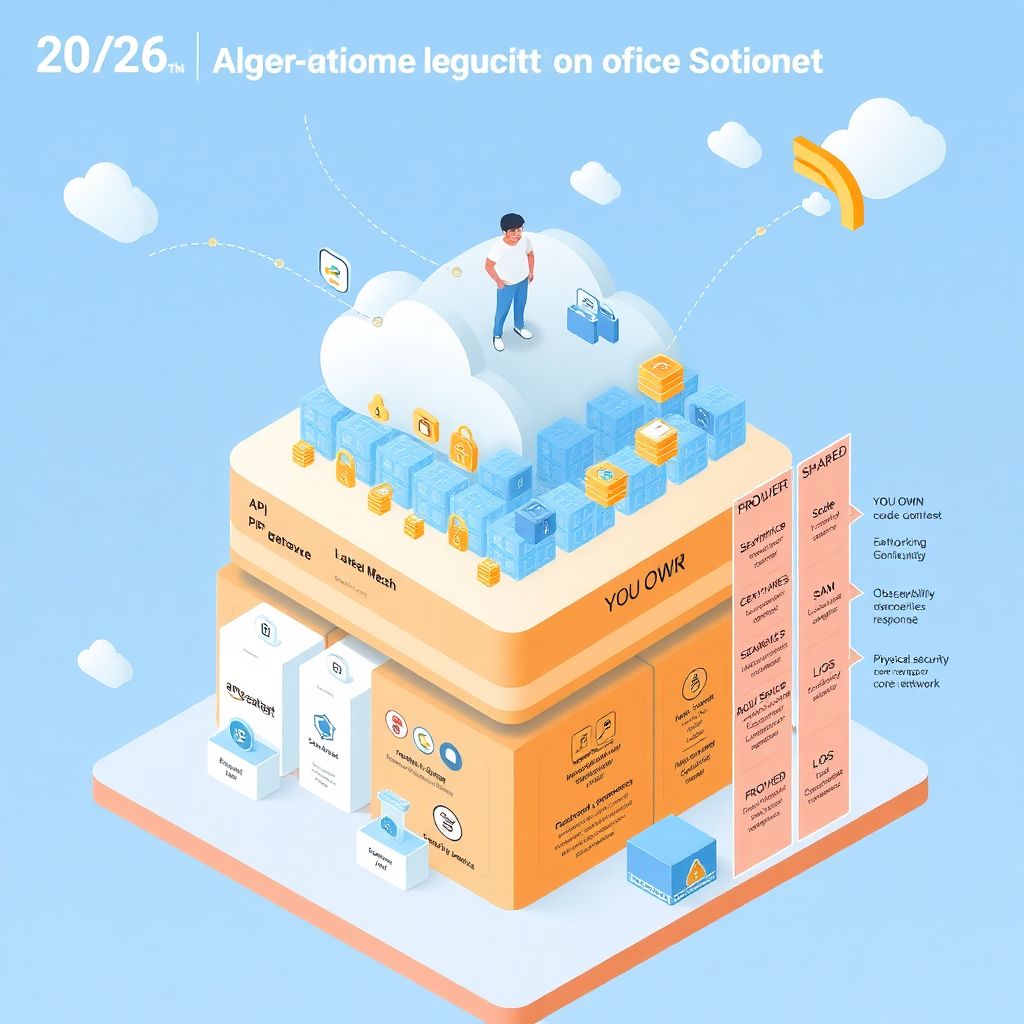
Imagine a simple mental diagram. At the top, there’s a user sending personal data through a web or mobile app. That app calls APIs hosted in containers or serverless functions. Underneath, a platform layer provides networking, secrets, observability and CI/CD. At the bottom sits the cloud provider with storage, compute, database and security primitives. Draw three vertical brackets on the side: “You own” (code, configs, IAM choices), “Shared” (hardening managed services, logging, incident handling) and “Provider” (physical security, hypervisor, core network). This is the classic shared responsibility model translated into compliance language: the law doesn’t care who owns which layer; it only cares that obligations are met and that responsibilities are clearly provable and contractually mapped.
Translating LGPD and GDPR into technical requirements
From articles in the law to design patterns in code
LGPD and GDPR look abstract, but they map surprisingly well to technical patterns when you break them into themes. Law articles about “data minimisation” and “purpose limitation” become practical decisions like: don’t log raw identifiers; drop unnecessary fields at the edge; separate personal data from business data in different schemas. The right to access and delete data turns into searchability and traceability requirements: you need stable identifiers, data lineage, and soft‑delete patterns that propagate across microservices. Security and “integrity and confidentiality” become encryption, zero‑trust networking, strong authentication and auditable change control. Even Data Protection Impact Assessments (DPIA) can be embedded as stages in your architecture review and threat‑modeling sessions, instead of being lonely PDFs sitting on SharePoint that nobody updates.
The big win: when engineers read the law as non‑functional requirements, they start using consistent patterns rather than ad‑hoc exceptions negotiated in endless meetings.
Comparing LGPD, GDPR and ISO 27001 in a cloud context
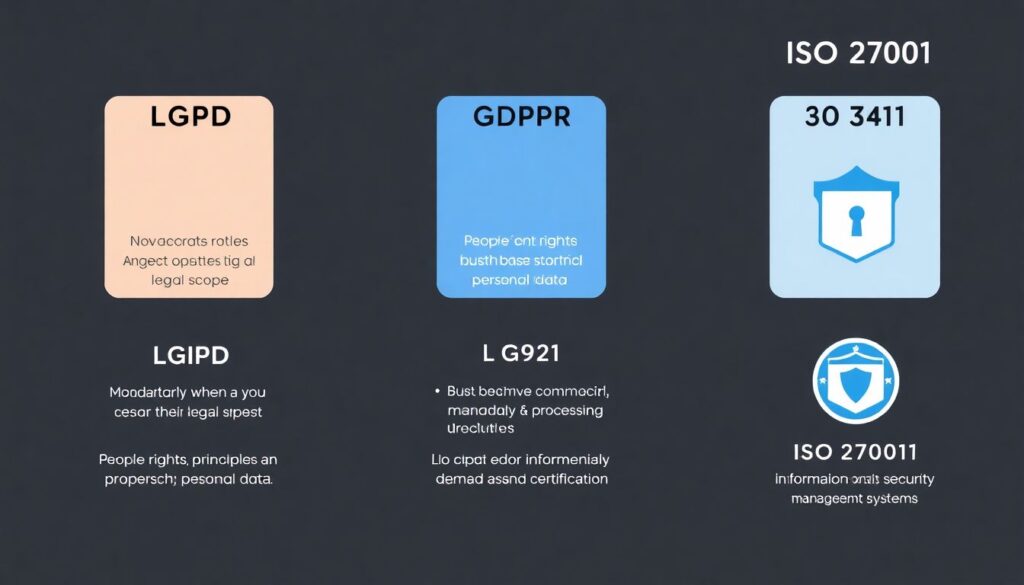
A quick comparison helps to position each piece. LGPD and GDPR are mandatory if you fit their scope; ISO 27001 is voluntary but often becomes “commercially mandatory” because clients demand it. The regulations are about rights, principles and legal bases for processing personal data; ISO 27001 is about building the management system and controls that make those legal promises realistic. In a cloud environment, ISO 27001 gives you the structure (asset inventory, risk register, incident playbooks, change control) that makes LGPD and GDPR compliance auditable. Many organisations choose consultoria lgpd gdpr iso 27001 em nuvem precisely to align legal interpretations with the very practical constraints of containers, multi‑account setups and multi‑region deployments.
Designing a compliant cloud‑native architecture
What “secure by design” means in 2026
A arquitetura cloud native segura iso 27001 in 2026 is less about shiny tools and more about opinionated defaults. In a modern platform, every new microservice is created from a template that already includes: mutual TLS between services, least‑privilege IAM roles, central secrets management, structured logging with correlation IDs, and compliance‑friendly tags (data classification, owner, retention hints). Kubernetes admission controllers, policy engines like OPA/Gatekeeper and service meshes become enforcement points for these defaults. When ISO 27001 requires access control, logging or change management, you can point to these platform features and to automated evidence rather than screenshots. In other words, the platform embodies the security policy; developers only opt out through formal exceptions, which are themselves logged and reviewed.
This approach shrinks the gap between “paper controls” and actual runtime behaviour, which is where most audits fall apart.
Text‑only diagram of a compliant microservice
Picture this stack from top to bottom. At the top: “User / API Client”. Under it, “API Gateway (Auth, Rate Limit, Data Minimisation)”. Next layer: “Service Mesh (mTLS, traffic policies, telemetry)”. Then “Microservice Pods” running in a cluster, with sidecars handling encryption in transit. Below them: “Secrets Manager” and “Config Store”, not local files. At the base: “Managed Database (encrypted at rest, backups, PITR)” and “Central Logging & SIEM”. On the side, two vertical services: “IAM / RBAC” controlling human and machine identities, and “DLP & Classification” scanning data stores. When a privacy officer asks, “Where can we cut access to this data set?”, you can point to IAM and network policies instead of hoping nobody has created a rogue snapshot.
Managed services: blessing or compliance nightmare?
Leaning on managed services without losing control
Managed services often look scary to legal teams because of data residency, sub‑processors and opaque internals. Yet, in practice, serviços gerenciados cloud compliance lgpd gdpr are usually safer than self‑managed components, especially in small and mid‑sized teams. Providers offer encryption by default, key management, fine‑grained IAM, tamper‑resistant audit logs, and security certifications that would cost a fortune to replicate on‑prem. The trick is to treat each managed service as an extension of your risk register: identify what personal data might land there, which region it uses by default, how backups and logs are stored, and which features you must disable (public endpoints, cross‑region replication, weak auth modes). With that done, your legal basis and contractual clauses can reference real technical constraints instead of vague assumptions about “the cloud”.
In practice, the loss of low‑level control is offset by much better defaults and faster patching cycles.
Comparing managed vs self‑managed in real life
Think of a database example. Self‑managed Postgres on virtual machines gives you full OS control, but also full responsibility for patching, backup encryption, and secure configuration. A managed relational database service offers automated patching, built‑in encryption, and integrated IAM; you trade some customisation for strong baselines. From a compliance perspective, it’s easier to prove that patches are applied and backups are protected when the platform exposes these facts via API. That’s one reason soluções de segurança e compliance para ambientes cloud nativos increasingly build on top of provider‑native services and add visibility, policies and workflow orchestration, instead of re‑inventing databases, message buses or identity stores from scratch.
Implementing LGPD/GDPR on AWS, Azure and Google Cloud
Pragmatic multi‑cloud patterns
By 2026, multi‑cloud is less a buzzword and more a boring reality: mergers, vendor risk management and latency requirements push teams to mix providers. The good news is that patterns for implementação lgpd em nuvem aws azure google cloud have converged. You’ll usually see a central identity layer (IdP) federated to each cloud, a unified data classification scheme applied via tags/labels, and a common logging architecture exporting to a shared analytics and SIEM stack. Data residency is enforced through landing zones: each region and account/subscription is pre‑configured for specific jurisdictions and retention rules. When regulators ask “where is EU personal data stored?”, you can answer by design instead of by discovery: only specific landing zones can host that data, and automated policies block deployments elsewhere.
The difficulty shifts from tooling to governance: agreeing on patterns and making them stick across dozens of teams and providers.
Role of specialised consulting and internal platforms
Many companies in 2026 discovered that ad‑hoc projects don’t scale, and turned to two complementary forces: platform engineering and specialised consulting. Internal platform teams build paved roads: reusable modules, templates and guardrails that make the compliant way the easiest way. In parallel, consultoria lgpd gdpr iso 27001 em nuvem helps reconcile legal requirements, regulator guidance and the realities of specific industries like fintech, health or gov. Together they define data domains, residency rules, DPIA processes and control mappings, and then encode them as code: Terraform modules, policy sets, CI checks and self‑service portals. Instead of long PDF policies that nobody reads, developers see concrete “product” features: choose data sensitivity, region and expected retention, and the platform wires everything accordingly.
Looking ahead: where compliance and cloud native are going
Trends to expect after 2026
From today’s vantage point in 2026, three trends are pretty clear. First, regulators are getting much more technical: guidance documents already mention encryption configurations, log retention, API security and even specific cloud risks. Expect audits to include architecture reviews and not just contracts. Second, automation is swallowing traditional compliance work: continuous control monitoring, evidence collection from APIs, and policy‑as‑code are becoming the norm, shrinking the distance between audit findings and real configuration drifts. Third, AI plays both sides: it introduces new risks (model leakage, training‑data governance) while also helping map data flows and detect anomalies in huge cloud estates. Organisations that treat LGPD, GDPR and ISO 27001 as living design constraints, embed them into platforms, and keep legal, security and engineering talking weekly, will handle these shifts with far less friction than those stuck in the “security vs delivery” mindset.
The direction is clear: cloud native and compliance aren’t enemies; badly designed processes are.