
Why cloud compliance suddenly became everyone’s problem in IT
If you work with infrastructure, security or devops, you’ve probably noticed something in the last few years: talking about LGPD, GDPR and ISO 27001 in cloud environments stopped being a “legal thing” and turned into a very practical, very technical day‑to‑day concern. Since around 2022 the volume of audits, security questionnaires from clients and regulator attention exploded, and by 2026 every serious customer expects clear answers on how you treat their data in AWS, Azure, GCP or any other provider. In practice, compliance in the cloud has become as basic as uptime, and IT teams that ignore this end up blocked in sales cycles, punished in security incidents or simply burned out trying to fix everything at the last minute when a big client demands proof of control and evidence of processes overnight.
Quick historical context: from on‑prem boxes to audited clouds
Back when almost everything ran on‑premise, LGPD and GDPR were already scary acronyms, but the technical scope was relatively limited: your data center, your network, your storage, your backup tapes. With the migration to cloud computing, responsibility didn’t vanish, it just got more distributed and significantly more complex. Around 2018–2020 most companies were still in the “lift and shift” phase, assuming that just putting workloads in the cloud magically made them more secure and compliant. By 2023 regulators and big clients started asking awkward questions: where is the data physically? who has access? how is it logged? Since then, consultoria lgpd para ambientes em nuvem turned into a real market, because legal and business teams needed people who could translate articles of law into Terraform policies, IAM rules and data‑retention configurations in real services.
How LGPD and GDPR landed in the cloud world
GDPR (in Europe) and LGPD (in Brazil) were never written with only cloud in mind, but their principles fit perfectly into what cloud does worst when left unmanaged: massive data replication, easy sharing and automated processing. Once companies began pushing personal data into SaaS, PaaS and multi‑cloud architectures, supervisory authorities realized that data residency, cross‑border transfers and vendor chains were getting opaque. Since 2024 investigations and fines have increasingly mentioned cloud explicitly, forcing CIOs to revisit their architectures. From there, adequação lgpd e gdpr em cloud computing stopped being a “future project” and turned into a prerequisite for any serious digital product that wants to scale internationally or handle sensitive data without living in constant fear of the next breach headline.
Core principles: same laws, new technical translation
LGPD, GDPR and ISO 27001 did not change in essence because of the cloud; what changed was how IT teams need to implement and prove those principles. Instead of only thinking about firewalls and antivirus, we now talk daily about data minimization, purpose limitation, accountability and continuous risk management. For each one of these, the impact in cloud environments is concrete: what gets logged, who can access logs, which regions a storage bucket uses, what encryption strategy is in place, how keys are rotated and how every bit of this is automated through pipelines and policies‑as‑code. All those abstract legal concepts turned into checkboxes and alerts in dashboards that SREs and security engineers stare at every morning.
Data minimization and purpose limitation, but for real
One of the biggest practical shifts for IT teams has been to stop collecting data “just in case”. LGPD and GDPR both insist on only gathering what is necessary and for a clear purpose, which used to be interpreted mainly at the application level. In the cloud era, this principle spreads throughout the architecture: do we really need to replicate full production databases to every test environment? does that analytics lake actually need raw personal data, or can it work with pseudonymized or aggregated datasets? With modern data platforms, the temptation to “store everything forever because it’s cheap” is strong, but that directly collides with current enforcement trends, where regulators demand proofs of controlled retention and anonymization. The best IT teams now embed these questions into design reviews and backlog items instead of leaving them to a desperate “clean‑up sprint” before an audit.
Security and privacy by design in cloud architectures
By 2026, “security by design” and “privacy by design” are not just nice slides in a presentation; they show up as concrete patterns in cloud templates and reference architectures maintained by the IT team. Network segmentation, zero‑trust access, strong identities, secrets‑management and default‑encrypted storage are built into Terraform modules, Helm charts and CI/CD pipelines. When a squad starts a new service, they inherit these guardrails automatically. That’s where services de compliance em nuvem lgpd gdpr iso 27001 add value: they help formalize these patterns and align them with what auditors expect, so that your “we’re secure” claim is backed by logs, metrics and policies that can be demonstrated in a structured way.
ISO 27001 as the “operational glue”
If LGPD and GDPR tell you what to protect and why, ISO 27001 tells you how to organize yourself to do this consistently. The standard doesn’t care if your servers are in your office or scattered across three clouds; what matters is whether you have risk analysis, access control, incident management, logging and continuous improvement. For cloud‑heavy organizations, certificação iso 27001 para provedores de cloud became a decisive factor when choosing vendors: if your provider or your own company has a certified ISMS (Information Security Management System), half of the questions in big‑client security questionnaires get easier. For the IT team, that means processes: documented change management, controlled access requests, structured backup and restore tests, and clear evidence that controls are both implemented and monitored over time.
What actually changes for the IT team in day‑to‑day work
The practical impact of cloud compliance on the IT team can be summarized in one sentence: improvisation no longer scales. Spreadsheets tracking access, undocumented firewall rules and manual configuration in consoles used to work when the estate was small. With multi‑cloud, microservices and global users, that approach collapses. The team needs to treat security and privacy controls as code, automate evidences for audits and integrate legal requirements into architecture decisions. It’s less about doing “extra work for compliance” and more about building systems that are secure and auditable by default, so that passing an audit is mostly reusing artifacts you already generate to operate the platform reliably.
From “project” to continuous compliance
In many companies between 2020 and 2023, adequação a LGPD and GDPR was treated like a one‑off initiative: create policies, update privacy notice, run some training and assume the problem is solved. In cloud environments this mindset fails fast, because services, APIs and data flows change weekly. By 2026, mature IT teams treat compliance as a continuous process, in the same way they treat observability or cost optimization. That means automation everywhere: access reviews running monthly with automatic revocation of unused privileges, data lifecycle policies that delete or anonymize records on schedule, CI pipelines that block deployments if secrets are committed or if a resource is declared in the wrong region, and dashboards showing real‑time posture. The job of the engineer includes understanding these guardrails enough to work with them, not against them.
Practical workflow shifts for engineers and SREs
In practical terms, the daily life of IT professionals now includes tasks that used to belong only to “security” or “governance”. When you design a new microservice, you’ll think about which categories of personal data it processes, which legal basis applies and which retention rules must be implemented. When creating a data pipeline, you’ll choose whether the target dataset contains personal data and, if so, whether encryption‑at‑rest and in‑transit is mandatory, and how to manage encryption keys. When building IaC modules, you’ll embed tags that map resources to data classifications and business owners, making it easier to prove accountability. It’s common to see pull requests where code reviewers flag not only performance issues, but also potential non‑conformities with privacy and ISO policies, creating a culture where everyone feels responsible for compliance outcomes.
Implementation examples that actually work
Let’s look at how all this theory translates into real cloud setups. The most successful organizations treat compliance like part of their engineering toolkit, not as a separate bureaucratic universe. They standardize building blocks, automate boring checks and document enough so that new team members can follow patterns instead of reinventing them. While every company has its own tools and providers, some patterns are recurring because they are efficient both technically and for audit purposes. Understanding these examples helps you avoid getting lost in abstract requirements and focus on what changes in actual code, infrastructure and workflows.
Example 1: Mapping and classifying personal data in the cloud
A common starting point is to build a real‑time inventory of where personal data lives. Instead of Excel inventories that become obsolete in two weeks, companies deploy automatic discovery tools and integrate them with IaC. Databases, storage buckets and message queues receive labels like “contains personal data”, “sensitive” or “anonymous”. This classification propagates through CI/CD, so that if somebody tries to expose a dataset marked as “sensitive” directly to the public internet, the pipeline fails. Over time, engineers learn to think about classification when provisioning resources, in the same way they think about costs or performance. During audits or DPIAs (Data Protection Impact Assessments), this catalog offers concrete evidence of control, replacing guesswork with actual cloud metadata that can be exported and analyzed.
Example 2: Access control, logs and just‑in‑time permissions
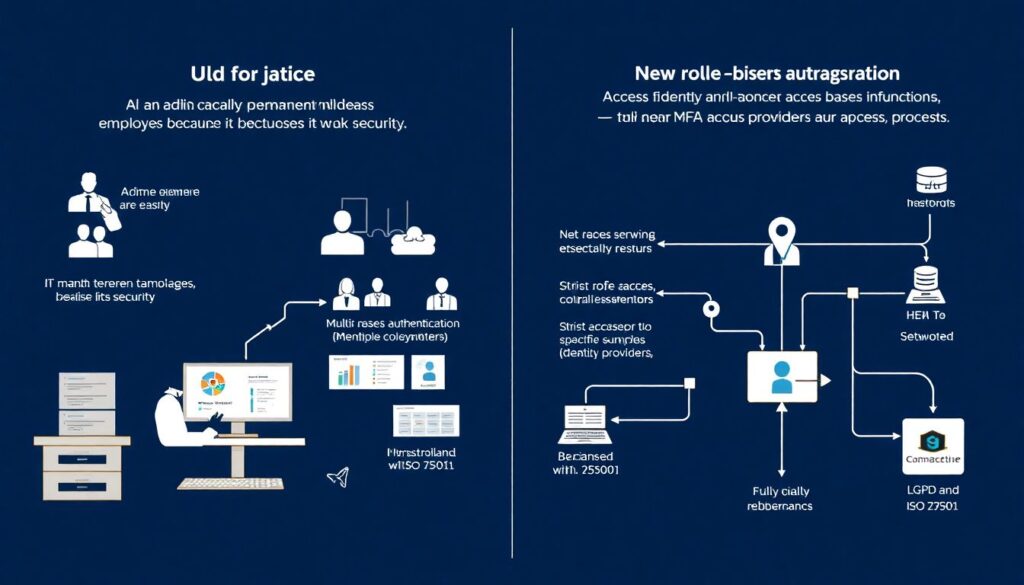
Another very tangible change is how access is managed. The old model of giving permanent admin roles “because it’s easier” is a direct enemy of both LGPD and ISO 27001. Modern setups use identity federation, MFA everywhere and role‑based access tied to job functions. For sensitive environments, just‑in‑time elevation is used: an engineer requests temporary access for a specific task, the request is logged and approved, and permissions expire automatically after a short time. Centralized logging captures who accessed what, when and from where, and alerts are configured for suspicious patterns. When an incident happens, this audit trail lets you answer regulators and clients with hard data, not with vague “we think only two people had access” statements that are no longer acceptable in 2026, especially for companies offering SaaS to regulated industries.
Example 3: Data retention and anonymization automated
Many LGPD and GDPR fines in the last years involved companies keeping personal data longer than necessary or failing to anonymize properly. To avoid that in the cloud, engineering teams now codify retention policies directly in the infrastructure. Databases are configured with TTL rules, object storage uses lifecycle policies to move old data to cheaper storage and then delete it, and scheduled jobs anonymize certain fields after a defined period. Crucially, these rules are versioned together with the code, making it easy to track who changed which retention period and why. When legal or DPO adjust a policy, IT translates that into config changes, reviews them via pull request, tests in non‑prod and only then deploys to production. This tight loop between policy and implementation is what separates companies truly compliant from those that only have pretty PDFs with no technical reflection.
Example 4: Integrating external expertise without losing control
Because the regulatory and technical landscape moves fast, many organizations partner with an empresa especializada em segurança da informação e lgpd na nuvem to accelerate their journey. The trick is to use this expertise to strengthen your own capabilities instead of outsourcing responsibility. Good partners help define reference architectures, evaluate your cloud security posture, prioritize gaps and structure the roadmap, but they also work side‑by‑side with your devops, security and data teams so knowledge stays inside. Combined with internal champions and regular training, this approach creates a virtuous cycle: audits stop being traumatic, incident response becomes more professional and business areas feel confident to launch new cloud‑based products without fearing hidden compliance barriers.
Frequent misconceptions that still cause trouble
Even in 2026, some myths about cloud and compliance refuse to die, and they usually explode at the worst possible moment, such as right before a big enterprise client’s due diligence or during an incident investigation. These misconceptions often arise from a gap between how lawyers describe obligations and how engineers perceive their own responsibilities. Clearing them up is crucial so that IT teams can plan realistically, avoid underestimating effort and steer budgets and priorities in the right direction instead of chasing illusions that “the cloud provider already solved everything for us” or “we’re too small to be audited”.
Myth 1: “Our cloud provider is compliant, so we’re automatically safe”
One of the most persistent errors is confusing the provider’s compliance with your own. Yes, big cloud vendors invest heavily in certifications and offer piles of reports and whitepapers, but regulators and clients look at the entire stack, not just the infrastructure layer. The shared responsibility model is very clear: the provider takes care of the underlying platform; you are responsible for configurations, access, data classification and application behavior. If you misconfigure an S3 bucket or deploy a database without encryption, no AWS or Azure certificate will save you from the consequences. This is where services de compliance em nuvem lgpd gdpr iso 27001 help: they map exactly which controls are inherited from the provider and which ones remain entirely under your accountability, so there are no nasty surprises when the auditor starts asking detailed questions.
Myth 2: “Compliance is a one‑time project we can close and move on”
Another trap is treating compliance like a migration project: there is kick‑off, rush, delivery and celebrations, then the subject disappears until the next law or incident. For static environments, this was already risky; in cloud it is simply unrealistic. New services appear, APIs change, third‑party vendors are added, regions are activated and data flows evolve. Without continuous monitoring and periodic reassessment, any adequação lgpd e gdpr em cloud computing degrades quickly. Mature teams accept that there is no “done”; there is “in a good enough state for now, with metrics and alerts to keep it that way”. Documentation is kept in version control, policies are automated where possible and regular internal audits check if reality still matches what is written in procedures and privacy notices.
Myth 3: “Compliance only slows us down and kills innovation”
It’s common to hear developers complaining that privacy and ISO 27001 add only obstacles. The irony is that, when implemented with automation and good design, these same controls end up accelerating delivery. When there are clear patterns for handling personal data, predefined modules for secure storage and reference CICD pipelines with all checks wired in, squads can create new services without having to reinvent security from scratch. The bottleneck shifts from endless discussions about “how to do it safely” to shipping using proven building blocks. The presence of a structured ISMS, often backed by certificação iso 27001 para provedores de cloud or by your own certification, also reduces the barrage of custom security questionnaires from clients, freeing engineering time that would otherwise be wasted on filling forms instead of shipping features.
Myth 4: “We’re too small to attract auditor or regulator attention”

Size no longer protects companies from scrutiny. Cloud made it cheap to build products that scale fast, and both regulators and customers know this. Small SaaS companies that serve large enterprises or process sensitive data become visible targets very quickly. In many sectors, big clients demand strong assurances from all suppliers, regardless of their headcount. That is one of the reasons why consultoria lgpd para ambientes em nuvem and specialized advisory in privacy‑by‑design grew so much: even startups and mid‑sized companies need practical guidance to meet vendor‑risk requirements without paralyzing their roadmap. Starting with a minimal but solid compliance foundation early on avoids painful refactors and emergency “war rooms” later, when revenue is already tied to customers with tougher standards.
Trends in 2026: what IT teams need to anticipate now

Looking at the current trajectory, IT teams can’t just react to audits; they need to anticipate how expectations will evolve over the next few years. Regulators are getting more technical, clients are increasing requirements in contracts and users are more aware of their rights. At the same time, new technologies like generative AI, edge computing and data‑sharing platforms create fresh attack and risk surfaces. Complacency is dangerous: doing only the bare minimum may be enough to pass an audit this year, but probably won’t cut it when your company starts using AI models trained on customer data or expanding to stricter jurisdictions where enforcement is more aggressive and more public.
AI, data sovereignty and the new cloud frontiers
By 2026, one of the hottest pain points is combining LGPD/GDPR obligations with massive use of cloud‑based AI services. Training and inference pipelines consume data at scale, sometimes crossing regions without clear visibility. IT and data teams are now forced to answer detailed questions like: which personal data points feed into which models, in which region are they processed, what is the legal basis, and how is data minimization ensured? Edge and multi‑region architectures add another layer of complexity, as data sovereignty rules in certain countries restrict transfers. The organizations that stay ahead are those that embed data‑protection assessments into AI project lifecycles and keep mappings up to date, instead of treating AI platforms like magic black boxes disconnected from existing compliance frameworks.
Security posture as a continuous service
Another clear trend is the migration from “point‑in‑time audits” to continuous posture management. Regulators and large customers increasingly expect proof that you are monitoring controls and reacting to deviations quickly. That’s why many companies now engage long‑term serviços de compliance em nuvem lgpd gdpr iso 27001 rather than one‑off consulting engagements: they want ongoing risk dashboards, monthly reports on misconfigurations, automated checks against benchmarks and real‑time alerts. This doesn’t replace internal teams; it augments them. Engineers keep building and operating systems, while specialized tools and partners constantly validate whether what’s running in the cloud still aligns with what your policies, contracts and legal obligations say you’ll do with personal data and security controls.
More collaboration between IT, legal and business
Finally, the cultural trend is toward breaking silos. The era when legal wrote policies in isolation and IT tried to “translate” them after the fact is fading. In 2026, successful organizations form cross‑functional squads for high‑risk projects: engineers, security analysts, DPO, legal counsel and business owners sit together to design solutions that are compliant by design. This reduces rework, avoids absurd requirements that don’t fit the technology and speeds up product launches. For IT professionals, that means learning to speak a bit of legal language and to explain technical constraints and risks clearly, so decisions are informed and defensible. Over time, this collaboration becomes a competitive advantage: you ship faster, with fewer incidents, and build a reputation as a company that treats data with respect, which is exactly what customers and regulators expect in this increasingly cloud‑driven world.
Where to start (or how to level up) in your own environment
If your team feels overwhelmed by LGPD, GDPR and ISO 27001 in the cloud, the worst move is to ignore the problem and hope it goes away. It won’t. A more realistic strategy is to choose a few high‑impact areas and move from chaos to controlled, visible processes. You don’t need perfection or a giant program on day one; you need concrete first steps that reduce risk and create momentum. As results appear, stakeholders gain confidence and it becomes easier to secure time and budget for deeper improvements in architecture, automation and training.
Practical roadmap: five steps that IT can own
1. Map where personal data actually lives in your cloud, classify key datasets and connect this information to your infrastructure‑as‑code.
2. Fix the basics: enable encryption everywhere it makes sense, implement strong identities with MFA and clean up overly broad access in critical accounts.
3. Automate at least a few data‑retention or anonymization rules, starting with the most sensitive or most voluminous datasets in your environment.
4. Establish a simple but real incident‑response flow that includes IT, security, legal and communication, and test it with tabletop or technical exercises.
5. Engage with an internal champion or an external empresa especializada em segurança da informação e lgpd na nuvem to review your posture, prioritize actions and translate legal obligations into practical, testable controls.
Closing thoughts for IT teams in 2026
Cloud didn’t make compliance easier; it made it unavoidable and much more technical. For IT teams, the choice is between being dragged into this reality by crises and urgent audits, or proactively shaping architectures and processes that are secure and compliant by design. The organizations that thrive are not those that spend the most on tools or lawyers, but those that align people, processes and technology around a simple idea: personal data deserves the same engineering rigor as availability and performance. Once this mindset takes hold, LGPD, GDPR and ISO 27001 stop being a distant threat and become part of how you build trustworthy systems in a cloud‑first world.