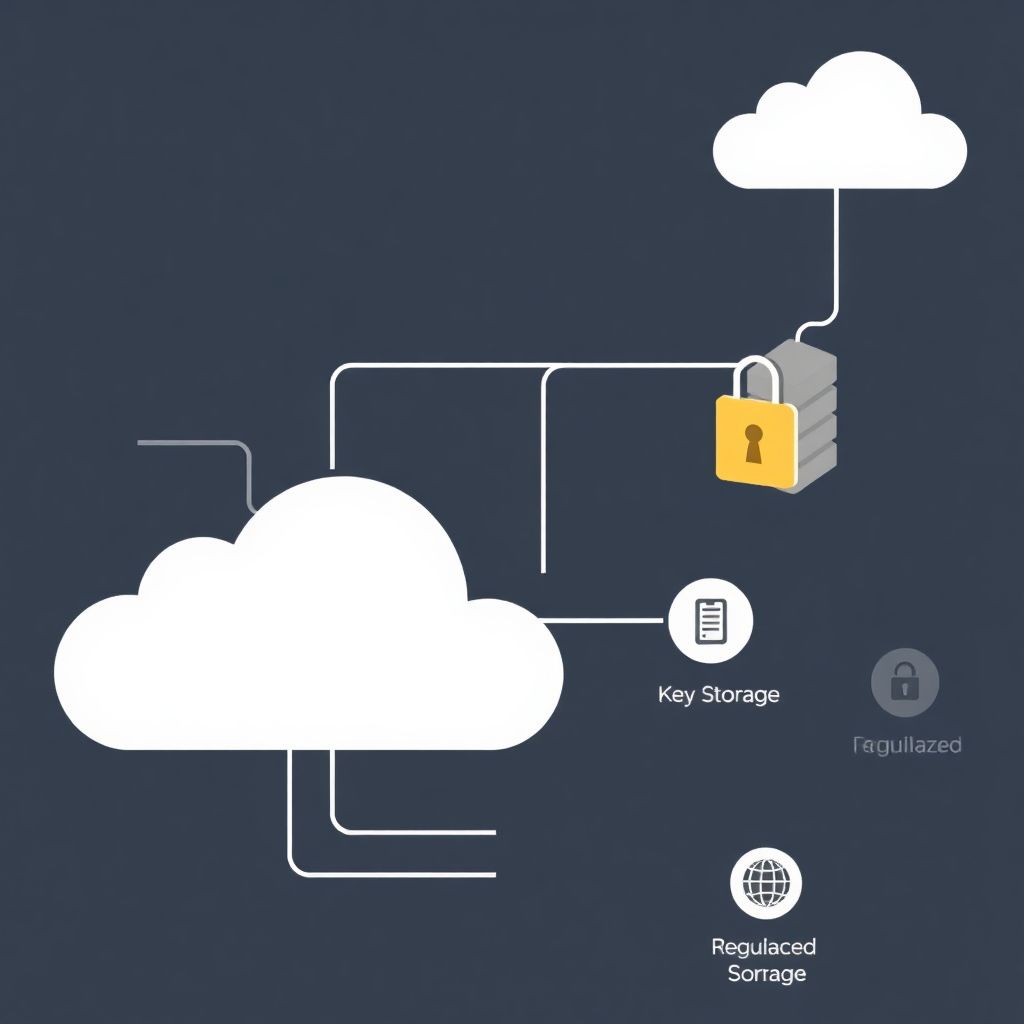
Cloud encryption that actually reduces risk focuses on three things: consistent protection for data at rest and in transit, strong but practical key management, and alignment with regulations like LGPD. Start by mapping sensitive data, enforcing provider-native encryption, hardening TLS, and centralizing keys in managed KMS instead of building custom crypto.
Core encryption priorities for cloud data
- Cover the full lifecycle: apply criptografia de dados na nuvem em repouso e em trânsito for every sensitive workload, not only for storage snapshots.
- Use cloud-native KMS and HSM integrations as default; avoid homegrown key storage or ad‑hoc scripts.
- Apply melhores práticas de criptografia na nuvem para empresas: standard algorithms, sufficient key sizes, and automated rotation.
- Align ferramentas de criptografia de dados na nuvem для compliance LGPD with data classification and data residency policies.
- Automate policy checks and logging so you can prove how you proteger dados sensíveis na nuvem com criptografia during audits and incidents.
Designing an encryption-first cloud architecture
This approach fits organizations in Brazil that already run critical workloads on AWS, Azure or GCP and must demonstrate compliance (for example LGPD, PCI, healthcare regulations). It is less suitable when you have mostly public, non-sensitive content or very small experimental workloads with short lifetimes.
Preflight assessment: where encryption adds the most value

- Identify data classes: personal, sensitive, regulated, internal, public. Treat LGPD personal data as at least “sensitive”.
- List all storage and network paths that touch sensitive data: object storage, block volumes, databases, message queues, backups.
- Map which provider features already exist: default storage encryption, KMS, HSM, service mesh, private links, VPNs.
- Note cross-border flows: where data leaves Brazil or your primary region, encryption-in-transit is non-negotiable.
- Decide early where you need customer-managed keys (BYOK/CKMS) instead of fully provider-managed keys.
Architecture checklist for encryption-first design
- Make encryption opt-out instead of opt-in: all new storage, databases, and messaging resources are created encrypted by default.
- Centralize key management in one KMS domain per cloud, with clear separation between production and non-production.
- Use standardized patterns: one template for “internet-facing app with TLS termination and mTLS to backend”, another for “internal batch job with encrypted object storage”.
- Prefer provider-native soluções de criptografia em repouso и em trânsito para AWS Azure GCP before adopting third-party appliances.
- Route all admin access through bastion/VPN with strong TLS, not directly over the public internet.
Mitigation note: when you cannot refactor legacy apps, wrap them with encrypted proxies (TLS terminators, database proxies, or service mesh sidecars) instead of modifying application code immediately.
Selecting algorithms and key sizes for practical security
Before choosing exact algorithms, ensure you can consistently configure them in all environments (dev, staging, prod) and that your chosen stacks are fully supported by AWS, Azure and GCP managed services.
Minimum viable crypto profile for cloud workloads
- Symmetric encryption: AES with GCM mode (AEAD) for most data-at-rest and internal data-in-transit use cases.
- Asymmetric encryption and signatures: widely supported curves or RSA for key exchange, certificates and tokens.
- Hashing: modern cryptographic hash (for integrity) and dedicated password-hashing algorithms for credentials.
Algorithm and tool comparison for typical scenarios
| Scenario | Recommended approach | Why it is practical | Preflight check | Mitigation if unavailable |
|---|---|---|---|---|
| Data at rest in storage or databases | AES with provider-managed KMS keys (e.g., AES-256-GCM where supported) | Native support in cloud services, hardware acceleration, minimal app changes | Confirm service supports KMS integration and encryption by default | Use file/disk-level encryption inside the VM as a compensating control |
| External HTTPS endpoints | TLS with modern cipher suites, certificates from trusted CA or ACM/Key Vault/Certificate Manager | Simplifies browser and mobile client compatibility | Verify TLS version policies and automatic certificate renewal | Place cloud load balancer or API gateway in front of legacy endpoints |
| Service-to-service internal calls | mTLS via service mesh or mutual TLS-capable ingress | Provides both encryption and strong service identity | Ensure CA and certificate rotation are managed automatically | Use private subnets plus VPN/IPSec while planning mesh migration |
| File-level application encryption | Envelope encryption: data keys for files, master keys in KMS | Limits blast radius if one data key is exposed | Check SDK support for envelope encryption in your language/runtime | Temporarily rely on storage-level encryption and tighten IAM permissions |
Safety note: do not implement your own cryptographic primitives. Always rely on vetted libraries and cloud-native tooling; configuration mistakes are far more common than algorithm weaknesses in modern stacks.
Key management lifecycle: HSMs, KMS, BYOK and CKMS choices
Prepare the environment before you start changing keys, so you can roll back safely if something breaks.
Preparation checklist before touching keys
- List all applications and services that currently use encryption keys, including batch jobs and integrations.
- Check which keys are customer-managed versus provider-managed in each cloud account or subscription.
- Confirm you can access audit logs for KMS/HSM operations in all environments.
- Validate backup and restore procedures for critical data stores, including encrypted backups.
- Define emergency contacts and rollback conditions for key rotation or policy changes.
-
Step 1: Choose your KMS and HSM deployment model
Start with the managed KMS offering in each cloud and add HSM integration only where regulations or internal policies demand hardware-backed keys. Document where you accept provider-managed keys and where BYOK or CKMS is mandatory.
- Use dedicated HSMs for highly regulated or payment workloads.
- Use multi-tenant KMS for general-purpose application data.
-
Step 2: Define key hierarchy and naming conventions
Create a simple hierarchy: root keys (in HSM/KMS) for envelope encryption, intermediate keys for applications or environments, and data keys for individual resources. Standardize naming to include environment, application, data sensitivity, and region.
- Avoid reusing the same key across unrelated systems or tenants.
- Keep root keys offline or tightly restricted; most services should use derived or data keys.
-
Step 3: Establish key creation, rotation and retirement policies
Define rotation intervals based on data sensitivity and legal requirements, then configure automatic rotation where supported. Ensure you have procedures for scheduled rotation and emergency rotation after suspected compromise.
- Test rotation on non-production data before enabling it in production.
- Keep old keys disabled but not deleted until all data has been re-encrypted or decommissioned.
-
Step 4: Restrict key usage through IAM and application design
Grant applications permission to use keys (encrypt/decrypt) but not to manage or rotate them. Separate roles for security admins, system operators, and developers to minimize accidental key exposure.
- Use least privilege IAM policies scoped to specific keys and operations.
- Store only key references or aliases in application configs, never raw keys.
-
Step 5: Integrate logging, monitoring and alerting for key events
Enable detailed logs for key usage, creation, deletion, policy changes and failed decryption attempts. Forward these logs to your SIEM and create alerts for unusual access patterns.
- Flag usage of sensitive keys outside expected regions, roles or time windows.
- Regularly review logs for unused or over-privileged keys and retire them.
-
Step 6: Document recovery and incident response procedures
Maintain clear runbooks for key loss scenarios, suspected compromise, or KMS service outages. Regularly test these procedures through tabletop exercises and limited-scope simulations.
- Ensure you can restore from encrypted backups with minimal manual intervention.
- Practice emergency rotation and application reconfiguration using staging environments.
Mitigation note: if your team lacks KMS/HSM experience, start with provider defaults, add strict IAM around keys, and gradually introduce BYOK or CKMS only for the most sensitive workloads.
Encrypting data at rest across block, object and database stores
Use this checklist to verify that criptografia de dados na nuvem em repouso e em trânsito for storage is consistently applied and observable.
- All block volumes (VM disks, Kubernetes node disks) are encrypted using a central KMS key, not per-instance ad-hoc settings.
- Object storage buckets with personal or financial data enforce encryption by default and block uploads without server-side encryption.
- Managed databases (SQL/NoSQL) have storage encryption enabled, with keys tied to your KMS, not only provider-managed defaults where LGPD requirements are stronger.
- Backup and snapshot policies explicitly confirm encrypted outputs and restrict restoration to trusted accounts or subscriptions.
- Logs and metrics that may contain sensitive information are stored in encrypted log services or buckets with strict access policies.
- File shares (NFS/SMB) used by legacy workloads are protected with at-rest encryption and restricted to private networks.
- Test data in lower environments is either synthetic or strongly masked, but storage remains encrypted to avoid future leakage.
- Access to KMS keys used by storage services is limited to storage services and a small security admin group.
- All resource templates (CloudFormation, ARM/Bicep, Terraform, Deployment Manager) include encryption configuration and are validated in CI.
- Regular reviews ensure ferramentas de criptografia de dados na nuvem para compliance LGPD remain aligned with provider feature updates and regulatory guidance.
Mitigation note: if you discover unencrypted storage in production, first snapshot and migrate data to encrypted resources during low-traffic windows, then block new unencrypted resource creation through policies.
Securing data in transit: TLS, mTLS, service mesh and VPN patterns
Most incidents involving data in transit come from misconfigurations rather than broken algorithms. Watch for these common issues and address them early.
- Plain HTTP or database connections allowed from the internet or across VPC/VNet peering links instead of enforced TLS.
- Mixed TLS termination points (some at the load balancer, some in the app) without a clear pattern, increasing the chance of accidental plaintext segments.
- No mTLS between microservices, relying only on network segmentation or security groups for authentication.
- Custom TLS stacks or outdated libraries in legacy apps that do not support modern cipher suites or protocols.
- Inconsistent certificate management: manual renewals, certificates stored in repos, or unclear ownership of CA chains.
- VPN or IPSec tunnels configured without strong authentication, weak pre-shared keys, or lacking regular key rotation.
- Administrative access to cloud consoles or bastion hosts over unsecured Wi‑Fi without additional protections (VPN, strong MFA).
- Lack of monitoring on TLS handshake failures, certificate expiration warnings, or unusual traffic routes.
- Ignoring internal traffic between managed services (queues, caches, storage endpoints) that can still traverse shared infrastructure.
- No documented pattern for soluções de criptografia em repouso e em trânsito para AWS Azure GCP, resulting in each team improvising their own approach.
Mitigation note: standardize on a small set of patterns (public HTTPS via managed load balancer, internal mTLS via mesh, site-to-site VPN/IPSec) and encode them in reusable infrastructure templates.
Operational playbook: rotation, monitoring, auditing and breach response
Different organizations can adopt different operational models for encryption, as long as responsibilities are clear and safe for non-specialist teams to execute.
Option 1: Security-led central crypto operations
- Security team owns KMS/HSM configuration, key policies, rotation schedules and SIEM rules, while platform teams consume standardized services.
- Works best for enterprises with strict LGPD oversight, where melhores práticas de criptografia na nuvem para empresas must be enforced consistently across many squads.
- Mitigation: invest in self-service tooling and clear runbooks so central teams do not become a bottleneck.
Option 2: Platform-led with guardrails and golden paths
- Platform/SRE teams provide opinionated templates, service mesh, and logging pipelines; security defines policies and reviews exceptions.
- Suitable for fast-moving product teams needing autonomy while still using common patterns for como proteger dados sensíveis na nuvem com criptografia.
- Mitigation: schedule regular posture reviews to catch drift (unencrypted resources, disabled TLS, outdated certificates).
Option 3: Hybrid with third-party encryption and key services
- Use external CKMS, DLP or tokenization platforms integrated with cloud-native KMS and HSMs, especially for multi-cloud or on-prem integration.
- Useful when you must centralize keys and policies across multiple clouds while leveraging soluções de criptografia em repouso e em trânsito para AWS Azure GCP under one umbrella.
- Mitigation: avoid overlapping responsibilities between provider KMS and external CKMS to reduce complexity and misconfiguration risk.
Minimal operational runbook items for all models
- Rotation: documented intervals, approval flows, test plans and rollback criteria for all critical keys and certificates.
- Monitoring: dashboards for key usage anomalies, failed decryptions, TLS errors and certificate expiry timelines.
- Auditing: periodic reviews of who can manage and who can use keys, tied to HR and role changes.
- Breach response: clear triggers for emergency rotation, containment actions, communication plans and regulatory notification timelines under LGPD.
Practical practitioner questions about cloud encryption
How do I start encrypting an existing workload without breaking it?
Begin with storage-level encryption using cloud-native features that are transparent to the application, then enforce TLS on external endpoints. Monitor for errors, and only after that introduce more advanced measures like mTLS or application-level encryption.
When is provider-managed key encryption acceptable for LGPD?

Provider-managed keys are usually acceptable when combined with strong IAM, logging and contractual controls, and when data sensitivity is moderate. For highly sensitive categories, consider customer-managed keys or HSM-backed keys to increase control and auditability.
Do I need mTLS for every internal service call?
Not always, but mTLS is strongly recommended for high-value or multi-tenant services, and for any traffic crossing trust boundaries. Start with your most critical paths and gradually extend coverage as your service mesh or certificate tooling matures.
How often should I rotate encryption keys in the cloud?
Use provider defaults as a baseline and shorten intervals for more sensitive data or stricter regulations. The key is to automate rotation, test it regularly in staging, and ensure that logs and documentation clearly show when and how rotations occur.
Is application-level encryption necessary if storage is already encrypted?
Application-level encryption is valuable when you need field-level protection, tenant isolation, or want to limit what admins and cloud providers can see. For many workloads, storage encryption plus strong access controls is an acceptable first step before adding finer-grained encryption.
How can I validate that everything is really encrypted?
Combine infrastructure-as-code checks, cloud security posture tools and manual spot checks using CLI or console views. Regularly review KMS usage logs, TLS configuration reports and resource policies to confirm that encryption is enforced and cannot be disabled accidentally.
What is the safest way to handle keys in CI/CD pipelines?
Store only key aliases or IDs in pipelines and rely on the cloud provider’s identity for decryption at runtime. Avoid injecting raw keys as secrets; instead, let the workload assume a role with tightly scoped permissions for the required KMS operations.