
To evaluate cloud provider security safely, combine a structured technical checklist, documentary evidence, and controlled tests. Focus on identity and access, data protection, network isolation, monitoring, and resilience. For Brazilian companies (pt_BR), also map provider controls to LGPD and sector norms, and document what remains your responsibility versus the provider or partners.
Critical Assessment Summary
- Define business-critical assets and compliance obligations before comparing suppliers; use them to narrow down the provedores de cloud mais seguros for your context.
- Request third-party attestations plus concrete technical artefacts (config samples, logs, policies) instead of accepting marketing statements.
- Use a clear checklist de due diligence para escolher provedor cloud to compare security baselines, shared responsibility, and SLAs side by side.
- Test identity, logging, and backup assumptions in a sandbox environment before production migration.
- For complex or regulated environments, bring in serviços de consultoria em segurança cloud or an independent auditor.
- Review security posture at least annually or after major architectural changes, not only at contract signature.
Provider Security Posture: Governance and Compliance
This approach fits mid-size and larger organisations in Brazil that handle personal data, financial flows, or critical business operations in cloud. It may be excessive for short-lived test environments with no sensitive data, or when you only use non-critical SaaS with minimal integration.
Key governance questions to ask
- Which security standards and regulations does the provider support (e.g., LGPD alignment, Brazilian Central Bank norms where relevant, international frameworks)?
- Is there an independent auditor performing regular auditoria de segurança em nuvem para empresas of the platform and services?
- How is the information security management system (ISMS) structured, and who is accountable for cloud security decisions?
- What is the documented shared responsibility model for each chosen service (IaaS, PaaS, SaaS, managed services)?
- Which countries and legal jurisdictions are involved in data processing, support, and subcontractors?
Evidence you should request
| Due diligence requirement | Requested evidence from provider | How you verify it |
|---|---|---|
| Defined security governance and roles | Security policy, organisation chart, RACI for cloud security | Check named roles, escalation paths, and approval workflows. |
| Independent compliance attestations | Recent audit reports or certificates (scope clearly defined) | Confirm scope covers data centres and services you plan to use. |
| Documented shared responsibility model | Service responsibility matrices and diagrams | Map each control (backup, patching, IAM) to provider vs customer. |
| Third-party and subcontractor management | List of key subprocessors and vendor risk process | Confirm critical subprocessors are contractually bound to security controls. |
| Security risk management process | Risk register template, example risk assessments | Check for cloud-specific risks, treatment plans, and review cadence. |
Governance-focused checks for pt_BR organisations
- LGPD mapping: verify that privacy impact assessments can include cloud processing details and data flows per region.
- Local support and response: check if incident response staff and legal contacts understand Brazilian legal timelines and notifications.
- Contract language: ensure SLAs and security clauses are enforceable under Brazilian law or another acceptable jurisdiction.
- Right-to-audit: confirm you can commission or rely on auditoria de segurança em nuvem para empresas that match your regulator expectations.
Identity, Access and Privilege Controls
Prepare the right prerequisites and tools before you benchmark identity and access control capabilities across providers.
What you need ready on your side
- Clear user and role model for your organisation (developers, admins, DevOps, finance, auditors, vendors).
- Existing identity provider (IdP) or directory, such as Active Directory, LDAP, or modern cloud IdP.
- Baseline access policies (least privilege rules, separation of duties, approval flows) documented.
- An inventory of automation tools (CI/CD, Terraform, Ansible) that will need access to the cloud APIs.
Questions and required proof for IAM
-
Multi-factor authentication
- Questions: Is MFA enforceable for all console, CLI, and API access? Can you enforce phishing-resistant factors for admins?
- Evidence: Screenshots or demo of MFA policy configuration and coverage reports.
-
Integration with your IdP
- Questions: Does the platform support SAML/OIDC and SCIM? Can you manage JIT provisioning and deprovisioning centrally?
- Evidence: Documentation and sample configuration for your IdP technology.
-
Role-based and attribute-based access control
- Questions: Can you define fine-grained roles per project, environment, and resource type?
- Evidence: Example role definitions and policy language with least-privilege samples.
-
Privileged access and break-glass
- Questions: How are emergency accounts controlled and monitored? Is there a maximum time-to-live for elevated privileges?
- Evidence: Procedure for break-glass use, logs, and periodic review reports.
-
API access for tools and automation
- Questions: Are service accounts supported with scoped permissions, rotation, and secrets management?
- Evidence: Documentation for secrets storage, key rotation processes, and example policies for CI/CD pipelines.
Data Protection: Encryption, Residency and Lifecycle
Before applying the steps below, consider these risks and constraints specific to data in cloud environments:
- Misconfigured storage or encryption may expose personal data and create LGPD liabilities.
- Data residency restrictions can limit which regions or provedores de cloud mais seguros are acceptable for your sector.
- Poor key management can turn strong encryption into a false sense of security.
- Uncontrolled backups and replicas may break data minimisation and retention commitments.
-
Map data categories and regulatory obligations
Identify which datasets contain personal data, financial information, or trade secrets, and which LGPD or sector rules apply to each category. Classify data by sensitivity level and required retention time before any migration.
-
Evaluate data residency and regional options
Request a list of available regions and data centres, plus details on where data at rest, backups, and logs are stored. Determine which regions are acceptable for each dataset, considering Brazilian and international legal constraints.
- Ask how the provider ensures data does not leave a selected region without explicit configuration.
- Confirm how cross-region replication and CDN caches are controlled and logged.
-
Assess encryption at rest capabilities
Check whether all storage types (block, object, database, logs) support encryption at rest by default. Compare options for provider-managed keys versus customer-managed keys with a key management service (KMS).
- Require documentation of supported algorithms and key sizes.
- Verify that enabling encryption does not break required features or performance for your workloads.
-
Review encryption in transit and endpoint security
Confirm that all public endpoints support strong TLS and that you can enforce modern cipher suites and protocol versions. Validate whether mutual TLS or private connectivity options exist for critical services.
- Request sample configuration for secure client connections and certificate management.
- Confirm how certificates are issued, renewed, and revoked.
-
Analyse key management and rotation processes
Determine how encryption keys are generated, stored, rotated, and destroyed. Ask who can access keys (provider staff vs your admins) and how access is logged and reviewed.
- Require a documented key hierarchy (root keys, data keys, session keys).
- Check that automated rotation is supported with a frequency aligned to your policy.
-
Control data lifecycle, retention, and deletion
Review how data is versioned, archived, and deleted across primary storage, backups, and replicas. Ensure your policies for retention and right-to-erasure can be implemented in the chosen services.
- Ask for documented deletion procedures and timeframes for both logical and physical deletion.
- Confirm how deletion propagates to backups and disaster recovery sites.
-
Validate logging, monitoring, and evidence for compliance
Ensure that all critical data access and key operations are logged immutably and can be exported to your SIEM. Verify that the provider offers reports that support internal audits and external regulators.
- Test log integrity and retention in a pilot environment.
- Confirm which log fields are available for identity, IP, resource, and action.
Network Architecture and Perimeter Defenses
Use the following checklist to verify that the provider network model can enforce your segmentation, isolation, and perimeter requirements.
- Virtual network isolation: You can create separate VNets/VPCs per environment (dev, staging, prod) with strict routing controls.
- Subnet-level segmentation: Security groups or equivalent can enforce least-privilege rules between tiers (web, app, DB).
- Ingress protection: Managed firewalls or WAFs support application-layer rules, geolocation filters, and rate limiting.
- Egress controls: You can restrict outbound traffic with allowlists, DNS filtering, and logging of all external connections.
- DDoS mitigation: Built-in or add-on DDoS protection exists for public-facing services, with clear coverage and response process.
- Private connectivity: Options such as VPN, private links, or dedicated circuits are available for on-premises integration.
- Micro-segmentation support: The provider offers mechanisms (tags, policies) to segment workloads by business domain or sensitivity.
- Network telemetry: Flow logs, packet captures, and policy logs can be exported to your monitoring tools.
- Configuration-as-code: Network policies and firewall rules can be managed via APIs or IaC for repeatability and review.
- Third-party integration: If needed, you can integrate external ferramentas de avaliação de segurança em cloud computing, such as network scanners and CSPM tools, without violating provider terms.
Resilience, Backup and Disaster Recovery

When you evaluate resilience and recovery, watch for these common mistakes that often appear in a technical due diligence.
- Assuming provider backups cover your specific resources without verifying which services are included and how often they run.
- Relying on a single region or availability zone for mission-critical workloads without documented recovery objectives.
- Not defining recovery time objectives (RTO) and recovery point objectives (RPO) per application and testing against them.
- Using manual backup procedures that depend on individual admins instead of automated, policy-based schedules.
- Ignoring restoration tests and never validating that backups can actually be restored within acceptable time.
- Storing backups in the same security boundary as production, with identical credentials and no extra protection.
- Failing to document which party (you, provider, or managed service partner) is responsible for DR runbooks.
- Not including third-party SaaS and integrations in the disaster recovery plan, creating hidden single points of failure.
- Overlooking licensing or capacity constraints that might block large-scale restores during a real incident.
Operational Security: Monitoring, Patching and Incident Response
There are several operating models for cloud security operations; choose the one that matches your skills, budget, and regulatory profile.
-
Fully in-house operations
- Suitable for organisations with a mature SOC, existing SIEM, and strong cloud skills. You integrate provider logs, manage patching policies, and own incident response procedures end-to-end.
-
Co-managed with specialised partners
- Appropriate when you have some security team capacity but want to leverage serviços de consultoria em segurança cloud or an MSSP for 24/7 monitoring and incident response expertise.
-
Provider-centric managed services
- Useful for smaller teams relying on provider-native SOC tools, detection rules, and managed patching services. You still keep governance and approval control but delegate much of the operational workload.
-
Independent external assessment model
- Best when you want periodic external validation via auditoria de segurança em nuvem para empresas and automated ferramentas de avaliação de segurança em cloud computing instead of continuous outsourcing.
Typical Due Diligence Concerns
How do I build a practical checklist de due diligence para escolher provedor cloud?
Start from your highest-risk assets and regulatory requirements, then translate them into yes/no questions with required proof. Group items under governance, IAM, data protection, network, operations, and resilience, and use the same template to score each provider consistently.
What evidence should I prioritise when time is limited?
Focus on independent audit reports, the shared responsibility model, encryption and key management features, IAM integration options, and incident response SLAs. These areas usually carry the highest risk and strongest impact on compliance for Brazilian organisations.
Can automated ferramentas de avaliação de segurança em cloud computing replace manual reviews?

Automated tools are valuable for configuration checks, continuous monitoring, and benchmarking against best practices. They do not replace contract analysis, governance assessment, or verification of legal and regulatory fit, so always combine them with human-led due diligence.
When should I involve external serviços de consultoria em segurança cloud?
Consider external consultants when dealing with complex multi-cloud architectures, strict sector regulations, or limited internal expertise. They are also helpful for validating assumptions made by your team and for preparing for regulator or customer audits.
How often should I repeat an in-depth security review of my cloud provider?
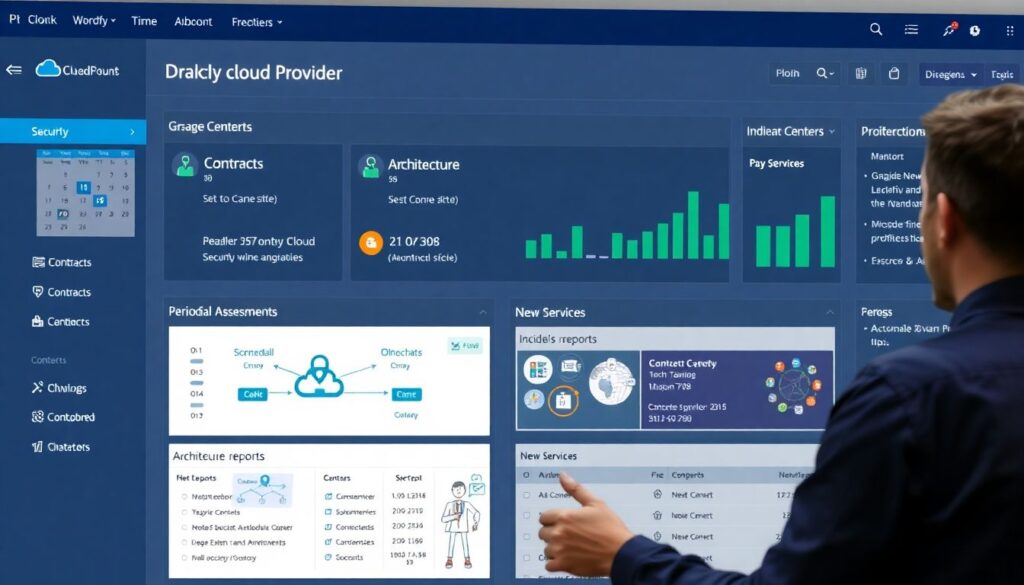
Perform a thorough review before onboarding, then revisit it after major architecture changes, contract renewals, or significant incidents. In addition, schedule periodic light reviews focused on new services you adopt and changes in provider security features.
Are the largest providers automatically the provedores de cloud mais seguros?
Larger providers usually have more mature security capabilities, but they are not automatically the safest choice for your needs. Security depends on the specific services you use, how you configure them, and how well they align with your governance and compliance context.
What is the minimum I should do if I cannot run a full auditoria de segurança em nuvem para empresas?
At least review IAM options, encryption and key management, backup and recovery features, logging capabilities, and incident response commitments. Document open risks and compensating controls you apply on your side, and plan for a deeper review when resources allow.