
To build a complete cloud security strategy for large enterprises, start by mapping business-critical assets and risks, then define governance and policies, design a secure cloud foundation, harden identity and access, protect data end-to-end, and establish strong detection and incident response. Evolve through pilot, scale-out and continuous improvement, aligned with Brazilian regulatory context.
Critical Strategy Highlights for Cloud Security

- Anchor cloud security on business impact and risk, not only on tools or vendor features.
- Create a unified governance and policy framework across all clouds and data centers.
- Design a secure landing zone and network segmentation as the technical backbone.
- Centralize identity, least privilege and privileged access management at scale.
- Use data classification and encryption everywhere, with clear lifecycle rules.
- Operationalize detection, incident response and continuous assurance with metrics.
- Combine internal capabilities with consultoria em segurança de cloud corporativa where needed.
Assessing Cloud Risk and Business Impact
Cloud risk assessment ensures segurança em nuvem para empresas is driven by business outcomes, not fear or marketing. It is most useful before large migrations, when consolidating multiple clouds, or when regulators and auditors demand evidence of control maturity.
It is not the best moment to run a full assessment if you are under active incident response pressure, or if your asset inventory is completely outdated. In these cases, stabilize operations first, then run a focused, staged assessment.
Preparation checklist for risk and impact assessment
| Item | Asset / Scope | Owner | Required Controls / Inputs |
|---|---|---|---|
| 1 | Critical business applications in cloud | Application owners | Availability, integrity, confidentiality requirements |
| 2 | Cloud accounts / subscriptions / tenants | Cloud platform team | List of providers, environments and regions used |
| 3 | Sensitive data categories (LGPD-related) | Data protection officer / legal | Data classification scheme and legal basis |
| 4 | Existing security controls | Security architecture | Current tools, policies, monitoring coverage |
| 5 | Known incidents and audit findings | GRC / security operations | Past incident reports and open remediation items |
How to run a pragmatic cloud risk assessment
- Define scope and business goals. Limit the assessment to specific business units, cloud providers, or critical services. Clarify what leadership expects: compliance readiness, cost optimization for serviços de segurança em cloud para grandes empresas, or prioritization of remediation.
- Map assets and data flows. For each in-scope application, identify which cloud services it uses, what data it stores or processes, and cross-border data transfers relevant for LGPD and sector-specific regulation in Brazil.
- Identify threats and vulnerabilities. Combine standard threat catalogs (misconfiguration, credential theft, ransomware) with your industry-specific threats. Map existing gaps such as unmanaged accounts, flat networks, or missing logging.
- Estimate impact and likelihood. Use simple scales (low/medium/high) instead of complex scoring models. Focus on business consequences: operational downtime, regulatory fines, reputation and contractual penalties.
- Prioritize risks and define treatment. Convert the assessment into a prioritized backlog: quick wins, strategic redesigns, and items that require external soluções de segurança em cloud para grandes corporações or specialized consulting.
Useful KPIs for this phase:
- Percentage of critical applications with completed cloud risk assessment.
- Average time from identified risk to approved remediation plan.
- Reduction in high-risk findings over each quarter.
Governance, Compliance and Security Policy Framework
A strong governance model keeps melhores práticas de segurança em nuvem para empresas consistent across teams, providers and projects. It translates regulatory and business requirements into clear guardrails and accountability for day-to-day cloud operations.
Governance preparation checklist
| Item | Asset / Domain | Primary Owner | Required Controls / Decisions |
|---|---|---|---|
| 1 | Cloud governance committee | CISO / CIO | Charter, roles, decision rights |
| 2 | Policy and standards library | GRC / security architecture | Baseline policies mapped to ISO 27001, LGPD, sector rules |
| 3 | Cloud service catalog | Cloud CoE | Approved, restricted and prohibited services list |
| 4 | Exception management process | Risk management | Workflow and risk acceptance criteria |
| 5 | Third-party and MSP oversight | Vendor management | SLAs and security clauses for serviços de segurança em cloud para grandes empresas |
Core components of a cloud governance and policy framework
- Establish decision-making structures. Create a cross-functional cloud governance board including security, infrastructure, development, data, and legal. Define meeting cadence and which decisions require board approval.
- Define unified cloud security policies. Cover identity, network, data, logging, backup, incident response and vendor management. Express the target state and mandatory controls, leaving implementation details to standards and playbooks.
- Translate policies into technical guardrails. Implement cloud-native controls such as policies-as-code, blueprints, and organizational policies to enforce tagging, region restrictions, encryption and logging.
- Integrate compliance requirements. Map LGPD, Central Bank rules, health or other sector regulations to specific controls. Ensure auditability by keeping evidence in centralized repositories and automating reports where possible.
- Manage exceptions and risk acceptance. Define who can approve deviations, how long they are valid, and what compensating controls are required. Track exceptions in a system accessible to both risk and engineering teams.
Governance KPIs to monitor:
- Percentage of cloud resources compliant with baseline policies.
- Number and aging of open policy exceptions.
- Time to approve new cloud services into the official service catalog.
Architecture: Secure Cloud Foundation and Network Design
The secure cloud foundation is your landing zone: accounts, networks, shared services and guardrails. Invest early here to reduce long-term complexity and costs of soluções de segurança em cloud para grandes corporações.
Foundation preparation checklist
| Item | Asset / Component | Owner | Required Controls / Artifacts |
|---|---|---|---|
| 1 | Cloud providers and regions | Cloud architecture | Defined multi-region, multi-cloud strategy, data residency constraints |
| 2 | Account / subscription structure | Cloud platform team | Organizational model (prod/non-prod, BU, project) and naming standards |
| 3 | Network connectivity | Network team | On-prem, VPN, Direct Connect/ExpressRoute design principles |
| 4 | Shared security services | Security operations | Central logging, SIEM, vulnerability scanning, secrets management |
| 5 | Reference architectures | Security architecture | Approved patterns for web apps, data platforms, integration |
Quick pre-design checklist
- Decide which environments (prod, dev, test, sandbox) you will support in the first phase.
- Confirm which identity provider will be your single source of truth.
- List critical on-prem systems that must connect to the cloud securely.
- Agree on standard tagging and naming conventions.
- Allocate budget and team capacity for a 3-6 month foundation pilot.
Step-by-step: designing a secure cloud foundation
-
Design your account and environment structure.
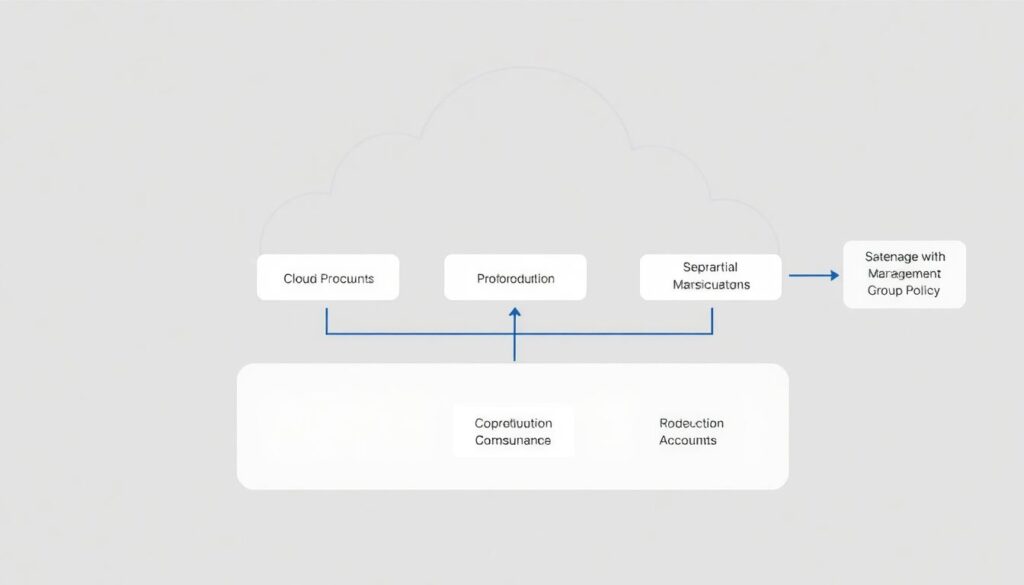
Separate production, non-production and sandbox environments into distinct accounts or subscriptions, with clear ownership and budgets. Use management groups or folders to apply policies consistently.- One root organization with management groups per business area.
- Dedicated security and logging accounts for centralized services.
-
Build a segmented network topology.
Use hub-and-spoke or similar patterns to separate shared services, application tiers and partner connectivity. Avoid flat networks that mix internet-facing and internal workloads.- Create separate subnets for web, app, data and management.
- Use network security groups, firewalls and routing tables to control flows.
-
Establish secure connectivity to on-premises.
Combine VPN and private dedicated links if needed, with strong encryption and redundancy. Terminate connections in the hub network and filter traffic before it reaches workloads.- Document which ports and protocols are allowed.
- Use private DNS and consistent IP addressing plans.
-
Centralize logging, monitoring and secrets.
Configure cloud-native logging for all accounts, sending logs to a central, immutable store and SIEM. Standardize secrets management using dedicated services, never environment variables or code comments.- Enable activity logs, flow logs and workload logs by default.
- Grant read-access to logs only through dedicated security roles.
-
Template your baseline as code.
Use Terraform, CloudFormation, Bicep or equivalent to codify the landing zone. This enables repeatable deployments, version control and automatic enforcement of standards.- Store infrastructure code in central repos with pull-request reviews.
- Integrate with CI/CD for deployment and compliance checks.
-
Run a controlled pilot, then scale.
Onboard a limited set of non-critical workloads to validate the design. Collect metrics, fix gaps, then extend to more business units in waves, using consultoria em segurança de cloud corporativa as needed for complex migrations.
Foundation KPIs:
- Percentage of cloud accounts created via landing zone templates.
- Coverage of centralized logging across accounts and regions.
- Number of workloads running in non-standard or legacy network patterns.
Identity, Access and Privilege Management at Scale
Identity is your primary security perimeter in cloud. Centralizing and hardening it is mandatory for any robust segurança em nuvem para empresas.
Identity and access preparation checklist
| Item | Asset / Scope | Owner | Required Controls / Inputs |
|---|---|---|---|
| 1 | Corporate identity provider | Identity team | Single sign-on strategy, MFA policy, conditional access requirements |
| 2 | Role definitions and RBAC model | Security architecture | Standard roles for admins, developers, auditors, service accounts |
| 3 | Privileged Access Management (PAM) | Security operations | Break-glass procedures, just-in-time elevation, session recording |
| 4 | Joiners-movers-leavers process | HR / IT operations | Automated provisioning and de-provisioning flows |
| 5 | Third-party identities | Vendor management | Access review cadence, isolation requirements, contract clauses |
Identity and access health checklist
- All human users authenticate via a central identity provider with enforced MFA.
- Cloud-native accounts without federation are limited, monitored and have strong justification.
- Roles and groups are aligned with job functions; no use of generic shared accounts.
- Privileged access is granted just-in-time, with recorded sessions and approval workflows.
- Service principals and machine identities use short-lived credentials or managed identities.
- Regular access reviews are executed for administrators, third parties and high-risk applications.
- Break-glass accounts exist, are stored securely, and tested periodically.
- Audit trails exist for all administrative actions, integrated into SIEM.
- Suspicious sign-in patterns trigger alerts with clear runbooks for investigation.
Identity KPIs:
- Percentage of users and applications covered by MFA and SSO.
- Number of standing privileged accounts versus just-in-time access sessions.
- Completion rate and aging of periodic access reviews.
Data Protection: Encryption, Classification and Lifecycle
Data protection is central to compliance and customer trust, especially under LGPD. Strong encryption and classification are core elementos das melhores práticas de segurança em nuvem para empresas.
Data protection preparation checklist
| Item | Asset / Data Domain | Owner | Required Controls / Inputs |
|---|---|---|---|
| 1 | Data classification scheme | Data governance | Labels for public, internal, confidential, restricted, LGPD-sensitive |
| 2 | Key management service | Security architecture | Policies for key creation, rotation, backup and separation of duties |
| 3 | Storage and databases inventory | Application owners | Registry of buckets, blobs, databases and backups per application |
| 4 | Data retention requirements | Legal / compliance | Retention periods per data type and legal basis |
| 5 | Data loss prevention capabilities | Security operations | DLP policies for email, endpoints and cloud storage locations |
Common mistakes in cloud data protection
- Relying only on provider-managed default encryption without understanding key ownership and access logs.
- Leaving storage buckets or data lakes with overly permissive access, such as broad public or cross-account reads.
- Failing to classify data, leading to the same controls for low-risk and highly sensitive datasets.
- Not encrypting data in transit between microservices, regions or between cloud and on-premises.
- Ignoring backups and snapshots, which may contain sensitive data without proper protection or retention limits.
- Mixing production and non-production data, including real personal data in test environments without masking.
- Storing secrets, keys or tokens in source code repositories, wikis or plain configuration files.
- Absence of clear data deletion and anonymization processes when contracts end or consent is revoked.
- Insufficient monitoring of access to high-value datasets, making it hard to detect exfiltration or misuse.
Data protection KPIs:
- Percentage of storage and databases with enforced encryption at rest and in transit.
- Number of public or misconfigured data stores detected and time to remediate.
- Coverage of data classification across critical systems and data platforms.
Operations: Detection, Incident Response and Continuous Assurance
Operational security turns architecture and policies into real protection. For grandes empresas, combine internal capabilities with external serviços de segurança em cloud para grandes empresas, depending on your maturity and scale.
Operations preparation checklist
| Item | Asset / Capability | Owner | Required Controls / Inputs |
|---|---|---|---|
| 1 | Security Operations Center (SOC) | SOC lead | Coverage for cloud logs, playbooks, 24×7 model definition |
| 2 | SIEM and cloud security platforms | Security engineering | Data sources, correlation rules, integration with cloud-native tools |
| 3 | Incident response plan | CSIRT / CISO | Roles, communication flows, regulatory notification templates |
| 4 | Vulnerability and posture management | Infrastructure / DevSecOps | Scanning scope, SLAs for remediation, exception handling |
| 5 | Continuous compliance checks | GRC | Automated controls tests and reporting cadence |
Operational strategy options and when to use them
-
Fully in-house SOC with cloud specialization.
Suitable for large organizations with high sensitivity data, strong internal teams and requirements to keep incident data within Brazil or specific jurisdictions. Requires ongoing investment in training, tooling and 24×7 coverage. -
Hybrid model with co-managed services.
Combine an internal core team with an external MSSP for first-line monitoring and basic triage. This fits companies starting their cloud journey that still need robust detection and response while building internal skills. -
Outsourced operations with strong governance.
Use external soluções de segurança em cloud para grandes corporações for monitoring, incident response and continuous assurance, while keeping strategy and decision-making in-house. Works when speed and coverage are prioritized over full internal control, and when SLAs and reporting are mature. -
DevSecOps-centric approach with embedded controls.
Focus on prevention, automated checks in CI/CD and self-service security guidance for squads, complemented by a lean SOC. Fits organizations with advanced engineering culture and high automation levels.
Operational KPIs:
- Mean time to detect (MTTD) and mean time to respond (MTTR) for cloud incidents.
- Coverage of detection use cases mapped to top cloud threats.
- Percentage of cloud resources continuously evaluated by posture management tools.
Practical Answers to Common Implementation Challenges
How do I start if my company already has workloads in multiple clouds?
Begin with an inventory and basic risk assessment across all providers, then define a minimal common governance baseline. From there, build a unified identity strategy and a standard landing zone pattern that you can gradually retrofit to existing environments.
Which teams should own cloud security in a large enterprise?
Security defines policies, guardrails and monitoring, while a cloud platform team implements shared services and patterns. Application squads own secure implementation of their workloads, with clear shared-responsibility models documented and approved by leadership.
When is it worth engaging consultoria em segurança de cloud corporativa?
Bring external experts when designing your first landing zone, during complex migrations of critical systems, or when you must meet demanding regulatory audits quickly. Use consulting to accelerate architecture and knowledge transfer, not as a permanent replacement for internal capabilities.
How can I measure if my cloud security strategy is actually improving?
Define a small set of KPIs per domain: identity, data protection, network, operations and governance. Track them over time, tied to quarterly objectives, and use the metrics to prioritize investments and demonstrate risk reduction to executives.
What is the safest way to deploy new cloud services at scale?
Introduce new services through a controlled onboarding process: security review, reference architecture, configuration baselines-as-code and a limited pilot. Only after validation should you allow wide adoption via the official service catalog.
How do I deal with legacy applications that are hard to secure in cloud?
Isolate legacy systems in tightly controlled network segments, restrict access and add strong monitoring. Plan a modernization roadmap while using compensating controls, and avoid lifting-and-shifting fragile architectures without redesign.
What if my developers feel blocked by new cloud security controls?
Work with engineering to provide secure-by-default templates, self-service tooling and clear documentation. Involve developers early when defining controls, measure friction, and adjust policies to balance safety and delivery speed.