
A practical incident response guide for hybrid cloud environments combines clear preparation, safe investigation steps, and repeatable containment tactics. You will map assets across on‑prem and cloud, define a realistic plano de resposta a incidentes para infraestrutura de nuvem híbrida, integrate telemetry into a SIEM, and run tested playbooks without disrupting critical services.
Rapid reference: incident response essentials for hybrid cloud
- Document a single, provider-agnostic incident response plan that covers on-prem, IaaS, PaaS and SaaS.
- Centralize logs and alerts into a plataforma SIEM para detecção e contenção de incidentes em cloud híbrida.
- Use consistent identity, MFA and role design across cloud providers and datacenters.
- Define containment patterns in advance: network isolation, access revocation, workload snapshots.
- Practice playbooks with safe simulations and update runbooks after every real incident.
- Align detection, response and retention with Brazilian legal and contractual requirements where applicable.
Preparing hybrid cloud environments for incidents
This guide fits teams running a mix of on-premises, private cloud and at least one major public cloud provider (AWS, Azure, GCP or similar). It assumes intermediate familiarity with security basics and shared-responsibility models, typical of Brazilian companies moving workloads gradually to the cloud.
It is not ideal if you have:
- Only a single SaaS application and no administrative control over infrastructure.
- No dedicated or part-time security role to own the process.
- No access to logs or configuration of your providers beyond end-user settings.
For these situations, prioritize vendor support channels or consultoria em segurança e resposta a incidentes em ambientes cloud before attempting to build full internal playbooks.
Preparation checklist table for hybrid-cloud readiness
| Readiness item | Primary owner | Review frequency |
|---|---|---|
| Documented incident severity levels and escalation tree | Security lead / CISO | Every 6-12 months or after org changes |
| Centralized logging to SIEM from on-prem and all cloud accounts | Cloud / Infrastructure team | Quarterly validation |
| Asset inventory of critical workloads, data stores and external dependencies | IT operations and application owners | Quarterly or before major deployments |
| Access to provider consoles with incident-response roles (read + limited write) | Identity and access management (IAM) | Monthly access review |
| Documented legal and regulatory contacts (e.g., DPO, legal counsel) | Legal / Compliance | Yearly or after regulation updates |
| Tested runbooks for shutdown, isolation, restore and communication | Security operations (SOC) | After every major test or incident |
When managed services make sense
If you lack 24×7 coverage or internal SOC capability, consider resposta a incidentes em cloud híbrida serviços gerenciados to handle monitoring, triage and initial containment, while you keep ownership of business decisions and communications.
Mapping assets, identities and trust boundaries across providers
Before tuning detection or running investigations, you need a clear map of what exists, who can access it and how components communicate across boundaries (on-prem ⇄ VPN ⇄ cloud VPC/VNet ⇄ SaaS).
Information and access you will need
- Access to all cloud provider consoles with at least:
- Read access to logs, network configurations, IAM policies, workloads.
- Permission to create snapshots and export logs during incidents.
- Network diagrams or at minimum:
- List of VPCs/VNets, subnets, peering, VPNs, ExpressRoute/Direct Connect links.
- Ingress/egress points, WAFs, load balancers, API gateways.
- Identity and access structures:
- Directories (Azure AD/Entra ID, AD, LDAP, IdPs, OAuth providers).
- Role naming conventions, admin groups and break-glass accounts.
- SSO integrations to SaaS platforms and cloud consoles.
- Asset inventory:
- Servers/VMs, containers, serverless functions, managed databases, storage accounts.
- Business-critical SaaS (email, CRM, ERP, collaboration).
- Data classification tags and criticality per system.
- Existing ferramentas de resposta a incidentes em nuvem híbrida:
- EDR/XDR agents on endpoints and servers.
- Cloud-native security tools (CSPM, CWPP) from each provider.
- Ticketing and collaboration tools used during incidents.
Define trust boundaries explicitly
- List boundaries where trust changes:
- Corporate network to internet.
- On-prem to each cloud provider.
- Production to test/dev environments.
- Internal services to third-party SaaS APIs.
- For each boundary, document:
- Expected traffic types and protocols.
- Authentication and authorization mechanisms.
- Monitoring visibility and logging points.
Detection strategies: telemetry, alerting and anomaly baselines
Before building full detection logic, confirm this short preparation checklist is satisfied to keep steps safe and realistic.
- Ensure logging is enabled but not set to aggressive sampling that drops important events.
- Confirm a non-production environment exists for testing policy changes when possible.
- Verify you can roll back detection rules and automation without impacting availability.
- Agree with stakeholders on acceptable false-positive levels for initial tuning.
- Document how to contact on-call staff for each critical system.
- Unify telemetry across on-prem and all clouds – Configure native logging in each environment and centralize into your SIEM or log platform. Aim for broad coverage before deep analytics.
- Enable audit and admin logs in cloud control planes (e.g., IAM, configuration changes, role assignments).
- Collect host and container logs (system, application, EDR) from critical workloads.
- Ingest network logs (firewalls, load balancers, VPC/VNet flow logs, WAF events).
- Capture SaaS logs for email, IAM and collaboration tools where available.
- Normalize and enrich events in your SIEM – Map similar events from different providers into a consistent schema. This is key for correlation rules in a plataforma SIEM para detecção e contenção de incidentes em cloud híbrida.
- Standardize fields like user, source IP, destination, action, resource type.
- Enrich with asset tags (environment, owner, data sensitivity, region).
- Add identity context (department, role, contractor vs. employee).
- Define incident categories and severities – Classify potential scenarios so alerts map directly into response playbooks.
- Examples: credential compromise, ransomware, data exfiltration, web app compromise, misconfiguration exposure.
- Define severity levels (e.g., low, medium, high, critical) with business-oriented criteria.
- Map each category-severity pair to required response time and communication rules.
- Create detection rules and safe alert workflows – Start with high-confidence, low-volume alerts that are easy to investigate.
- Suspicious sign-ins (impossible travel, MFA fatigue, unusual devices).
- Privilege escalation or creation of powerful accounts outside change windows.
- Unusual data movement across trust boundaries (e.g., high-volume egress to the internet).
- Execution of known malicious tools or patterns on servers/endpoints.
- Establish baselines and anomaly detection – Use your SIEM and cloud-native analytics to learn what normal looks like, then alert on deviations.
- Baseline login times, locations and methods for privileged users.
- Baseline bandwidth usage and typical destinations per environment.
- Baseline API calls and administrative operations in each cloud.
- Test and tune with controlled simulations – Run safe scenarios that do not violate policies or harm systems, such as test accounts and synthetic traffic.
- Use test tenants or non-production environments when possible.
- Trigger benign events (e.g., login from an unusual country using a dedicated test user) to confirm alerts.
- Refine thresholds, suppression rules and notification channels based on real response capacity.
Investigation playbooks for cross-cloud evidence collection
Use this checklist during investigations to validate that evidence collection is complete and consistent across providers, without performing intrusive or destructive actions.
- Confirm incident scope: affected accounts, workloads, regions and providers are identified and documented.
- Capture an initial timeline using SIEM queries, ticket timestamps and communication logs.
- Collect control-plane logs (IAM, configuration, API) from each relevant cloud account or subscription.
- Obtain endpoint or workload telemetry (EDR, OS logs, application logs) from impacted systems.
- Export network logs covering the suspected timeframe and relevant boundaries.
- Preserve snapshots or backups of critical workloads before making changes, following legal and privacy guidance.
- Verify that log retention settings prevent loss of older events needed for root-cause analysis.
- Correlate cloud, on-prem and SaaS evidence to link identity actions to infrastructure changes and data movement.
- Record hypotheses and findings clearly so they can be reviewed by legal, compliance and management.
- Store investigation artifacts in a restricted, version-controlled repository with defined access.
Example incident 1: suspicious admin sign-in
Timeline illustration:
- T0 – SIEM alert: privileged login from unfamiliar country into Cloud Provider A.
- T0+5 min – Analyst validates user identity through out-of-band contact; user denies activity.
- T0+10 min – Access temporarily suspended; new sign-in attempts blocked by MFA reset.
- T0+30 min – Investigation confirms no configuration changes; password reset, tokens revoked, monitoring heightened.
Example incident 2: abnormal data egress from storage
Timeline illustration:
- T0 – Alert: unusual outbound traffic from storage subnet in hybrid connection to Cloud Provider B.
- T0+10 min – Network team validates routing, confirms no planned maintenance, isolates subnet to internal networks only.
- T0+30 min – Logs show misconfigured backup tool copying data to external service; configuration fixed and tested.
- T0+1 hour – Data owners notified, incident documented as misconfiguration without evidence of external compromise.
Containment and eradication tactics tailored to hybrid architectures
These are frequent mistakes during containment and cleanup that you should explicitly avoid in your playbooks.
- Overusing broad network blocks that unintentionally disrupt critical production systems or VPN connectivity.
- Destroying or rebuilding compromised resources before collecting necessary forensic evidence and logs.
- Revoking all access tokens and keys at once without a plan, causing unnecessary outages and complex rollbacks.
- Applying on-prem playbooks directly to cloud services without considering provider APIs and managed-service specifics.
- Leaving backdoors such as unused admin accounts, unattended service principals or legacy VPN tunnels active.
- Failing to coordinate containment across providers, resulting in attackers pivoting to less-monitored environments.
- Running unverified scripts from the internet on production systems as part of “cleanup” efforts.
- Ignoring SaaS components (email, collaboration, identity) while focusing only on IaaS or on-prem servers.
- Not informing cloud providers when required, missing access to additional telemetry or support they can offer.
- Skipping stakeholder communication, which leads to parallel, conflicting technical actions by different teams.
Recovery, post-incident compliance and lessons learned
There are alternative approaches to implementing hybrid-cloud incident response, depending on your maturity and constraints. Consider these options and choose what best fits your environment in Brazil.
- Internal team-led model – Build in-house SOC capabilities, run your own SIEM and develop custom playbooks for all major incident types. Suitable when you have stable staff and strong cloud skills.
- Co-managed operations with external experts – Use consultoria em segurança e resposta a incidentes em ambientes cloud to design processes and complex detections, while your internal team executes day-to-day triage and business decisions.
- Fully managed detection and response – Outsource 24×7 monitoring, initial triage and containment actions to a provider, integrating them with your change management and communication channels. Ideal for smaller teams or organizations without round-the-clock coverage.
- Provider-centric approach – Where possible, rely heavily on cloud-native tools and managed services (e.g., monitoring, backups, WAF, access management) to simplify operations, while keeping a lean central SIEM and clear governance.
Practical clarifications for common hybrid-cloud response scenarios
How detailed should my hybrid-cloud incident response plan be?
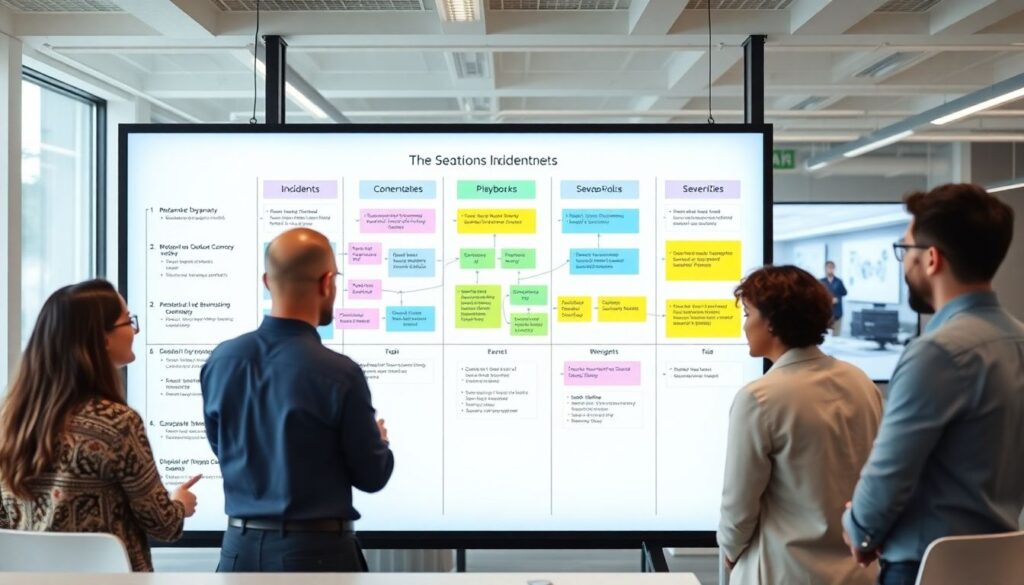
Your plan should describe roles, communication paths, severity levels and high-level playbooks for the main incident categories, without hard-coding every technical command. Keep technical runbooks separate so they can be updated often without re-approving the whole policy.
Do I need a separate plan for each cloud provider?
Use a single overarching plano de resposta a incidentes para infraestrutura de nuvem híbrida, plus provider-specific annexes. The main document covers governance and escalation, while annexes detail how to pull logs, isolate workloads and contact support in each provider.
What if log collection from one environment fails during an incident?
Document fallback procedures, such as accessing provider consoles directly, using local log buffers or taking safe snapshots. Record the gap clearly in your report and adjust monitoring architecture afterwards to reduce single points of failure.
How can I test playbooks without risking production outages?
Prefer non-production environments, synthetic accounts and limited-scope simulations that test processes rather than breaking systems. Perform partial drills that exercise decision-making, logging queries and communication, not full infrastructure shutdowns.
When should I involve external legal or regulatory authorities?
Involve legal as soon as there is a possibility of data exposure, privacy impact or contractual breach. They will decide if notifications to regulators, customers or partners are required, following Brazilian laws and any sector-specific rules.
Are managed response services necessary for smaller teams?

They are not mandatory but can be effective if you lack 24×7 coverage or specialized expertise. Managed providers can handle monitoring and initial triage while your team focuses on business context, approvals and long-term improvements.
What are safe first actions if I suspect an account is compromised?
Do not start by deleting the account. Instead, revoke active sessions, require password reset, enforce MFA, review recent activity and increase monitoring. If risk is high, temporarily disable access after ensuring needed evidence is preserved.