Regulatory landscape in the cloud: why it suddenly got serious
Cloud compliance stops being “nice to have”
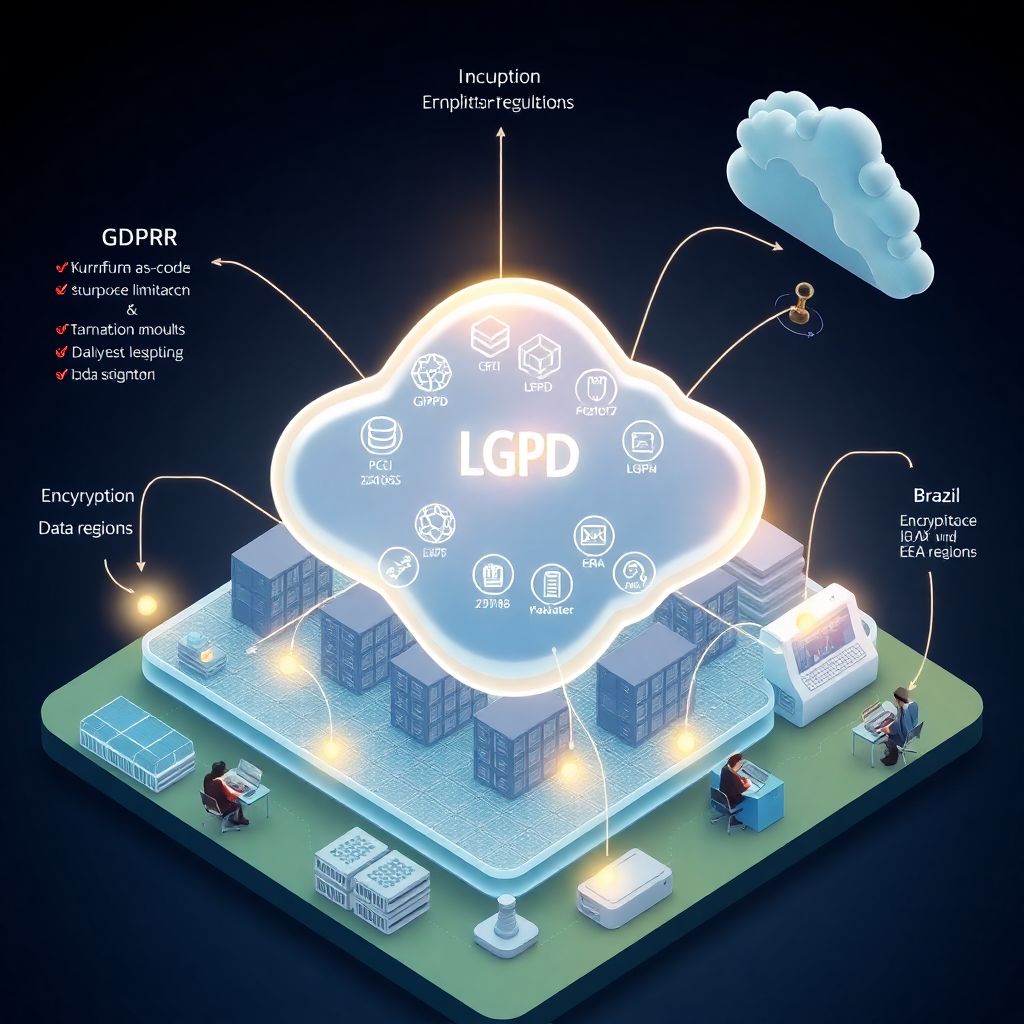
Cloud regulation isn’t just catching up; it’s overtaking how companies design architecture. LGPD and GDPR are no longer read only by lawyers – architects, DevOps and product teams now need to know what “minimization” or “legitimate interest” means in practice. Add PCI-DSS for payments and ISO 27017/27018 for cloud security and privacy, and you get a scenario where a single misconfigured bucket can trigger multi‑jurisdiction fines, incident response costs and long‑term brand damage. That’s why even smaller teams are starting to look for consultoria em LGPD e GDPR para cloud as early as the design phase, not after a breach.
LGPD vs GDPR vs PCI vs ISO: different roots, overlapping impact
These frameworks come from different “worlds”: GDPR and LGPD are privacy laws, PCI‑DSS is an industry standard for card data, ISO 27017/27018 are voluntary best‑practice baselines for cloud security and privacy controls. Yet, in the real world, they collide on the same Kubernetes cluster. GDPR and LGPD define roles (controller, processor), rights and legal bases; PCI drills into network segmentation, logging and key management; ISO 27017/27018 describe how a mature cloud provider should behave. The trick is to map them into one control set instead of maintaining four parallel checklists that nobody actually follows.
Comparing regulatory approaches in a cloud‑first world
Principles‑based vs checklist‑based mindsets
GDPR and LGPD are principles‑based: they tell you *what* to respect – transparency, purpose limitation, data minimization – and leave you to figure out *how* in your architecture. PCI‑DSS, in contrast, is checklist‑driven: do you encrypt this, segment that, log those events? ISO 27017/27018 sit in the middle, recommending structured governance without being fully prescriptive. A strong approach is to start with the principles, then translate them into a unified technical control library, so that one network rule or one log pipeline satisfies several obligations at once, reinforcing serviços de compliance em nuvem PCI-DSS e ISO 27001 that are coherent instead of fragmented.
Local nuance: Brazil, EU and global providers
Cloud makes geography fuzzy, but regulators still think in borders. Brazil’s ANPD is younger and sometimes more pragmatic, while EU regulators have more case law and guidance. Global hyperscalers respond with regional data centers, encryption options and contractual addenda, yet by default they focus on the average customer, not your edge cases. That’s why an empresa especializada em adequação LGPD para dados em nuvem often acts as a translator between legal language and provider documentation, turning vague statements like “data may be replicated globally” into concrete design rules for backups, analytics and incident logging.
Pros and cons of cloud compliance technologies
Native cloud tools: powerful but easy to misread
Cloud providers ship an array of “compliance” features: encryption at rest, KMS, IAM, logging, DLP and configuration scanners. The upside: they scale cheaply, integrate well and are updated alongside the platform. The downside: they’re agnostic to LGPD, GDPR or PCI; they just enforce technical states. If you misconfigure scopes or interpret findings too narrowly, you get a false sense of security. A stronger pattern is to treat these tools as building blocks and overlay them with policy‑as‑code that encodes legal requirements in plain, testable rules, which then feed your auditoria de segurança e conformidade em cloud computing with evidence that’s actually mapped to articles and clauses.
Third‑party platforms and “compliance fatigue”
External GRC, CASB and posture‑management tools promise dashboards full of green checks. They do help with multi‑cloud visibility and independent validation of controls. But over‑reliance leads to “compliance fatigue”: teams drown in alerts, while root‑cause issues – like uncontrolled data replication across regions – remain unsolved. To avoid this, modern solutions of governança e compliance para cloud híbrida should prioritize a small, curated set of metrics tied to business risk, not every minor deviation. Integrating them into CI/CD, rather than only quarterly reviews, also avoids last‑minute production freezes just because somebody remembered a forgotten checklist.
Recommendations for choosing your cloud compliance strategy
Start with data maps, not with tools
The most underrated, non‑technical step is to map *which* personal and payment data you process, *where* it flows and *why* it’s kept. This doesn’t require fancy software at first; whiteboards and interviews can reveal shadow databases, rogue spreadsheets and unsanctioned SaaS. Once you recognize real flows, you can choose targeted technologies instead of buying another generic “data security” platform. A lean approach is to align this mapping with existing risk management, so legal, security, architecture and product look at the same diagrams and agree on a single source of truth for impact analysis and DPIAs.
Make engineers and lawyers build controls together
Classic compliance projects died because lawyers wrote policies that engineers never read. In 2026 the winning pattern is cross‑functional design: privacy officers define constraints, architects propose patterns and DevOps codify them. For example, a legal requirement like “process EU data within the EEA” becomes a Terraform module that only allows EEA regions. Auditors then check the module and its usage, instead of checking every single resource. This reduces friction and makes controls scalable: new microservices automatically inherit compliant defaults without another massive, manual review.
Consider consultative help, but keep ownership inside
Bringing in consultoria em LGPD e GDPR para cloud can speed up interpretation of overlapping norms and reduce blind spots, especially during migrations or mergers. However, outsourcing *thinking* is risky: if all knowledge sits with vendors, you’re stuck every time contracts change. Aim for a hybrid model: use external specialists to bootstrap frameworks, train teams and validate architectures, but steadily grow internal competence. Over time, the organization should be able to explain, in simple terms, how its own systems satisfy LGPD, GDPR, PCI and ISO baselines without pulling out a 300‑page external report.
Non‑standard and emerging trends for 2026
Compliance‑as‑code and “policy unit tests”

By 2026, compliance‑as‑code will be less buzzword and more routine. Instead of PDF policies, organizations will define rules in machine‑readable formats enforced at deploy time. A non‑standard but effective twist is to write “policy unit tests”: before deploying, pipelines run checks that simulate typical regulator questions – data residency, retention, access rights – and fail if answers don’t match expected patterns. This mirrors how good engineering teams write software tests and turns compliance into a living, evolving artifact, not a yearly ceremony before an external assessment or certification project.
Synthetic data and privacy‑safe experimentation

Another unconventional direction is aggressive use of synthetic data and differential privacy to decouple innovation from raw personal data. Rather than granting analysts direct access to production datasets, teams generate statistically similar, non‑identifiable data for most experiments. Real personal data is kept in tightly controlled enclaves with PCI‑grade protections. This approach drastically reduces the surface for LGPD and GDPR breaches, while also calming debates around new AI models. It doesn’t eliminate obligations, but shifts the default from “everything is personal data” to “personal data is the exception, not the rule.”
Continuous, story‑driven audits instead of yearly panic
Regulators increasingly expect evidence of *continuous* governance, not just a spotless folder before inspection. Forward‑looking companies move from annual, spreadsheet‑driven reviews to narrative‑driven, incremental audits. Every sprint, high‑risk changes are logged with a short “compliance story”: what changed, which data is affected, which safeguard was applied and why it’s proportionate. Over a year, these stories become a rich audit trail, far more convincing than retrofitted documents. When auditors or partners request proof, you share a timeline of concrete decisions, showing that compliance was embedded in daily work – not bolted on at the end.