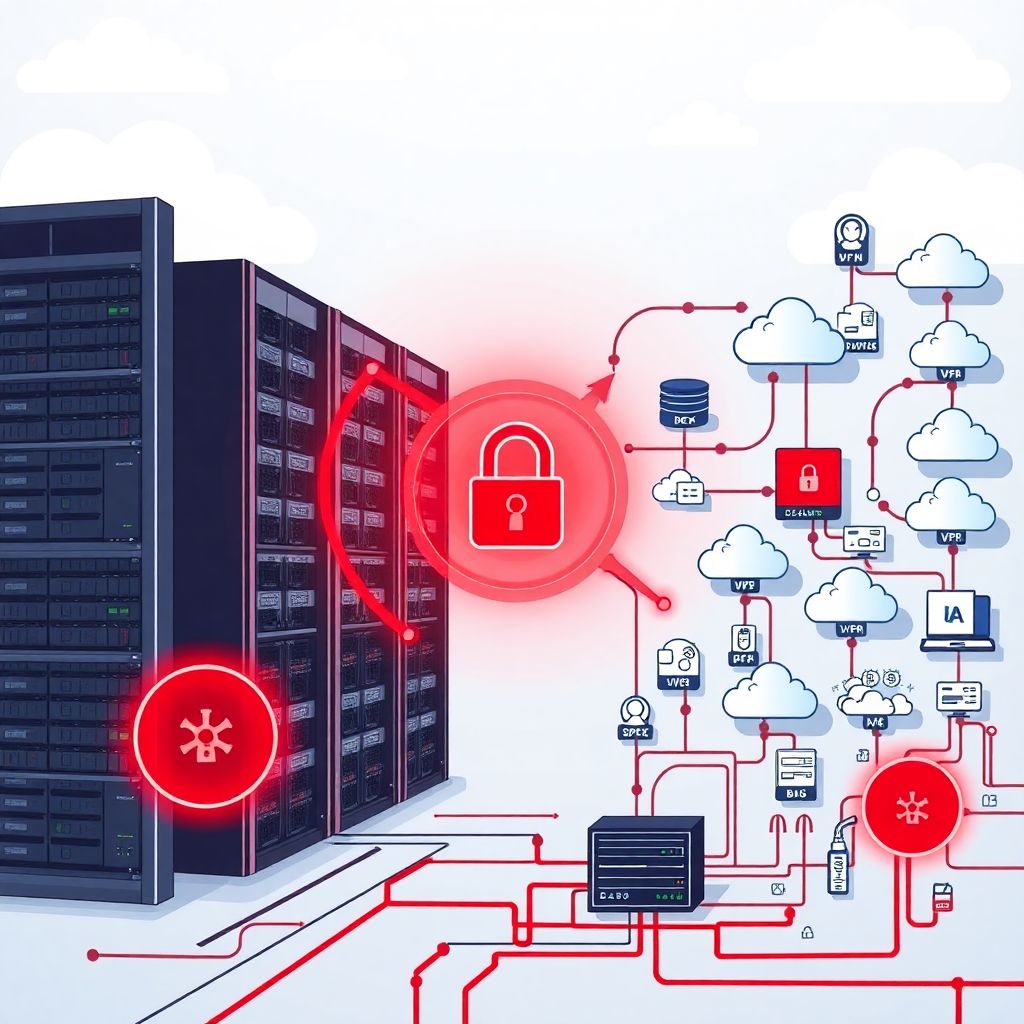
Hybrid cloud sounds like the best of both worlds: a bit of public cloud flexibility, a bit of on‑prem control, and you glue it all together with some clever networking. Then ransomware shows up and reminds everyone that complexity cuts both ways. When attackers can jump between your data center and your cloud accounts, the blast radius grows very quickly, and suddenly that “modern architecture” looks more like a labyrinth. Let’s walk through how people actually deal with this, what works, what breaks, and what’s mostly wishful thinking.
From classic ransomware to hybrid‑cloud nightmares: a short history
Ransomware started out pretty “local”: a user clicked on a shady attachment, their workstation got encrypted, maybe a shared folder too, and that was it. As companies moved workloads to the cloud, attackers adapted. First they went after exposed RDP and misconfigured VPNs, then they realized hybrid architectures were gold mines: one compromised laptop could lead into the corporate network, and from there into cloud management consoles and storage buckets. Over the last decade we’ve gone from random “spray and pray” campaigns to very deliberate, multi‑stage operations that map out your hybrid environment before pulling the trigger. This is where segurança em nuvem híbrida contra ransomware became not just a buzzword, but a survival requirement, especially for organizations that mix legacy systems with shiny new cloud‑native stacks and can’t simply “lift and shift” their way out of trouble.
Core principles: what actually reduces ransomware risk
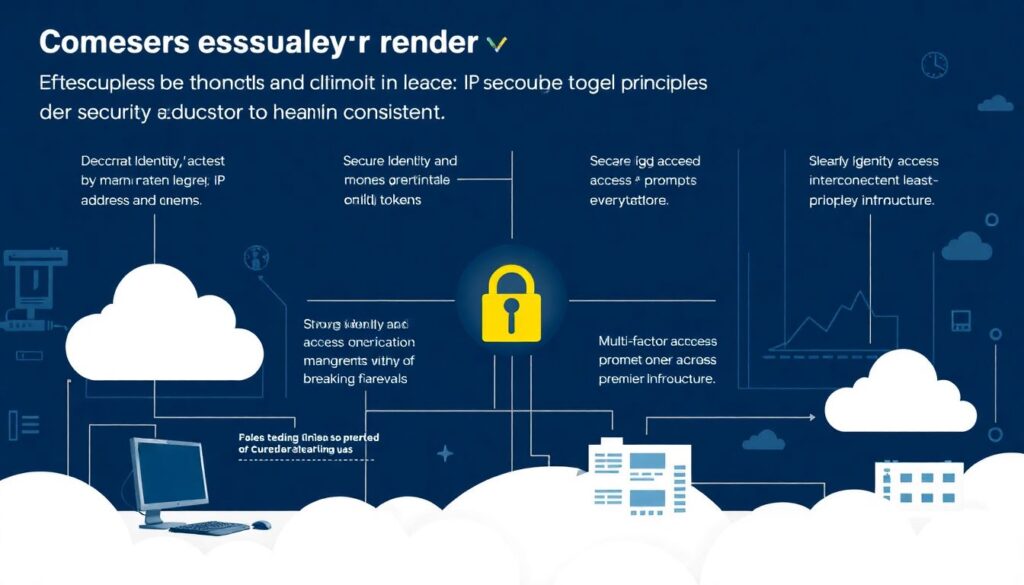
Under all the tooling and vendor marketing, the basics are surprisingly consistent. First, identity matters more than IP addresses: attackers love stealing credentials and abusing legitimate access, so strong identity and access management, MFA everywhere, and least‑privilege roles across cloud and on‑prem are non‑negotiable. Second, visibility is everything. If you can’t see how workloads talk to each other across your hybrid links, you’re basically defending blindfolded. Third, segmentation and isolation limit damage: break your network and your cloud accounts into smaller zones so that compromise in one area doesn’t become a full‑environment disaster. Finally, you need to assume breach: build your strategy around the idea that at some point, somewhere, a machine will be infected, and your job is to keep it from turning into a company‑wide crisis. That mindset drives melhores práticas de segurança para infraestrutura cloud híbrida, where prevention, detection, and recovery are treated as equally important pillars rather than separate projects.
– Strong, enforced MFA for all admin and remote access
– Consistent identity and role models across cloud and on‑prem
– Network and account segmentation with clear trust boundaries
Approaches in practice: prevention, detection, and recovery compared
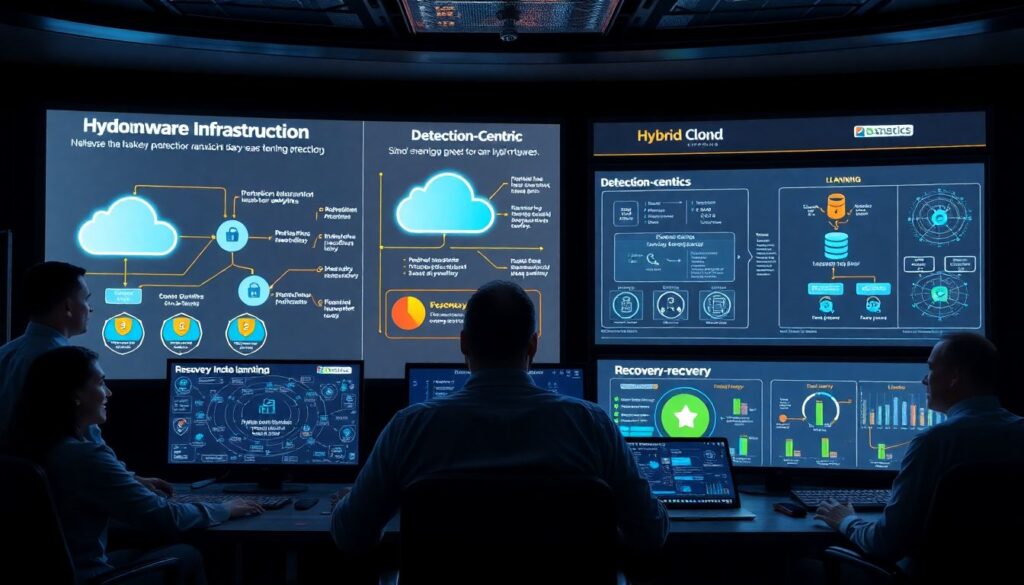
When teams start designing soluções de proteção ransomware para cloud híbrida, they usually gravitate toward one of three primary angles, even if they eventually combine them: prevention‑heavy, detection‑centric, or recovery‑focused. The prevention‑heavy camp invests most of its energy in hardening: strict access control, zero‑trust networking, hardened golden images, patch automation, and strong email filtering. This approach can seriously reduce the number of successful intrusions, but it has a blind spot: when something finally does slip through (and it will), the environment may be brittle, with limited practice handling active incidents and recovering quickly. On the other hand, detection‑centric strategies pour resources into logs, SIEM, EDR/XDR, behavioral analytics, and threat hunting. They’re great at spotting suspicious lateral movement or mass file encryption in progress, especially in complex hybrid topologies, but if they’re not backed by solid configuration and prevention, teams end up chasing endless alerts in an environment that’s still easy to break into.
A third school focuses on resilience and recovery: immutable backups, well‑tested disaster recovery, and automation to rebuild environments from scratch. In hybrid setups, these teams obsess over backup e recuperação de ransomware em ambientes híbridos, making sure that snapshots are stored in isolated accounts, backup credentials are separate from production, and restores are rehearsed under realistic conditions. The trade‑off is that if they underinvest in prevention and detection, they may experience more frequent incidents, albeit with less catastrophic outcomes. In reality, the most mature organizations blend all three: they use prevention to cut the attack volume, detection to shorten dwell time, and robust recovery to keep ransomware from ever becoming an existential event, regardless of whether the encrypted data sits in a data center, an IaaS volume, or a managed SaaS database.
– Prevention‑heavy: fewer compromises, higher risk when one finally lands
– Detection‑centric: better visibility, risk of alert fatigue if basics are weak
– Recovery‑focused: faster bounce‑back, needs strong guardrails to avoid repeat hits
Implementation examples: DIY, platform‑centric, and managed models
When it comes to actually putting this into practice, organizations usually pick between three broad implementation models, each with its own pros and cons. The DIY approach is popular with teams that have strong internal security engineering skills. They stitch together open‑source and commercial tools, define custom policies for hybrid firewalls, build their own log pipelines from on‑prem SIEM into cloud analytics, and script orchestration across different vendors. This gives maximum flexibility and can be cost‑efficient at scale, but it’s fragile if key people leave or if the architecture grows faster than the team can safely operate. The platform‑centric approach leans heavily on built‑in cloud security services: native key management, cloud‑provider firewalls, managed identity, and integrated threat detection. This usually simplifies operations and closes common configuration gaps, but it can leave on‑prem assets less protected if they’re treated as an afterthought, and it increases dependence on a single vendor’s roadmap and limitations.
The third model relies more on serviços gerenciados de segurança cloud híbrida contra ransomware. Here, a managed security provider or MDR service continuously monitors both sides of the hybrid setup, correlates events, and often brings predefined playbooks for ransomware scenarios. This can be a lifesaver for mid‑size organizations without 24/7 SOC coverage, but it introduces a different risk: assuming “the provider has it” and neglecting internal security hygiene and governance. In practice, many companies end up with a hybrid approach even here: they use platform tools as a baseline, layer a managed detection service on top, and keep a small specialized internal team to handle architecture decisions, incident command, and alignment with business risk.
Common misconceptions and painful lessons learned
One of the most persistent myths is that “we’re safe because most of our critical stuff is still on‑prem.” In a hybrid world, that line doesn’t really exist. If your identity provider or admin workstations are compromised, attackers can pivot into both sides without caring where the actual databases live. Another misconception is that cloud‑native backups automatically protect you from ransomware; in reality, if those backups share the same credentials, management plane, or network paths, a determined attacker can encrypt, delete, or quietly corrupt them before you even realize you’ve been hit. That’s why so many incident post‑mortems highlight the need for independent backup domains, offline or immutable copies, and clear separation of duties around backup management. Organizations that took this to heart tend to fare much better during real incidents, because they can restore quickly instead of negotiating from a position of desperation.
There’s also a flawed belief that simply “centralizing logs” equals security. Centralized logging is crucial, but unless someone is actively tuning detections, testing them in hybrid scenarios, and automating at least parts of the response, logs become just another data swamp. Teams that successfully defend hybrid environments often share a few habits: they test their assumptions with red‑team exercises that move across on‑prem and cloud; they document and rehearse ransomware playbooks with business stakeholders; and they manage access as if every admin credential is a potential skeleton key. Over time, these practices change the culture from “IT handles security” to “security is an architectural constraint,” which is the only sustainable way to keep up with evolving ransomware tactics that increasingly target the seams between legacy systems and cloud services.
– “On‑prem is safer by default” ignores identity‑based attacks
– “Cloud backups are enough” fails when backups share the same blast radius
– “We have logs, so we’re fine” collapses without tuned detections and automation
Pulling it all together: practical strategies that actually work
If you strip away the buzzwords, a realistic hybrid‑cloud ransomware strategy means doing a handful of things consistently well rather than chasing every new tool. First, normalize identity and access across your entire environment: one clear source of truth, strict role definitions, MFA everywhere, and privileged access that’s tightly scoped and time‑bound. Second, treat your network and account topology as a safety mechanism: segment aggressively, minimize permanent connectivity between zones, and review those links regularly. Third, invest in detection that understands context: your tooling should know which workloads are crown jewels, which connections are expected, and which behaviors are anomalous in your specific hybrid setup. Finally, design for survivability. That includes immutable snapshots, cross‑account or cross‑region backup targets, tested restoration of whole applications (not just files), and explicit playbooks for who decides what when a ransomware demand appears.
Different organizations will lean on different mixes of DIY engineering, platform tools, and managed services, and that’s fine—as long as the result covers prevention, detection, and recovery in a way that matches their actual risk and skills. The goal isn’t to build an impenetrable fortress; it’s to make sure that when an attacker does land somewhere inside your hybrid infrastructure, they hit tripwires quickly, their ability to move sideways is constrained, and your most valuable data can be restored without paying for a decryption key that may or may not even work. Over time, the companies that internalize these lessons stop treating ransomware as an unpredictable catastrophe and start treating it as just another operational risk—serious, but manageable—embedded into how they design and run modern cloud‑connected systems.
Комментарии
Я бронировала онлайн через детский парк «Замания» — там удобно выбрать парк, сценарий и время. По итогу праздник вышел даже лучше, чем я ожидала: дети устали от впечатлений, но были в полном восторге, а мы с мужем вообще почти не вмешивались в процесс.