
Why cloud vulnerabilities are back in the news (and why you should care)
Over the last few years, cloud has gone from “nice to have” to “if it goes down, our business stops.” That shift made every misconfiguration, weak password and sloppy API suddenly front‑page material. When you read headlines about huge data leaks, ransomware in virtual machines or stolen access keys, most of the time the root cause is surprisingly mundane: someone rushed a deployment, reused an old pattern from on‑prem, or assumed the cloud provider “handles security.” Understanding the principais vulnerabilidades recentes em serviços cloud is less about chasing exotic zero‑days and more about finally closing all those boring, well‑known gaps that attackers exploit every single day to quietly walk into corporate environments and stay there for weeks without being noticed.
What’s actually going wrong in cloud right now
If you strip away all the jargon, most cloud incidents fall into a handful of categories. Attackers rarely need black‑magic exploits; they mostly feed on predictable mistakes. Misconfigured storage buckets exposing sensitive files, overly permissive IAM roles that let any workload do almost anything, and forgotten test environments that no one patches anymore form a kind of “starter pack” for breaches. Add on top exposed management interfaces, weak MFA policies and noisy logs no one reviews, and you have the perfect playground for intrusion, lateral movement and data exfiltration without tripping basic alarms until it is far too late for a quiet response or a cheap cleanup.
One of the biggest recurring problems is identity and access management. Cloud IAM is powerful but also unforgiving. A single wildcard permission like “*” in a production role can move a company from “reasonably safe” to “one compromised key away from disaster.” Many teams copy snippets from old tutorials or Stack Overflow and end up granting broad rights “just to make it work,” planning to tighten them later. “Later” rarely arrives. Meanwhile, attackers hunt for exactly these weak policies, combine them with leaked credentials or OAuth tokens, and elevate their access until they can reach the data layer or tamper with backups and logging.
You also can’t ignore the rise of supply‑chain and API‑driven attacks. Modern cloud apps rely on layers of managed services, third‑party SaaS and open source packages glued together over APIs. A vulnerability in a CI/CD pipeline, a poisoned container image or a mis‑scoped token for a partner integration can cascade across multiple environments. Instead of directly breaking into your virtual machine, adversaries compromise a tool you trust and let your own automation deploy their malware or backdoors. This is why the conversation moved from “is my VM patched?” to “who signed this image, where did this script come from, and which service account can talk to what?”
To make things worse, observability often lags behind complexity. Logs are scattered across services and regions, retention is set to the cheapest option rather than the most useful, and alerting rules are copied from generic templates. When something strange happens, there is either no signal at all or a tsunami of meaningless alerts that everyone silently ignores. In that noise, a careful attacker can test credentials, map permissions and eventually encrypt or steal data without triggering any real investigation until customers start complaining or regulators knock on the door.
Comparing different approaches to cloud security
There are several competing philosophies for keeping cloud environments safe, and each comes with serious trade‑offs. Some organizations lean heavily on native features from their cloud provider, assuming a tightly integrated stack will reduce blind spots. Others adopt multi‑cloud tools that sit on top of everything, promising a single pane of glass across AWS, Azure, GCP and SaaS. A third group still treats the cloud almost like a virtual data center, re‑creating traditional perimeter defenses with virtual firewalls and VPNs rather than embracing identity‑centric designs and service‑level segmentation that fit the reality of elastic workloads and ephemeral resources.
Shared responsibility done right (and wrong)
Every major provider talks about the “shared responsibility model,” but many teams interpret it in a way that either leaves huge gaps or duplicates effort. Cloud vendors secure the underlying infrastructure, hypervisor, physical network and basic platform. You’re on the hook for identities, data, application logic, configuration and how all those services are linked. When people assume “the provider encrypts everything, so we’re fine,” they miss details like key management, access logging, or which roles can disable encryption or copy snapshots to personal accounts.
Beginners often over‑rely on default settings, assuming they are safe by design. In reality, defaults are designed to work in as many scenarios as possible, not to meet strict compliance or risk profiles. Encryption may be available but not enforced, IAM policies may be more open than ideal, and network rules might allow broad internal connectivity. When teams treat “it worked on the first try” as proof of a good design, they accidentally optimize for convenience rather than resilience, making incident response harder and raising the blast radius of any single compromise.
DIY security vs managed services vs external partners
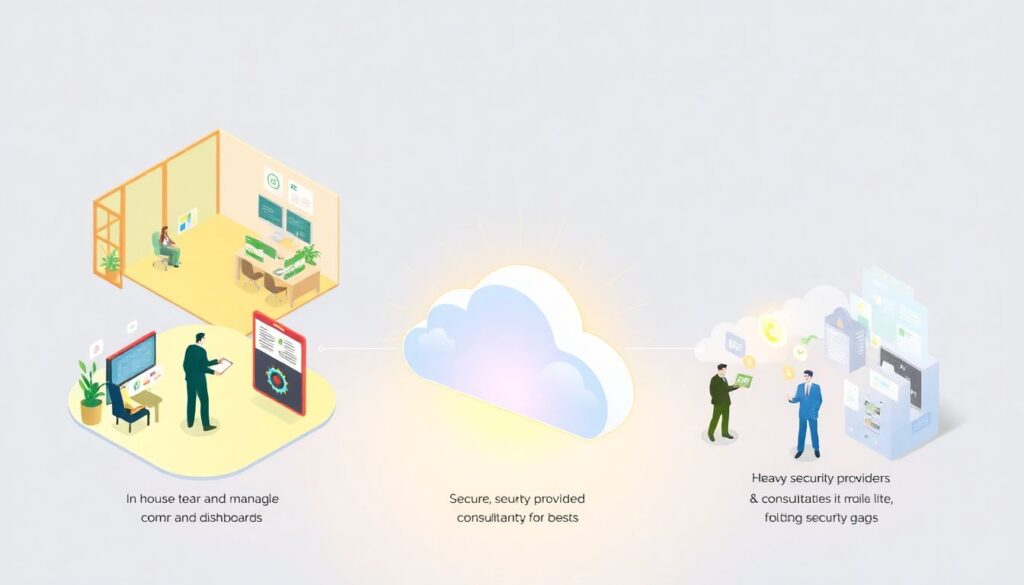
When it comes to implementing segurança em nuvem para empresas, you have three main routes: build and manage most controls in‑house, lean heavily on managed cloud services, or bring in external security providers and consultants to fill gaps. None of these options is universally best; the right mix depends on your skills, budget and regulatory constraints, as well as how critical cloud workloads are to your business and how quickly you expect them to scale or change over time.
Some common patterns look like this:
– Fully DIY: maximum control and customization, but requires strong internal expertise, continuous training and dedicated staff for monitoring and incident response. Good for mature teams, risky for small ones.
– Provider‑centric: you use as many native security features as possible, from IAM to WAFs and managed detection. Great integration, but you can get locked in and might miss cross‑cloud visibility if you expand later.
– Hybrid with partners: external SOC or MSSP plus your own cloud engineers. Faster maturity, but you must manage hand‑offs and make sure partners actually understand your architectures, not just send generic alerts.
In practice, many companies start with a provider‑centric approach because it feels straightforward: toggle some security add‑ons, enable logging, maybe buy a higher‑tier support plan and call it a day. The catch is that attackers don’t limit themselves to a single provider, and neither do most businesses. As you add SaaS products, secondary clouds or on‑prem integrations, visibility fragments. If you haven’t planned for that multi‑environment reality from day one, you end up with overlapping tools, orphaned accounts and policies that no one really understands anymore.
Common beginner mistakes that keep causing breaches
Newcomers to cloud often repeat the same painful errors, mostly because they apply on‑prem habits to a very different environment. One of the most damaging mistakes is treating the cloud console like a personal sandbox. People create test resources directly in production accounts, use personal admin rights far too often and forget to clean up. Those leftovers become perfect targets: outdated containers, old security groups left wide open, or demo credentials lying in plain text inside forgotten configuration files.
Another classic misstep is skipping structured identity and network design. Instead of designing roles around least privilege and grouping workloads by sensitivity, beginners create a small number of “god roles” that can do almost anything, then share them across multiple services and pipelines. On the network side, they punch broad inbound and outbound rules in security groups or firewalls “until it works,” then move to the next urgent task. This approach gets projects out the door quickly but slowly builds a fragile environment, where one compromised credential or one exploited web app can see and reach far more than it should.
You also see many teams underestimate the importance of continuous posture management. They do an initial hardening pass, maybe after a security review or customer audit, and then assume that configuration will remain stable. In reality, developers keep adding new services, vendors ship new features with different defaults, and temporary exceptions become permanent. Without automated checks and alerting, the environment drifts from secure to vulnerable without anyone explicitly deciding to take that risk. From the attacker’s perspective, this “security decay” is a predictable pattern they can patiently wait for and exploit at scale.
Some of the most frequent rookie errors include:
– Reusing admin passwords and not enforcing MFA on all high‑value accounts and consoles.
– Exposing management ports (SSH, RDP, databases) directly to the internet instead of using bastions, VPNs or just‑in‑time access.
– Keeping production and development in the same account or subscription, with shared credentials and overlapping permissions.
– Treating logging as an optional cost rather than a core security control, leading to gaps in forensic evidence when something does go wrong.
How to choose safer providers and architectures
Picking provedores de cloud seguro para empresas is not about brand loyalty; it is about how transparently a provider handles security, how clearly it documents its shared responsibility boundaries, and how much visibility it gives you into your own environment. When evaluating vendors, look beyond marketing claims and check whether they support strong identity primitives, granular policies, regional segregation, robust key management, and detailed logging and audit trails. Ask how fast they patch their own infrastructure and how they communicate incidents that may affect your workloads.
Architecturally, you want serviços de cloud com proteção contra vulnerabilidades woven into the very fabric of how you build and deploy. That means starting with separate accounts or projects for different environments, enforcing least privilege at the role and service level, and adopting network segmentation that reduces lateral movement opportunities. Use managed secrets stores instead of environment variables or config files, standardize on hardened images, and treat infrastructure as code so you can review, version and roll back changes in a controlled way rather than clicking around the console and hoping you remember what you did last week.
When you consider third‑party tools promising soluções de segurança cloud para empresas, focus on how they will actually fit into your workflows. A powerful platform that no one has time to operate ends up as expensive shelfware, while a smaller but opinionated tool that integrates tightly with your CI/CD and ticketing may deliver far more real‑world risk reduction. Make sure any tool you choose respects the principle of least privilege for itself: it should not need full admin access to monitor or protect your environment, and you should be able to see and control exactly what it can do on your behalf.
Practical tools and habits that actually reduce risk
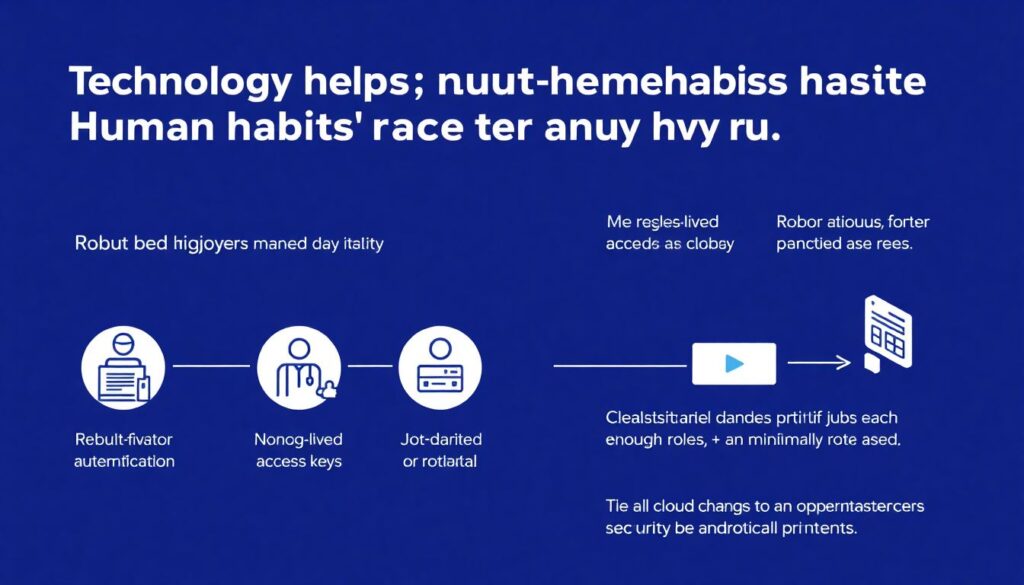
Technology helps, but your habits matter more than any shiny dashboard. Start with robust identity hygiene: enforce MFA everywhere, avoid long‑lived access keys, and rotate secrets automatically. Adopt role‑based access with just‑enough permissions for each team or service. Tie all cloud changes to tickets or pull requests so there’s always a human‑readable reason behind every new port, role or exception. That alone makes it much easier to spot suspicious activity that doesn’t match any legitimate change record.
Next, embrace ferramentas de monitoramento de vulnerabilidades em nuvem that fit your stack. These can be native scanners from your provider or independent products that watch for risky configurations, exposed services and outdated software versions. The key is to treat their alerts as part of your regular operations, not an occasional “security project.” Integrate findings into your backlog, assign owners and due dates, and track remediation rates like you track uptime or performance. Over time, this turns security from a series of crises into a predictable maintenance routine.
Do not underestimate the value of regular chaos and drills. Run tabletop exercises where you simulate credential theft, data loss or ransomware in your cloud workloads and walk through how you would detect, contain and recover. Test your backups by actually restoring systems and verifying data integrity. Review logs to see if the simulated attack path would have left footprints and whether your alerts would trigger. These exercises reveal gaps far more reliably than checklists and force you to streamline runbooks, permissions and communication channels before a real incident forces you to improvise under pressure.
Trends shaping cloud vulnerabilities toward 2026
Heading toward 2026, the cloud landscape is evolving in ways that will both help and complicate defense. On one hand, providers are doubling down on strong defaults, deeper integration of threat intelligence and automated remediation. More services ship with encryption enabled by default, stricter identity enforcement, and built‑in anomaly detection. On the other hand, workloads are becoming more distributed: multi‑cloud, edge computing and serverless functions mean the attack surface now stretches across clouds, devices and regions, making simple perimeter thinking even less useful than it already was a few years ago.
AI is another big factor. Attackers use automation and machine learning to scan for misconfigurations faster and craft more convincing phishing or social‑engineering campaigns targeting cloud admins and DevOps staff. At the same time, defenders rely on AI‑driven analytics to correlate signals across logs, detect unusual access patterns and prioritize alerts. The arms race is less about raw technology and more about data quality and process: organizations that centralize logs, maintain clean asset inventories and keep clear ownership will get much more value from these new tools than those drowning in noisy, mislabeled telemetry.
Regulation and customer expectations are also tightening, especially around privacy, data residency and incident reporting. Companies are expected to know exactly where their data lives, how it’s protected and how quickly they can notify stakeholders after a breach. This pushes more teams to adopt formal risk assessments, continuous compliance monitoring and clearer contracts with cloud and SaaS providers. The organizations that adapt early will find security conversations with auditors and clients far easier; those that delay may find themselves stuck between technical debt in their cloud setups and mounting external pressure to prove that their controls are more than just slide‑deck promises.
Wrapping up: treating cloud security as an everyday discipline
If there is a single lesson from the recentes notícias sobre vulnerabilidades em serviços cloud, it is that the biggest risks come from ordinary mistakes repeated at scale, not from exotic new bugs. Misconfigurations, over‑privileged identities, weak monitoring and neglected test environments combine into a predictable recipe for breaches. The good news is that the same repeatable patterns that make cloud attractive for business also make it possible to bake strong security into templates, pipelines and daily habits, rather than relying on heroics once something goes wrong.
For teams just starting out, the most important move is to slow down a bit at the beginning: design your accounts, roles and networks with intent, automate as much as possible, and treat security checks as a built‑in part of development and operations. Choose providers and tools that give you visibility instead of black boxes, and invest early in skills, not just products. Do that, and the next wave of headlines about cloud vulnerabilities is far more likely to be something you read about, not something you’re forced to explain to your customers and regulators under stress.
Комментарии