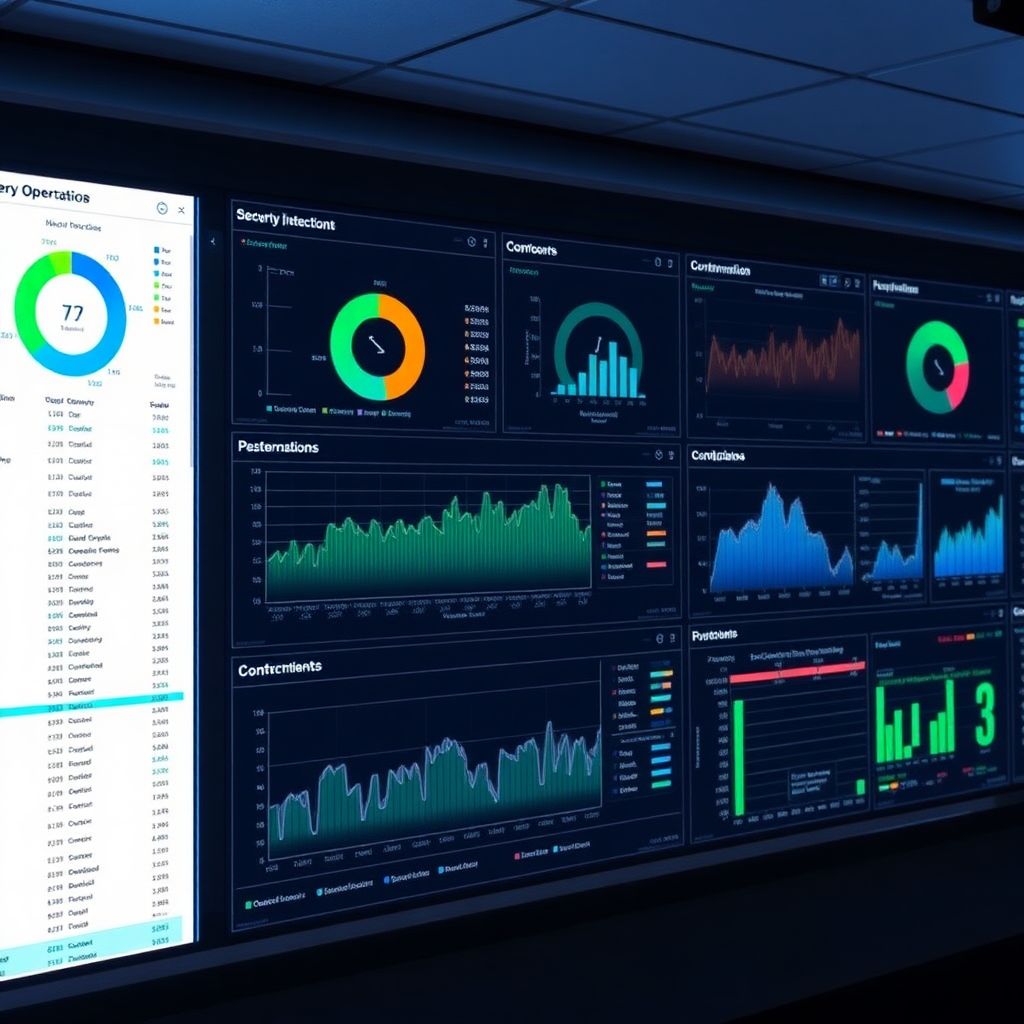
Using AI and machine learning for threat detection in cloud-native environments means turning logs, traces and metrics into near real-time detections of abnormal behavior. You combine telemetry from Kubernetes, serverless, PaaS and managed services with models that spot deviations, then feed alerts into response workflows already used by your security and SRE teams.
Practical objectives for AI-driven cloud-native threat detection
- Gain continuous visibility into containers, Kubernetes clusters, serverless and managed cloud services without relying only on static rules.
- Use segurança em cloud native com inteligência artificial to reduce alert fatigue while still catching subtle, low-and-slow attacks.
- Build soluções de detecção de ameaças em nuvem com machine learning that adapt automatically as workloads, versions and traffic patterns change.
- Integrate ferramentas de IA para segurança em ambientes cloud native into existing SIEM, SOAR and incident response runbooks.
- Control cost and latency so plataformas de segurança cloud com detecção de ameaças por IA remain practical for high-volume Brazilian environments.
- Leverage serviços de cibersegurança em nuvem com machine learning from your CSP when full in-house development is not realistic.
Mapping cloud-native attack surface and telemetry sources
Without a clear map of your cloud-native attack surface, AI models will miss critical signals or drown in noise. Start by deciding where AI-driven detection adds value and where simpler controls are enough.
This approach fits when you run production workloads on Kubernetes, managed container services or serverless, and already collect basic logs. It is not ideal if you lack any observability stack, have no security ownership over the cloud account, or must rely only on manual, ad hoc investigations.
- Identify core runtime platforms
List the cloud-native runtimes you must protect:- Kubernetes clusters (managed or self-managed) and their namespaces.
- Container platforms like ECS, App Runner, Cloud Run, AKS, EKS, GKE.
- Serverless (Lambda, Cloud Functions, Functions, etc.).
- Managed PaaS: databases, API gateways, queues, data streams.
- Map critical identities and network edges
Attackers often abuse identity and network paths rather than exploits.- Cloud IAM roles used by clusters, nodes, CI pipelines and automation.
- Ingress points: load balancers, API gateways, public endpoints.
- Privileged service accounts inside Kubernetes or containers.
- Enumerate available telemetry sources
For each runtime and edge, list what you can log today:- Cloud audit logs (IAM changes, API calls, resource creation).
- Network flow logs and WAF logs.
- Container and pod logs, host OS logs, Kubernetes API server logs.
- Traces and metrics from your APM or observability platform.
- Decide where AI adds the most value
Prioritize areas where static rules are weak:- East-west traffic between services and namespaces.
- Behavior of service accounts and cloud IAM roles.
- Anomalous use of managed database or storage services.
Designing features from logs, traces and metrics
AI is only as good as the features you extract from raw telemetry. The goal is to build compact, privacy-aware features that capture behavior, not sensitive content.
Prepare the following foundations before you start model work.
- Tooling and data platform prerequisites
You will need:- A central log and metrics platform (e.g., Elasticsearch, OpenSearch, Loki, Cloud-native logging, or a commercial SIEM).
- An observability stack with distributed tracing (OpenTelemetry or similar) where possible.
- Storage for feature datasets (object storage, data lake or database) with strict access control.
- Compute for feature engineering and training: notebooks, jobs or pipelines in your preferred language (Python, Scala, etc.).
- Access and governance requirements
To keep the solution safe and compliant:- Read-only access to production telemetry, with masking of personal data or secrets.
- Scoped IAM roles or service accounts for feature pipelines and training jobs.
- Approval process for moving new detection models into production.
- Core behavioral features to design
Start with features that are robust and easy to compute:- Per identity: number of API calls, resources touched, regions used, error codes, time-of-day patterns.
- Per pod or container: processes spawned, outbound destinations, unusual parent-child process trees.
- Per service: request rate, status code distribution, auth failures, payload size statistics.
- Per database or storage bucket: access frequency, new caller identities, cross-region activity.
- Feature windows and aggregation
Security behavior is temporal:- Use sliding windows (e.g., minutes or hours) for metrics like call volume and error spikes.
- Maintain longer history windows (days) to learn normal patterns for identities and services.
- Normalize features (z-score, min-max) to stabilize model training.
- Data minimization and privacy
Design features to avoid leaking sensitive content:- Use hashes or tokens instead of raw IPs or user IDs when possible.
- Drop payload bodies unless absolutely required; prefer metadata and counts.
- Document which fields are used by each model for review and audits.
Selecting and training models for anomaly and signature detection
Now you turn features into detections. The main challenge is choosing models that are accurate but understandable and maintainable for your security team.
Risks and limitations to keep in mind before building models

- Overfitting to a clean lab dataset can make models blind to real-world Brazilian traffic patterns.
- Excessively complex models may be impossible to explain to auditors or incident responders.
- Uncontrolled training pipelines might ingest sensitive data or violate data residency requirements.
- Under-tested anomaly models can flood your SOC with false positives and damage trust.
- Vendor-specific features may lock you into a single cloud provider or security platform.
Model options, trade-offs and cost implications
| Model type | Best suited for | Pros | Cons | Cost considerations |
|---|---|---|---|---|
| Rule-based plus heuristics | Known signatures and compliance checks | Simple, transparent, easy to tune | Limited to known patterns, brittle to changes | Cheap to run; mainly storage and rule evaluation cost |
| Unsupervised anomaly detection (e.g., clustering, isolation forests) | Unknown threats and behavior changes | No labels required, adapts to new patterns | Harder to explain, needs careful thresholding | Moderate compute for training; cheap to infer if features are compact |
| Supervised classifiers | Patterns seen in historical incidents | High precision when trained on good labels | Needs continuous labeled data and maintenance | Higher training cost; inference cost depends on model size |
| Sequence models (e.g., simple RNN-like or temporal models) | Session or sequence-based attacks | Captures order and timing of events | Complexity, explainability, more tuning | More expensive training and inference, especially at scale |
- Define clear detection objectives
Decide what you want the models to catch:- Compromised access keys or service accounts abusing cloud APIs.
- Malicious lateral movement between pods, nodes or VPCs.
- Data exfiltration through unusual storage or network patterns.
- Abuse of serverless functions or PaaS services for cryptomining.
- Segment use cases by data and response needs
Group detections into categories:- High-urgency incidents that require real-time or near real-time alerts.
- Low-urgency hygiene or misconfiguration issues suited to batch scoring.
- Use cases with high-quality labels versus mostly unlabeled data.
- Select initial model families
Based on your segmentation:- Use rule-based plus light heuristics as a baseline for known threats.
- Apply unsupervised anomaly detection for behavioral deviations where you lack labels.
- Introduce supervised models only where you have reliable ground-truth incidents.
- Prepare safe training datasets
Build datasets from your feature store:- Exclude sensitive fields and anonymize identifiers where possible.
- Balance examples over time windows to avoid bias towards quiet periods.
- Include known attack windows and red-team exercises for evaluation.
- Train and evaluate with security-centric metrics
Go beyond generic accuracy:- Measure precision and recall per use case, not just overall.
- Track alert volume per day and per cluster or account.
- Simulate incidents and verify that alerts are raised within acceptable latency.
- Perform human-in-the-loop review
Before production:- Ask security analysts to review top anomalies for several days of data.
- Collect feedback on clarity of features and alert explanations.
- Adjust thresholds, features or model choice based on operator feedback.
- Harden and document the training pipeline
Finally, make the process repeatable:- Automate data extraction, feature computation and training as code.
- Version models, datasets and configuration used for each training run.
- Restrict who can trigger training and who can promote models to production.
Architecting real-time inference, scalability and cost control
Even the best model fails operationally if inference is slow, fragile or too expensive. Treat the detection service like any other critical microservice.
Use the following checklist to verify that your real-time architecture is safe, scalable and financially sustainable.
- Inference endpoints are deployed in at least two availability zones or regions for high availability.
- Models are exported into lightweight formats suitable for your runtime (e.g., on-prem, managed ML, or serverless) to reduce latency.
- Incoming telemetry is pre-aggregated into features before hitting the model, reducing payload size and compute cost.
- Back-pressure and rate limiting protect the model service from spikes in log volume.
- Autoscaling is configured based on queue depth or request rate, with sensible maximums to avoid runaway cost.
- Per-tenant or per-cluster quotas prevent one noisy environment from exhausting shared resources.
- Cost dashboards show inference requests, compute usage and storage size for model-related data.
- Graceful degradation paths exist, such as temporary downgrade to rules-only detection if the ML service fails.
- Security controls protect the model API: authentication, authorization and network restrictions.
- Configuration is managed as code, with blue-green or canary deployments for new model versions.
Validation, metrics and drift monitoring in production
Once deployed, models slowly degrade due to changes in workloads, tools and attacker techniques. You need explicit metrics and drift monitoring to keep segurança em cloud native com inteligência artificial effective over time.
Avoid these common pitfalls when running AI-driven detections in production.
- Running models without a baseline of pre-ML alerts makes it impossible to compare improvement or regression.
- Ignoring feedback from analysts and SREs about false positives leads to silent rejection of alerts.
- Failing to monitor input feature distributions hides drift until detection quality collapses.
- Never retraining models after major infrastructure changes (such as new clusters or new regions) leaves blind spots.
- Not logging model decisions and scores prevents later investigations and tuning.
- Hardcoding thresholds and never revisiting them as traffic volume grows or shifts.
- Skipping periodic red-team simulations means you do not know if models still catch realistic attack paths.
- Allowing multiple teams to change features independently without coordination, producing incompatible datasets.
Integrating detection outputs into response and risk workflows

Detections only matter when they change decisions. Integrate AI-based alerts into the tools your teams already use, and consider simpler alternatives when full ML is not justified.
- Full AI integration with SOAR and ITSM
Best for mature teams with established incident processes:- Route high-confidence alerts to SOAR playbooks that can enrich, contain and notify automatically.
- Open tickets in ITSM for medium-priority anomalies with clear guidance for triage.
- Use detection scores to prioritize investigations during busy periods.
- Hybrid AI plus managed cloud security services
Useful when you have limited in-house expertise:- Combine your models with serviços de cibersegurança em nuvem com machine learning offered by the CSP.
- Ingest alerts from plataformas de segurança cloud com detecção de ameaças por IA into your SIEM as additional signals.
- Let the provider handle low-level models while you customize rules and workflows.
- Rules-first with selective ML augmentation
Appropriate when starting out or under strong resource constraints:- Keep core detections implemented as transparent rules in the SIEM or WAF.
- Apply soluções de detecção de ameaças em nuvem com machine learning only to a few high-value identities, clusters or applications.
- Use results as recommendations rather than automatic blocking actions at first.
- Off-the-shelf tools for smaller environments
When custom development is overkill:- Adopt ready-made ferramentas de IA para segurança em ambientes cloud native that integrate with your logging and Kubernetes stack.
- Rely on vendor-provided models and focus on policy, onboarding and response procedures.
- Periodically evaluate if volumes, complexity and regulatory needs justify in-house ML later.
Common practitioner concerns and operational clarifications
Do I need data scientists to start using AI for cloud-native threat detection?
No. You can begin with managed ML features from your cloud provider or security vendors, plus simple anomaly rules. Data scientists become more important when you build and operate custom models at scale.
How much historical data should I keep for training and baseline building?
Focus on having enough normal behavior to cover weekday and weekend patterns, seasonal peaks and recent architecture changes. More history is useful, but only if it reflects the current design of your environment.
Will anomaly detection replace my existing SIEM rules?
Not in the short term. Treat AI-based detections as an additional layer for subtle or unknown behaviors, while rules and signatures continue to cover well-known attack techniques and compliance requirements.
Is it safe to run models directly on production telemetry?
Yes, if you minimize sensitive fields, use read-only access and enforce strict IAM roles. Run heavy training on anonymized or masked datasets, while production inference uses compact features only.
How do I prevent false positives from overwhelming my SOC?

Start with limited, high-value use cases and conservative thresholds. Use human-in-the-loop review for early alerts, and continuously incorporate analyst feedback into threshold updates and feature improvements.
Can I rely only on vendor platforms with AI-based detection?
You can for many scenarios, especially in smaller teams. Still, you should understand what data these platforms use, how to tune them and how to combine their alerts with your own contextual rules.
What is the best first use case for AI in a Brazilian cloud-native environment?
A practical first step is detecting anomalous cloud IAM and Kubernetes service account behavior, because misuse of identities is common, impactful and relatively easy to observe with existing logs.
Комментарии