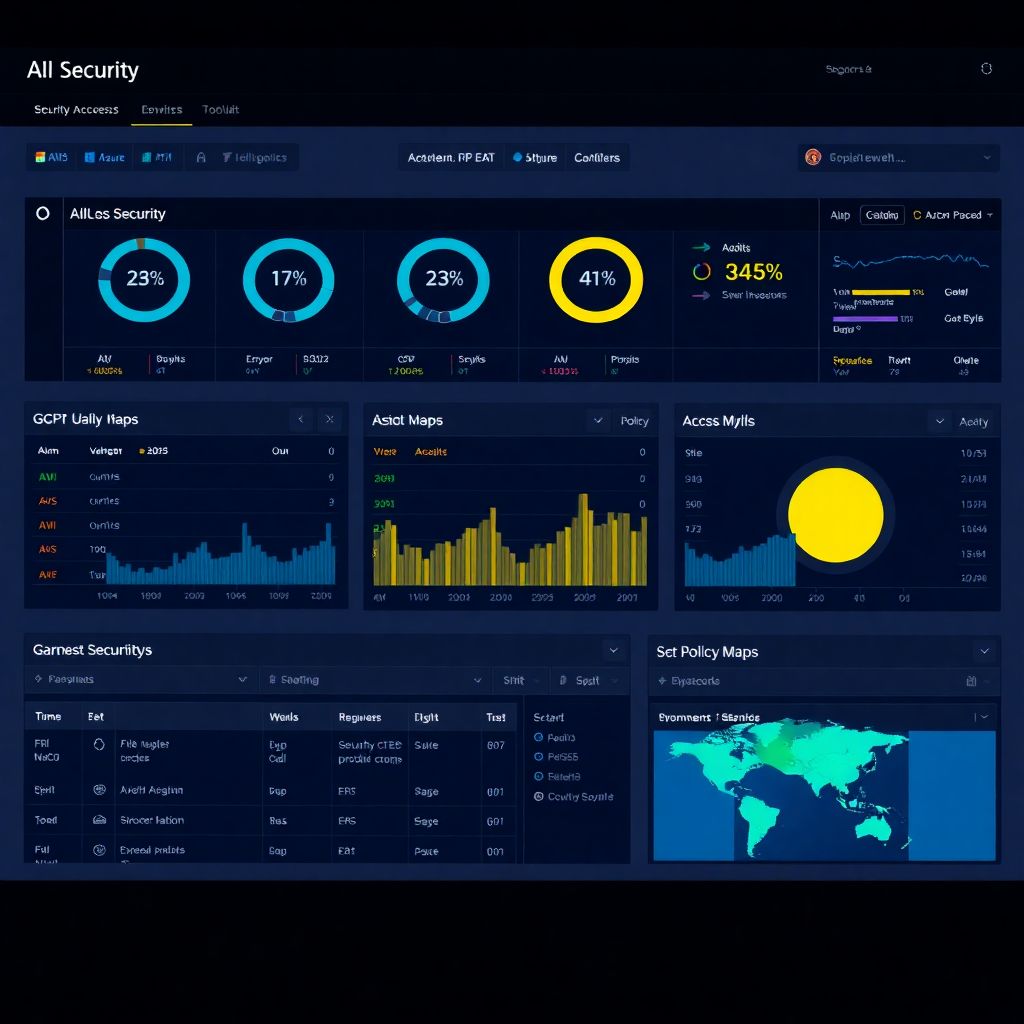
To implement secure, identity-based access control across AWS, Azure and GCP, centralize identities, enforce strong authentication, define least‑privilege roles, standardize cross‑cloud mappings, protect secrets with managed services and continuously audit. Start small with core workloads, then iterate policies using logs, access reviews and automated policy checks.
Core IAM Principles to Enforce Across AWS, Azure and GCP
- Use a single corporate identity source (IdP) and avoid local cloud-only human users where possible.
- Apply strict least privilege with role-based access and time-bound elevation for administrators.
- Prefer roles and service principals over long-lived access keys and passwords.
- Standardize permission sets across clouds to simplify gestão de identidades e acessos iam corporativo em nuvem.
- Enforce MFA, SSO and conditional access for every admin and privileged workload.
- Continuously monitor with ferramentas para auditoria e governança iam em aws azure gcp and remediate drifts automatically.
Designing Identity Models: Users, Groups, Roles and Service Principals
This section fits organizations building a consistent, secure IAM foundation across AWS, Azure and GCP, especially in Brazil where teams already use corporate IdPs like Azure AD / Entra ID or Okta. It is less appropriate if you still manage users manually per project or treat each cloud as an isolated island.
| Concept | AWS | Azure | GCP | Typical Use |
|---|---|---|---|---|
| Human user | IAM User (avoid for admins) | Azure AD / Entra user | Google Workspace / Cloud Identity user | Employees, support engineers |
| Group | IAM Group / AD Group via SSO | Azure AD group | Google group | Role-based membership (Dev, SecOps) |
| Role | IAM Role | Azure role assignment + role definition | IAM custom role / predefined role | Attach permissions to a function, not a person |
| Workload identity | IAM Role for service / IAM Role for Service Account | Managed identity / Service principal | Service account / Workload Identity Federation | Apps, CI/CD, automation without static keys |
For a robust implementação segura de controle de acesso baseado em identidade na nuvem, follow these design rules:
- Define all human identities in a central IdP, synchronize to clouds only as needed.
- Use groups in the IdP to map business roles (e.g.,
Dev-App1-Read,Ops-Platform-Admin). - Use cloud roles and custom roles to implement technical permission sets and attach them to groups.
- Use service principals, managed identities and service accounts for applications; never reuse human accounts for automation.
- For iam aws azure gcp melhores práticas de segurança, document a canonical role catalog and reuse names across clouds.
Authentication Best Practices: MFA, SSO and External Identity Providers

To implement secure authentication across AWS, Azure and GCP, ensure you have the following prerequisites and tools:
- Corporate IdP: Azure AD / Entra ID, Okta, Ping, or another SAML/OIDC provider configured for Brazilian regulations and company policies.
- Admin access to:
- AWS Organizations management account and AWS IAM Identity Center (or IAM for legacy setups).
- Azure AD / Entra admin center and Azure subscription RBAC.
- GCP organization-level IAM and Cloud Identity / Google Workspace admin console.
- MFA options:
- Hardware security keys (FIDO2/U2F) for high-privilege admins.
- Authenticator apps or push-based MFA for standard users.
- Networking and security:
- Conditional Access / Context-Aware Access policies for location-based and device-based controls.
- Logging enabled in AWS CloudTrail, Azure AD sign-in logs and GCP Cloud Audit Logs.
- Runbooks and help-desk procedures for:
- MFA enrollment, device loss and recovery.
- Onboarding and deprovisioning employees and contractors.
| Authentication Choice | AWS | Azure | GCP | Notes |
|---|---|---|---|---|
| SSO for admins | IAM Identity Center + external IdP | Native Azure AD; use PIM for elevation | Cloud Identity / Workspace + SAML/OIDC | Preferred for gestão de identidades e acessos iam corporativo em nuvem |
| MFA enforcement | Enforce via IdP + IAM policies | Conditional Access policies | Context-Aware Access / IdP policies | Use stronger factors for privileged roles |
| External IdP | SAML/OIDC federation | Azure AD as primary or federated | SAML/OIDC for workforce identities | Simplifies consultoria configuração iam multi cloud aws azure gcp |
Authorization Strategies: Least Privilege, Role Segregation and Scoped Policies
The steps below describe a safe, repeatable way to deploy least-privilege authorization across AWS, Azure and GCP.
-
Map business roles to technical responsibilities
Identify who needs access to what and why: developers, operators, security, auditors, data analysts. Convert these into stable access profiles (e.g., App Owner, Platform Admin, Read-only Auditor).
- List critical applications and environments (dev, test, prod).
- Assign each profile to specific environments and services.
-
Create reusable permission sets per cloud
In AWS, define IAM policies and permission sets; in Azure, define built-in or custom roles; in GCP, define custom roles from minimal permissions. Align names and scope across all clouds.
- AWS: Start from AWS managed policies, then shrink.
- Azure: Use built-in roles where possible, custom only when needed.
- GCP: Prefer predefined roles over primitive roles (Owner, Editor, Viewer).
-
Bind permission sets to groups, not users
Assign your cloud roles to identity provider groups. Users join groups; groups hold roles. This is easier to audit and consistent with iam aws azure gcp melhores práticas de segurança.
- IdP groups like
BR-Cloud-Prod-ReadOnlyorBR-Cloud-SecOps-Admin. - Link groups to roles at account/subscription/project scope.
- IdP groups like
-
Limit scope and duration of admin permissions
Use time-bound elevation and scoped roles. Admins should not be permanent full admins in production.
- Azure: use Privileged Identity Management for just-in-time roles.
- AWS: define break-glass roles with approval and logging.
- GCP: use access approval workflows where available.
-
Implement workload identities for applications and CI/CD
Replace static keys with roles, managed identities and federation. Keep secrets in dedicated services instead of code repos or environment files.
- AWS: IAM roles for EC2, ECS, Lambda; GitHub/GitLab OIDC to AWS.
- Azure: system/user-assigned managed identities; workload identity federation.
- GCP: service accounts + Workload Identity Federation from CI/CD.
-
Test policies in lower environments first
Apply and validate permissions in dev/test with realistic scenarios before rolling into production. Use dry-runs and policy simulators provided by each cloud.
- Track denied actions and adjust policies minimally.
- Document every additional permission with a justification.
-
Continuously review and tighten permissions
Schedule periodic reviews of group membership and active roles. Use access analytics in ferramentas para auditoria e governança iam em aws azure gcp to find unused permissions and remove them.
- Quarterly access review for all privileged roles.
- Automated detection of risky grants (e.g., wildcard permissions).
Fast-Track Least-Privilege Setup
- Create three core profiles: Admin (time-bound), Power User (no IAM), Read-Only.
- For each cloud, map these profiles to existing managed or built-in roles with minimal changes.
- Create IdP groups for each profile and environment; bind them to roles at account/subscription/project level.
- Roll out to non-production first, fix denied actions, then extend to production.
- Set a recurring calendar reminder for access reviews every quarter.
Cross-Cloud Role Mapping, Trust and Federation Patterns
Use this checklist to validate your multi-cloud trust design and federation patterns for implementação segura de controle de acesso baseado em identidade na nuvem.
- Each human identity logs in through one IdP and receives mapped roles in every cloud; no direct cloud-local admin accounts are used for daily work.
- Role names and responsibilities are documented and consistent across clouds (e.g.,
Cloud-Prod-Adminmeans the same everywhere). - Federation trust (SAML/OIDC) is configured from IdP to AWS accounts, Azure tenants and GCP organizations with signed, time-limited tokens.
- Cross-account (AWS), cross-subscription (Azure) and cross-project (GCP) access is implemented via roles, not shared credentials.
- Third-party partners receive dedicated, restricted roles and groups, with clear end dates and limited scopes.
- Break-glass accounts exist per cloud, stored securely offline, tested quarterly and monitored for any use.
- Federated workloads (e.g., CI/CD runners) use OIDC or workload identity federation instead of long-lived keys.
- Logs for auth events and role assumptions are centralized into a SIEM and retained according to corporate and Brazilian compliance rules.
- A documented runbook exists for revoking all access of a compromised identity across AWS, Azure and GCP within minutes.
Secrets, Keys and Short-Lived Credentials Management
Common pitfalls to avoid when handling secrets and credentials in multi-cloud IAM:
- Storing access keys or passwords directly in source code repositories, CI/CD configuration files or shared drives.
- Using long-lived access keys for applications instead of roles, managed identities or service accounts with federation.
- Having multiple copies of the same secret spread across AWS Secrets Manager, Azure Key Vault and GCP Secret Manager without clear ownership.
- Not rotating keys, database passwords and API tokens regularly or after staff changes and incidents.
- Letting developers create ad-hoc secrets per project without standards, naming conventions or lifecycle management.
- Granting broad read access to secret stores (e.g., full vault access) instead of scoped, per-application permissions.
- Exposing secrets in logs, error messages, debugging tools or screenshots used in tickets and chat.
- Ignoring local workstation security, leaving credentials in plain-text files or unencrypted password managers.
- Not monitoring secret access patterns to detect anomalies or excessive usage for specific identities or applications.
| Secrets Practice | AWS | Azure | GCP | Risk / Mitigation |
|---|---|---|---|---|
| Secret storage | Secrets Manager / SSM Parameter Store | Key Vault | Secret Manager | Risk: scattered secrets; Mitigation: standardize on one per cloud and document owners. |
| Short-lived access | STS AssumeRole, session policies | Managed identities, access tokens | Service account tokens, Workload Identity Federation | Risk: persistent keys; Mitigation: use tokens and roles with expiration. |
| Rotation | Automatic rotation in Secrets Manager | Key Vault rotation + versioning | Secret Manager rotation integrations | Risk: stale secrets; Mitigation: enforce rotation schedules by policy. |
Monitoring, Auditing and Automated Policy Enforcement
There are several viable approaches for monitoring and enforcement; combine them according to your maturity and tooling.
- Cloud-native controls per provider – Use AWS CloudTrail, AWS Config, Azure Activity Logs, Azure Policy, GCP Cloud Audit Logs and Organization Policy to detect and block risky IAM changes close to the source. Suitable when you want minimal extra tools and your teams are cloud-specific.
- Centralized SIEM and analytics – Ingest identity and access logs from all clouds into a SIEM (e.g., Sentinel, Splunk, Elastic) and build correlation rules and dashboards. Works best for gestão de identidades e acessos iam corporativo em nuvem with a central security operations center.
- Policy-as-code and drift detection – Use tools like Terraform, Open Policy Agent, or similar to codify IAM baselines and check every change in CI/CD. Ideal when infrastructure is already managed as code and you need predictable, reviewable IAM changes.
- Specialized IAM governance platforms – Adopt dedicated ferramentas para auditoria e governança iam em aws azure gcp to perform access reviews, certify roles and automate approvals. Useful for enterprises seeking consultoria configuração iam multi cloud aws azure gcp with strong compliance and audit requirements.
Practical Questions and Short Solutions for Common IAM Challenges
How do I start cleaning up overly permissive IAM in a production environment?
Begin with read-only monitoring: enable logging, analyze who uses which permissions and identify unused ones. Apply stricter roles in a staging environment, then gradually reduce permissions in production with clear communication and rollback plans.
Should I disable all local cloud users once SSO is enabled?
Disable or restrict most local users used for human access, but keep a small number of break-glass accounts per cloud with strong MFA and strict monitoring. Document and regularly test their use in incident drills.
How can I give developers more autonomy without risking production?

Provide developers with admin-like roles in isolated dev/test environments, while enforcing read-only or limited change roles in production. Use approval workflows and just-in-time elevation for rare production interventions.
What is the safest way to grant temporary access to external consultants?
Create dedicated consultant groups and roles with narrow scopes and explicit end dates. Use your IdP or the consultant's IdP for federation, avoid shared accounts and review or revoke access immediately after the engagement.
How do I manage IAM for CI/CD pipelines securely?
Use workload identity federation or managed identities instead of static keys. Grant pipelines only the minimal permissions they need in each environment and store any required secrets in managed secret stores, never directly in pipeline configuration.
When should I choose custom roles instead of built-in roles?
Use built-in roles whenever they closely match your needs and are not excessively powerful. Create custom roles only when built-in ones give too many permissions or when compliance requires precisely defined actions.
How often should I review group membership and privileged roles?
Perform formal access reviews at least a few times per year, and after major organizational changes. High-risk roles can be reviewed more frequently, such as monthly, especially in regulated or highly targeted sectors.