
Network segmentation and microsegmentation in cloud reduce attack surface by isolating workloads, enforcing least privilege, and limiting lateral movement. For pt_BR organizations, start with a simple, default-deny model, use labels and security groups consistently across clouds, and evolve to zero trust policies as you gain visibility, monitoring, and operational maturity.
Core objectives for reducing attack surface with segmentation
- Minimize lateral movement by isolating workloads, environments, and tenants with explicit, least-privilege policies.
- Standardize segment definitions across providers so segmentação de rede na nuvem para segurança is consistent in multi-cloud.
- Use microsegmentation to protect critical business services, not just network tiers or IP ranges.
- Prefer default-deny rules and explicit allowlists, enforced close to the workload.
- Continuously validate policies with logging, flow visibility, and attack-path analysis.
- Automate labeling and policy deployment to reduce human error and configuration drift.
Fundamentals of network segmentation in cloud environments
Objective: Define where segmentation adds the most risk reduction and where it may add unnecessary complexity.
Cloud segmentation starts with isolating environments (dev/test/prod), applications, and data sensitivity levels using VPCs/VNETs, subnets, and security groups. Then, you refine with microsegmentation inside each zone. This is the foundation for software de microsegmentação zero trust na nuvem and other advanced controls.
Segmentation is well-suited for:
- Workloads processing sensitive or regulated data.
- Internet-facing services with backend databases or internal APIs.
- Hybrid environments where on-prem networks connect to cloud workloads.
- Companies adopting soluções de microsegmentação em cloud para empresas as part of zero trust.
Segmentation is not ideal or should be delayed when:
- Your asset inventory and basic security hygiene (patching, IAM) are not under control yet.
- The environment is highly dynamic but you lack automation for labels and policy deployment.
- There is no monitoring to detect blocked flows or policy misconfigurations.
- Confirm that environments and data sensitivity levels are clearly defined.
- Verify you can map applications to subnets, VNets/VPCs, and security groups.
- Ensure IAM and basic network controls are stable before adding complexity.
- Plan for automation early, especially tagging/labeling standards.
Threat modeling and risk-driven segmentation strategy
Objective: Drive segmentation decisions from concrete risks, not only from network diagrams.
Before deploying ferramentas de segmentação de rede para reduzir superfície de ataque, clarify what you protect and against whom. Start with threat modeling sessions involving security, networking, application owners, and operations teams who know the flows and business impact.
You will need:
- Access and visibility
- Read-only access to cloud accounts/subscriptions (VPCs, VNets, security groups, firewall rules).
- Flow logs (VPC Flow Logs, NSG Flow Logs, load balancer logs) to observe current traffic.
- CMDB or at least an asset inventory linking workloads to owners and applications.
- Threat modeling inputs
- Business criticality classification for applications and data.
- Known attacker profiles: external, insider, supplier, compromised workload.
- Past incidents or penetration-test findings involving lateral movement.
- Decision criteria for segments
- Segregate by environment (prod vs non-prod), data type (PII, financial), and exposure (internet vs internal).
- Identify choke points where controls can be enforced with minimal disruption.
- Define what must never communicate directly (e.g., prod payment DB vs all non-payment workloads).
- Tooling considerations
- Native cloud firewalls and security groups for coarse-grained segmentation.
- Host-based agents or software de microsegmentação zero trust na nuvem for fine-grained policies.
- Serviços gerenciados de segmentação de rede corporativa if internal expertise is limited.
- List top 10-20 critical apps and their dependencies (databases, APIs, message buses).
- Document must-not-talk pairs (e.g., dev → prod, internet → admin networks).
- Choose segmentation units: environment, app, data sensitivity, or combinations.
- Agree on a small, consistent label/tagging scheme to drive policies.
Microsegmentation design patterns: labels, policies and service maps
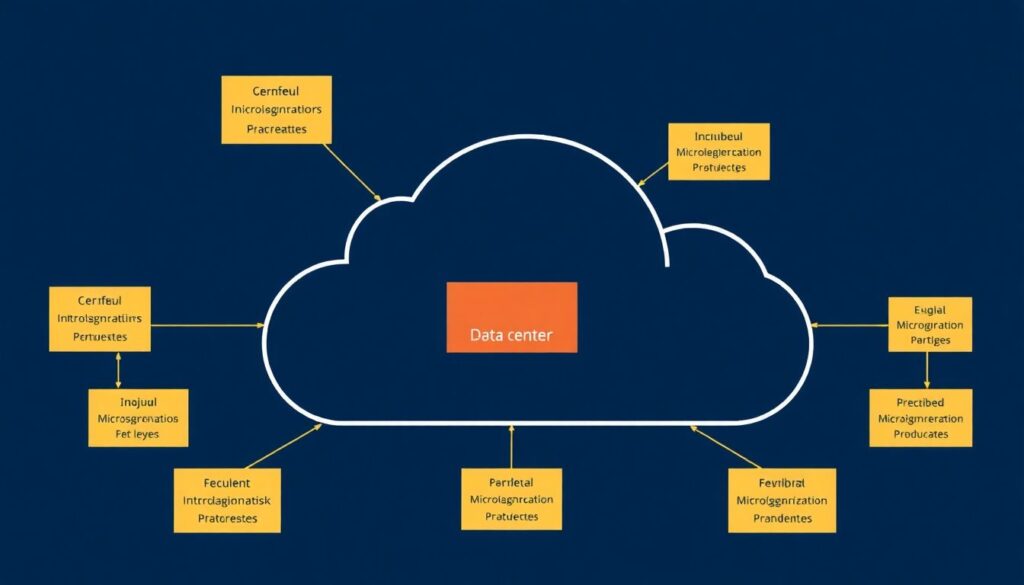
Objective: Implement safe, incremental microsegmentation using labels and explicit policies, minimizing outages.
Risk and limitations check before starting:
- Overly aggressive default-deny can break production if you skip the observation phase.
- Inconsistent tags across clouds make policies brittle and hard to maintain.
- Relying only on IPs or subnets fails in autoscaling and containerized environments.
- Deploying agents everywhere at once increases the blast radius of configuration mistakes.
- Standardize labels and tags across clouds
Create a minimal but expressive taxonomy that you can apply in AWS, Azure, GCP and other platforms.
- Core keys:
Environment,Application,Tier,DataSensitivity,Owner. - Example:
Environment=Prod,Application=Billing,Tier=API,DataSensitivity=High. - Ensure CI/CD pipelines and infrastructure-as-code templates always set these labels.
- Core keys:
- Build an application and service map
Use flow logs and APM/service-discovery tools to map which services talk to which.
- Group flows by labels instead of IPs; this is the basis for durable policies.
- Identify core paths: user → web → API → DB, messaging, cache, external APIs.
- Document dependencies with owners so changes can be validated.
- Start with observation-only policies
Before enforcing, deploy rules in monitor mode whether using native SGs/ACLs or software de microsegmentação zero trust na nuvem.
- Proposed pattern: allow only observed legitimate flows, log all others without blocking.
- Run observation long enough to capture peak loads, batch jobs, and maintenance windows.
- Review logs with app owners to confirm which flows are truly required.
- Define default-deny, label-based policies
Translate observed and approved flows into explicit allow rules, then block everything else.
- Example high-level rule:
ALLOW Environment=Prod AND Tier=Web → Environment=Prod AND Tier=API port 443. - Example DB rule:
ALLOW Application=Billing AND Tier=API → Tier=DB port 5432; no other sources allowed. - Keep policy language abstracted from IPs whenever possible to survive scaling and redeploys.
- Example high-level rule:
- Rollout in small, low-risk segments first
Begin enforcement in non-critical services or non-prod environments to validate approach.
- Choose one or two representative applications.
- Apply microsegmentation in stages: internal tiers first, then external-facing edges.
- Use automated rollback (infrastructure-as-code versioning) to revert if needed.
- Integrate with change management and CI/CD
Policies must evolve with applications; avoid one-off manual changes.
- Store policies in version control alongside infrastructure code.
- Require pull requests for new flows, with security review for prod segments.
- Automate deployment and validation tests as part of release pipelines.
- Confirm a small, consistent label schema is applied across all workloads.
- Verify that observed flows are validated by app owners before enforcement.
- Ensure default-deny is active only after allow rules are thoroughly tested.
- Keep a tested rollback procedure ready for policy changes.
- Continuously refine service maps as new dependencies appear.
Cross-cloud and hybrid deployment: architecture and trust boundaries
Objective: Maintain clear, enforceable trust boundaries across multiple clouds and on-prem environments.
Many pt_BR organizations run hybrid architectures and adopt serviços gerenciados de segmentação de rede corporativa to reduce operational burden. Regardless of who manages the tools, you must define where trust starts and ends and how traffic is inspected and controlled between zones.
- Check that each environment (on-prem, each cloud account/subscription) has documented trust level.
- Confirm that cloud-to-cloud and on-prem-to-cloud connections pass through controlled choke points (VPNs, transit gateways, SD-WAN, or firewalls).
- Verify that segmentation policies are expressed in a provider-neutral way (labels, app identities) where possible.
- Ensure identity and access controls (e.g., workload identity, certificates) are aligned with network trust boundaries.
- Validate that management and admin planes (SSH/RDP, control APIs) are isolated from user and data planes.
- Confirm logging is centralized so that blocked/allowed cross-boundary flows are visible in one place.
- Check that failover paths (DR sites, secondary regions) preserve segmentation policies.
- Review third-party connections (partners, suppliers, MSSPs) and ensure they land in constrained segments.
Enforcement options: cloud-native controls, host-based agents and SDN
Objective: Choose appropriate enforcement technology, understanding trade-offs and typical mistakes.
Organizations often combine cloud-native controls with dedicated soluções de microsegmentação em cloud para empresas or SDN-based overlays. The table below compares common options, their primary risk coverage, and trade-offs.
| Enforcement option | Primary risks addressed | Typical trade-offs | Best suited scenarios |
|---|---|---|---|
| Cloud-native security groups / firewalls | Coarse lateral movement, ingress/egress control, basic east-west filtering. | Provider-specific, less granular visibility inside hosts, complex in multi-cloud. | Single-cloud workloads, smaller environments, early segmentation phases. |
| Host-based agents (microsegmentation software) | Fine-grained process-level control, strong lateral movement prevention. | Agent management overhead, potential performance impact if misconfigured. | Critical workloads, heterogeneous/hybrid estates, zero trust initiatives. |
| SDN / overlay networks | Network-level isolation across sites, traffic steering via central control. | Requires SDN expertise, added complexity, dependency on controller. | Large enterprises, multi-site WAN and data center integration. |
| Managed segmentation services | Design and operations of segmentation; reduces misconfiguration risk. | Less direct control, recurring service cost, need clear SLAs. | Teams lacking deep network security skills or 24/7 operations capacity. |
Common mistakes when choosing and deploying enforcement:
- Relying only on perimeter firewalls while leaving east-west traffic unrestricted.
- Deploying agents broadly without phased rollout and performance baselines.
- Mixing many enforcement types without a single source of truth for policies.
- Ignoring identity-aware and label-based rules, falling back to IP-only controls.
- Not validating how auto-scaling and ephemeral workloads interact with controls.
- Underestimating operational overhead, especially for rule reviews and updates.
- Lack of integration between segmentation logs and SIEM/monitoring pipelines.
Validation and operationalization: testing, monitoring and change control
Objective: Keep segmentation effective over time with safe validation and sustainable operations.
Even the best-designed policies degrade without testing and feedback. Build a light but disciplined operational model before expanding segmentation or onboarding new ferramentas de segmentação de rede para reduzir superfície de ataque.
Alternative approaches and when they fit:
- Minimalist, cloud-native-only segmentation
Use only security groups, network ACLs, and cloud firewalls with strong tagging. Suitable for smaller environments, or as a first step before adopting specialized software de microsegmentação zero trust na nuvem.
- Agent-based microsegmentation platform
Deploy host agents to gain visibility and fine-grained control. Suitable when lateral movement risks are high and you can invest in operations, or when you want consistent policies in hybrid and multi-cloud.
- SDN-centric network virtualization
Implement segmentation at the virtual network fabric layer. Suitable for organizations already invested in SDN for data centers and WAN, needing unified control across sites.
- Serviços gerenciados de segmentação de rede corporativa
Outsource design and day-to-day management to a trusted provider. Suitable for teams with limited security/network staff who still must demonstrate strong segmentação de rede na nuvem para segurança to auditors and regulators.
- Define regression tests for critical flows and run them on every policy change.
- Centralize logs and alerts; monitor for unexpected denials and new allowed flows.
- Review segmentation policies on a regular cadence with app and security owners.
- Tie policy changes to formal change management with documented rollback steps.
- Periodically re-run threat modeling as architecture and business priorities evolve.
Practical clarifications and common pitfalls during rollout
How strict should default-deny policies be in the first phase?
Start with observation-only or soft-enforcement for new segments, then move to strict default-deny once legitimate flows are documented and tested. Apply the strictest posture first on non-critical or well-understood applications.
Is microsegmentation necessary for every workload in the cloud?
No. Focus microsegmentation on high-value and high-risk workloads, such as internet-facing services and sensitive data stores. Use simpler, coarse-grained segmentation for low-risk or short-lived workloads to avoid unnecessary complexity.
How do I avoid breaking legacy applications during segmentation?
Map dependencies using flow logs and application owner input before enforcing rules. Keep a rollback plan and validate legacy communication patterns in staging where possible, then roll out gradually with tight monitoring.
What is the role of identity in network segmentation?
Identity (service accounts, workload identities, certificates) lets you bind policies to who a workload is, not only where it is. Combining identity-aware controls with segmentation reduces reliance on fragile IP-based rules.
When should I consider managed segmentation services?

Consider managed services when you lack 24/7 coverage, when network security expertise is scarce, or when regulatory pressure demands faster, auditable improvements than your internal team can deliver alone.
Can I rely completely on cloud-native tools instead of dedicated microsegmentation software?
Cloud-native tools are often enough for smaller or single-cloud environments. As complexity, hybrid scenarios, and compliance needs increase, dedicated microsegmentation platforms can provide more consistent visibility and control across estates.
How do I measure whether segmentation is actually reducing risk?
Track reduced reachable attack paths, blocked lateral movement attempts, and smaller blast radius during incidents or tests. Combine these with fewer misconfiguration incidents and improved audit results as indicators of real risk reduction.