
Threat modeling for cloud-native applications is a repeatable process to map your architecture, identify critical assets, think like realistic attackers, and prioritize risks with concrete controls. For Brazilian teams building on Kubernetes and managed cloud services, start small, automate where possible, and integrate with CI/CD instead of running one-off, heavyweight workshops only.
Operational summary checklist for cloud-native threat modeling
- Define clear scope: environment, tenant, cluster, repository and data boundaries.
- Draw a current-state diagram of services, data stores, and external dependencies.
- List primary attacker profiles and the most likely entry vectors first.
- Identify vulnerabilities, misconfigurations and supply-chain exposures per component.
- Score threats by business impact and exploitation likelihood, then pick controls.
- Automate checks in CI/CD and monitor production for drift from the model.
Map cloud-native architecture and critical assets
This phase frames modelagem de ameaças em aplicações nativas de nuvem around business reality, not abstract diagrams.
- Confirm environment: public cloud provider(s), regions, tenancy model and data residency constraints in Brazil and abroad.
- List platforms: Kubernetes clusters, serverless functions, message buses, managed databases and identity providers.
- Identify business-critical assets: customer data, payment flows, authentication tokens, secrets and intellectual property.
- Mark trust boundaries: VPCs, namespaces, accounts, subscriptions and cross-cloud links.
- Note who operates what: internal squad, shared platform team, third-party serviços de threat modeling para microsserviços e kubernetes, or MSSP.
Skip or radically shrink this exercise only when you are prototyping a disposable proof of concept without real users, sensitive data or production connectivity. For any internet-exposed workload, payment integration or regulated data, threat modeling should be treated as a mandatory design activity.
Enumerate attacker profiles and entry vectors
This step clarifies who you defend against and how they are most likely to get in.
- Have architecture diagrams and repository links handy, plus at least one engineer from each major microservice or platform domain.
- Ensure read-only access to cloud consoles, Kubernetes manifests and CI/CD pipelines to validate assumptions quickly.
- Gather logs or examples from WAF, API gateways and identity providers to see real-world traffic and abuse attempts.
- Use structured methods (STRIDE, kill chain, or MITRE ATT&CK for cloud) to guide attacker thinking.
- Leverage existing consultoria em segurança e threat modeling para aplicações em nuvem or internal security champions to challenge optimistic assumptions.
Typical attacker profiles to consider: cloud account takeover, malicious insider, compromised CI runner, supply-chain attacker via dependency or base image, opportunistic internet scanner and targeted fraudster abusing business logic.
Catalog components, data flows and threat surfaces
Before detailing the steps, ensure you are ready with this short preparation checklist:
- Architecture diagrams for current production and near-term target state are available and recently updated.
- Service ownership is clear: you know who owns each microservice, database and shared platform component.
- Deployment descriptors (Helm charts, Kustomize, Terraform, CloudFormation, Pulumi) are accessible in version control.
- Documented data classification exists or can be created quickly for each major data set.
- Chosen notation (simple boxes-and-arrows, C4, or DFD) is agreed across the squad for consistency.
-
List and label all components
Map every microservice, job, function, queue, topic, and external SaaS. Avoid only listing Kubernetes objects; focus on logical services.- Group by domain (billing, onboarding, notifications) to make the model navigable.
- Mark platform elements: Ingress controllers, API gateways, service meshes, secrets managers, and CI/CD runners.
- Include third-party dependencies and managed services (databases, caches, storage buckets).
-
Document trust boundaries and runtime locations
Show where traffic crosses namespaces, clusters, accounts, VPCs, or cloud providers.- Call out internet exposure via load balancers, API gateways, or public buckets.
- Highlight shared runtimes like multi-tenant clusters or serverless environments.
- Note network policies, security groups, and mesh policies that restrict flows.
-
Trace key data flows end-to-end
Pick 3-5 critical journeys (login, payment, data export, admin actions) and trace data across services and storage.- Record what data is processed at each hop and its classification.
- Mark where data is decrypted, enriched, logged, or shared with third parties.
- Identify sync vs. async flows (REST, gRPC, events, batch jobs).
-
Identify exposed surfaces per component
For each microservice or function, list interfaces and how they are protected.- APIs: protocol, auth method, rate limiting, authorization model.
- Messaging: topics/queues, consumer groups, filtering and ACLs.
- Admin paths: dashboards, management ports, debug endpoints, health checks.
-
Connect infrastructure as code to runtime surfaces
Link Terraform/Helm/IaC modules to the services and flows they create.- Note security-relevant settings: public exposure flags, encryption, policies.
- Mark where IaC scanners and ferramentas de modelagem de ameaças para aplicações cloud native should plug in.
- Ensure diagrams include both logical architecture and concrete deployment aspects where needed.
-
Validate the catalog with service owners
Review the diagram and flows in a short session with each squad.- Ask them to correct missing dependencies and undocumented admin tools.
- Record known pain points or incidents related to each component.
- Store the final version in version control alongside the code.
Assess vulnerabilities, misconfigurations and supply-chain risks

Use this checklist to verify that your assessment of weaknesses is thorough and actionable:
- Confirm code-centric checks: SAST, unit tests with security cases, and input validation patterns are defined per service.
- Confirm dependency and image scanning (SCA and container scanning) is enabled in CI for all build pipelines.
- Review IaC scans for Kubernetes manifests, Terraform, and policies to detect public exposure and missing encryption.
- Map each public endpoint to WAF, API gateway protections and authentication/authorization mechanisms.
- Check secret handling: use of KMS, vaults, Kubernetes Secrets, rotation strategy and avoidance of secrets in code or images.
- Evaluate supply-chain risks: third-party libraries, base images, GitHub/GitLab actions, and build plugins.
- Validate cluster hardening: RBAC roles, namespace isolation, pod security standards, and admission controls.
- Ensure runtime agents (eBPF, cloud workload protection, service mesh telemetry) exist for detection and for validating assumptions from the model.
- Review logging and monitoring: sensitive data not logged, key security events captured, and alerts wired to on-call rotations.
- Document each identified issue with owner, severity rationale, and initial mitigation idea, even if deferred.
Rank threats: scoring, mitigations and control selection
To avoid wasting effort, prioritize threats with a consistent method and map them to concrete controls. The table below illustrates a practical pattern for common cloud-native risks.
| Threat scenario | Likelihood (relative) | Impact (relative) | Recommended controls |
|---|---|---|---|
| Public Kubernetes service with weak or missing authentication | High | High | API gateway with strong auth, WAF, rate limiting, zero-trust policies, least-privilege RBAC on cluster. |
| Leaked cloud access keys from CI logs or developer machines | Medium-High | High | Short-lived credentials, centralized identity, strict secret management, CI log scrubbing, anomaly detection. |
| Vulnerable base image across multiple microservices | Medium | Medium-High | Approved image catalog, SCA and image scanning in CI, automated rebuilds, runtime exploit detection. |
| Misconfigured S3/Blob bucket with sensitive backups | Medium | High | Private-only storage policies, encryption, backup access controls, periodic configuration drift scans. |
| Abuse of internal admin endpoints exposed via misrouted ingress | Low-Medium | High | Network policies, separate admin ingress, strong auth, mesh policy rules, continuous verification tests. |
Avoid these frequent mistakes when ranking and selecting controls:
- Relying only on subjective opinions instead of using a simple, agreed scoring model (e.g., low/medium/high for impact and likelihood).
- Focusing purely on technical severity and ignoring business impact, regulatory exposure, or reputational damage in Brazil.
- Over-investing in rare, spectacular threats while leaving common misconfigurations or leaked secrets unresolved.
- Choosing controls that are hard to operationalize in your current platform, creating “paper security”.
- Ignoring the role of automated tools (SAST, SCA, IaC scanners, runtime agents) and trying to cover everything with manual review.
- Leaving threat rankings undocumented, causing the same debate in every planning cycle.
- Not linking threats to specific user stories, tasks, or runbooks, so mitigations never get implemented.
- Failing to re-rank threats after major architecture changes or introduction of new third-party services.
Embed threat modeling into CI/CD, runtime monitoring and incident playbooks
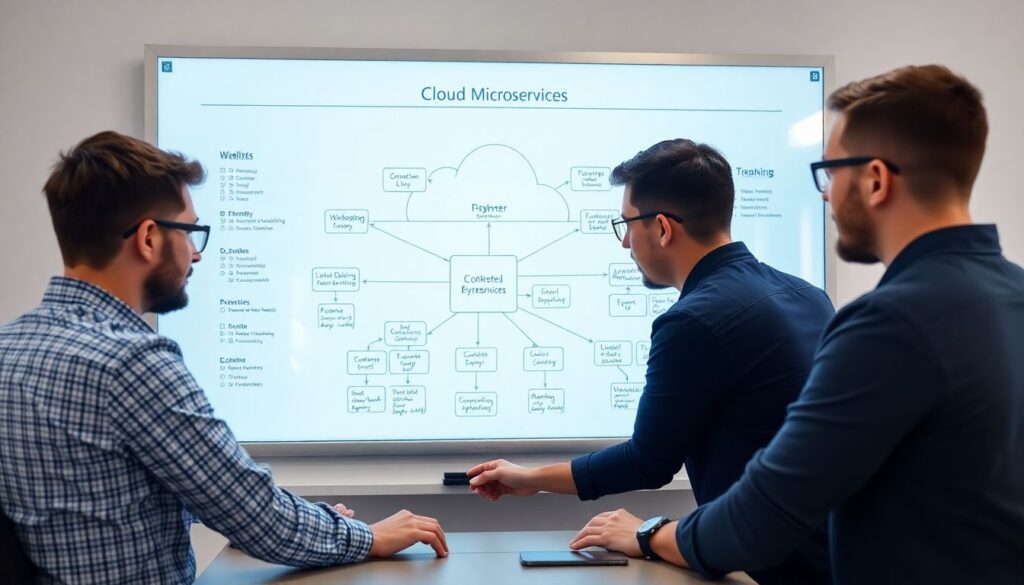
To make como implementar threat modeling em arquitetura de microsserviços na nuvem sustainable, integrate it with day-to-day delivery instead of treating it as a side activity. Below are alternative integration patterns and when they are suitable.
- Lightweight design review per feature – For squads shipping frequently, add a short threat discussion to design docs or ADRs. Great when teams already document flows and use modern ferramentas de modelagem de ameaças para aplicações cloud native integrated with diagrams.
- Pipeline-driven security gates – For organizations with mature CI/CD, encode checks as automated gates: IaC scanners, SAST, SCA, container scanning, policy-as-code. Threat models inform which rules are mandatory before deploy.
- Quarterly architecture-level modeling – For complex platforms or regulated workloads, run deeper sessions each quarter focused on cross-cutting concerns (multi-tenancy, data residency, shared clusters) and align with external serviços de threat modeling para microsserviços и kubernetes if internal expertise is limited.
- Incident-informed updates – After every serious incident or near-miss, update the threat model, adjust monitoring and enrich incident playbooks. This pattern is essential when leveraging external consultoria em segurança e threat modeling para aplicações em nuvem that brings lessons learned from other clients.
Typical implementation obstacles and practical resolutions
How can we start threat modeling without delaying our cloud-native project?
Limit initial scope to one critical user journey and its microservices. Run a 60-90 minute workshop, capture the main threats and top three mitigations, then integrate them into the backlog. Expand coverage in subsequent sprints as diagrams and tooling mature.
Which tools are recommended for cloud-native threat modeling in a microservices context?
Combine diagram-friendly tools with automation: architecture diagramming, a simple threat modeling template, SAST/SCA scanners, IaC scanners and container image scanners in CI. Add runtime agents and service mesh telemetry to validate that real traffic matches your assumed data flows.
How often should we update threat models for Kubernetes and serverless workloads?

Update models whenever you add a significant feature, expose a new public endpoint, or change core infrastructure (cluster topology, networking, identity). At minimum, schedule a refresh each quarter or alongside larger release planning for your cloud-native platform.
What if teams feel threat modeling is too theoretical or time-consuming?
Anchor every session on a concrete user journey and recent incidents or near-misses. Timebox the exercise, pre-fill diagrams, and bring only relevant security concepts. Demonstrate one or two real bugs or misconfigurations the session helped avoid to build credibility.
How do we adapt threat modeling to Brazilian regulatory and customer requirements?
Include LGPD considerations in asset classification and impact discussions. Work with legal and compliance early, capture explicit requirements as threats (e.g., data residency violations), and ensure mitigations map to auditable controls in your cloud provider and Kubernetes configurations.
Can small teams without dedicated security staff still benefit from threat modeling?
Yes. Use lightweight checklists, reuse public guidance from cloud providers, and focus on a small number of high-impact threats. When necessary, bring in targeted external consultoria em segurança e threat modeling para aplicações em nuvem for design reviews of your most critical services.
How do we keep threat models in sync with fast-moving microservice architectures?
Store threat models with the code, require updates as part of pull requests for significant changes, and let CI validate diagrams or metadata. Periodically compare models to observability data to detect drift and adjust the model or the environment.