
If you want an effective program for gestão de vulnerabilidades em cloud, define clear scope and ownership, build continuous asset inventories, use risk-based assessment, enforce structured remediation workflows, automate via pipelines and APIs, and track a small set of outcome-focused metrics. If you align all this with business priorities, risk actually goes down.
Core principles for cloud vulnerability management
- If ownership is ambiguous, then define per-domain responsibility (accounts, workloads, tooling) before buying any ferramentas de gestão de vulnerabilidades em nuvem.
- If you cannot list every internet-exposed asset, then prioritize automated, continuous discovery over deeper scanning.
- If all vulnerabilities look equally important, then adopt a risk-based model combining severity, exploitability, and business impact.
- If remediation is slow or ad hoc, then standardize workflows, SLAs, and exception paths by asset criticality.
- If teams are overwhelmed by manual work, then automate scanning, ticketing, and testing via CI/CD and cloud-native services.
- If leadership doubts progress, then report on time-to-remediate and risk reduction instead of raw finding counts.
Defining scope and ownership across multi-cloud environments
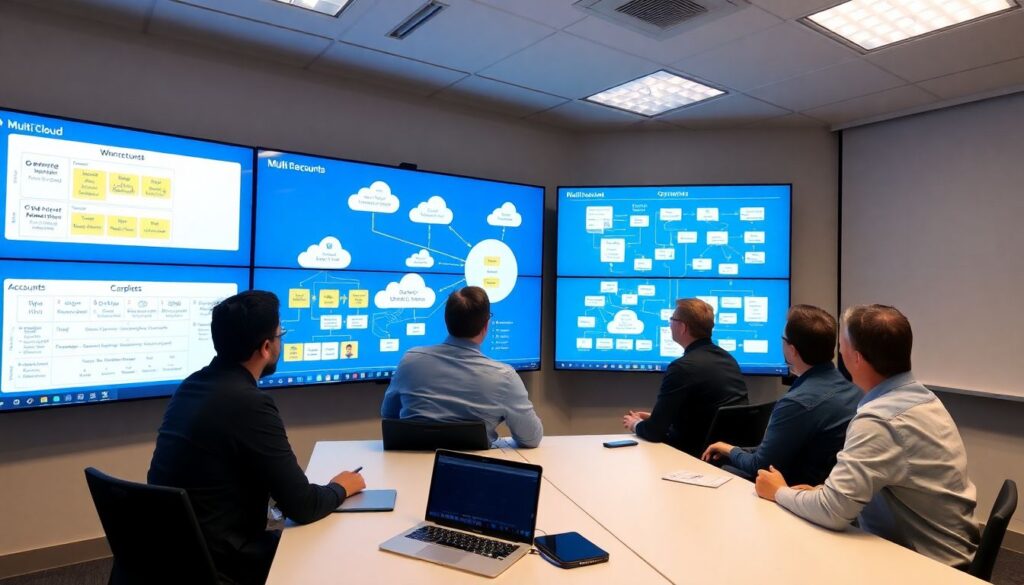
If you want to understand como implementar programa de gestão de vulnerabilidades em nuvem, start by defining exactly where it applies and who owns what. In multi-cloud (AWS, Azure, GCP, on-prem extensions), scope must include accounts, regions, services, and workload types (VMs, containers, serverless, managed PaaS).
If multiple teams touch the same cloud, then split responsibilities by layer: platform (landing zones, network, base images), product teams (applications, containers, serverless), and security (standards, tools, governance, and serviços de segurança e gestão de vulnerabilidades cloud). Each layer must know which vulnerabilities are “theirs” to fix.
If ownership is unclear, then create a simple RACI for each category of asset and activity:
- If the asset is a shared platform component (VPC, subnet, shared image), then platform/Cloud Center of Excellence is responsible for remediation.
- If the asset is an application workload or container, then the owning product squad is responsible for remediation, with security as a consultant.
- If the activity is scanning and tooling maintenance, then security or a central cloud platform team is responsible, with infra teams consulted.
If your environment spans multiple clouds, then harmonize policies: define one set of severity levels, SLAs, and tagging standards that apply to every provider. Cloud-specific differences (for example, security group vs. NSG rules) stay implementation details under the same top-level rules.
Comprehensive asset discovery and continuous inventories

If you cannot see it, you cannot secure it. Asset discovery in cloud must be continuous and API-driven, not a periodic, manual spreadsheet exercise.
- If an asset lives in a cloud account or subscription, then discover it via cloud-native APIs (for example, AWS Config, Azure Resource Graph, GCP Asset Inventory) rather than only via network scans.
- If you manage many accounts/projects, then centralize discovery by aggregating inventories into a single data store (security data lake, CMDB, or specialized inventory tool).
- If workloads are short-lived (Kubernetes pods, auto-scaling groups, serverless), then integrate discovery with orchestrators and deployment pipelines, not only with IP-based scanners.
- If you want accurate context for prioritization, then enforce mandatory tagging (owner, environment, criticality, data classification) at creation time using policies (for example, tag policies, OPA, custom admission controllers).
- If assets appear outside of standard provisioning paths (shadow IT), then correlate cloud billing, DNS records, and WAF/load balancer logs to detect unmanaged endpoints.
- If inventories become stale, then schedule continuous sync jobs (near-real-time where possible) and treat inventory freshness as a metric, not a “nice to have”.
If you do this well, your program for gestão de vulnerabilidades em infraestrutura cloud has a reliable foundation: every exposed IP, load balancer, VM, container image, and serverless function is known, tagged, and linked to an accountable team.
Risk-based vulnerability assessment and prioritization
If you simply sort by scanner CVSS score, you will drown in noise. Risk-based assessment focuses effort where it changes real-world risk.
Typical application scenarios in cloud environments:
- If a vulnerability affects an internet-facing workload with high business impact, then treat it as top priority regardless of “medium” or “high” labels, and escalate directly to the owning team.
- If an issue is rated critical but there is no known exploit and the asset is deep in a private subnet, then schedule remediation as “important but not urgent”, combining it with the next planned maintenance window.
- If a known exploited vulnerability (KEV) appears on any workload, then automatically bump its priority and route it into an expedited remediation track with tighter SLAs.
- If container base images or serverless runtimes are affected, then update the base image or runtime once and roll it out across all dependent workloads, instead of fixing each workload individually.
- If a finding appears on non-production environments only, then enforce lighter SLAs but still remediate systematically to avoid drift and future promotion of vulnerable artifacts to production.
- If the scanner generates thousands of similar low-risk findings, then consider bulk risk acceptance with documented justification, focusing manual effort on issues that materially change attack paths.
If you combine severity, exploit intelligence, asset criticality, and exposure (internet vs. internal), your ranking aligns with real attacker behavior rather than pure theoretical impact.
Remediation workflows: patching, mitigation, and exception handling
If assessment is good but remediation is weak, your risk barely moves. Workflows must be predictable, automated where possible, and adapted to application realities.
If-then patterns for remediation, mitigation, and exceptions

Advantages of structured workflows:
- If a new critical finding appears, then it automatically triggers:
- Creation of a ticket in the right backlog (mapped via tags/ownership).
- Notification in team channels (Slack/Teams).
- Tracking against an SLA based on asset criticality.
- If a patch exists and can be safely applied, then prefer patching over configuration workarounds, and standardize patch windows by environment (prod vs. non-prod).
- If an infrastructure-as-code template is the source, then fix the template first and redeploy, instead of manually patching every existing instance.
- If the vulnerability sits in a library or container base image, then update dependencies centrally, rebuild images, and redeploy through CI/CD.
- If remediation is blocked (third-party dependency, legacy system), then apply layered mitigations (WAF rules, network segmentation, stricter IAM) and track them together with the underlying vulnerability.
Limitations and trade-offs to consider:
- If uptime requirements are extreme, then emergency patching might conflict with SLOs, forcing you to rely more on mitigations until a safe change window appears.
- If different teams use different ticketing tools, then cross-platform visibility becomes difficult, and your central dashboard might not reflect real status.
- If exception approvals are too easy, then “temporary” risk acceptances become permanent, and your backlog fills with never-closed findings.
- If you treat every vulnerability identically, then remediation teams burn out, and high-risk issues can age alongside cosmetic ones.
Short scenarios before choosing remediation strategies
If a critical remote-code-execution bug hits internet-facing APIs, then:
you block known exploit patterns at the WAF, schedule an emergency change, deploy patched containers via CI/CD, and only close the ticket when both WAF and patch are in place.
If a medium-severity issue affects a rarely used internal tool without internet exposure, then:
you plan remediation in the next regular release, document the risk level, and avoid disrupting higher-priority work.
Automation, orchestration, and integration with CI/CD
If a program scales across many squads and clouds, manual processes will fail. Automation must cover discovery, scanning, triage, and feedback into development workflows.
Common mistakes and myths in automation
- If you believe “more scanners means more security”, then you will create duplicated findings and confusion; instead, orchestrate a small set of integrated ferramentas de gestão de vulnerabilidades em nuvem with clear responsibilities (SCA, SAST, container, infra, cloud posture).
- If you think automation replaces ownership, then you risk nobody feeling accountable; automation should route work to teams, not “solve” it alone.
- If you break every build on any vulnerability, then developers will disable checks or ignore pipeline output; instead, fail builds only for defined thresholds and environments (for example, critical findings in new production images).
- If you run heavy scans only in production, then you discover issues too late; integrate lighter, faster checks into CI and deeper scans in staging and early production.
- If you assume cloud-native security services auto-fix everything, then you underinvest in process; these serviços de segurança e gestão de vulnerabilidades cloud must be combined with SLAs, playbooks, and people.
- If you automate ticket creation but not deduplication, then teams are flooded with near-identical tickets and will start ignoring them.
If you integrate scanning with CI/CD, then each change (code, container, IaC) is evaluated before deployment, and production becomes a second safety net, not the first line of defense.
Operational metrics, reporting, and continuous improvement
If you cannot measure progress, you cannot tune the program. Metrics should emphasize risk reduction, not “number of vulnerabilities found”.
A simple mini-case that follows an if-then pattern:
If your baseline shows that critical vulnerabilities on internet-facing assets take weeks to fix, then you define a target SLA (for example, days), align on ownership, and automate routing. After three months, you compare median time-to-remediate and proportion of assets meeting the SLA. If the metrics improve but new incidents still occur, then you review root causes and adjust: perhaps you need earlier checks in CI, or better tagging to avoid orphan assets.
If you regularly review these metrics with engineering leadership, then vulnerability management becomes part of normal delivery conversations, and melhores práticas para gestão de vulnerabilidades em infraestrutura cloud naturally converge with your broader reliability and DevOps practices.
Clarifying typical implementation challenges and trade-offs
How should we start if our cloud footprint is already complex?
If your environment is messy, then start with one cloud and one critical product line. Establish inventory, scanning, ownership, and SLAs there, prove value, and only then expand to other accounts and providers.
How often should we run vulnerability scans in cloud environments?
If workloads are static, then weekly to monthly deep scans may be enough, with continuous monitoring for critical issues. If you use ephemeral containers or serverless, then integrate scanning into build pipelines so each artifact is scanned on creation.
Who should own cloud vulnerability management: security or platform teams?
If you have a central platform team, then it should own shared tooling and guardrails, while security defines policy and oversight. Application teams own remediation for their workloads, guided by these central functions.
How do we handle legacy systems that cannot be easily patched?
If a system cannot be patched quickly, then apply layered mitigations such as segmentation, WAF rules, stricter IAM, and increased monitoring, and document a time-bound exception with a clear remediation plan.
What is the role of third-party tools versus native cloud services?
If native services cover your main use cases and integrate well with your workflows, then start there. If you need multi-cloud correlation, advanced analytics, or unified reporting, then complement them with specialized third-party platforms.
How can we avoid overwhelming development teams with vulnerability tickets?
If teams are overloaded, then implement risk-based filtering, aggregate similar findings into single tickets, and align SLAs with business criticality. Integrate results into existing backlogs instead of sending emails or spreadsheets.
How do we demonstrate value of the program to leadership?
If you want executive support, then highlight reductions in high-risk exposure, time-to-remediate improvements, and correlation with fewer security incidents, rather than showcasing how many vulnerabilities you found.