Categoria: Guias
-

Container and kubernetes security best practices for configuration and incident response
To secure containers and Kubernetes in production, combine hardened cluster configuration, protected image supply chain, strict runtime controls, deep security monitoring, and a tested incident response workflow. Focus on least privilege, immutable infrastructure, and automation. Start small with a pilot namespace, then progressively enforce policies across your Brazilian pt_BR production environments. Critical Security Controls for…
-

Continuous vulnerability assessment in serverless environments without performance impact
To run continuous vulnerability assessment in serverless without hurting performance, separate scanning from the hot request path, use agentless integrations, and rely on asynchronous analysis of code, dependencies, and configurations. Combine build-time checks, passive telemetry, and sampled runtime tests, then tune concurrency, timeouts, and exclusions until latency and cost stay within your SLOs. Snapshot: goals…
-

News and analysis: impact of new log4shell-type critical flaws on modern cloud
New critical cloud vulnerabilities like Log4Shell remain dangerous because they are remotely exploitable, easy to weaponise and hard to eradicate across complex estates. For Brazilian organisations on AWS, Azure or GCP, reducing impact means tight visibility of dependencies, disciplined patching, layered controls and clear incident playbooks that prioritise business‑critical workloads first. Executive snapshot: what a…
-

Security checklist for critical workloads migrating from datacenter to the cloud
Use this security checklist to protect critical workloads during a migração de datacenter para nuvem segurança: classify data, design least-privilege access, encrypt in transit/at rest, segment networks, harden and patch workloads, and enable monitoring and incident response. Apply it before, during and after migration, especially when using serviços de migração de workloads críticos para nuvem….
-

Security in serverless architectures: specific threats, permission models and logs
Serverless security in AWS and other clouds hinges on three pillars: strict identity and permission models, hardened runtimes, and high‑quality logs and traces. Focus first on attack paths with the biggest impact: over‑privileged roles, exposed event sources, insecure dependencies, and missing monitoring. Then iterate permissions, isolation, and observability together. Security briefing: primary risks and controls…
-

Ransomware in cloud environments: attack vectors, early detection and response
Cloud ransomware in Brazilian environments is mainly about compromised identities, misconfigured storage and exposed services being abused to encrypt or delete cloud data. To troubleshoot, verify access anomalies, check cloud logs for suspicious encryption patterns, confirm backup in nuvem contra ataques ransomware integrity, and prepare an immediate containment and rollback plan before touching production resources….
-

Cloud security posture management Cspm tools comparison with pros and use cases
CSPM (Cloud Security Posture Management) tools differ most in depth of risk detection, noise level of alerts, automation of remediation, multi-cloud coverage and integration effort. To choose, map your environments (AWS, Azure, GCP), compliance needs and team skills, then balance detection quality, automation and total cost over at least three shortlisted platforms. Snapshot: CSPM feature…
-
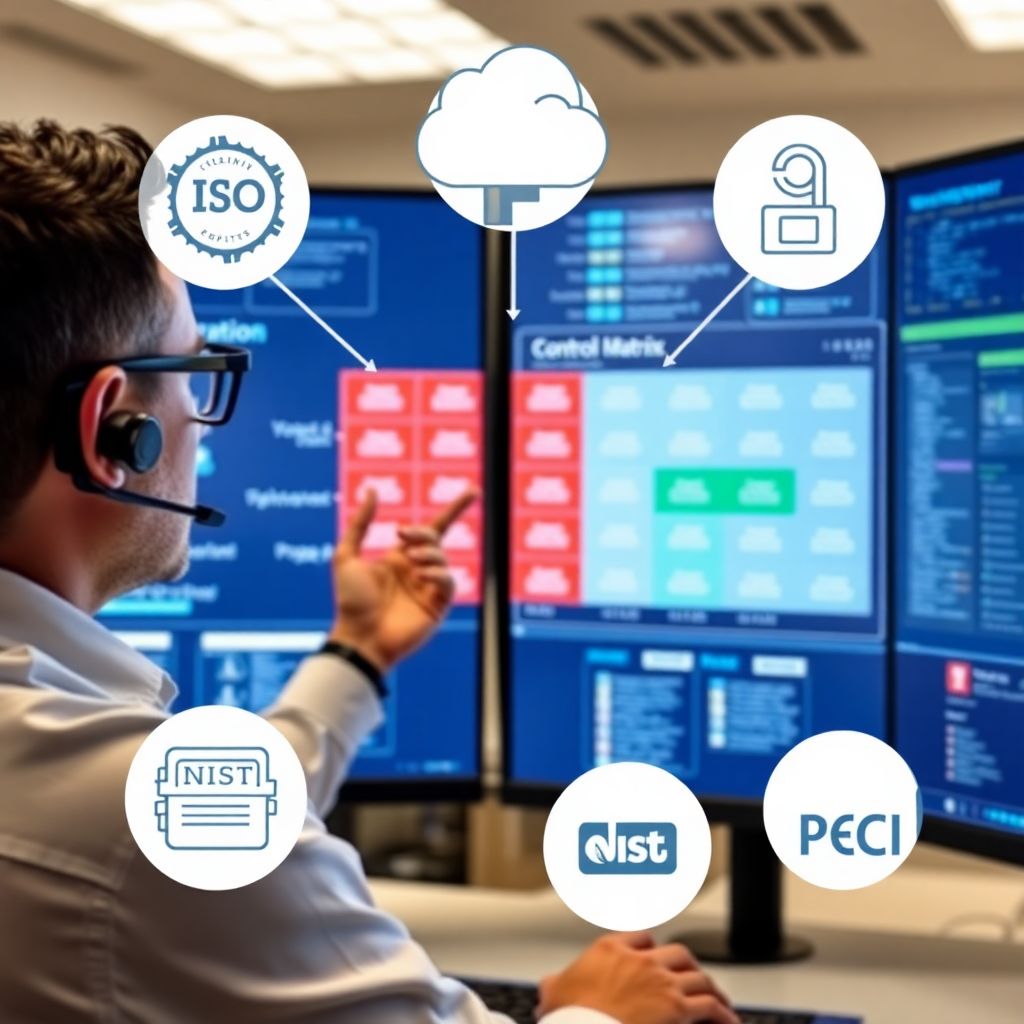
Cloud security alignment with Iso 27001, Nist and other compliance standards
To align cloud security with ISO 27001, NIST CSF, CIS Benchmarks and PCI‑DSS, build a unified control matrix, map each framework requirement to concrete cloud-native controls, automate checks where possible, and document residual risk. Start with business‑critical scopes, then iterate: design, implement, evidence, and continuously improve. Core alignment objectives for cloud security Create a single,…
-

Runbook for incident response in cloud and hybrid environments: a practical guide
A cloud and hybrid incident response runbook is a structured, provider-aware guide that defines who does what, when, and with which tools across AWS, Azure, GCP and on‑prem. To build one, clarify scope and ownership, define triggers, write step‑by‑step playbooks, align communication paths and continuously refine via metrics and reviews. Critical Objectives for Cloud and…
-
Iam in practice: designing secure roles and policies in Aws, azure and Gcp
Secure IAM across AWS, Azure, and GCP means: design role-based models around business domains, apply least privilege iteratively, centralize identities, and enforce policy-as-code with continuous logging. For teams in Brazil (pt_BR), this guide shows concrete steps, examples, and safe defaults you can reuse in production, even without prior deep security expertise. Actionable summary for implementing…