
CSPM (Cloud Security Posture Management) tools differ most in depth of risk detection, noise level of alerts, automation of remediation, multi-cloud coverage and integration effort. To choose, map your environments (AWS, Azure, GCP), compliance needs and team skills, then balance detection quality, automation and total cost over at least three shortlisted platforms.
Snapshot: CSPM feature and risk comparison

- Start your ferramentas CSPM comparação by clarifying which clouds (AWS, Azure, GCP, Kubernetes) and accounts must be covered from day one.
- Prioritize melhores ferramentas de Cloud Security Posture Management that reduce false positives and map findings directly to business impact.
- Check how each platform supports compliance frameworks (e.g., CIS, ISO, LGPD-related controls) and evidence export for audits.
- Compare automation depth: prebuilt playbooks, custom workflows, and safe rollout of remediation versus pure alerting.
- Use CSPM tools pricing comparação early, including overage for APIs, events and extra accounts to avoid surprise bills.
- Evaluate integration with CI/CD, ticketing and SIEM, especially for plataformas CSPM para empresas em nuvem com equipes DevOps.
- Favor a solução CSPM para segurança em cloud AWS Azure GCP that your team can operate daily, not only that looks powerful in demos.
How CSPM tools detect and prioritize cloud risks
When comparing CSPM products, use clear and practical selection criteria focused on detection quality, signal-to-noise ratio and operational impact.
- Cloud and asset coverage: Multi-account and multi-cloud visibility (AWS, Azure, GCP, Kubernetes), including serverless, containers and managed services.
- Detection techniques: Use of configuration baselines, behavior analytics, identity graph and public exposure checks (e.g., open storage, public endpoints).
- Prioritization and risk scoring: Context-aware scoring that considers internet exposure, business tags, identity blast radius and known exploits.
- False positive control: Ability to suppress noisy rules, tune policies per account and track mean time to acknowledge and resolve.
- Remediation capabilities: From guided “click to fix” and IaC snippets to fully automated workflows with approval steps.
- Compliance and reporting: Built-in policies mapped to CIS, NIST, PCI, ISO and LGPD-related controls, with exportable evidence and exec-friendly dashboards.
- Integration footprint: APIs, webhooks and connectors to CI/CD, ITSM, SIEM, SOAR and existing identity providers.
- Operational overhead: Ease of onboarding accounts, managing policies at scale, and training SecOps/DevOps teams.
- Vendor and ecosystem maturity: Update frequency for new cloud services, rule quality and local support for pt_BR teams when needed.
Feature-by-feature comparison: detection, remediation, compliance
The table below compares four common CSPM strategy options, focusing on who they fit, core pros/cons and when each is a rational choice.
| Variant | Best for | Pros | Cons | When to choose |
|---|---|---|---|---|
| Enterprise-native CSPM suite | Large enterprises with mixed on-prem and multi-cloud, mature SecOps and audit pressure | Deep detection, strong reporting, broad compliance packs, rich integrations with SIEM/SOAR and ITSM tools | Complex to deploy, higher cost, may require dedicated administrators and professional services | Choose when you need unified risk and compliance views across many business units and regions |
| Cloud-provider-native CSPM | Teams mostly on one cloud (AWS, Azure or GCP) seeking tight-native integration | Easy onboarding, aligned with provider services and IAM, good baseline policies, predictable scaling | Weaker multi-cloud story, limited cross-environment correlation, feature gaps across providers | Choose when most workloads run in a single provider and you want lower integration overhead |
| Developer-centric CSPM platform | Product and DevOps teams embedding security in CI/CD and infrastructure as code | Strong IaC scanning, shift-left policies, API-first design, fits GitOps workflows | May offer lighter compliance reporting, requires engaged engineering teams to realize value | Choose when your main risk is misconfigurations introduced through fast releases and IaC changes |
| Open-source CSPM toolkit | Security-savvy teams with tight budgets and strong scripting skills | Low licensing cost, high flexibility, transparent rule sets, community plugins | DIY maintenance, fragmented dashboards, fewer managed integrations, limited support | Choose when you can invest engineering time instead of license fees and accept more manual work |
Use this comparison structure as a reusable template for any ferramentas CSPM comparação, regardless of specific vendors. Extend it with proof-of-concept notes on detection accuracy, ease of policy tuning and impact on developer workflows, not just a static feature checklist.
Performance, scalability and integration benchmarks
To evaluate performance and scalability realistically, test against your own workloads and operational limits, using “if-then” scenarios instead of generic benchmarks.
- If you manage hundreds of accounts and subscriptions, then focus on bulk onboarding, API rate limits and how fast new accounts are brought into compliance scope.
- If your environment is highly dynamic (auto-scaling, containers, short-lived workloads), then verify detection freshness, asset discovery intervals and how quickly removed assets disappear from dashboards.
- If you already run a SIEM and SOAR, then prioritize CSPM tools that send normalized events, support bidirectional enrichment and do not flood downstream systems with unfiltered alerts.
- If most teams live in Jira, ServiceNow or similar ITSM tools, then require native ticket integration, bidirectional state sync and clear mapping between CSPM findings and incident workflows.
- If you operate in multiple regions with data residency constraints, then confirm log storage locations, data processing regions and options for localizing reports for Brazilian stakeholders.
- If security ownership is shared across SecOps and DevOps, then validate role-based access control, project-level scoping and whether developers can safely self-serve risk views.
Cost structure, licensing and total cost of ownership
Use the following checklist to run a disciplined CSPM tools pricing comparação and avoid hidden operational costs.
- Define billable units: Identify how each vendor charges (assets, accounts, vCPUs, events, data volume) and estimate for your current and projected footprint.
- Include integration and rollout effort: Account for internal hours or services needed to onboard clouds, tune policies and build automations.
- Model growth scenarios: Simulate 12-24 months of cloud expansion, including new regions and services, and check how licensing scales.
- Quantify savings from automation: Estimate reduction in manual checks, audit preparation and incident handling, and compare with license spend.
- Check support and training terms: Verify what is included (SLA, language, channels) and what requires premium tiers or add-ons.
- Assess vendor lock-in risk: Evaluate export options for findings, policies and reports, and whether contracts allow gradual migration.
- Compare against a “do nothing” baseline: Contrast costs with the risk and potential impact of major misconfiguration incidents in your environment.
Real-world use cases and recommended matches
Across plataformas CSPM para empresas em nuvem, many organizations repeat the same mistakes when choosing a solution and planning adoption.
- Starting with a tool-first mindset instead of documenting concrete risks, compliance drivers and business KPIs.
- Underestimating the operating model: who owns triage, who can approve remediation, and how tickets are routed.
- Ignoring developer experience and introducing a CSPM that generates friction, leading to bypasses and shadow cloud resources.
- Relying purely on default policies without tuning to local regulations, internal baselines and risk appetite.
- Failing to test multi-cloud scenarios for a solução CSPM para segurança em cloud AWS Azure GCP and discovering gaps after production rollout.
- Skipping proof-of-concept stages and buying long-term contracts based on slideware and generic demos.
- Not involving stakeholders from compliance, infra, application security and operations early in the process.
- Measuring success only by number of findings instead of reductions in critical misconfigurations and incident rates.
- Ignoring exit strategies, making future migrations or hybrid setups costly and politically difficult.
Migration and implementation decision tree
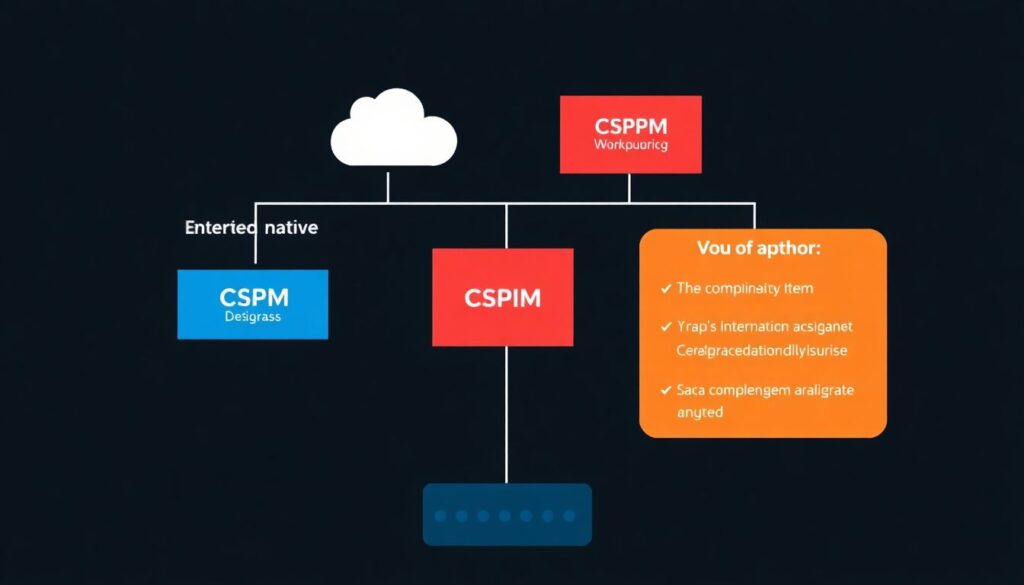
Use this mini decision tree to narrow down a shortlist before running in-depth pilots.
- If you are mostly in one cloud with simple compliance needs, choose a cloud-provider-native CSPM first and validate gaps.
- If you run complex, multi-cloud workloads with strict audits, start with an enterprise-native CSPM suite that centralizes risk and compliance views.
- If speed of delivery and IaC dominate, prioritize a developer-centric CSPM platform and integrate it early into pipelines.
- If budget is very limited but expertise is strong, combine an open-source CSPM toolkit with targeted commercial add-ons where needed.
For organizations centered on centralized governance and regulatory scrutiny, enterprise-native CSPM suites are usually the best balance of visibility and compliance coverage. For engineering-led teams optimizing speed and autonomy, developer-centric CSPM and provider-native options tend to fit better, with open-source toolkits as complements where customization is critical.
Answers to common evaluation dilemmas
How many CSPM tools should I run at the same time?
Most teams should standardize on one primary CSPM and, if needed, supplement with lightweight or open-source tools for specific gaps. Running multiple overlapping platforms increases noise and operational burden unless you have clear, separated use cases.
What is the minimum environment size that justifies CSPM?

Size matters less than complexity and exposure. If you run internet-facing workloads, handle sensitive data or use multiple accounts and regions, a CSPM becomes valuable quickly, even for relatively small environments.
How long should a CSPM proof-of-concept last?
Plan for a proof-of-concept long enough to cover at least one full release cycle and typical change windows. This allows you to observe detection behavior, false positives, and how well teams integrate findings into daily work.
Can CSPM replace traditional vulnerability scanning?
No. CSPM focuses on cloud configuration and posture, while vulnerability scanners focus on software flaws and patch levels. You typically need both, integrated where possible, to cover misconfigurations and exploitable weaknesses.
What is the best way to compare CSPM alert quality?
Run tools in parallel on the same accounts for a limited period, tag findings by tool and manually review a sample. Track true positives, false positives and time spent per valid issue instead of just counting total alerts.
How do I involve developers without overwhelming them?
Start by surfacing only high-severity, developer-actionable issues in their tools (Git, CI, backlog). Keep noisy, exploratory detections within security dashboards until tuning is complete.
When should I reconsider or switch my CSPM platform?
Warning signs include persistent alert fatigue, difficulty onboarding new cloud services, lack of local support and inability to demonstrate posture improvement. Use periodic reviews to decide whether optimization or replacement is the better path.