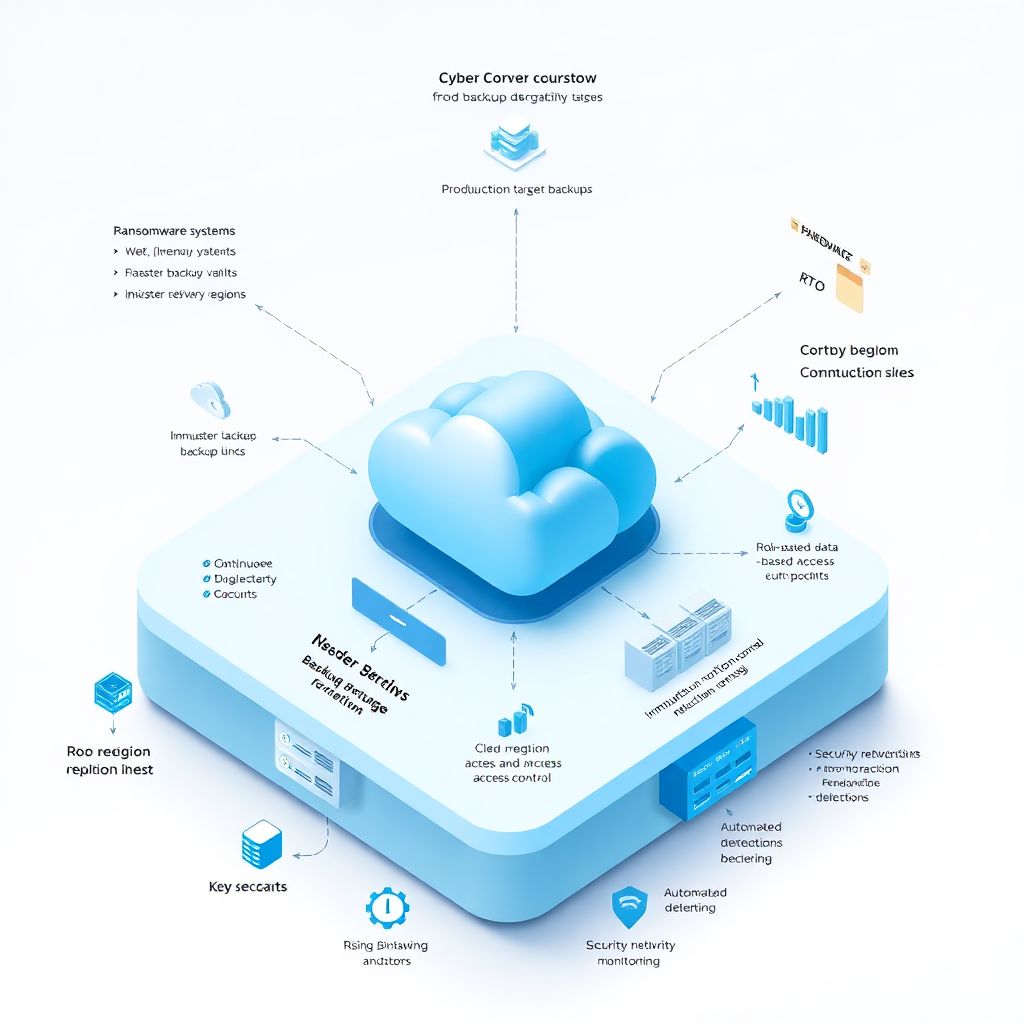
Designing a solid cloud‑security‑focused backup and disaster recovery strategy today is less about buying tools and more about understanding risk, numbers and how your business actually works. Below we’ll walk through the “why” and the “how” in plain language, mixing real statistics from the last few years with practical guidance. Note that reliable public data is available up to 2024; for 2025–2026 I’ll clearly mark forecasts and not present them as established facts.
Why cloud‑centric backup and DR became unavoidable
If you look at incident data from the last three years, the direction is very clear. According to the Verizon Data Breach Investigations Report and similar sources, ransomware incidents grew roughly 13–15% year‑over‑year between 2021 and 2023, with backup systems explicitly targeted in more than 30% of large attacks by 2023. In parallel, analyst firms such as IDC estimated that by 2024 more than 60% of new corporate data would be created or processed in cloud environments. This convergence – more attacks plus more data in the cloud – explains why a traditional tape or on‑premises approach no longer keeps up. A modern backup em nuvem empresarial strategy must assume that attackers know your toolset, know your network and will go after your backups first.
Key concepts before you touch any tools
Before choosing shiny platforms, it helps to fix a few basic notions: RPO (Recovery Point Objective) is how much data you can afford to lose, expressed as time between the last backup and an incident; RTO (Recovery Time Objective) is how long you can be down before the business really suffers. Between 2022 and 2024, surveys by organisations like Uptime Institute showed that the median “tolerable” outage for digital‑first businesses dropped below one hour, while expected data loss shrank from “a few hours” to “under 15 minutes” for critical workloads. These tighter expectations drive the architecture choices you’ll make when designing soluções de backup e recuperação de desastres, especially in the cloud, where you can mix instant snapshots, continuous replication and long‑term archives more flexibly than in a legacy datacentre.
Step 1 – Map your business risks to cloud realities
The first design step is surprisingly non‑technical: understand which processes actually keep the company alive. Finance, e‑commerce, manufacturing lines, clinical systems – they don’t all need the same level of protection. Between 2021 and 2023, cost‑of‑downtime studies from Gartner and Ponemon showed that for highly digitalised companies, a single hour of outage could cost anywhere between 300,000 and 5 million US dollars, depending on sector. However, that top tier usually represents less than 20% of total systems. In a cloud context, this means you can afford premium serviços de backup em nuvem segura and near‑real‑time replication for a relatively small number of workloads, while cheaper and slower protection is fine for development, testing or archival systems.
Step 2 – Choose cloud trust boundaries and data locations
Security‑oriented backup planning in the cloud starts with defining where data is allowed to live and which providers you trust. From 2022 to 2024, the big public cloud players reported double‑digit annual revenue growth specifically in backup and storage services, but regulators also tightened the rules. Data residency laws in the EU, Brazil and several Asian countries now affect where and how long you can keep certain records. When you sketch a plano de recuperação de desastres na nuvem, you need to decide in advance which regions can hold copies of personal, financial or health data and which must stay local. Multi‑region replication improves resilience against regional outages, but it also multiplies your compliance exposure if you don’t document and control it carefully.
Step 3 – Design for attackers that know you use the cloud
Attack patterns over the last few years show that criminals adapted quickly to cloud backup. By 2023, incident reports from providers like Microsoft and AWS described campaigns where attackers first compromised cloud admin accounts, then altered or deleted backup policies before triggering ransomware. This means a security‑focused design has to assume an attacker can log into your cloud console. Technically, that leads to a few non‑negotiables: use separate accounts or subscriptions for production and backup, enforce hardware‑backed multifactor authentication for all backup admins and apply least‑privilege roles so that no single user can both change retention policies and delete snapshots. Many serviços de backup em nuvem segura now offer “immutable” or “locked” backups, where data cannot be changed or deleted for a defined time; enabling this for critical workloads is one of the simplest ways to blunt modern extortion attempts.
Step 4 – Architecting the layers: from hot replicas to cold archives
A realistic cloud strategy mixes different backup and recovery techniques rather than betting on one. For mission‑critical systems, continuous replication or frequent snapshots stored in a different availability zone give you very low RPO and RTO, but they cost more. For medium‑tier applications, daily image backups with weekly full backups may be more economical. Research from 2022–2024 shows that organisations that tiered their backup strategies in this way cut storage costs by 20–40% compared with those that tried to apply premium protection everywhere. When you adopt software de backup e disaster recovery em nuvem, look for the ability to define separate policies per workload class, and to move older restore points into cheaper “cold” storage transparently while keeping indexes and metadata searchable.
Step 5 – Automation, testing and runbooks that people can follow
One of the most persistent findings in outage post‑mortems over the last three years is that many companies technically had backups but could not restore quickly because procedures were out of date or untested. Studies around 2023 indicated that less than 30% of organisations tested full disaster recovery scenarios more than once a year, and a non‑trivial share had never tested them at all. To avoid joining that group, your design work should include human‑readable runbooks, not just architecture diagrams. In a cloud setting, you can script most of the recovery sequence – spinning up networks, restoring images, switching DNS – and schedule automated drills during low‑traffic windows. The goal is that, under stress, a small team can follow a numbered, step‑by‑step document and bring core services back without improvisation.
Economic aspects: balancing resilience and cloud bills
Cost is where strategy meets reality. Cloud has a habit of looking cheap at first and then ballooning silently. Between 2021 and 2024, FinOps Foundation surveys showed that storage and data transfer for backup and logs represented 15–25% of many organisations’ cloud bills, often without clear ownership. Designing backup em nuvem empresarial with economics in mind means tracking not just raw storage but also API calls, cross‑region data transfer and egress during large restores. You can usually cut costs without risking safety by adjusting retention for non‑critical systems, using deduplication and compression features aggressively, and off‑loading very old, rarely accessed data to archival tiers. What you should not do is save money by disabling encryption, reducing redundancy for critical data or limiting test restores; history shows that these shortcuts translate into much higher losses when a real incident happens.
Industry impact and how practices are evolving
As more companies migrate to cloud‑native architectures, the backup and DR market has been reshaped. Analyst reports up to 2024 suggest that spending on cloud‑integrated backup and disaster recovery grew at roughly twice the rate of traditional on‑premises solutions. This shift influences vendors too: many classic backup providers have rebuilt their platforms to offer tightly integrated soluções de backup e recuperação de desastres that understand Kubernetes, serverless functions and SaaS applications. For industries with strict regulation – finance, healthcare, public sector – certification and auditability became major differentiators, pushing providers of serviços de backup em nuvem segura to invest in transparency features such as immutable audit logs, cryptographic proof of backup integrity and granular role‑based access controls that map directly to compliance frameworks.
Trends and forecasts for 2025–2026
Looking ahead from the data available up to late 2024, analysts project several trends that will shape strategies over 2025–2026. First, the volume of data under management continues to grow by around 20–25% per year for many enterprises, meaning your backup architecture must scale, not just function today. Second, use of AI and automation in incident response is expected to rise, with backup platforms incorporating anomaly detection to spot suspicious deletion spikes or unusual restore requests. While exact 2025 and 2026 numbers are not yet fully documented, the direction is clear: manual, ad‑hoc approaches will become unmanageable. A modern plano de recuperação de desastres na nuvem will increasingly resemble a living system that monitors itself, suggests policy changes and can trigger partial failovers automatically when predefined conditions are met.
Security controls you should not skip
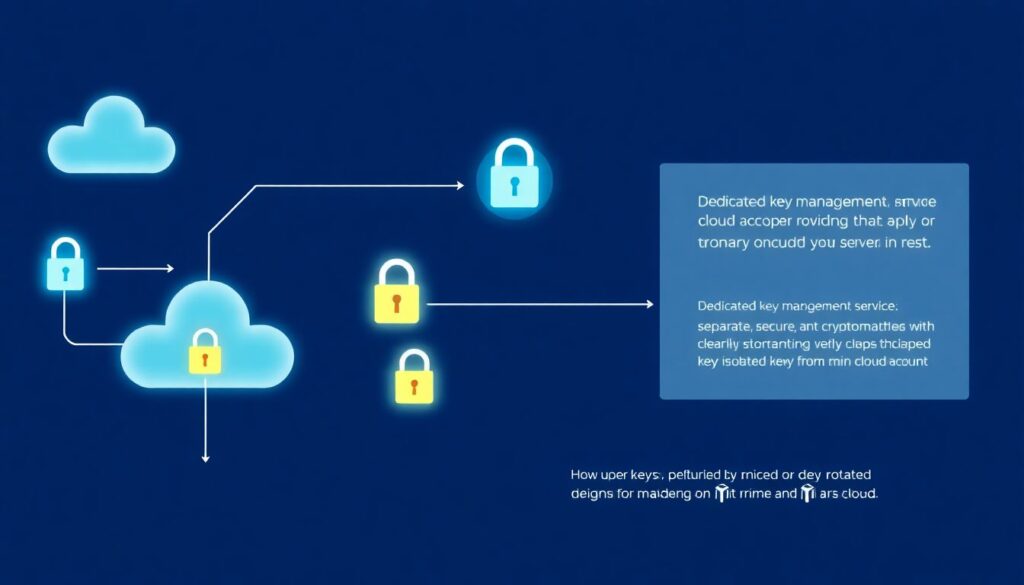
When you prioritise security, some controls are optional and some are table stakes. In cloud‑centric backup, encryption in transit and at rest is already standard, but the devil is in key management: use dedicated key management services, rotate keys regularly and avoid leaving keys in the same account that an attacker might compromise. Network isolation for backup traffic, such as private endpoints and separate virtual networks, reduces exposure if an application environment is breached. Continuous monitoring for configuration drift – for example, backups suddenly losing immutability or retention periods being shortened – is another high‑value layer. Over 2022–2024, incident data showed that misconfiguration remained a leading cause of data exposure in the cloud; disciplined configuration baselines and automated policy checks are often more effective than adding yet another security product.
Practical blueprint: turning ideas into an actionable plan
To make this concrete, you can translate the concepts into a simple sequence of actions. The goal isn’t to create a perfect design on day one but to move from wishful thinking to an operational backup em nuvem empresarial strategy that you can improve over time. A pragmatic way to do this, especially for small and mid‑sized teams, is to organise the work as a series of iterations with clear checkpoints and measurable outcomes, revisiting assumptions at least once or twice a year as your cloud footprint changes and new threats emerge.
1. List and classify your applications and data, grouping them by business criticality and regulatory sensitivity.
2. Define RPO and RTO targets for each group, then map them to specific backup and replication patterns offered by your cloud and your software de backup e disaster recovery em nuvem.
3. Choose one cloud region as your primary and at least one independent region or provider as your recovery target, documenting data residency constraints.
4. Implement role‑based access, multifactor authentication and immutable backup policies, then perform a controlled test restore for at least one critical system.
5. Review costs after the first month, adjusting retention and storage tiers where safe, and schedule regular disaster recovery drills with clear success metrics.
How this reshapes the broader technology landscape
The cumulative effect of these practices goes beyond individual companies. As more organisations treat backup and disaster recovery as core security controls rather than background utilities, we see a gradual shift in how systems are designed from the outset. Application teams start to think about recoverability when they define architectures, not weeks later when a separate team “adds backup.” Cloud providers respond by embedding backup‑friendly features like native snapshots, cross‑account replication and integrated key management. Over time, the line between production and protection blurs: parts of your disaster recovery environment may double as testing or analytics platforms, and lessons from recovery drills feed directly into software design. This positive feedback loop is already visible in industries that faced heavy ransomware pressure between 2021 and 2024, such as healthcare and manufacturing, and is likely to become standard practice across sectors by the mid‑2020s.
Closing thought: treating backup as a security habit, not a project
Designing a strategy for cloud‑focused backup and disaster recovery is less about a one‑time project and more about building a durable habit inside the organisation. The statistics from the last three years show that attacks will continue, outages will happen and cloud complexity will grow. What distinguishes resilient companies is not that they avoid every incident, but that they expect failure and prepare for it, investing in clear policies, realistic testing and careful use of cloud services. If you align your backup and recovery approach with how you already manage security – with continuous improvement, regular audits and automation where it makes sense – the cloud shifts from being a risky black box into a platform you can rely on, even on the worst day.