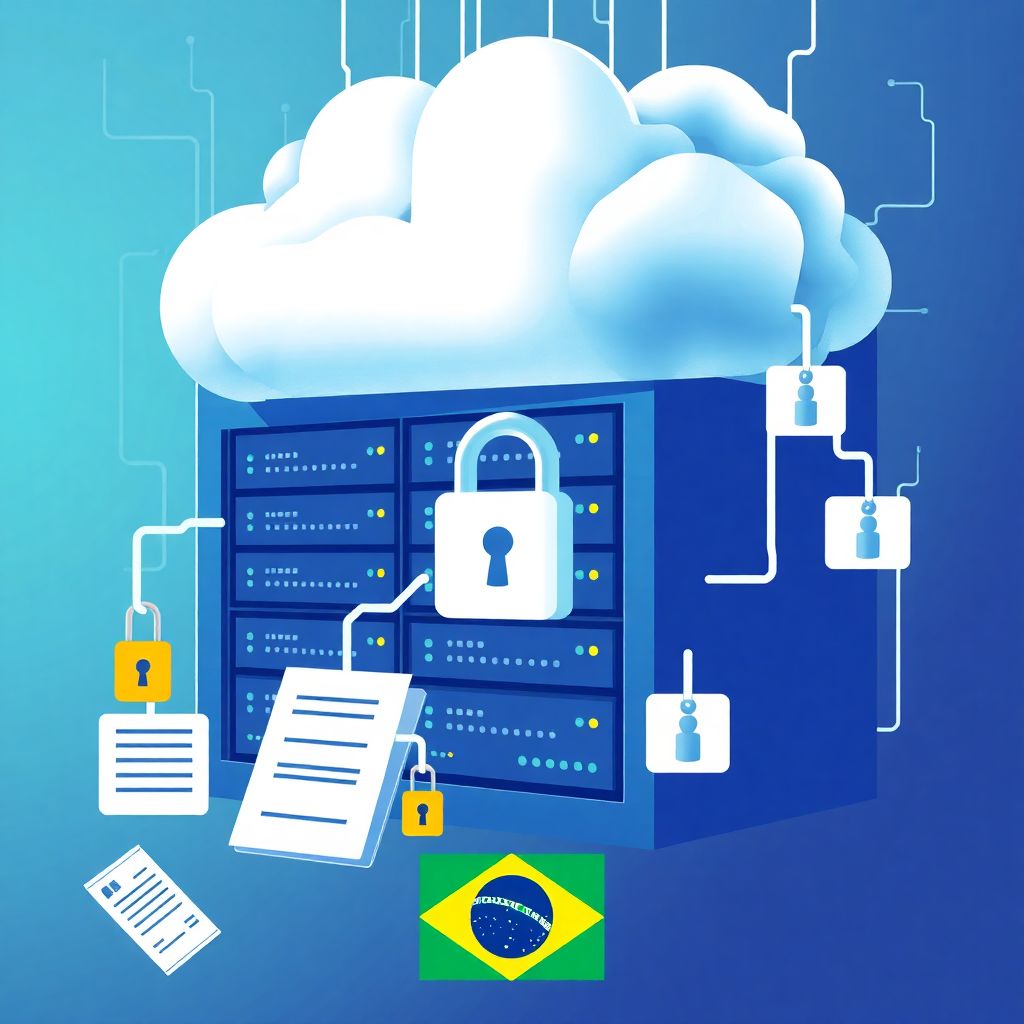
To protect sensitive data in cloud environments you must classify data, choose between encryption and tokenization per use case, and operate a secure key management setup using cloud KMS and, when needed, HSMs. Combine technical controls with strict access policies, logging, rotation, and a tested incident response plan aligned with Brazilian LGPD requirements.
Core principles for protecting sensitive cloud data
- Always perform cloud-specific threat modeling before selecting controls such as proteção de dados sensíveis em cloud com criptografia or tokenization.
- Classify data and bind protection levels to business impact and LGPD obligations, not only to technical convenience.
- Prefer platform-native encryption and tokenization capabilities when they meet your security and compliance requirements.
- Operate keys using serviços KMS e HSM para segurança de dados na nuvem, separating duties between security and workload teams.
- Apply least-privilege and Just In Time access to all ferramentas de gestão segura de chaves criptográficas em cloud.
- Continuously monitor, log, and test your plataformas de segurança em nuvem сom criptografia e tokenização to detect misuse.
- Design for reversible, well-governed decryption and detokenization processes, with clear break-glass procedures.
Threat modeling and data classification for cloud workloads

This approach fits companies on AWS, Azure, GCP, or Brazilian local clouds that store or process personal data, payment data, or confidential business information in SaaS, PaaS, or IaaS. It is especially relevant for LGPD-regulated workloads and for empresas migrating core systems to the cloud.
It is not the best first step if you:
- Do not yet have any inventory of systems and data stores (start with basic asset discovery).
- Are running only public, non-sensitive content (e.g., marketing websites without personal data).
- Lack minimum operational maturity such as change management or basic identity and access management.
For suitable environments, start with a lightweight but structured exercise:
- List applications and data stores per workload (databases, object storage, message queues, SaaS APIs).
- Identify data types: personal data, sensitive personal data (LGPD), secrets, financial, and internal-only data.
- Map data flows between services, regions, and third parties, including cross-border transfers relevant to Brazilian data residency considerations.
- Identify threats: external attackers, malicious insiders, compromised credentials, misconfigurations, and abused API keys.
- Define protection levels (for example: public, internal, confidential, restricted) and bind concrete controls like encryption or tokenization to each level.
Choosing between encryption and tokenization: a practical decision framework
You will need a clear view of functional requirements, compliance constraints, and the technical landscape before deciding between encryption, tokenization, or a hybrid. This section also guides which soluções de tokenização de dados em nuvem para empresas make sense alongside native encryption.
| Approach | Best suited scenarios | Main advantages | Key risks and trade-offs |
|---|---|---|---|
| Encryption | Protecting full databases, storage buckets, backups, and streams, where applications can handle ciphertext. | Strong confidentiality, broad cloud-native support, good performance, simpler integration. | Data is still present in original systems, access depends largely on IAM and KMS policies; analytics over ciphertext is limited. |
| Tokenization | Replacing specific sensitive fields (CPF, card numbers, emails) while keeping applications and logs functional. | Reduces scope for compliance, tokens can preserve format, lower impact of application compromises. | Requires high-availability tokenization service; if misdesigned, tokens may leak patterns; added latency and complexity. |
| Hybrid | Highly sensitive workloads combining structured and unstructured data, multi-cloud and SaaS integrations. | Fine-grained control: tokenize most sensitive fields and encrypt the rest; flexible analytics and integration. | More components to operate (KMS, HSM, tokenization platform); harder troubleshooting; requires disciplined governance. |
To make the choice, establish these inputs:
- Business needs: which teams require access to raw data, how often, and from which locations and tools.
- Regulatory drivers: LGPD categories, sector regulations (e.g., financial sector guidance in Brazil), contract clauses with customers.
- Technical landscape: supported algorithms, modes, and integration in your cloud provider, databases, and message buses.
- Operational capabilities: whether your team can reliably operate plataformas de segurança em nuvem com criptografia e tokenização, or must lean on fully managed services.
- Performance and latency budgets: acceptable overhead per request when calling tokenization and key services.
Based on the answers, decide:
- Use encryption as default baseline for all storage, especially when only infrastructure teams and a limited set of apps access the data.
- Use tokenization where multiple downstream systems, partners, or analytics tools must handle records without seeing raw identifiers.
- Use hybrid when you must minimize data exposure while supporting complex integrations, or when bringing your own keys in combination with tokenization gateways.
Implementing encryption correctly: algorithms, modes, and ciphertext management
Before detailing the steps, keep in mind these concrete risks and limitations:
- Weak or obsolete algorithms and modes may create a false sense of segurança instead of effective proteção de dados sensíveis em cloud com criptografia.
- Mishandled keys or IVs can expose data even if the algorithm is formally strong.
- Lack of logging, rotation, and separation of duties around KMS leads to undetected misuse.
- Poor ciphertext storage design can break data recovery or cause integrity issues under concurrency.
- Custom cryptographic code is error-prone; prefer vetted libraries and managed cloud services.
-
Choose vetted algorithms and modes
Select symmetric encryption with widely accepted ciphers and authenticated modes. Use standard, provider-supported settings.
- Favor AES in authenticated modes (such as GCM or CCM) instead of bare CBC without integrity protection.
- Avoid home-grown algorithms or undocumented modes that are not maintained by your language or cloud provider.
-
Leverage cloud-managed KMS wherever possible
Configure a cloud Key Management Service to generate and store master keys, then use envelope encryption for application data.
- Use serviços KMS e HSM para segurança de dados na nuvem so that master keys never leave hardened, audited infrastructure.
- Grant applications permission to use keys, not to manage or rotate them.
-
Design key hierarchy and access boundaries
Create separate keys per environment, system, and sometimes per data domain, to reduce blast radius of a single key compromise.
- Use different keys for test, staging, and production; block lower environments from using production keys.
- For multi-tenant platforms, consider tenant-specific keys or at least per-tenant data encryption contexts.
-
Implement safe IV and nonce handling
Ensure every encryption operation uses a unique IV or nonce as required by the chosen mode.
- Generate IVs using a secure random source; never reuse IVs with the same key and plaintext space.
- Store IVs alongside ciphertext (for example in the same database row or object metadata).
-
Structure ciphertext storage and metadata
Store ciphertext with enough metadata to decrypt and rotate keys safely over time.
- Include identifiers for key versions and algorithms so that applications can interpret records even after rotations.
- Separate unencrypted indexes from encrypted payloads where query patterns require it.
-
Integrate logging, monitoring, and alerts
Log all key usage and encryption errors via native cloud audit logs and SIEM integrations.
- Create alerts for unusual KMS usage, such as spikes in decryption calls or access from unexpected services or regions.
- Regularly review logs to validate that only intended workloads use specific keys.
Tokenization architectures and integration patterns for cloud services
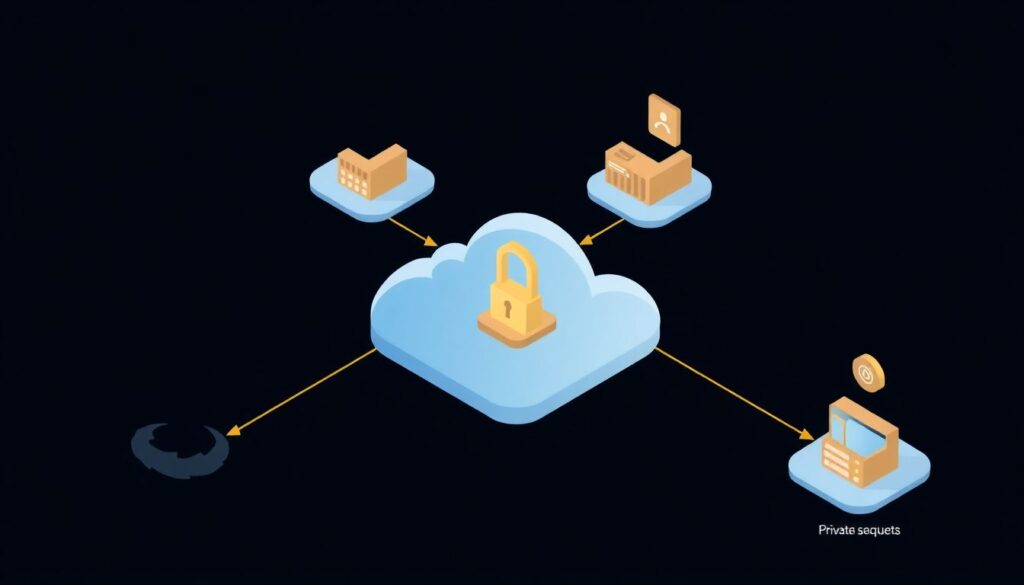
After implementing or choosing soluções de tokenização de dados em nuvem para empresas, validate your design against this checklist:
- Tokenization service is network-isolated (for example, private subnets and private endpoints) and not reachable from the public internet.
- All calls to the tokenization API are authenticated via strong, short-lived credentials (service identities, OAuth tokens, or mutual TLS).
- Only specifically authorized services can detokenize; most workloads can only tokenize or use tokens.
- Tokens are format-preserving where necessary (for CPF, phone numbers, or card numbers), but do not leak sensitive patterns.
- Detokenization events are logged with purpose, requesting service, and user or system context.
- Token vault or mapping database is encrypted at rest with keys managed by the same KMS strategy as other sensitive stores.
- High availability and disaster recovery are defined: you know how tokenization behaves during region failures and planned maintenance.
- Latency introduced by tokenization is measured and remains within defined SLOs for affected applications.
- Security tests include attempts to abuse tokenization APIs, such as massive detokenization, pattern inference, or bypass of authorization.
- Data lifecycle is defined: you know when to expire or delete tokens and mappings in alignment with retention policies.
Secure key management: KMS, HSM, and hybrid design patterns
When adopting ferramentas de gestão segura de chaves криптográficas em cloud, be aware of these frequent mistakes:
- Using a single global key for many unrelated systems, making it impossible to limit impact of a key compromise.
- Allowing developers or CI systems to manage or rotate production keys instead of restricting them to usage only.
- Leaving KMS keys with default or overly permissive IAM policies that allow any compute instance to decrypt data.
- Failing to separate roles for key administrators, security officers, and application operators in accordance with governance policies.
- Not integrating HSM-backed keys where regulatory or contractual obligations require hardware-based protections.
- Using customer-managed keys without a documented rotation and incident response playbook.
- Storing application secrets (API keys, database passwords) outside of dedicated secret management tools, such as in code or instance metadata alone.
- Ignoring multi-region or multi-cloud strategies, then discovering that keys cannot be used or migrated where workloads move.
- Not testing backup and restore of key materials, leading to potential permanent data loss after accidental key deletion.
- Relying on manual ad-hoc procedures instead of automated, auditable workflows integrated with your KMS and HSM setup.
Operational controls: rotation, access policies, logging, and breach response
Different organizations may choose complementary or alternative ways to reach acceptable risk, depending on constraints and maturity:
- Provider-native only: Rely almost entirely on built-in cloud encryption, tokenization, and KMS, suitable for smaller teams that prioritize simplicity over maximum customization.
- Hybrid provider plus specialized platform: Combine native KMS with independent plataformas de segurança em nuvem com criptografia e tokenização, appropriate when you must secure data across multiple clouds and SaaS vendors.
- Centralized security gateway model: Route sensitive traffic through a gateway layer that encrypts or tokenizes data before reaching applications, useful when modernizing legacy systems without heavy refactoring.
- On-prem HSM extended to cloud: For highly regulated sectors, extend existing HSM infrastructure to manage keys used by cloud KMS, at the cost of higher operational complexity.
Typical implementation pitfalls and pragmatic remedies
How do I avoid breaking existing applications when enabling encryption at rest?
Start with non-production environments and enable encryption using provider-native mechanisms that are transparent to applications. Monitor performance and error logs, and only then roll out to production with a documented rollback plan.
When is tokenization overkill compared to simple field-level encryption?

Tokenization is overkill if only one or two internal systems access the data and there is no need to share records with third parties or analytics tools. In that case, well-implemented field-level encryption with KMS-managed keys is usually sufficient.
How can I safely test key rotation without risking data loss?
Use a small, representative dataset in a staging environment, rotate keys through your standard process, and verify that all applications can still decrypt. Automate decryption tests and keep the previous key version until you are confident that the new configuration is stable.
What should I do if KMS or tokenization latency spikes in production?
First, check provider status dashboards and your own metrics. If the issue is internal, scale out the affected services and temporarily adjust timeouts. Investigate recent configuration changes, and consider implementing local caching where appropriate, without caching highly sensitive raw values.
How do I limit insider abuse of detokenization and decryption capabilities?
Apply strict role-based access and Just In Time approvals, log every detokenization and decryption event, and periodically review those logs. Implement dual control for extremely sensitive operations, such as bulk detokenization or exporting decrypted datasets.
How can I handle multi-cloud or SaaS integrations that do not support my encryption model?
Introduce an integration layer that encrypts or tokenizes data before sending it to third-party services. Use standard, interoperable formats and ensure that decryption keys or detokenization capabilities remain under your control, not under the external provider.
What is the safest way to start for a small Brazilian company with limited security staff?
Begin with native encryption at rest for all storage services and enforce strong IAM around KMS. Then, add tokenization only for the most sensitive personal identifiers, using managed services where possible to reduce operational burden.