
A practical cloud security strategy aligned to LGPD and other compliance norms starts with mapping personal data in all cloud services, defining lawful bases and retention, and then applying proportional technical and organizational controls. Combine encryption, IAM, monitoring, vendor governance, and clear processes for incidents, DPIAs, and data subject rights, documented with audit‑ready evidence.
Core compliance objectives for LGPD and cloud security
- Ensure that any processing of personal data in cloud environments has a clear lawful basis, purpose limitation and data minimization.
- Maintain confidentiality, integrity, and availability of personal data through appropriate technical and organizational measures.
- Demonstrate conformidade LGPD em cloud computing with documented processes, risk assessments and evidence of controls in operation.
- Align cloud controls with recognized frameworks such as soluções de compliance em nuvem LGPD ISO 27001 to reduce audit friction.
- Guarantee data subject rights (access, correction, deletion, portability) even when data is distributed across multiple cloud providers.
- Integrate incident response, vendor management and DPIAs into a single estratégia de segurança cloud para empresas.
Mapping personal data flows and identifying cloud touchpoints
This phase is suitable for companies of any size that already use SaaS, PaaS or IaaS and handle personal data from Brazilian data subjects. It is not the right time if the organization has no basic inventory of systems at all; in this case, start with a high-level IT inventory first.
Focus the mapping on segurança em nuvem LGPD: where personal data enters, where it is stored, processed, shared and deleted in your cloud stack. Typical touchpoints for a Brazilian mid‑size company include CRM SaaS, marketing automation, HR cloud systems, finance systems, and custom workloads in public cloud.
- List all cloud services (including shadow IT) used by each business area, with owners and purposes.
- For each service, identify which categories of personal data (customer, employee, lead, supplier) are processed.
- Mark cross‑border transfers, especially where data leaves Brazil or is replicated to other regions.
- Record main integrations (APIs, batch exports, event streams) that move personal data between clouds.
- Highlight high‑risk flows: large volumes, sensitive data, profiling, or automated decisions.
Conducting risk assessments and selecting proportional controls

To run a robust yet pragmatic risk assessment, prepare the following requirements, accesses and tools.
- Access to updated data mapping, system diagrams and cloud accounts (read‑only is usually enough).
- Participation from data protection leads, security, legal/compliance and key business owners.
- Risk methodology harmonized with LGPD concepts and at least one reference framework (for example ISO 27001 or NIST).
- Visibility tools: cloud security posture management (CSPM), IAM review reports, logging/monitoring dashboards.
- Vendor documentation: data processing agreements, security whitepapers, audit reports (e.g. ISO certificates, SOC reports).
Then assess the probability and impact of threats such as unauthorized access, misconfigured storage, excessive data retention and vendor failures, and select proportional controls rather than blindly copying checklists.
| Control area | LGPD focus | ISO 27001 / other norms focus |
|---|---|---|
| Data mapping & records of processing | Evidence of purposes, lawful basis, data categories, sharing and retention in cloud services. | Supports asset management and information classification controls; improves scope definition. |
| Access control & IAM | Limits access to personal data to authorized roles; supports accountability and security of processing. | Directly related to access control and user management controls in ISO 27001 and SOC 2. |
| Encryption in transit and at rest | Mitigates risk of unauthorized access in case of leaks or misconfiguration. | Maps to cryptography and network security controls across multiple frameworks. |
| Incident response | Supports breach notification duties and mitigation of impacts to data subjects. | Aligns with incident management requirements and continuous improvement cycles. |
| Vendor and third‑party oversight | Ensures processors and sub‑processors meet LGPD obligations and contractual guarantees. | Relates to supplier relationship and outsourcing controls across standards. |
Designing data governance, retention and consent mechanisms
Use this structured sequence to design LGPD‑aligned governance in the cloud, with safe and understandable steps.
-
Define data categories and purposes
Group personal data handled in each cloud service by category (identification, contact, behavioral, financial, sensitive) and associate clear purposes.
- Document which purposes are necessary for contract or legal obligation, and which are based on consent or legitimate interest.
- Avoid vague purposes like “improving services”; be as concrete as possible.
-
Map lawful bases to cloud processing
For each processing activity in your cloud landscape, define and record the lawful basis under LGPD, especially where multiple bases might apply.
- Ensure that consent is used only where appropriate and that it can be withdrawn easily.
- For legitimate interest, document a balancing test and safeguards.
-
Design practical consent flows
Implement consent collection and management in applications that rely on cloud storage and services.
- Ensure that consent requests are specific, informed and separate from general terms.
- Store consent metadata (who, when, what, how) in a system that can be queried for audits.
- Connect consent state to downstream cloud tools (e.g., marketing platforms) via API or sync jobs.
-
Set retention rules aligned with purposes
Translate legal and business requirements into concrete retention periods for each data category in each cloud service.
- Define default retention, maximum retention and conditions for early deletion or anonymization.
- Use built‑in features (lifecycle rules, archive tiers, automatic deletion) from cloud providers to enforce rules.
-
Implement data subject rights processes
Create end‑to‑end workflows to handle access, correction, deletion and portability requests across cloud systems.
- Prepare standard operating procedures and response templates that legal and operations teams can follow.
- Ensure that identity verification, searches, exports and deletions are logged and traceable.
-
Establish governance roles and decision bodies
Clarify who makes decisions on new cloud uses of personal data and who approves DPIAs and exceptions.
- Designate data owners for key datasets and assign responsibilities for accuracy and retention.
- Set up a recurring committee (security, legal, business) to review risky cloud initiatives.
-
Integrate governance with contracts and vendors
Reflect your LGPD rules in contracts with cloud providers and in internal onboarding checklists.
- Require that processors support your retention rules, rights requests and incident handling.
- Use serviços de consultoria em segurança da informação na nuvem when internal expertise is limited.
Fast‑track mode for governance and consent
- Pick your top five cloud systems with most personal data and define clear purposes and lawful bases for each.
- Set one pragmatic default retention rule per system and enforce it using built‑in lifecycle features.
- Create a simple, centralized log for all data subject requests, even if execution is still manual.
- Update privacy notices and consent texts to match what actually happens in those cloud systems.
Implementing technical safeguards: encryption, IAM and secure configs
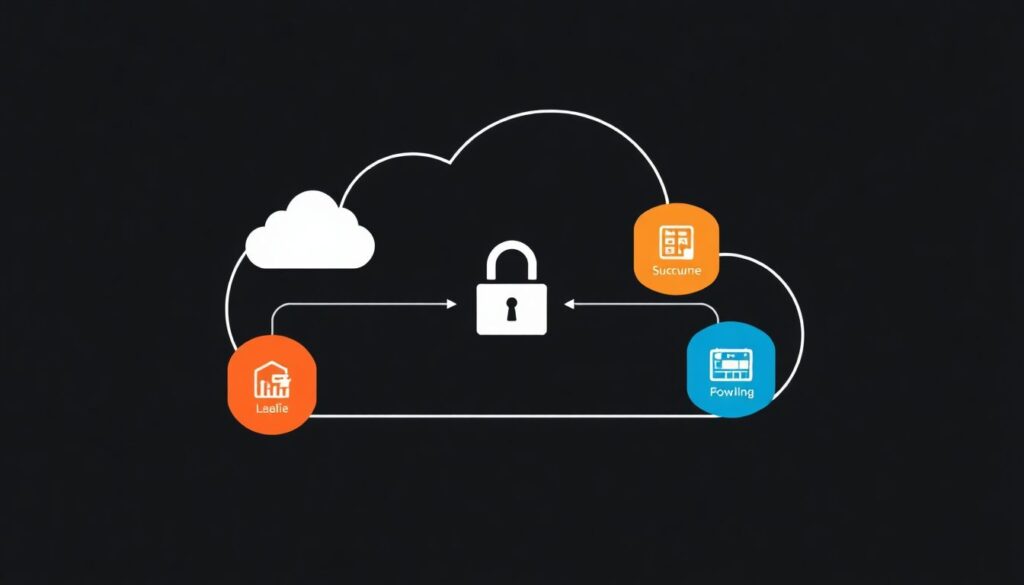
Use this checklist to verify if your technical layer supports segurança em nuvem LGPD and broader norms effectively.
- All storage services and databases with personal data enforce encryption at rest with managed or customer keys, with documented key management practices.
- All external and internal connections use strong encryption in transit (TLS) and outdated protocols are disabled.
- IAM is based on least privilege and roles, not shared accounts; administrative actions require strong authentication and, where possible, MFA.
- Default cloud security configurations have been hardened: public access disabled by default, security groups/firewalls restricted, and unused services turned off.
- Secrets (API keys, tokens, passwords) are stored in dedicated secret‑management services, not in code, wikis or spreadsheets.
- Logging is enabled for access, configuration changes and security events, with retention consistent with legal and operational needs.
- Automated tools (CSPM or equivalent) regularly scan for misconfigurations, open storage buckets and risky network rules.
- Backups of critical cloud workloads are encrypted, tested for restorability, and protected from ransomware and unauthorized access.
- Environment separation exists between production, staging and development, with strict controls on production data copies in non‑production.
- Technical safeguards are mapped to business risks and LGPD obligations, not just to generic IT hardening guides.
Operational controls: incident response, DPIAs and third‑party oversight
These are recurring mistakes that weaken both LGPD alignment and other compliance efforts in cloud contexts.
- No clear criteria for what constitutes a personal data incident in the cloud, leading to late or inconsistent escalation.
- Incident response plans exist only on paper and are not tested with realistic cloud‑focused scenarios and stakeholders.
- DPIAs are treated as one‑off documents for “big projects” instead of ongoing tools whenever risk profiles change.
- Vendor assessments are limited to obtaining certificates, without reviewing how the provider handles sub‑processors and regional data storage.
- Contracts with cloud providers do not clearly address support for data subject rights, retention enforcement and cooperation during incidents.
- Changes in cloud architecture (new regions, new services, new integrations) are made without revisiting LGPD risk analysis.
- Business teams onboard new SaaS tools without involving security, DPO or legal, creating unmanaged exposure.
- Metrics focus only on uptime and cost, ignoring LGPD‑relevant indicators such as time to fulfill rights requests or frequency of misconfigurations.
- There is no structured training program tailored to cloud use cases for developers, admins and business users.
Monitoring, evidence collection and preparing for audits
You can combine several implementation approaches depending on size, maturity and budget. The alternatives below can even be mixed by system or business area.
- Cloud‑native, do‑it‑yourself approach – Use built‑in logs, audit trails, configuration histories and security centers of your main cloud providers. Suitable for small and mid‑size organizations with moderate complexity and some internal expertise.
- Platform‑based centralized monitoring – Deploy a security or compliance platform that aggregates events, configurations and vendor documents into a single view. Works well when you have multi‑cloud environments and frequent audits against ISO and LGPD.
- Managed security and compliance services – Outsource parts of monitoring, evidence collection and reporting to specialized providers. Useful for organizations without a dedicated security team or under strong regulatory pressure.
- Consulting‑led jumpstart – Engage serviços de consultoria em segurança da informação na nuvem to design baselines, templates and dashboards, then operate them internally going forward.
In all alternatives, maintain a living evidence register: risk assessments, DPIAs, configuration baselines, logs of key events, vendor contracts and proof of training. This enables you to show conformidade LGPD em cloud computing in a structured and efficient way.
Concise practical clarifications and quick answers
How do I start aligning my cloud environment with LGPD in a small team?
Start by mapping where personal data is stored and processed in your main cloud services, then prioritize the top three risks. Apply simple controls: enforce encryption, clean up access permissions, and document purposes and retention. Expand gradually from there.
Is ISO 27001 certification enough to prove LGPD compliance in the cloud?
ISO 27001 helps structure your security management and is a strong signal of maturity, but it is not sufficient on its own. You still need LGPD‑specific governance for lawful bases, rights requests and local regulatory expectations, especially for Brazilian data subjects.
When do I need a DPIA for a cloud project?
Perform a DPIA whenever a cloud project involves high‑risk processing such as large‑scale profiling, sensitive data, monitoring of public areas or innovative technologies. Also reassess when you significantly change data volumes, purposes, regions, or vendors.
How can I manage data subject rights across multiple cloud providers?
Create a central intake channel and workflow for rights requests, then map each request type to specific actions in your cloud systems. Use automation where possible but ensure every step is logged and verifiable for audit and regulatory purposes.
What is the fastest way to improve cloud security configurations safely?
Enable encryption at rest and in transit everywhere, remove unused accounts and shared credentials, activate MFA for admins, and review public access on storage and services. Use automated configuration scanning tools to find and fix the most critical misconfigurations first.
Do I always need external consultants to build a cloud security strategy?
Not always. Many organizations can start internally using provider best practices and public frameworks. Consultants become more useful when you face complex multi‑cloud environments, strict audit timelines, or limited internal expertise with LGPD and international standards.
How often should I review my cloud and LGPD controls?
Review key controls at least annually, and whenever you introduce significant new cloud services, expand into new regions or change how personal data is used. Regular reviews keep your estratégia de segurança cloud para empresas aligned with business and regulatory changes.