For Terraform and CloudFormation in pt_BR environments, start with Checkov as your main open-source IaC security scanner, add tfsec for Terraform-heavy stacks, and cfn-nag for CloudFormation-focused projects. Combine them with pre-commit hooks and CI pipelines so every pull request gets a fast, consistent static security review of your infrastructure code.
Executive snapshot: immediate verdicts for Terraform vs CloudFormation
- Best overall balance for multi-cloud and mixed IaC (Terraform + CloudFormation): Checkov.
- Best Terraform-first workflow with simple CLI and clear messages: tfsec.
- Best CloudFormation specialization, especially for AWS-only: cfn-nag.
- Most flexible policy language and enterprise-style rules engine: Terrascan.
- Strong multi-IaC coverage with powerful querying: KICS.
- For fully free pipelines, all compared tools are open source and suited as ferramentas gratuitas para análise estática de código IaC terraform cloudformation.
Survey of open-source scanners for IaC (Terraform & CloudFormation)
When you evaluate ferramentas open source para detecção de vulnerabilidades em terraform and CloudFormation, prioritize these selection criteria:
- IaC coverage and depth: Native support for Terraform HCL and AWS CloudFormation (YAML/JSON), plus how well the tool understands modules, nested stacks and variables.
- Rules quality and update cadence: How actively new checks are added for cloud services, CIS-style baselines, common misconfigurations and provider-specific risks.
- Customization and policy language: Ability to write or tweak rules in a clear DSL or configuration format, align with internal standards and compliance requirements.
- Integration surface: Native support or documented recipes for running in GitHub Actions, GitLab CI, Azure DevOps, Jenkins, Bitbucket Pipelines and local developer workflows.
- Developer ergonomics: Quality of error messages, links to documentation, speed of feedback and ease to suppress or justify accepted risks.
- Performance and scalability: Capability to scan mono-repo IaC trees, large Terraform plans and many CloudFormation templates without slowing CI/CD excessively.
- Extensibility and ecosystem: Plugins, community rules, existing security baselines and examples already built for your main cloud providers.
- Governance capabilities: Support for policy-as-code, central rule sets, organization-wide enforcement and reporting across many repos.
- Onboarding and documentation: Clear tutorials, example pipelines and minimal friction for teams who are not full-time security engineers.
Any scanner de segurança open source para infraestrutura como código should help your team catch high-risk misconfigurations early, without blocking developers with too many noisy findings.
Detection engines, rule languages and coverage matrix
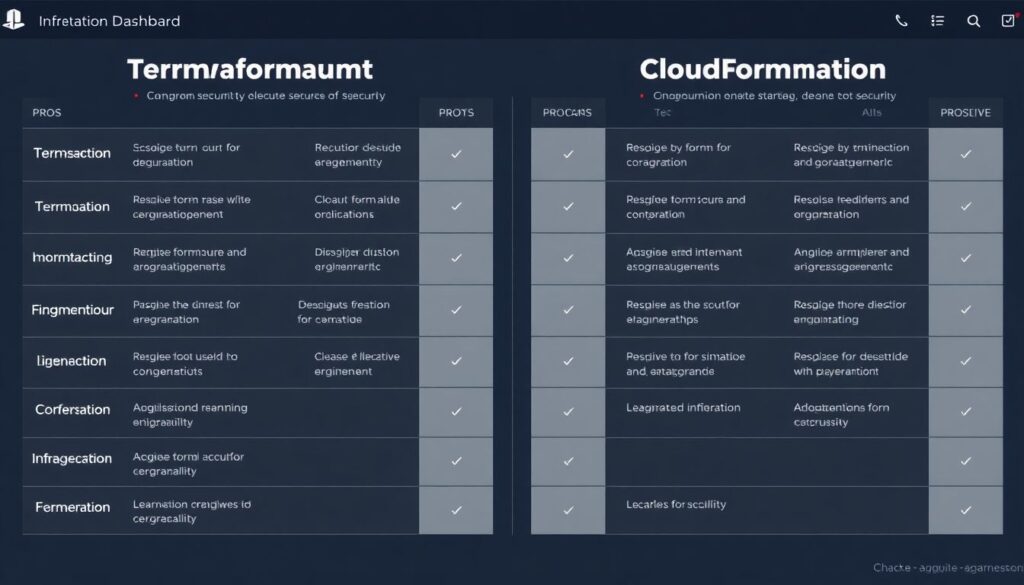
The tools below appear most often in any comparativo de ferramentas de segurança para iac terraform cloudformation. They differ mainly in rule engines, extensibility and how they treat Terraform versus CloudFormation.
| Variant | For whom | Pros | Cons | When to choose |
|---|---|---|---|---|
| Checkov | Teams with mixed Terraform, CloudFormation and other IaC wanting one primary scanner. | Broad IaC support; rich built-in policies; good docs; strong CI integrations; active community; easy to extend with custom checks. | Rule set can feel large and noisy at first; policy language requires some learning; tuning for low-noise takes time. | Choose when you want a single, extensible scanner for multi-cloud IaC with solid defaults and long-term maintainability. |
| tfsec | Terraform-heavy teams who want a simple CLI focused on Terraform security. | Terraform-first UX; clear messages; quick to adopt; works well with pre-commit; good community examples and how-tos. | CloudFormation coverage is not its core focus; may require pairing with another tool for deep AWS template checks. | Choose when Terraform is dominant, you need fast feedback for developers, and you will complement CloudFormation with another scanner. |
| Terrascan | Security teams needing policy-as-code features and customizable governance for multiple IaC frameworks. | Powerful policy engine; support for many IaC types; suited for central security teams; integrates into pipelines and admission controllers. | Steeper learning curve; policy language more complex; initial setup can feel heavy for small teams. | Choose when you need strong governance, custom rules and centralized control across many projects. |
| KICS | Organizations with varied IaC (Terraform, CloudFormation, Kubernetes and more) looking for robust query-style checks. | Wide coverage; rule queries are expressive; good for large repos; helpful output formats for automation and dashboards. | Query-style rules may feel advanced for newcomers; tuning requires some security expertise. | Choose when you want one engine for multiple IaC types with strong reporting and flexible querying. |
| cfn-nag | AWS-centric teams using CloudFormation heavily, including nested stacks and SAM. | CloudFormation-specialized; many AWS-specific checks; integrates well into AWS-focused workflows; stable and battle-tested. | Terraform support is not the goal; Ruby-based stack may be unfamiliar; limited beyond AWS CloudFormation. | Choose when CloudFormation is your main IaC and you want the melhores ferramentas para análise de vulnerabilidades em cloudformation with AWS-focused rules. |
All these scanners qualify as ferramentas gratuitas para análise estática de código IaC terraform cloudformation and can be combined if you accept some overlap to increase coverage.
Accuracy in the field: handling false positives and false negatives
To get reliable results from any ferramentas open source para detecção de vulnerabilidades em terraform or CloudFormation, focus on tuning around common scenarios:
- If you hit many false positives on known-exception resources, then introduce a suppression strategy:
- Tagging allowed exceptions (for example, specific public S3 buckets).
- Using inline ignore comments with clear justification.
- Maintaining a central ignore list for shared modules.
- If critical misconfigurations slip through (false negatives), then add compensating controls:
- Create custom rules for your cloud baseline (for example, mandatory encryption and logging).
- Scan not only source code but also Terraform plan outputs where available.
- Combine more than one scanner when your threat model is strict.
- If developers complain about noisy or unclear findings, then improve feedback:
- Map findings to your internal guidelines and documentation.
- Group and triage results so only high-severity issues break builds.
- Use PR comments or summaries instead of raw logs to explain issues.
- If scans are reliable locally but different in CI, then standardize environments:
- Use the same scanner version and configuration in both environments.
- Containerize scanners or use pinned action versions in CI.
- Share a central config file for all repos to avoid drift.
- If teams bypass scanners to keep delivery speed, then align incentives:
- Set realistic timeouts and only fail builds on serious issues.
- Run full scans nightly while keeping fast checks on pull requests.
- Celebrate issues caught early and fix false positives quickly.
CI/CD integration, pre-commit hooks and pipeline deployment

Use this checklist to pick and roll out a scanner de segurança open source para infraestrutura como código in your pipelines effectively:
- Start from developer machines: add a pre-commit hook using a simple wrapper like:
repos: - repo: https://github.com/antonbabenko/pre-commit-terraform rev: v1.90.0 hooks: - id: terraform_tflint - id: terraform_checkov - Select a primary scanner per IaC type: for Terraform, consider tfsec or Checkov; for CloudFormation, cfn-nag or Checkov; use others where they bring unique rules.
- Define pass/fail strategy: configure scanners to only break builds on high-severity issues at first, logging medium/low issues for later cleanup.
- Embed in CI with clear steps: in GitHub Actions, a Terraform/Checkov job can be as simple as:
- name: Run Checkov uses: bridgecrewio/checkov-action@v12 with: directory: ./infra - Standardize configuration: place config files (for example, .checkov.yml, terrascan config) at repo root and share examples across projects.
- Monitor and iterate: review metrics like number of failed builds, time to fix, and top rule offenders; adjust severity, suppressions and training accordingly.
- Document the workflow: ensure contributors know how to run scans locally, how to fix typical findings and how to request exceptions.
Performance benchmarks, scalability and scanning modes
Teams often underestimate performance when choosing ferramentas gratuitas para análise estática de código IaC terraform cloudformation. Avoid these common mistakes:
- Assuming one-size-fits-all scan mode and not experimenting with file-by-file, directory and plan-based scanning options.
- Running full deep scans on every commit instead of using faster, incremental checks on pull requests plus periodic full runs.
- Ignoring repository layout: huge mono-repos with mixed apps and IaC need careful path filters to keep scan times acceptable.
- Forgetting about caching: not reusing container images, dependencies or scanner downloads between CI jobs.
- Using default concurrency settings: not tuning thread or worker counts for your CI agents capabilities.
- Mixing unrelated checks in one step: combining lint, unit tests and IaC scans in a single job, making it harder to locate and optimize bottlenecks.
- Skipping baseline creation: not using previous scan results to focus on newly introduced issues in very large legacy stacks.
- Neglecting CloudFormation specifics: some scanners process nested stacks or SAM templates differently, which can impact both coverage and runtime.
- Underestimating plan scanning costs: scanning Terraform plans adds context but can be heavier; use it selectively for critical environments.
- Failing to profile: rarely measuring scan durations and resource usage to guide fine-tuning per tool and repository.
Decision path: selecting the right scanner for your stack
Use this simplified decision path to narrow down your options based on your IaC mix and team profile:
- If you are AWS-only and rely mostly on CloudFormation, prioritize cfn-nag and then consider Checkov for additional multi-IaC coverage.
- If Terraform dominates and the team prefers simple CLIs, start with tfsec, then optionally add Checkov or KICS for broader rule sets.
- If you manage several IaC types (Terraform, CloudFormation, Kubernetes, others) and need one central engine, favor Checkov or KICS.
- If a central security team owns policy-as-code and governance, evaluate Terrascan first and pair it with developer-friendly tools if needed.
- If your main goal is fast developer feedback and easy pre-commit setup, pick the scanner with the best hooks and documentation for your VCS platform.
In summary, Checkov is usually the best primary choice for mixed Terraform and CloudFormation codebases, tfsec fits Terraform-centric workflows that want simplicity, cfn-nag remains a strong option for AWS CloudFormation specialists, KICS works well in heterogeneous IaC environments, and Terrascan is attractive where policy governance is paramount.
Common selection dilemmas and quick answers
How do I choose between Checkov and tfsec for a Terraform-first project?
Pick tfsec if your codebase is almost exclusively Terraform and you want a lightweight, Terraform-focused CLI with very simple onboarding. Prefer Checkov if you already use or plan to use more IaC types, or if you want a richer ruleset and centralized policy management.
When does it make sense to add cfn-nag on top of a general-purpose scanner?
Add cfn-nag when CloudFormation templates are business critical and you need deep AWS-specific checks, including SAM and nested stacks. It works well alongside Checkov or KICS, giving you CloudFormation specialization plus broader multi-IaC coverage from the other engine.
Which scanner is better for a security team that owns organization-wide policies?
Terrascan is often a strong fit because of its policy-as-code and governance capabilities. Use it to encode organization-wide rules, then complement it with developer-friendly tooling such as Checkov or tfsec to keep the feedback loop smooth for individual contributors.
What should I do if scans are too slow in large Terraform and CloudFormation mono-repos?
Scope scans to IaC directories, enable parallel execution where supported and separate fast PR checks from periodic full runs. Most scanners allow directory filters and configuration files that let you exclude generated code or legacy paths that do not need frequent scanning.
How can I phase in IaC scanning without blocking existing delivery pipelines?
Start in advisory mode: run scanners on pull requests but only warn on failures while you tune rules and suppressions. Once noise is under control, change the policy so that only high-severity findings fail the build, and gradually tighten standards as teams become comfortable.
Is it practical to run more than one scanner de segurança open source para infraestrutura como código?
Yes, running two complementary tools is common, for example Checkov plus cfn-nag or tfsec. Limit overlap by standardizing which tool is authoritative for which IaC type, and manage suppressions centrally so developers are not forced to handle the same issue multiple times.