Why real cloud breaches teach more than glossy vendor brochures
When people talk about cloud security, the conversation often stays at the level of principles and best practices. In reality, most teams start changing behavior only after a painful incident — theirs or someone else’s. Looking closely at big data leaks in the cloud gives us something much more valuable than generic recommendations: it shows how real people, with real constraints, really make mistakes. And it shows, sometimes very bluntly, what actually works when everything goes wrong.
Case 1 – Capital One and the misunderstood AWS metadata service
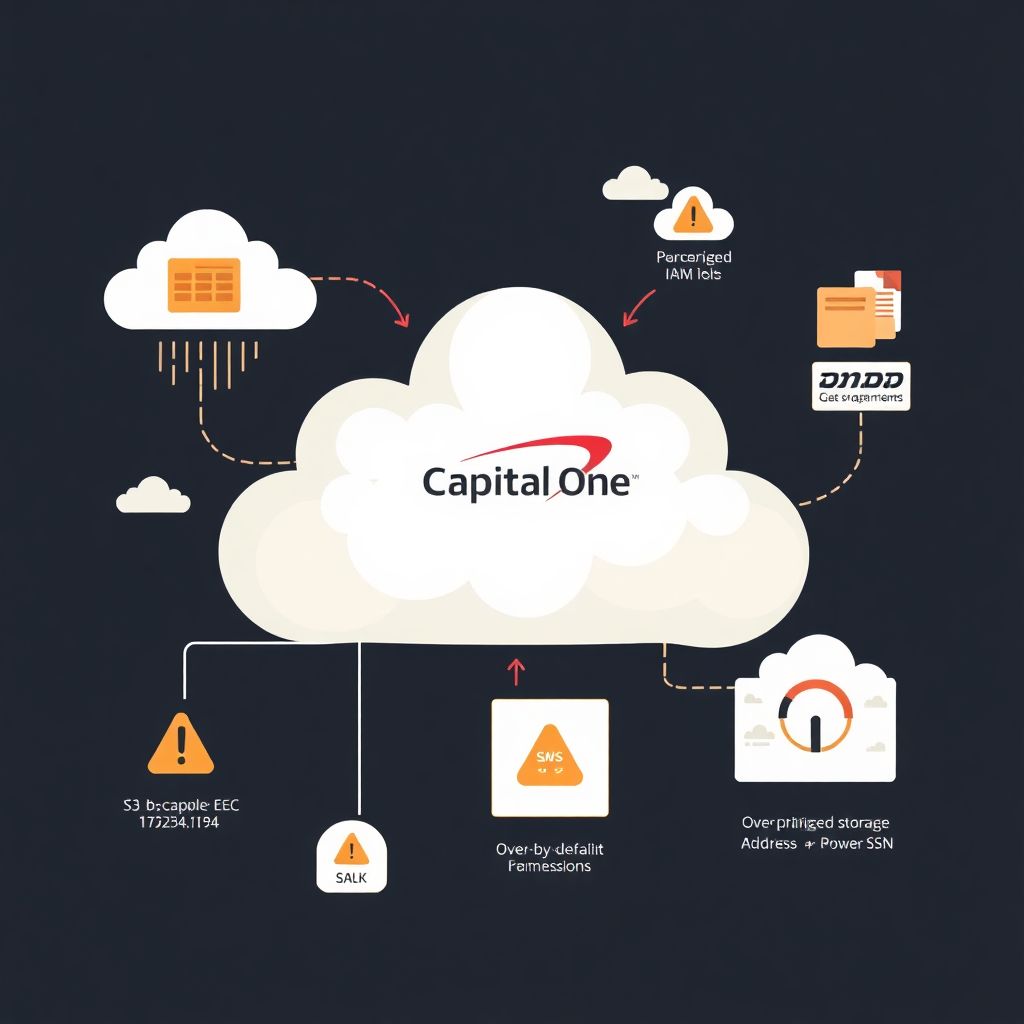
In 2019, Capital One disclosed that data from about 100 million US customers and 6 million Canadian customers had been accessed via a misconfigured AWS environment. Contrary to some early media coverage, AWS itself wasn’t “hacked”; the weak point was how the bank used cloud resources and permissions. This is a classic example of segurança em nuvem para empresas que já инвестiram milhões, но все равно остались уязвимыми из‑за комбинации архитектурных ошибок и недостаточного контроля привилегий.
What actually happened
The attacker exploited a Server-Side Request Forgery (SSRF) vulnerability in a web application hosted on AWS. That SSRF allowed them to query the EC2 metadata service, grab temporary IAM credentials attached to the instance, and then use those credentials to list and exfiltrate data from S3 buckets. The root of the problem was that the EC2 role had permissions broader than it needed, and there were not enough guardrails to limit what those temporary credentials could actually do in the account.
Technical details – Capital One incident
– Stack: AWS EC2, S3, IAM, WAF
– Entry point: SSRF in a web application, bypassing web application firewall rules
– Lateral movement: Use of instance metadata (169.254.169.254) to obtain IAM role credentials
– Impact: >100M customer records, including names, addresses, credit scores, and partial SSNs
– Key misconfigurations:
– IAM role with overly broad S3 privileges (`s3:ListBucket`, `s3:GetObject` on multiple buckets)
– Insufficient defense-in-depth around metadata service access
– Monitoring signals existed but were not correlated quickly enough
What we should learn from it
From a distance, this looks like a “cloud problem,” but at its core it’s about access design and boundaries. The app shouldn’t have had such powerful permissions; the metadata service should have been constrained; S3 should have had tighter bucket policies. The most painful part is that each of these controls existed in AWS at the time, but they were either not used or not enforced strongly enough. That’s why many companies today look for serviços de cloud security gerenciada: not just to “watch” their environments, but to force minimum standards on IAM, network segmentation, and sensitive storage before a similar chain of events can happen.
Case 2 – Public-by-default: misconfigured storage buckets and Power Apps
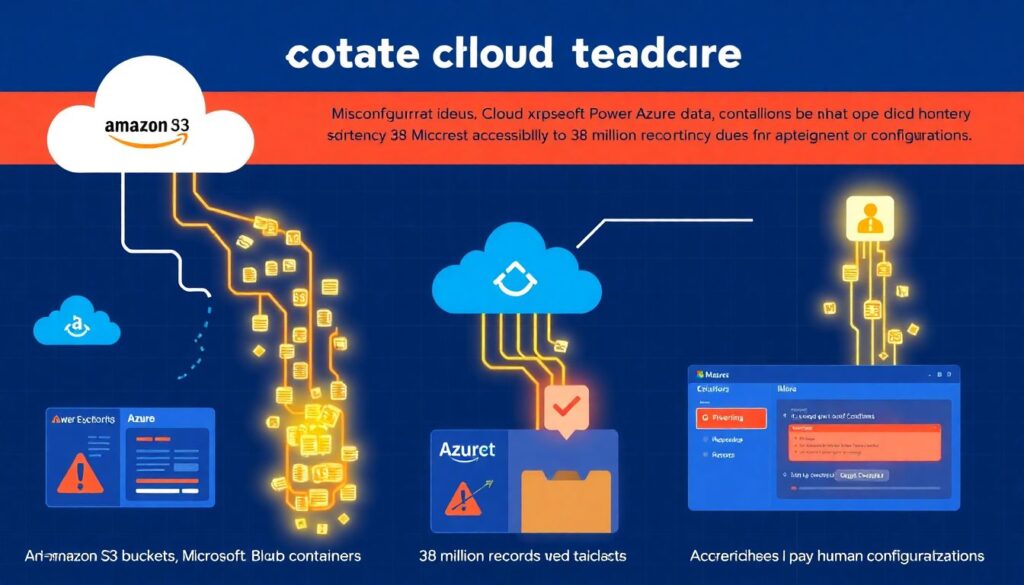
Misconfigured cloud storage is responsible for a long list of breaches: open S3 buckets, exposed Azure Blob containers, and, in 2021, the Microsoft Power Apps case, where 38 million records were publicly accessible due to incorrect portal configurations. The pattern is almost always the same: a “convenience” setting left enabled, no systematic discovery of public endpoints, and an assumption that “nobody will find this URL”. That assumption does not survive contact with the real internet.
Real-world examples of public cloud data leaks
Over the last years, researchers and attackers have repeatedly found huge volumes of data sitting wide open:
– A Verizon partner exposed data on 6+ million customers via an S3 bucket used for logging and support interactions.
– Accenture left several S3 buckets publicly accessible containing internal keys, API data, and backup archives.
– Multiple marketing and analytics firms leaked hundreds of millions of email addresses and behavioral profiles through cloud storage misconfigurations.
These incidents weren’t the result of sophisticated zero-days; they were the consequence of a missing check-box, a default template that no one revisited, or a hand-crafted script that skipped access controls “just for this proof of concept” and then silently went into production.
Technical details – misconfigured storage and Power Apps
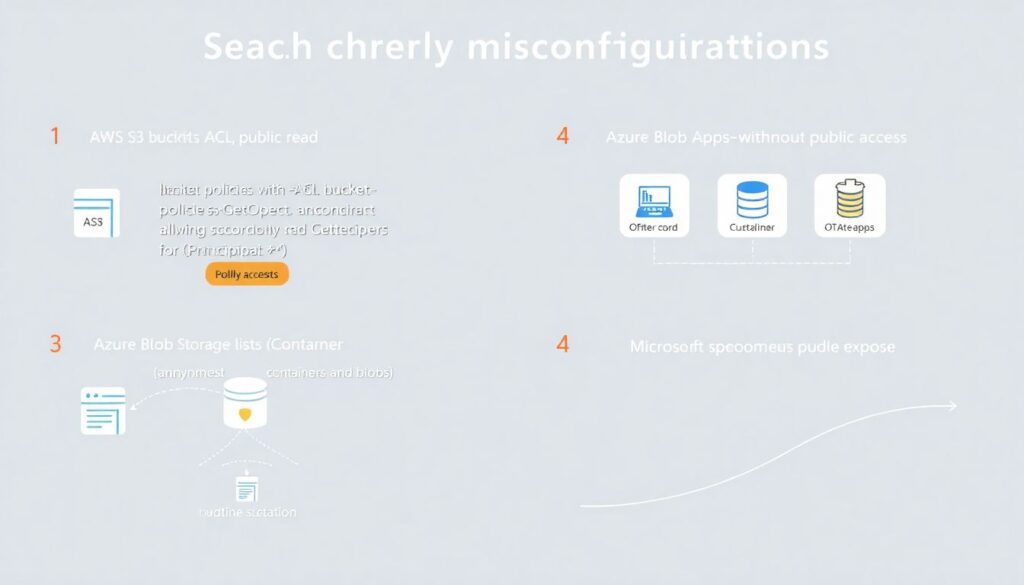
– Misconfig types:
– S3 buckets with `ACL: public-read` and bucket policies allowing `s3:GetObject` to `Principal: *`
– Azure Blob containers set to “Container (anonymous read access for containers and blobs)”
– Power Apps lists and APIs exposed via OData feeds without authentication
– Exposure scale:
– Power Apps: ~38M records, including COVID vaccination data, social security numbers (in some cases), and contact data of residents in multiple US states
– Various S3 incidents: from tens of GB to multiple TB of logs and customer data
– Common causes:
– Lack of standardized templates for secure storage provisioning
– No automated inventory of public endpoints
– No continuous scanning of access policies against baseline rules
Practical takeaways
The central lesson is uncomfortable: cloud platforms usually don’t “forget” to protect you; humans override defaults, bypass reviews, and fail to standardize secure patterns. To avoid being the next headline, you need both guardrails and detection. This is where ferramentas de monitoramento de segurança em nuvem become non‑negotiable: they continuously crawl storage, find anything that’s publicly accessible, match it against tagging policies, and alert when business-sensitive datasets are exposed to the internet. When these tools are wired directly into CI/CD and account baselines, “public by accident” becomes much harder.
Case 3 – Code Spaces: when the control plane is your single point of failure

The Code Spaces breach in 2014 is an older case, but it remains one of the most brutal examples of how not to manage cloud credentials. Attackers gained access to the company’s AWS console using stolen credentials, then used that access to delete most of their infrastructure: EC2 instances, EBS snapshots, S3 buckets. The company never recovered and shut down shortly afterwards.
What exactly went wrong
The attacker didn’t need to exploit any sophisticated vulnerability. Once they had access to the AWS console, they created new IAM users, changed existing credentials, and used AWS tools themselves to destroy data and backups. Several basic measures were missing: strong MFA on root and admin accounts, isolated accounts for production and backup, and disaster recovery procedures that assume a complete loss of the primary AWS environment.
Technical details – Code Spaces
– Entry vector: Compromised AWS console credentials (likely via phishing or reuse)
– Scope: Full control of a single AWS account where both production and backups lived
– Actions taken by attacker:
– Created new IAM users and policies
– Attempted to extort the company
– Deleted EC2 instances, EBS volumes, S3 buckets, and backups when ransom demands were not met
– Security gaps:
– No enforced MFA on critical IAM users and root account
– Single AWS account for everything (no account isolation for backup or staging)
– No offline or cross-account backups that attacker couldn’t reach
Lessons beyond “use MFA”
The instinctive takeaway here is “turn on multi-factor authentication,” but the deeper conclusion concerns architectural resilience. Assume that at some point, a high-privileged account will be compromised. If your entire environment — including backups and logging — lives in one trust domain, the blast radius is existential. Many organizations now build “break-glass” recovery accounts and cross-account, immutable backups, often with help from consultoria em segurança de dados na nuvem, precisely to avoid the Code Spaces scenario. The incident also reinforces the idea that the cloud control plane is itself a critical asset that must be hardened like a production database, not treated as an admin convenience.
Where companies repeatedly fail: patterns across incidents
When you layer these incidents on top of each other, clear patterns emerge. These patterns are remarkably similar across industries, company sizes, and cloud providers. The technology stacks differ, but the human and process issues converge in a few consistent weak spots.
Recurring weaknesses
– Over-privileged identities: IAM roles and service accounts with far more permissions than they actually need, often justified as “temporary” during development.
– Lack of inventory and visibility: no single, reliable map of which resources exist, who can access them, and from where.
– Weak change control: security policies and infrastructure-as-code templates are modified directly in consoles or via ad hoc scripts, bypassing review and testing.
– Underused native controls: features like AWS Config, Azure Policy, and Google Cloud Organization Policies are available, but either not enabled or not enforced.
Organizational blind spots
On the non-technical side, failures usually begin with assumptions: that developers “already know” the right patterns, that cloud is “self-securing,” or that audits once a year are enough. Cloud security is dynamic by design; permissions, resources, and data flows change daily. That’s why many mature teams treat security controls as part of their delivery pipeline and not as an afterthought. In this context, serviços de cloud security gerenciada make sense when internal teams don’t have the scale or expertise to continuously tune policies, triage alerts, and keep pace with new cloud services.
Turning lessons into practice: concrete steps that actually change outcomes
Looking at breaches is only useful if it changes how we build and operate. Instead of generic “harden your environment” advice, it helps to translate incident findings into very specific routines and guardrails. The most effective organizations I’ve seen consistently do a few things that, while not glamorous, dramatically reduce the probability and impact of the kind of incidents we’ve just discussed.
1. Treat identity and access as your primary attack surface
Cloud is identity-centric. Whoever gets valid credentials with the right permissions can do almost anything. Focusing on IAM first is not a theoretical best practice; it is a direct response to Capital One, Code Spaces, and countless internal incident reports that never make the news.
Key routines that pay off:
– Enforce MFA on all human users, with stronger devices (FIDO2 keys) for admins and break-glass accounts.
– Implement least privilege by default for roles, service accounts, and functions; routinely audit for unused or broad permissions.
– Use role assumption and short-lived tokens instead of long-lived access keys; rotate secrets automatically.
– Centralize identity through SSO and avoid local user sprawl across multiple cloud accounts and services.
2. Make “secure by default” the only allowed pattern
Developers are under pressure to deliver quickly. If the fastest way to get something done is insecure, it will be used. The goal is to reverse that: make the secure path the easiest and most reusable, and make any deviation highly visible.
Practical ways to do this:
– Adopt infrastructure-as-code (Terraform, CloudFormation, Bicep) with vetted modules that encode secure defaults for storage, networks, and identities.
– Add pre-commit and CI checks that scan IaC for risky patterns: public buckets, 0.0.0.0/0 rules, wildcard IAM policies.
– Use cloud policy engines (AWS SCPs, Azure Policies, GCP Organization Policies) so dangerous configurations are simply not allowed, regardless of who tries to apply them.
– Give developers ready-made blueprints for common use cases — public web app, internal API, data lake, analytics pipeline — where security is already built in.
3. Continuous detection, not one-time audit
Every breach we discussed had at least one moment where proper monitoring could have turned a disaster into a contained incident. Unusual API usage, data exfiltration patterns, or creation of new high-privilege accounts all leave traces in cloud logs. The question is whether those traces are collected, analyzed, and acted on in time.
To build that capability, companies typically combine several layers:
– Native logging (CloudTrail, Azure Activity Logs, GCP Audit Logs) enabled for all regions and accounts.
– Central aggregation of logs and configuration data into a SIEM or a cloud-native security analytics platform.
– Automated detection rules for:
– Access from unusual geolocations or autonomous systems
– IAM policy changes and creation of credentials for privileged roles
– Large or atypical data transfers from storage and databases
– Periodic tuning of alerts to cut noise without silencing real anomalies.
In this context, ferramentas de monitoramento de segurança em nuvem are not just dashboards: they are engines that correlate logs, configs, vulnerabilities, and identity context to surface the 10‑20 events per day that your team truly needs to investigate.
What about data itself? Moving from “access” to “sensitivity”
Many incident reports obsess over entry points and permissions, but the real question business leaders ask is simpler: how do we avoid seeing our customers’ data on the front page of a newspaper? Answering that means understanding not just who can access what, but how sensitive each data set is and how it is used. That’s where data-centric controls and practices come in.
Data-centric measures that actually work
– Classification and tagging of data stores: systematically marking buckets, databases, and file systems with labels like “public,” “internal,” “confidential,” and “regulated.”
– Tokenization and encryption: ensuring that even if an attacker reaches a database or object store, the most sensitive attributes are either encrypted with customer-managed keys or tokenized through dedicated services.
– Access paths minimization: making sure sensitive datasets are not casually replicated into less controlled systems (e.g., analytics sandboxes, test environments).
– Strong key management: restricting who can use and manage keys, enabling key rotation, and logging all cryptographic operations.
All this ties directly into the question of como proteger dados sensíveis na nuvem. The answer is never a single control, but a combination: classify and locate your data, encrypt and tokenize the parts that matter most, narrow who can access it and from where, and continuously watch for unusual patterns of access or movement. When a breach happens, this layering often determines whether the impact is embarrassing or catastrophic.
When to bring in external help
Not every company can afford a large, specialized cloud security team. At the same time, the attack surface grows every time a new project spins up a managed database, a new SaaS integration, or an experimental data pipeline. Recognizing when you need outside expertise is itself a risk management decision, not a sign of weakness.
External partners can help in several ways:
– Designing multi-account or multi-subscription architectures with isolated blast radiuses and well-defined trust boundaries.
– Conducting threat modeling and architecture reviews for new products before they go live.
– Implementing baselines for logging, IAM, and encryption across hundreds of accounts and projects.
– Training internal teams using real incident post-mortems from your own environment, not generic slides.
This is where structured consultoria em segurança de dados na nuvem and managed services converge: you offload part of the day-to-day security engineering while keeping strategic decisions in-house. The most effective model tends to be collaborative: your teams maintain domain knowledge and context, while external experts bring battle-tested patterns and keep an eye on evolving threats and provider features.
Final thoughts: normalize learning from failure
Real cloud incidents don’t happen because teams are incompetent; they happen because systems are complex, pressure is high, and incentives are often misaligned. The real mistake is not the misconfigured bucket or the over-privileged role — it’s refusing to analyze those failures deeply and adjust the way we work.
Organizations that treat breaches, near-misses, and external incidents as valuable data points end up with more robust architectures almost by accident. They run internal “game days” simulating credential theft or data exfiltration. They replay the Capital One and Code Spaces scenarios in their own environments to see what would actually happen. Above all, they accept that cloud security is not a static project but an ongoing discipline that evolves with every new service, integration, and attack technique.
If there is one overarching lesson from the big cloud leaks of the last decade, it’s this: you do not need to experience your own catastrophic incident to change course. But you do need to take other people’s failures seriously enough to rewrite your templates, strengthen your guardrails, and adjust your priorities before someone else tests them for you.